“Moral” argument for nuclear waste import is rejected, economic one is dodgy, too
at a dinner hosted by the Eurajoki municipal council at its restored 16th-century Vuojoki Mansion, the South Australian delegation was told to put aside any so-called moral obligations.
Mr Jalonen joined others who have urged caution and questioned whether the economic benefits are overblown.
Unlike the potential riches being speculated about in South Australia — more than $100 billion over 120 years — Mr Jalonen said there was only a “little bit” of money on offer for his region.
 Premier Weatherill’s nuclear ‘moral’ case rejected The Australian
 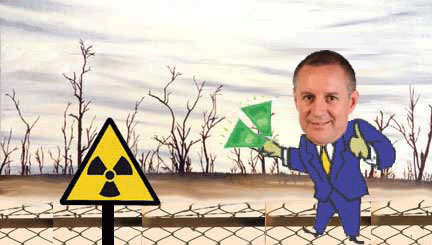 ,October 3, 2016 MICHAEL OWEN SA Bureau Chief Adelaide @mjowen
The head of a governing body in Finland where the world’s first permanent disposal facility for nuclear waste is being built has rejected Premier Jay Weatherill’s “moral” case that South Australia should consider following suit because of its uranium exports.
Mr Weatherill, who last month toured the site at Eurajoki, due to open in the early 2020s, has said South Australia is primarily considering permanent nuclear fuel disposal because of its potential long-term economic prosperity.
But during the visit, accompanied by The Australian, he also said that given South Australia accounted for 25 per cent of the world’s uranium reserves mined and exported for use in nuclear facilities internationally and creating waste, it was “sensible for us to ask ourselves ‘can we play a role in this nuclear fuel cycle?’ and ‘are we the appropriate place to store the material?’ given that this waste does exist in the world.
“Simply, does South Australia consider itself a global citizen?”, he said. Some of the 400 or so nuclear power plants around the world, including those in Finland, use Australian uranium. Continue reading
Wildfire danger for stranded nuclear wastes in NewMexico
 Feds Leave Radioactive Waste Stranded In Wildfire Danger
  Zone http://www.mintpressnews.com/feds-leave-radioactive-waste-stranded-wildfire-danger-zone/191781/ DOE announces it will not meet deadline for removal of radioactive containers held above-ground at northern New Mexico nuclear weapons lab, By The Department of Energy admitted Friday it will not meet a deadline to remove dangerous radioactive waste, currently stranded above-ground in unsafe conditions at a New Mexico nuclear weapons laboratory, before wildfire season hits.
At least 3,706 cubic meters of radioactive waste are being stored at the Los Alamos National Laboratory complex after the Waste Isolation Pilot Plant, an underground nuclear waste dump in southeastern New Mexico, was shut down indefinitely in February due to an airborne radiation leak.
Officials in New Mexico have warned that the waste at Los Alamos could be within the reach of wildfires and must be transferred elsewhere by the end of June. According to the Associated Press, “The agreement for removal of the waste by June 30 was reached after a massive wildfire lapped at the edge of lab property three years ago, raising concerns about the thousands of barrels of waste that were being stored outside.”
“The waste at Los Alamos is trapped with no place to go,” Arnie Gundersen, chief engineer and nuclear safety advocate at Fairewinds Associates, told Common Dreams.
The Los Alamos radioactive materials are “transuranic waste” that is described by the DOE as “clothing, tools, rags, debris, soil and other items contaminated with radioactive material generated during decades of nuclear research and weapons development.”
Concerns have been raised about the safety of these barrels after it was posited that changes in methods of packaging at Los Alamos, from use of inorganic to organic cat litter to absorb moisture, may be responsible for a chemical reaction with nitrate salts and set off the “heat event” behind the WIPP leak. Officials are still trying to determine the cause of the accident and are investigating the potential danger of the more than 500 nuclear waste containers originating from Los Alamos that were packed with organic cat litter.
The DOE had been sending some Los Alamos radioactive waste to a Texas facility for temporary storage until WIPP is functional. Upon discovering that Los Alamos shipments may be dangerous, the DOE halted all shipments, citing public safety.
But Gundersen warns that these barrels of waste could pose a threat in Texas and Los Alamos, where they are being stored above-ground. “It is worse in the summer, because it is hotter in the summer, and the reactions become less stable,” he said.
In a statement (pdf) released Friday, the New Mexico Environment Department said it is “disappointed, but not surprised” that the DOE will not meet its deadline to remove the waste.
Meanwhile, it is still not clear when WIPP will reopen. The facility, which was never supposed to leak, is the bedrock of the U.S. government’s current approach to dispose of military-generated plutonium-contaminated transuranic waste from decades of nuclear bomb production and testing.
Critics have warned that WIPP’s failure raises serious questions about the overall federal strategy for disposing of nuclear waste.
Another inaccuracy from pro nuclear propagandist Geraldine Thomas
 Steve Dale Nuclear Fuel Cycle Watch South Australia, 1 Oct 16 In Geraldine Thomas’s recent talk she showed dosimeter data from students in Japan, but she didn’t make it clear that the students were kept out of the “Restricted zone” (funny about that). But if you read the paper, it mentions that a teacher went into the zone for 2 hours (to Okuma) and had readings of 5 microSieverts per hour. Thought I would show how the graph would look with this data included. (Note: Okuma is not the “hottest” area, some areas in the restricted zone are over 20 microSieverts per hour) [relevant graph can be seen on original on Facebook] Facebook https://www.facebook.com/groups/1021186047913052/ Continue reading
Nuclear waste management inevitably becomes a tax-payer subsidy to the nuclear industry
Derek Abbott, Nuclear Fuel Cycle Watch South Australia, 3 Oct 16, Thought for the day: when we point out to nuclear apologists the fact that the management of waste fuel from each nuclear station ultimately runs into the many tens of billions of dollars, their smooth response runs something like this: “divide that cost by the many kWhrs of electricity from the lifetime of that nuclear station, and it’s only an extra two cents or so per kWhr.”
Here’s the big flaw with that argument: Over the lifetime of each reactor those billions have been effectively flowing into the private pockets of those behind nuclear power companies. Then when it’s time to spend billions repackaging that spent fuel and store it somewhere, those private individuals have long retired or are passed away and several changes in government have occurred in the meantime. No one is around to be accountable, so the taxpayer then picks up the tab.
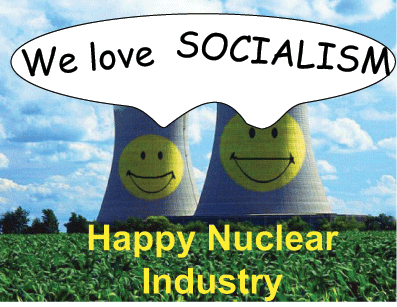 In other words the risks have been socialised, whilst profits have lined selected pockets. Profits for the elite are made by deferring costs, and the proletariat has to pay the price later.
Bottomline: Because of the 100-year cycle from building a station to ultimately dealing with its waste, it is impossible to enforce accountability and so the taxpayer ends up paying. The mantra that nuclear has no subsidies is false, as this is effectively a huge taxpayer funded subsidy. https://www.facebook.com/groups/1021186047913052/
China struggles with its stranded nuclear wastes
waste levels are growing rapidly. The government-backed China Nuclear Energy Association said that by the end of 2020, the nation’s nuclear plants will have to get rid of more than 1,000 tonnes of spent fuel each year……
The Tianwan facility as well as the Daya Bay nuclear plant complex in the southern city of Shenzhen have nearly run out of room for on-site waste storage, said Mr Chai Guohan, chief engineer at the Ministry of Environmental Protection’s Nuclear and Radiation Safety Centre.

Spent-fuel issues cloud China’s nuclear expansion Questions raised over country’s ability to handle radioactive waste as storage space runs out, Today, BEIJING , 2 Oct 16 — A Chinese nuclear power plant construction programme has been on a fast track ever since the government’s four-year moratorium on building such facilities was lifted this year.
Now, five years after Japan’s 2011 Fukushima disaster led to the moratorium, China is fully engaged in an expansion that is scheduled to add 24 new reactor units to the nation’s existing 32.
But nuclear plant construction projects have stirred controversy in China, particularly due to questions surrounding incomplete plans for handling a dangerous by-product of nuclear energy — radioactive waste.
In August, hundreds of people took to the streets to protest a government plan to build a nuclear waste recycling facility in the Jiangsu province city of Lianyungang. The protest prompted the local authorities to suspend work on a feasibility study that would have moved the project forward.
Indeed, public scepticism about nuclear power in China has persisted ever since an earthquake-induced tsunami destroyed the Fukushima plant.
Some analysts have linked that scepticism to a lack of transparency among government agencies that oversee nuclear power plants and the energy companies that build them.
In the wake of the Lianyungang protests, for example, neither the central nor local government authorities have said when work on the feasibility study might resume, nor whether officials might consider building the plant elsewhere. Continue reading
Nuclear industry privatises any profit, socialises the risks
Derek Abbott, Nuclear Fuel Cycle Watch 1 Oct 16 Here’s a very simple reason why a nuclear power plant is economically risky: (i) takes 10-20 years to build, (ii) runs for 40 years, (iii) takes 50 yrs to decommission, (iv) you can easily be still managing some spent fuel from that reactor, above ground, for another 20-30 years after that.
So consider this: the full end-to-end management of the project spans about three human generations and about 15-20 changes of government. No private investors are going to want that kind of time period for their investment, unless they can socialise the risk and get governments to pick up the tab on taxpayer’s money.
Also given now that nuclear is politically a hot potato, no investor is going to want to survive through 15-20 government changes….way too much uncertainty. And if they do go for it, it is at our expense.https://www.facebook.com/groups/1021186047913052/
Adi Paterson, Australia’s top nuclear guru, in pro nuclear promotion to Asian schools
 Dr Paterson highlighted the importance of changing the conversation around nuclear issues through both outreach and education to address the knowledge gap and a lack of understanding that exists in society……
“People’s awareness has to be raised about the benefits of nuclear technology for health, the environment and important research,” said Dr Paterson.
Inspiring tomorrow’s scientists: The IAEA presents a new nuclear science and technology educational resource package for secondary schools, International Atomic Energy Agency 30 September 2016 “…… a new educational resource package developed by the IAEA in partnership with education and communication experts from around the world aims to answer. The Compendium of Resources and Activities on Nuclear Science and technology for Secondary School Teachers and Students, presented this week at a side event entitled ‘Introducing Nuclear Science and Technology in Secondary Schools’ on the margins of the 60th IAEA General Conference, aims to make nuclear science more interesting and attractive to students, and to encourage young people to enter the fields of nuclear science and technology……. we need to ensure that the nuclear knowledge is passed on to the next generations. This project is an opportunity for the youth, for developing countries, for women! ” said Ms Najat Mokhtar, Director of the IAEA’s Division for Asia and the Pacific in her opening statement to the side event……

engaging their interest while still in high school is key to ensuring a cohort of students and graduates interested in pursuing careers as scientists, and ready to take on the challenge of developing nuclear knowledge and capacity in their countries……. Continue reading
Big protest against nuclear power in northern France
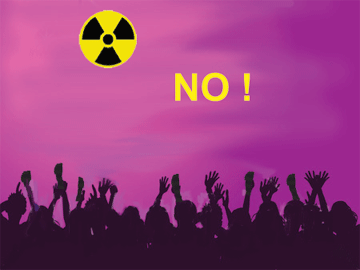
 Thousands protest against nuclear power in northern France http://en.rfi.fr/environment/20161001-thousands-protest-against-nuclear-power-northern-france Several thousand people demonstrated against the construction of nuclear reactors near the northern French town of Flamanville on Saturday. British opponents of the planned reactor at Hinkley Point joined European opponents of nuclear power.
The protesters gathered at Siouville-Hague, between a nuclear waste treatement centre at La Hague and the site of a third nuclear reactor at Flamanville, which is currently under construction.
The first protest against the plan took place 10 years ago at Cherbourg on the Channel coast.
French power company EDF, which is also building the Hinkley Point reactor, says it should be ready to operate in the third quarter of 2018, six years late.
Its cost has trebled to 10.5 billion euros after a number of problems.
French Green MP and possible presidential candidate Cécile Duflot joined the demonstration, as did a number of British anti-nuclear activists.
Opponents claim that nuclear power is dangerous and expensive. The sector employs about 10,000 people in Normandy.
South Australian power blackout – great opportunity for Australia’s anti renewable energy government
the federal government was taking the opportunity even before the state had begun mopping up to drive home its message that renewables are not yet reliable enough to become a primary energy source.
research fellow Dylan McConnell, of Melbourne University’s Energy Institute, writing on The Conversation website, says the level of renewables played no role…..This could have happened in any state or with any generation technology.”
 Political power struggle after SA’s statewide blackout, The Saturday Paper, KAREN MIDDLETON, 1 Oct 16
As clean-up began after South Australia’s freak storms, the federal energy minister seized the opportunity for a debate on renewables. “…….As the massive storm battered South Australia, 23 transmission towers were knocked over, bringing down crucial power lines. A power station was also struck by lightning.
According to Frydenberg, those two weather-driven events “plus others” led to electricity surging through the two interconnectors that supply electricity from Victoria into South Australia.
To protect consumers and their homes and businesses from what would have been a massive jolt, the system shut down.
…… The Australian Energy Market Operator has begun an investigation and will prepare a report for government.
Frydenberg has called an emergency meeting of federal, state and territory energy ministers to discuss the implications for the rest of the country. Continue reading
Is Western Australia’s current electricity blackout caused by coal and gas?
 WA weather: Thousands still without power after ‘incredible’ winds sweep the state WA Today Emma Young, 2 Oct 16
Western Power crews worked through Sunday to restore power to about 3500 homes in Perth and the South West after Saturday’s wind winds persisted into the night.
Most affected were in the South West, though on Sunday afternoon the metropolitan outages included more than 1000 homes in Carine, 80 in North Beach, 120 in Forrestfield and 76 in Mahogany Creek, though Western Power was hoping to have these areas restored by 5.30pm.
Gusts of up to 119km/h were recorded in the South West on Saturday, uprooting trees and taking down powerlines, with more than 24,000 without power at some point during the day. Some took to social media to report hail in areas including Kwinana, Jandakot and Balcatta………….http://www.watoday.com.au/wa-news/wa-weather-thousands-still-without-power-after-incredible-winds-sweep-the-state-20161002-grt575.html
Safety problems in France’s new nuclear reactors cast doubt on the industry in UK and China as well
As for For Hinkley Point C, it now appears inevitable that the Flamanville reactor will not be completed by its target date of the end of 2020, indeed it may very well never be completed at all. Under the terms of agreement for the plant’s construction accepted by the European Commission, this would render the UK government unable to extend promised credit guarantees to HPC’s financial backers.

for EDF, Areva, their shareholders and the entire French nuclear industry, the end really could be nigh.
 France’s Nuclear Power Stations ‘At Risk of Catastrophic
 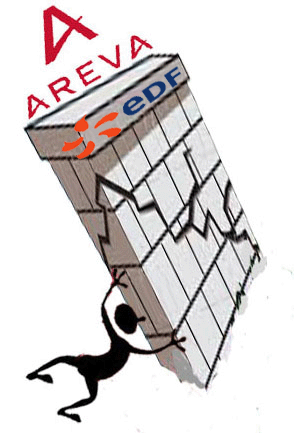 Failure’ http://www.globalresearch.ca/frances-nuclear-power-stations-at-risk-of-catastrophic-failure/5548593 Sizewell B and 27 Other EDF Nuclear Plants By Oliver Tickell Global Research, October 01, 2016 The Ecologist 29 September 2016 A new review of the safety of France’s nuclear power stations has found that at least 18 of EDF’s units are are ”operating at risk of major accident due to carbon anomalies.”
South Australia: Electranet’s privately owned and run electricity transmission system is in a mess.
Dennis Matthews , 3rd October 2016
 Electranet now wants the public to pay for new infrastructure. Electranet’s proposed investment will be rewarded with a handsome guaranteed return on the amount invested, which will be funded by all South Australian electricity users in the form of increased tariffs.
Why do we need such a high capacity transmission network? It is to service big electricity users to the north of Port Wakefield, like BHP. Getting everyone to pay for the new infrastructure is a huge publicly funded cross-subsidy to the mining industry. It is a publicly-funded disincentive for more efficient and reliable distributed generation. It is anti-competitive.
The windfall profits reaped by Electranet will then go offshore.
This is a win for Electranet and the big energy guzzling mining companies but, as usual, a huge kick in the guts for small businesses and the average South Australian.
New South Wales govt push for electricity interconnector with South Australia
NSW push for electricity interconnector with South Australia, SMH, Kirsty Needham , 2 Oct 16 The Baird government will push for a high-voltage interconnector to be built between NSW and South Australia following South Australia’s blackout, convinced the incident has highlighted the need for national energy security.
NSW Minister for Energy Anthony Roberts will attend an emergency meeting of COAG’s Energy Council on Friday, where the South Australian government is expected to seek to speed up a proposal to build the new interconnector between South Australia and the east coast.
The $500 million proposal would involve South Australia’s ElectraNet and NSW’s Transgrid constructing a 300-kilometre transmission route, potentially between Buronga in NSW and Robertson in South Australia, that could supply surplus electricity from NSW.
NSW can already exchange power with Queensland and Victoria.
The project must first be approved by the Australian Energy Regulator because the construction cost will ultimately be passed on to electricity consumers.
But the Baird government argues the interconnector would not only ensure the lights stay on but also boost the growth of the NSW renewable energy sector, particularly solar farms in regional NSW, which would be able to access South Australian customers…….
The NSW Greens energy spokesman Jeremy Buckingham said: “NSW should adopt a state-based renewable energy target, otherwise all the investment and jobs in the clean energy sector will be attracted to other states that do have state-based targets and NSW will miss out.
“Mike Baird can either dance with the coal-loving dinosaurs or he can embrace the booming clean energy future.”
ElectraNet is expected to lodge an application for approval for the interconnector project by the end of the year. An analysis by PWC for Transgrid has estimated the cost to NSW households at $8 a year. http://www.smh.com.au/nsw/nsw-push-for-electricity-interconnector-with-south-australia-20160930-grspxa.html
“Dig it up” era should end. It is time to design new technology for RECYCLING rare earths
 If mobile phones, lap-tops , wind turbines etc were all designed to make it easy to retrieve and recycle rare metals, the rare earth mining industry would hardly be needed.
At present, the world is mindlessly enjoying all the wonderful new gimmickry, without being aware of the toxic toll on miners who are being exploited by companies like Apple.
Sure – that industry must be cleaned up. But also, it’s time to minimise mining, by 21st Century design and recycling.

Investigative journalism reveals exploitation in getting lithium for our new technology
 We who advocate renewable energy systems, and new technologies need to be aware of the dangers of the mining and processing of rare metals such as lithium. The history of this industry is scandalous. AFP: China pays price for world’s rare earths addiction. But today, the exploitation of lithium miners continues.
THE COBALT PIPELINE Tracing the path from deadly hand-dug mines in Congo to consumers’ phones and laptops WP, by Todd C. Frankel September 30, 2016
The sun was rising over one of the richest mineral deposits on Earth, in one of the poorest countries, as Sidiki Mayamba got ready for work.

Mayamba is a cobalt miner. ….
This remote landscape in southern Africa lies at the heart of the world’s mad scramble for cheap cobalt, a mineral essential to the rechargeable lithium-ion batteries that power smartphones, laptops and electric vehicles made by companies such as Apple, Samsung and major automakers.
But Mayamba, 35, knew nothing about his role in this sprawling global supply chain. He grabbed his metal shovel and broken-headed hammer from a corner of the room he shares with his wife and child. He pulled on a dust-stained jacket. A proud man, he likes to wear a button-down shirt even to mine. And he planned to mine by hand all day and through the night. He would nap in the underground tunnels. No industrial tools. Not even a hard hat. The risk of a cave-in is constant……
The world’s soaring demand for cobalt is at times met by workers, including children, who labor in harsh and dangerous conditions. An estimated 100,000 cobalt miners in Congo use hand tools to dig hundreds of feet underground with little oversight and few safety measures, according to workers, government officials and evidence found by The Washington Post during visits to remote mines. Deaths and injuries are common. And the mining activity exposes local communities to levels of toxic metals that appear to be linked to ailments that include breathing problems and birth defects, health officials say.
The Post traced this cobalt pipeline and, for the first time, showed how cobalt mined in these harsh conditions ends up in popular consumer products. It moves from small-scale Congolese mines to a single Chinese company — Congo DongFang International Mining, part of one of the world’s biggest cobalt producers, Zhejiang Huayou Cobalt — that for years has supplied some of the world’s largest battery makers. They, in turn, have produced the batteries found inside products such as Apple’s iPhones — a finding that calls into question corporate assertions that they are capable of monitoring their supply chains for human rights abuses or child labor.
Apple, in response to questions from The Post, acknowledged that this cobalt has made its way into its batteries…….
Few companies regularly track where their cobalt comes from. Following the path from mine to finished product is difficult but possible, The Post discovered. Armed guards block access to many of Congo’s mines. The cobalt then passes through several companies and travels thousands of miles.
Yet 60 percent of the world’s cobalt originates in Congo — a chaotic country rife with corruption and a long history of foreign exploitation of its natural resources…..
In the past year, a Dutch advocacy group called the Center for Research on Multinational Corporations, known as SOMO, and Amnesty International have put out reports alleging improprieties including forced relocations of villages and water pollution. Amnesty’s report, which accused Congo DongFang of buying materials mined by children, prompted a fresh wave of companies to promise that their cobalt connections were being vetted.
But the problems remained starkly evident when Post journalists visited mining operations in Congo this summer. https://www.washingtonpost.com/graphics/business/batteries/congo-cobalt-mining-for-lithium-ion-battery/
1 This month

of the week – Australians for War Powers Reform (AWPR)
To see nuclear-related stories in greater depth and intensity
 Antinuclear