Uranium mining in Niger: exploitation of indigenous people
 Uranium Mining in Niger: Tuareg Activist Takes on French Nuclear Company, Spiegel.de By Cordula Meyer Translated from the German by Christopher Sultan, 2 Oct 16
Some 2,200 people work there. In the plant, workers break apart large pieces of rock, grind them into dust and then leach out the uranium using large amounts of water and acid. The end product is a yellow material known as yellowcake. The yellowcake is filled into barrels and then transported in convoys to Benin, 2,500 kilometers (1,560 miles) away. From there, the yellowcake is loaded onto ships bound for Marseilles.
Radioactive Dust Continue reading
Malcolm Turnbull jumps on the anti renewable energy bandwagon
 The lights go out in SA and Turnbull flicks the switch to peak stupid, Guardian 1 Oct 16 Lenore Taylor One big storm and our climate and energy debate is surging back to peak stupid.
Now Malcolm Turnbull has encouraged the campaign to use the South Australian blackout to slow the shift to clean energy, saying state renewable energy targets are “extremely unrealistic”.
Except all the evidence says the state targets are exactly what Australia needs to meet the promises the prime minister made in Paris last year about reducing greenhouse gases.
Of course it would be preferable to have a consistent national policy to reach those goals, but it’s not exactly the states’ fault that we haven’t got one. That vacuum was Tony Abbott’s proud achievement, with the abolition of the carbon price and the winding back of the federal renewable energy target, after a lengthy debate about whether it should be abolished altogether, which of course dried up almost all investment in renewable energy.
And consistent, credible national policy hasn’t been any more evident in the year since Turnbull took over either.
His own officials admitted in a Senate inquiry this week they had undertaken no modelling at all about how to meet the target Turnbull pledged in Paris for reducing Australia’s emissions out to 2030. That’s the target he is about to ratify, the target that will be Australia’s legal obligation.
But plenty of others have done modelling and analysis for him, and they all conclude that he won’t meet it, not with the Coalition’s current policies……..
Turnbull and his energy minister, Josh Frydenberg, absolutely should urgently consider how to make sure the electricity grid is better able to cope with increasingly frequent bouts of extreme weather.
But whatever Turnbull does has to involve convincing the climate sceptics in his own party that change – and some impact on power prices – is inevitable.
Backing in their belief that renewable energy can’t keep the lights on is a bad way to start. When Malcolm Roberts, the One Nation senator and former project leader of the climate-sceptic Galileo movement, tweets how great it is that Turnbull is “coming around to One Nation’s position” that’s not a good thing, not if the prime minister meant anything he said on this subject in the past or has any intention of keeping the promises he made in Paris.
And whichever way he does it, he will still have to shift electricity generation to renewables, at least as quickly as the state targets are suggesting…….https://www.theguardian.com/environment/2016/oct/01/the-lights-go-out-in-sa-and-turnbull-flicks-the-switch-to-peak-stupid
EU gives green light to ratifying Paris climate deal

 EU ministers are expected to ratify the agreement, along with India and Cananda, next week meaning enough countries will have signed up for the deal to come into legal force, Guardian, Arthur Neslen, 1 Oct 16, EU ministers have agreed to ratify the landmark Paris climate agreement at an extraordinary summit in Brussels on Friday, all but guaranteeing that it will pass a legal threshold to take effect next week and sparing the bloc’s blushes in the process.
The European Parliament is expected to rubber stamp the decision in Strasbourg next Tuesday, allowing the EU to sign off on it as soon as the following day.
The EU’s president, Jean-Claude Juncker said: “Today, the EU’s member states decided to make history together and bring closer the entry into force of the first ever universally binding climate change agreement. We must and we can hand over to future generations a world that is more stable, a healthier planet, fairer societies and more prosperous economies.
“This is not a dream. This is a reality and it is within our reach. Today we are closer to it.”
The Paris pact to limit global warming to “well below 2C” will enter into force 30 days after 55 countries, accounting for 55% of the planet’s emissions hand their ratification papers to the offices of Ban Ki-Moon in New York.
India is expected to ratify the deal over the weekend, with Canada next week also likely to join the 61 countries that have so far signed up. The EU’s added weight should then tip the treaty into effect……..
One spectre haunting the summit though was the prospect of a victory for the climate-sceptic Republican candidate, Donald Trump, in US elections later this year.
EU sources say that the bloc would aim to stick to its climate commitments if that happened. One told the Guardian: “It can’t be indefinite but our initial reaction would be to try to lead others in anticipation that this was a temporary aberration in US politics and that common sense would prevail, whether in four years time or sooner.”
Europe’s own intentions have been clouded for some by resistance from coal-dependant Poland to any review of the EU’s existing climate pledge in 2018. In the Paris deal, this is seen as an opportunity to scale up ambitions towards a 1.5C target.
The EU has not proposed any new climate actions in line with a 1.5C goal, but new legislation on renewables and energy efficiency is expected later this year, to help meet Europe’s existing climate pledges……..
everal EU countries have formaly signed off on the Paris deal to date, including France, Germany, Hungary, Slovakia, Portugal and Austria.
Theresa May has promised to ratify the agreement by the end of this year. https://www.theguardian.com/environment/2016/sep/30/eu-gives-green-light-to-activate-paris-climate-deal
West Australian wave energy company in CETO wave farm deal with Sri Lankan company
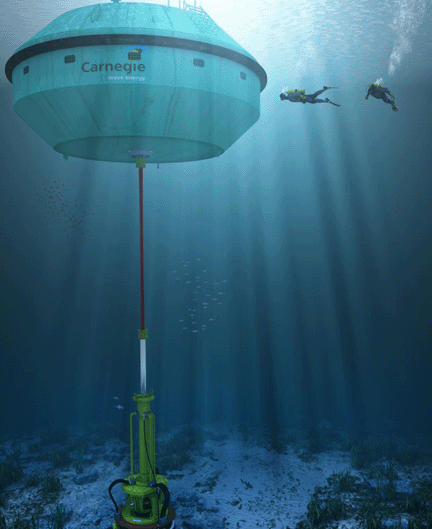 Carnegie Wave Energy up on Sri Lankan agreement https://au.news.yahoo.com/thewest/wa/a/32773367/carnegie-wave-energy-up-on-sri-lankan-agreement/#page1 – on September 30, 2016
The wave energy firm will work with Lanka Energy Conservation to identify opportunities and development pathways for its technology on the island nation.
Specifically the two companies will examine opportunities to enable CETO wave farms to be integrated into the existing or new power infrastructure to supply clean power and freshwater.
Carnegie’s chief operating officer Greg Allen said the company had made significant progress in its entry into the “small island” market this year.
“The signing of this MOU provides us with another opportunity to provide services to explore the possibility of incorporating CETO, along with microgrid solutions, to enable high penetration of renewable energy, displacing imported diesel,” he said.
Mr Allen said island nations were assessing clean, cost effective, alternative energy solutions to remove their reliance on electricity generated using imported fossil fuels.
“These imported fossil fuels come at a high cost, do not provide energy security and have a significant environmental footprint,” he said.
“Carnegie presents an effective clean energy alternative that can provide a solution for island and fringe of grid communities globally.” Lanka Energy Conservation chairman and managing director Dammica Wickramaratne said Sri Lanka showed good potential for wave, solar and wind energy power.
Australia can have renewable energy AND energy security
Director of CME Bruce Mountain said while it would take time and preparation to change the nation’s  generation mix, it was “entirely solvable” and had been done in places where renewables had made a large penetration of the energy market, such as Texas, Denmark, Portugal and Norway.
“There is nothing intrinsic to renewable capacity that implies a lower security and certainty of supply than a fossil system,” he said.
“There is nothing intrinsic to it. It is just not the case. There is a different mix of generation, a different operating regime of the existing capacity, a different operating regime of the power system and the transmission system, all of which is entirely within the skill set of engineers, power system operators, planners and so on.”
Nothing stopping Australia from having both energy security and renewable energies say experts, as Federal Government ramps up attacks, Examiner,
2 Oct 2016, There is no reason Australia can’t have energy security and a network increasingly reliant on renewables, energy experts say, as the Federal Government steps up its attacks on Labor state governments’ “aggressive” targets.
Energy Minister Josh Frydenberg said he wanted the Labor state governments, which included Queensland, South Australia and Victoria, to “understand there is a cost and there are implications to these aggressive state-based renewable energy targets”.
But Mr Frydenberg was also forced to admit preliminary inquiries had shown the mass South Australian blackout that sparked the debate was the fault of an unprecedented storm, and not the state’s increasing reliance on renewable energy.
But Mr Frydenberg said the experience should be used as a starting point for a national conversation for what he called “aggressive” renewable energy targets set by Labor state governments and those targets could not take precedence over energy security. …….
“The Australian Energy Market Operator has pointed out as recently as August this year that, if the interconnectors between South Australia and Victoria went down, because of the high reliance on intermittent supply, namely wind and solar, there would be in their words, a high likelihood of a full regional blackout,” he said.
But energy experts said there was no reason the nation could not have energy security while transitioning to a power network more heavily reliant on clean energy. Continue reading
1 This month

of the week – Australians for War Powers Reform (AWPR)
To see nuclear-related stories in greater depth and intensity
 Antinuclear