No new nuclear stations should be built: world must face up to the waste legacy
 the focus should be on managing it where it is rather than a premature search for new places and possibly new communities for deep disposal. The problem we already have is difficult enough and will only be compounded if new reactors are built extending the time-scales for implementation for very long, unknowable periods in the future. The burden of the existing legacy is unavoidable; we should not entertain having to deal with the avoidable wastes of a new build programme………
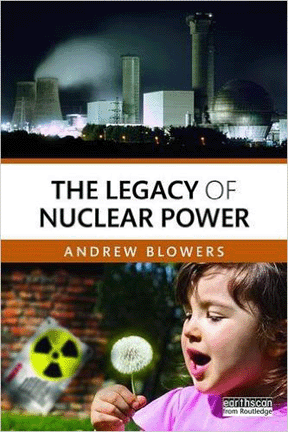
This article previews a new book by Andrew Blowers, The Legacy of Nuclear Power, Routledge, 2016, isbn 9780415869997. It is published at a critical time when the future of nuclear energy is high on the political agenda across the world. With the political focus on whether to build new nuclear power stations, this important book is a timely reminder that nuclear energy comes with a legacy of radioactive waste and clean-up that will be a burden on communities and generations far into the future.
The Legacy of Nuclear Power,This fascinating short article on four nuclear communities tellingly demonstrates why radioactive waste is a moral issue and explains what the priorities for its management should be. Routledge, By Andy Blowers. 7 Oct 16
“………..Finding a Solution
It is in places like Hanford, La Hague and Sellafield that the nuclear legacy has accumulated and which face the problem of managing it now and for generations to come. There is a recognised obligation, stated in principle by the International Atomic Energy Agency, that the legacy shall be managed in ‘such a way that will not impose undue burdens on future generations’ (IAEA, Principle 5). Much of this effort to find a final solution has been focused on deep geological disposal, removing the problem altogether by burying it deep underground. Yet, this solution is controversial since some radionuclides remain harmful for thousands of years and over infinitely long time-scales the uncertainties about safety and security of engineered barriers and geological containment in a repository become incommensurable……….
Seeking and securing disposal sites which is the contemporary approach, has in most countries thus far proved a slow, tedious and unsuccessful process. Successive attempts to secure political or social blessing for a site near Sellafield have failed and in Germany the resistance of Gorleben has been legendary. The history of trying to find sites for a repository for radioactive wastes is littered with examples where, to transcribe a biblical expression, many sites have been called but few chosen. The idea of the accumulating legacy of nuclear wastes from existing nuclear programmes being neatly and routinely packaged and transferred to a welcoming and pristine repository there to be entombed for ever is, with rare exceptions, little more than a distant prospect ……..
Given the time-scales involved there is no need to hurry towards a disposal solution that may, in terms of proving a concept and finding a site, be difficult to implement. Society can, and should, take its time in dealing with its nuclear legacy. Meanwhile the focus should be on managing it where it is rather than a premature search for new places and possibly new communities for deep disposal. The problem we already have is difficult enough and will only be compounded if new reactors are built extending the time-scales for implementation for very long, unknowable periods in the future. The burden of the existing legacy is unavoidable; we should not entertain having to deal with the avoidable wastes of a new build programme………
This article previews a new book by Andrew Blowers, The Legacy of Nuclear Power, Routledge, 2016, isbn 9780415869997. It is published at a critical time when the future of nuclear energy is high on the political agenda across the world. With the political focus on whether to build new nuclear power stations, this important book is a timely reminder that nuclear energy comes with a legacy of radioactive waste and clean-up that will be a burden on communities and generations far into the future. Written from the author’s perspective of active involvement in nuclear policy making, as academic, politician, government advisor and activist, this is a book that demonstrates the scale of the problem of nuclear’s legacy. https://www.routledge.com/posts/10360?utm_source=adestra&utm_medium=email&utm_campaign=160701303
No comments yet.
1 This month

of the week – Australians for War Powers Reform (AWPR)
To see nuclear-related stories in greater depth and intensity
 Antinuclear
Leave a comment