People power against nuclear waste dumping – protest at proposed dump site
 Nuclear waste protest http://www.transcontinental.com.au/story/4210032/people-power-on-display-in-the-flinders/ 10 Oct 2016, People power was in full force over the weekend, and it was directed against the federal government’s proposed nuclear waste facility.
‘Yanakanai Ngarpala Yarta – Come Here to Our Country’, saw 70 people travel to the proposed national nuclear waste dump site at Wallerberdina in the Flinders Ranges.
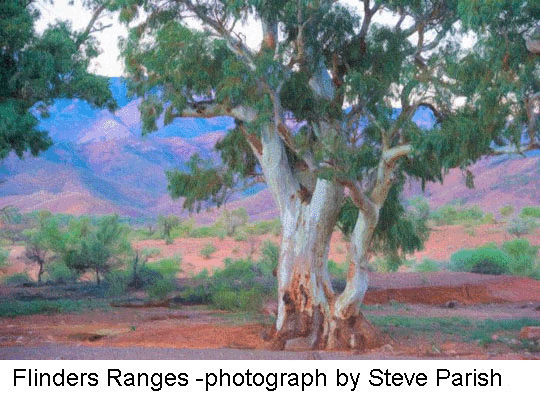
It was at the invitation of Adnyamathanha Traditional Owner and neighbour to the proposed site,Regina McKenzie,
Ms McKenzie made her opposition to the proposal clear.
“We don’t own the land, the land owns us. If you poison the land, you poison us,” she said.
At the three day camp, from October 7-9, Regina McKenzie shared her knowledge of the land and its cultural significance, including Australia’s first registered song-line, which runs from Hawker to Lake Torrens.
Supporters were taken to one of the world’s richest archaeological sites, and the sacred Hookina Springs.
More than 150 people gathered on Sunday and marched from the Blue Burt Memorial Park to the main intersection of Hawker, chanting “don’t waste the Flinders, dump the dump now!”
The rally was addressed by Traditional Owners, local pastoralists and members of the Flinders Local Action Group.
Hawker GP Dr Susan Andersson remains critical of the proposal.
“The continued availability of nuclear medicine services does not depend on a permanent waste repository. Less than one percent of the low level waste is medical waste,” she said.
Supporters across Australia will hold protests, film screenings and meetings for a national day of action against the nuclear waste dumps targeted for South Australia on October 15.
The danger as USA militarises the Pacific
 Washington Should Stop Militarizing the Pacific By NICHOLAS
  BORROZ and OCT. 9, 2016 WASHINGTON — Americans often assume that Chinese military aggression is increasing the likelihood of a clash between China and the United States. But many policy makers in Washington ignore that Beijing has good reason to be troubled by the United States’ military footprint in its neighborhood. President Obama’s “pivot” to Asia — which includes doubling down on Washington’s already-robust military presence in the region — further stokes the potential for conflict between China and the United States.
Thought for the day – on radioactive trash
 Derek Abbott Nuclear Fuel Cycle Watch South Australia, 12 Oct 16 Thought for the day: We haven’t even solved the problem of our own low level hospital nuclear waste, and we are talking about high-level waste from other countries? Jay should learn to walk before he can run. https://www.facebook.com/groups/1021186047913052/
South Australian government’s craven pandering to the nuclear lobby, losing public trust
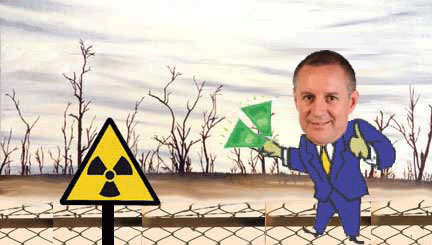 Claire Catt, on the Your Say site, 08 Oct 2016 Since Mr. Weatherill suggests politicians should perhaps trust the people, I suggest it is high time for the State Government to stop meddling in this debate and stop pushing the nuclear industry’s agenda.
This industry has been searching for a Government stupid enough to consider such a reckless proposition for years. No country, rich or poor, has found such a proposition acceptable. No doubt the nuclear lobby is overjoyed and perhaps somewhat baffled to find South Australia is listening and falling for their outrageous claims of safe management and riches.
If we are talking about trust, well I consider our Government is grossly failing in their duty of care towards the people and yes, I’ve certainly lost trust. They have lost my vote.
Premier Weatherill pretty much admitted he will try bribing Aboriginals for nuclearwaste dumping
 Claire Catt, on Your Say, 28 Sep 2016 On QndA Premier Jay Weatherill has all but admitted he will try to bribe Aboriginal landholders to get consent.
Why he should be so desperate to go into the history books as the Premier who wrecked South Australia’s reputation, economy and future I cannot fathom.
Our Premier is way out of line with his unconscionable push for this dangerous proposal. He is way out of line spending Millions of taxpayer’s money to advance the interests of the nuclear industry over the longterm welfare of his people.
Britain’s outrageous Hinkley nuclear plan a cover-up for nuclear militarism
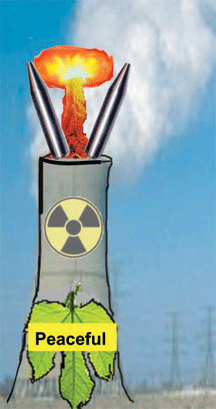 Britain’s Nuclear Cover-Up, NYT, OCT. 10, 2016
A painstaking study of obscure British military policy documents, released last month by the Science Policy Research Unit at the University of Sussex, demonstrates that the government and some of its partners in the defense industry, like Rolls-Royce and BAE Systems, think a robust civilian nuclear industry is essential to revamping Britain’s nuclear submarine program.
For proponents of Trident, civilian nuclear projects are a way of “masking” the high costs of developing a new fleet of nuclear submarines, according to the report. Merging programs like research and development or skills training across civilian and military sectors helps cut back on military spending. It also helps maintain the talent pool for nuclear specialists. And given the long lead times and life spans of most nuclear projects, connections between civilian and military programs give companies more incentives to make the major investments required.
One might say that with the Hinkley Point project, the British government is using billions of Chinese money to build stealth submarines designed to deter China.
One can certainly say that the British government is using an ill-advised civilian nuclear energy project as a convoluted means of financing a submarine program.
The British government must be more transparent about its military spending, if only so that those expenditures can be measured against the needs of other public programs. According to the Science Policy Research Unit study, the government itself estimated in 2015 that renewing the Trident deterrent force will cost nearly $38.5 billion. In comparison, the deficit of the National Health Services for the fiscal year 2015-6, a record, was about $3 billion.
Hiding the true costs of a project like Trident by promoting a questionable and ruinous project like Hinkley Point C distorts the economics of both the defense and the civilian energy sectors. It also skews energy policy itself.
If Britain’s energy policy were solely about energy, rather than also about defense, the nuclear sector would be forced to stand on its own two feet. And the government would have to acknowledge the growing benefits of renewable energy and make hard-nosed comparisons about cost, implementation, environmental benefits and safety.
Solar power needed, to bring energy security and jobs to Port Augusta, South Australia
 Sam Johnson: Solar power must be provided to regional centres such as Port Augusta to provide electricity security – and jobs
 http://www.adelaidenow.com.au/news/opinion/sam-johnson-solar-power-must-be-provided-to-regional-centres-such-as-port-augusta-to-provide-electricity-security/news-story/4ffcdfeb9fc35ef3f8cbfe0eea1c9bdc October 10, 2016 THE political hoo-ha over renewable energy in South Australia over recent weeks has revealed a serious lack of leadership when South Australian towns like Port Augusta need it most.
Canberra’s renewable energy leadership at risk, as Federal govt demonises renewables.
The solar industry already employs more people than coal-fired generation across the country. In 2014 the solar industry employed more than 13,000 people and even with the uncertainty and watering down of the renewable energy target this is likely to have grown. By comparison, according to the 2011 census 8,000 people worked in fossil fuel electricity generation.
A clean energy transition is already happening, but it is at risk, Guardian, Alexander White, 11 Oct 16 The transition to a low carbon economy is already happening, but is at risk when residents of Australia’s capital go to the polls in local elections.
The transition to a low carbon economy is already happening … in theAustralian Capital Territory, where the local Labor government has legislated for a 100% renewable energy target by the year 2020.
But this major achievement is at risk on Saturday when residents of Canberra go to the polls for territory elections. Continue reading
Should Australia follow Canada – let the states lead on climate?
 Canada lets the states lead on climate, should Australia do the same? The Conversation,October 11, 2016 Canadian Prime Minister Justin Trudeau showed Australia a thing or two when he announced a new climate change plan last week – and not just because it was delivered impeccably in two languages. Trudeau has decided to leave climate policy to the provinces, while forcing them to act.
Is this state-based approach a model for Australia? Continue reading
‘reckless’ and ‘indefensible’ Carmichael coal mine approved by Queensland govt
 Queensland fast tracks ‘reckless’ and ‘indefensible’ Carmichael coal mine, Independent Australia Renew Economy 11 October 2016 Minus financial backing, reneging on the Paris Agreement and even ignoring Adani’s own loss of interest in the project, the Queensland Government is fast tracking the Carmichael coal mine, writesRenewEconomy‘s Sophie Vorrath.
IN A MOVE that has been labelled “indefensible” and “reckless” by green groups, the Queensland Government has declared the massive Carmichael coal mine and port proposed for the State’s Galilee Basin as “critical infrastructure”, in an effort to fast-track its development.
State development minister Anthony Lynhamsaid on Monday that the Labor PalaszczukGovernment had invoked special powers to help progress Adani’s $21 billion project, reinstating and expanding its “prescribed project” status to include its water infrastructure…….
while governments of all colours appear to be rolling out the red carpet for the coal project, there are other hurdles it has yet to clear – not least of all economic ones – as coal looks more and more like a high-risk investment.
As John Quiggan wrote last month, a long list of banks and other funding sources have announced they won’t touch the project, or have pulled out of existing finance arrangements.
The list includes the Commonwealth Bank of Australia (formerly a big lender to Adani), NAB, the Queensland Treasury and global banks including Standard Chartered (another former big lender), Citigroup, JP Morgan Chase, Goldman Sachs, Deutsche Bank, Royal Bank of Scotland, HSBC and Barclays, as well as BNP Paribas, Credit Agricole and Societe Generale. The U.S. and Korean Export-Import banks and the State Bank of India have been touted as possible sources, but appear to have backed away.
Even Adani Group, the Indian conglomerate behind the project, has appeared to lose interest in its coal plans. And just this week, the energy minister for India – the main market for the coal that would be dug up at Carmichael – called on the country’s power generators to cease coal imports if the nation was to come good on its “One Nation, One Grid, One Price” energy goal…..https://independentaustralia.net/politics/politics-display/queensland-fast-tracks-reckless-and-indefensible-carmichael-coal-mine,9578
Active Volcanoes Endanger Japan’s Operating Nuclear Power Stations: Mount Aso Awakened Explosively; Sakurajima Already Awake

Japan’s Mount Aso volcano erupted explosively on Saturday, 8 Oct., 2016, and volcanic “ash was falling as far as 320 km (200 miles) away, … Kyushu Electric Power Co said the eruption had no impact on its Sendai nuclear plant, which is about 160 km (100 miles) south of Mount Aso“(Reuters, 8 Oct. 2016). Sendai nuclear power station has two reactors online. The other nuclear power station online is Ikata, with one reactor operating.https://en.wikipedia.org/wiki/Nuclear_power_in_Japan
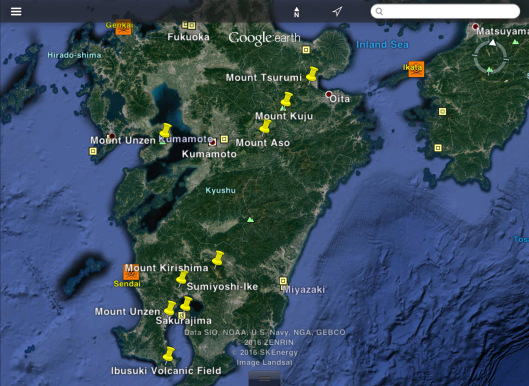
Volcano locations exported from: https://en.wikipedia.org/wiki/List_of_volcanoes_in_Japan
With a change in wind direction ashfall from Mount Aso and/or Sakurajima could endanger Japan’s operating reactors. As can be seen on the map, Ikata Nuclear Power Station is closer to Mount Aso, and Sakurajima to Sendai Nuclear Power Station. Ash plume forecasts for both appear at the bottom of this post.
Disruptions due to a major volcanic eruption, as well as ashfall could lead to nuclear meltdown:
View original post 171 more words
World first: Concentrated Solar Power Plant growing tomatoes #Auspol

Construction of a world-leading, concentrated solar power (CSP) tower plant that will supply electricity, heat and desalinated seawater to grow tomatoes in the Australian desert has been completed in South Australia.
Sunndrop Farms marked the completion of construction and the beginning of full operations at their world-first 20-hectare solar desalination farm in Port Augusta on Friday, with an official opening celebration.
The opening of the $200 million state-of-the-art solar thermal development is a fillip for Port Augusta, which last week took the brunt of 83km/h winds that accompanied the one-in-50-year storm that wreaked havoc in South Australia.

And the recent closure of the Port Augusta’s coal-fired power station – the state’s last in operation, that had been running since the 1960s – puts the region at the forefront of a major industrial and economic transformation.
The Sundrop tomato farm – which has generated jobs for around 175 people – is…
View original post 128 more words
1 This month

of the week – Australians for War Powers Reform (AWPR)
To see nuclear-related stories in greater depth and intensity
 Antinuclear