Britain’s outrageous Hinkley nuclear plan a cover-up for nuclear militarism
 Britain’s Nuclear Cover-Up, NYT, OCT. 10, 2016
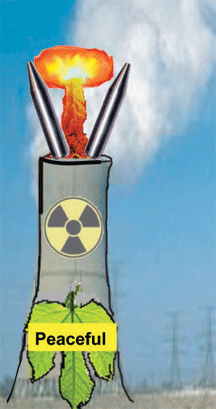
A painstaking study of obscure British military policy documents, released last month by the Science Policy Research Unit at the University of Sussex, demonstrates that the government and some of its partners in the defense industry, like Rolls-Royce and BAE Systems, think a robust civilian nuclear industry is essential to revamping Britain’s nuclear submarine program.
For proponents of Trident, civilian nuclear projects are a way of “masking” the high costs of developing a new fleet of nuclear submarines, according to the report. Merging programs like research and development or skills training across civilian and military sectors helps cut back on military spending. It also helps maintain the talent pool for nuclear specialists. And given the long lead times and life spans of most nuclear projects, connections between civilian and military programs give companies more incentives to make the major investments required.
One might say that with the Hinkley Point project, the British government is using billions of Chinese money to build stealth submarines designed to deter China.
One can certainly say that the British government is using an ill-advised civilian nuclear energy project as a convoluted means of financing a submarine program.
The British government must be more transparent about its military spending, if only so that those expenditures can be measured against the needs of other public programs. According to the Science Policy Research Unit study, the government itself estimated in 2015 that renewing the Trident deterrent force will cost nearly $38.5 billion. In comparison, the deficit of the National Health Services for the fiscal year 2015-6, a record, was about $3 billion.
Hiding the true costs of a project like Trident by promoting a questionable and ruinous project like Hinkley Point C distorts the economics of both the defense and the civilian energy sectors. It also skews energy policy itself.
If Britain’s energy policy were solely about energy, rather than also about defense, the nuclear sector would be forced to stand on its own two feet. And the government would have to acknowledge the growing benefits of renewable energy and make hard-nosed comparisons about cost, implementation, environmental benefits and safety.
No comments yet.
1 This month

of the week – Australians for War Powers Reform (AWPR)
To see nuclear-related stories in greater depth and intensity
 Antinuclear
Leave a comment