The protest was held on the 63rd anniversary of the first bomb going off Maralinga in the Woomera Prohibited Area, as part of a national day of action against nuclear dumps.
Aboriginal landowners joined by thousands in South Australian protest against nuclear waste dumping
Nuclear waste dump protesters bring the fight from outback South Australia to the city, By Lauren Waldhuter http://www.abc.net.au/news/2016-10-15/nuclear-waste-dump-protesters-bring-the-fight-to-adelaide/7935954
Traditional landowners from South Australia’s outback have brought their fight against proposed nuclear storage facilities to the steps of Parliament House.
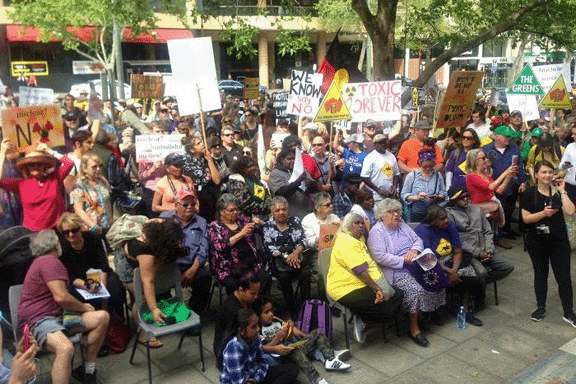
About 3,000 people rallied against proposed nuclear waste dumps, with Aboriginal families affected by nuclear testing at Maralinga among the crowd.
The State Government is considering whether it should store the world’s high-grade nuclear waste at a site somewhere in South Australia.
At the same time, the Federal Government is considering building its first storage facility for Australia’s low-grade radioactive waste, having short-listed Wallerberdina station, near Hawker in the Flinders Ranges, as a preferred site.
Traditional landowner Karina Lester said many people did not want to see either proposal go ahead.
“We are starting to unite and we are starting to really think about how we’re going to fight this, because it concerns us and we have a cultural responsibility,” she said.
“People travelled from the Mid North [and] from Ceduna as well to be part of this event and it was so important that they gathered here today to say ‘enough is enough’.
“Having Yalata crew, having Ceduna crew, the Yappala crew being involved is so strong for us as Aboriginal people.”
Renowned film director Scott Hicks lent his voice to the cause, with particular concern about the high-grade dump.
“To me it’s an idea that doesn’t make sense on any level I can look at it,” he said.
“It doesn’t make economic sense. We can’t even predict the price of coal a month from now. How can we predict the price of nuclear waste 100 years from now?
“Why would we want to leave a legacy for our children’s, children’s children and beyond 100,000 years, that can never be taken away?”
What is being proposed?
Federal
- Low-to-intermediate level radioactive waste generated in Australia stored in a purpose-built facility
- It would include materials such as nuclear medicine by-products
- This waste is currently stored in more than 100 sites across Australia, in metropolitan areas, regional towns and cities
- The project promises at least 15 ongoing jobs and $10 million in funding for the host community once the facility is operational
South Australia
- The Nuclear Fuel Cycle Royal Commission found SA could store the world’s high-grade nuclear waste
- Sealed waste would be stored 500 metres underground in a purpose-built facility
- The facility could create up to 5,000 jobs during construction and 600 ongoing jobs
- It is tipped to generate $5.6 billion of annual revenue for SA once established
The Advertiser (Under)Reports huge anti nuclear waste rally in Adelaide
 I have received several reports from those who attended the rally in Adelaide – estimates of attendance numbers range from 100o to 3000.
A smaller rally was held in Melbourne, and in Alice Springs. At this stage, I have no reports on the rally held in Sydney.
Hundreds march against nuclear dumping in South Australia http://www.9news.com.au/national/2016/10/15/12/51/hundreds-march-against-nuclear-dumping-in-south-australia Hundreds of land owners have converged in Adelaide’s city centre to resist the South Australian government’s plans for two nuclear waste dumps in the state’s north.
Groups opposing the government’s plans to store high-level waste from other countries have flooded the steps of Parliament House in Adelaide’s CBD.
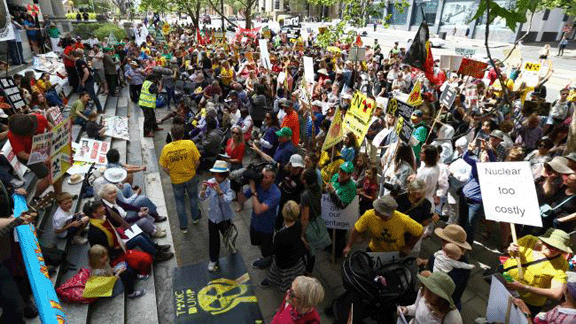
Many have come bearing flags and signs protesting the dumps, which were proposed in July. Traffic in the local area has been restricted to one lane as a steady stream of protesters continue to arrive. Motorists are advised to avoid the area.
Karina Lester, from the No Dump Alliance, said people need to send a strong message of opposition to the state and federal governments.
“All traditional owner groups need to unite and fight this as we all know the international waste storage facility is not going to be Norwood or Unley (in Adelaide), it will be in the far north of the state,” Ms Lester said.
Aboriginal Congress SA chairman Tauto Sansbury said people need to understand what building nuclear waste dumps means for future generations.
“We are talking about the importance of country and the preservation of culture and safety of our peoples,” Mr Sansbury said.
Conservation SA chief executive Craig Wilkins believes today’s rally is “another opportunity for all South Australian to express their concerns over the dump proposals”.
The rally also marks the 63rd anniversary of the first British atomic bomb test at Emu Field, in SA’s far northwest, in 1953.
Could the nuclear waste issue be the finish for South Australia’s Premier Jay Weatherill?
 Power to the people may mean pulling plug on Jay Premier Jay Weatherill must pull off complex balancing act on SA’s energy infrastructure Daniel Wills, The Advertiser,October 14, 2016 PREMIER Jay Weatherill is strangely now both a hero and villain of the environmental movement.
Jobs have long been the biggest issue in SA politics, and will undeniably dominate the campaign in 18 months’ time. It’s a sign of how desperate the situation in SA has become that beating Tasmania back into last place on the unemployment ladder is now a cause for muted celebration.
We also wait to see what future, if any, Whyalla has and the full impact of Holden’s closure.
But leaping up into the top strata of vote-changing issues, which includes the State Government’s overhaul of the health system, are two divisive topics that evoke powerful emotions……….
An Advertiser-Galaxy poll on the blackout published on Monday showed only 16 per cent of people supported dialling back renewables in favour of coal and gas generation……..Voters seem to want something existing technologies don’t offer – carbon-free renewable energy that is cheap and reliable……..
In two Saturdays’ time, Mr Weatherill will head to a Labor Party state convention where the prospect of the state taking high-level nuclear waste for cash will be a flashpoint.
Already, Labor MP Steph Key is speaking out against any change to the party platform. Stakeholders such as SA Unions are expressing grave doubts about the business model…….
The numerical dominance of Labor’s Right faction, plus hesitant support in elements of Mr Weatherill’s Left, makes it likely his nuclear position will survive………
The same people cheering speech lines about wind farms may roll their eyes at nuclear. And vice-versa. This is the core and complex balancing act Mr Weatherill must pull off in the bid for a fifth term – holding a coalition of diverse and often opposed interests to win the day.
It’s not about being all things to all people. It’s about being just enough to just enough.http://www.adelaidenow.com.au/news/opinion/daniel-wills-premier-jay-weatherill-must-pull-off-complex-balancing-act-on-sas-energy-infrastructure/news-story/69403007930c182f4d0f679491a3eee9
Marshall Islands lose their nuclear disarmament case on a legal technicality
Nuclear Standoff, CounterPunch, OCTOBER 14, 2016 “…………the Republic of the Marshall Islands has lost its case in the International Court of Justice. On a technicality, no less! Phon van den Biesen, lead attorney for the tiny island nation, which had sued the world’s nine nuclear powers — the United States, Russia, China, Great Britain, France, Israel, India, Pakistan and North Korea — to begin real nuclear disarmament negotiations, said the case was dismissed earlier this month on a “micro formality,” which in my layman’s grasp of the matter might be called, instead, a desperate legal cop out.
The case, which, technically, was brought against only three of the nine nuclear powers, Great Britain, India and Pakistan (because those are the only three nations that acknowledge the binding authority of the ICJ), was dismissed — in a split decision that could be called the First World against the rest of humanity — on the grounds that there wasn’t sufficient evidence of a dispute between the parties, so the court had no jurisdiction to hear the case on its merits.
Huh?
JOHN PILGER – Breaking The Silence – 2016
The ICJ’s dissenting judges (in the case against Great Britain, the verdict to dismiss was 9-7, against India and Pakistan it was 8-8), expressed as much incredulity as I did on hearing the news.
The Marshall Islands lawsuits (a second suit was also filed, specifically against the United States, in U.S. federal court, and is still pending) demanded compliance with Article VI of the 1968 Nuclear Nonproliferation Treaty, signed by the U.S. in 1970, which reads: “Each of the Parties to the Treaty undertakes to pursue negotiations in good faith on effective measures relating to cessation of the nuclear arms race at an early date and to nuclear disarmament, and on a treaty on general and complete disarmament under strict and effective international control.”
“General and complete disarmament — do these words actually have meaning?” I asked last January. “Right now the Marshall Islands stand alone among the nations of Planet Earth in believing that they do.”
This tiny nation of islands and atolls — this former U.S. territory — with a population of about 70,000, was the scene of 67 nuclear test blasts in the 1950s, back when bigger was better. Some people’s homes were destroyed for eternity. The islanders suffered ghastly and often lethal levels of radiation and were essentially regarded, by their U.S. overlords, as human guinea pigs — a fantastic opportunity to study the effects of nuclear fallout. Eventually, the U.S. atoned for its destruction by paying the Republic of the Marshall Islands a pathetic $150 million “for all claims, past, present and future.”
Now this nation is trying to save the rest of the planet by insisting that nuclear disarmament negotiations must get underway.
In a dissenting opinion, ICJ Judge Antônio Augusto Cançado Trindade of Brazil lamented that the world needed to recognize the “prevalence of human conscience” over national interests.
As Rick Wayman of the Nuclear Age Peace Foundation pointed out, of the ICJ justices who voted not to hear the case on its merits, six were from nuclear-armed nations (the U.S., Russia, China, France, Great Britain and India) and the other two from nations (Japan, Italy) “deeply invested in the U.S. ‘nuclear umbrella.’”
The nations of the dissenting judges included Brazil, Somalia, Jamaica, Australia and Morocco…….. The human conscience is dismissed on a technicality……. http://www.counterpunch.org/2016/10/14/nuclear-standoff/
1986 Critique of Nuclear Spin – it is still relevant today!
the long-term effects of low-level radiation exposure have consistently been downplayed, distorted or concealed by scientists, the nuclear industry and the government.
It seems that while the US and the USSR had a hard time cooperating on nuclear arms at that time, they had a tacit agreement to cover up each other’s nuclear power mistakes.
these facts, like all those about nuclear power and nuclear weapons testing, were kept secret and released only through the efforts of private citizens and a few courageous researchers and journalists.
At least 250,000 American troops were directly exposed to atomic radiation during the 17 years of bomb testing here and in the Pacific, but they have been totally ignored by the government and the Army.
There is little doubt that hundreds died and that countless others developed illnesses that led to death from various cancers, blood disorders and chronic body ailments. Today the government still rejects all claims for such illnesses.
The press also played a role in soothing public fears.
the US has led the world in setting examples of deliberate deceit, suppression of information and harassment of nuclear critics
Professionals, in order to perform their work, resist truth strongly if it calls the morality of their work into question. They sincerely believe they are helping humankind. In addition, scientific research involves so many uncertainties that scientists can, with an easy conscience, rationalize away dangers that are hypothetical or not immediately observable. They also have an intellectual investment if not a financial one in continuing their work as well as families to support, and nuclear science in particular has been endowed not only with government money and support but great status and prestige.
In order to perform professional work, one must not only believe one is doing good but must also rationalize the dangers. Indeed, with regard to ionizing radiation, this is quite easy inasmuch as the risks of radiation exposure at any level are statistical and not immediately manifested.
Pro Nuclear Propaganda: How Science, Government and the Press Conspire to Misinform the Public http://www.lornasalzman.com/collectedwritings/pro-nuclear.html by Lorna Salzman Hunter College, Energy Studies program, 1986 After the Chernobyl nuclear reactor disaster in the Soviet Union, there was much finger-wagging in the US about the suppression of information there, and the purported differences in reactor design and safety requirements between Russia and the US, which made a similar accident here unlikely if not impossible Continue reading
Western Australia’s uranium mining lobby rushing to get approvals before WA election
 WA uranium mines: Race for environmental ticks in Goldfields before WA election, conservationists say http://www.abc.net.au/news/2016-10-14/wa-uranium-mine-approvals-race-ahead-of-wa-election-cc-says/7931254 By David Weber, 14 Oct 16, Proponents of uranium mines in Western Australia are racing to gain environmental approvals ahead of the state election, in case Labor wins, according to the Conservation Council.
Three projects in the Goldfields are at various stages of assessment.
They include Vimy Resources’ proposed mine at Mulga Rock, Toro Energy’s proposal to mine near Wiluna, and Cameco’s nearby Yeelirrie project.
The Council’s anti-nuclear campaigner, Mia Pepper, said companies were seeking security for the projects. “Certainly we are getting the sense that [for] the three uranium projects that’re under assessment … they’re clearly seeking some level of approval before the state election,” she said.
The Environmental Protection Authority (EPA) has recommended conditional approval for Toro Energy’s proposal, 30 kilometres south of Wiluna.
Cameco’s project at Yeelirrie, 70 kilometres south-west of the town, was knocked back after the EPA said there was too much risk to the subterranean fauna. However the EPA in August recommended the green light for Vimy’s project at Mulga Rock, 260 kilometres north-east of Kalgoorlie, and preliminary site works have been given the go-ahead.
Approvals could lead to ‘pressure’ on Labor Ms Pepper has met the EPA appeals convenor expressing concern about Mulga Rock. She said if a project cleared certain hurdles, it would be harder to wind it back. “An environmental approval is just one layer of approval that a uranium project requires,” she said.
“[It] is a long way from final approval, so it doesn’t lock in Labor to any of these projects, but … there would be seen to be that kind of pressure.
“It’s a political issue, it’s a very contentious issue and certainly the companies are doing everything they can.”
Even after a positive EPA assessment, uranium projects still required state and federal ministerial backing as well as other approvals and licences.
Cameco’s open cut mine at Kintyre, 270 kilometres north-east of Newman, has gone as far as gaining conditional approval from the Federal Government last year. Labor’s stated policy suggests mines that have been granted final state approval for construction will be permitted to operate and export in the same manner as other mining ventures.
Native American Forum on Nuclear Issues held in USA
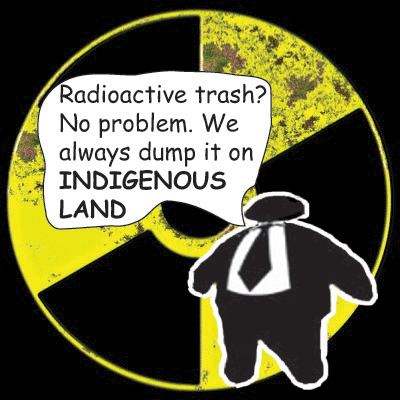
 Nuclear Standoff, CounterPunch, OCTOBER 14, 2016 “…….This week, as if in sync with the Marshall Islanders, a group called the Native Community Action Council convened the Native American Forum on Nuclear Issues, addressing half a century of lingering horror at another nuclear testing site, in Nevada. The forum addressed such issues as abandoned uranium mines and the proposed high-level nuclear waste disposal site under Yucca Mountain, “in the heart of the Western Shoshone Nation (and) a sacred site for Shoshone and Paiute peoples,” according to the organization’s press release.
“Because of U.S. nuclear testing in Nevada, the Western Shoshone Nation is already the most bombed nation on earth’” the release continues. “They suffer from widespread cancer, leukemia, and other diseases as a result of fallout from more than 1,000 atomic explosions on their territory.”
This is the reality we ignore. We’ve been ignoring it for the last 70 years and, indeed, much longer. We’ve reached the end of our ability to treat the planet, and much of its people, as disposable. Much of humanity knows this, but its leaders are refusing to listen. The human conscience is dismissed on a technicality. http://www.counterpunch.org/2016/10/14/nuclear-standoff/
Dangerous decisions as Ukraine’s aging nuclear reactors extending expiry dates
 On the domestic front, opposition to nuclear decision-making is silenced. Our colleagues in Ukraine, who have been voicing safety concerns, were sued in 2015 by Energoatom, Ukraine’s nuclear operator, and the state nuclear regulator joined in later. Eventually, the court backed the plaintiffs, who argued the public critique of the nuclear revival programme was inappropriate. Meanwhile, EU institutions keep on paying to support Ukraine’s aging nuclear fleet and claim to support democracy and rule of law in the country.
 New life for Ukraine’s aging nuclear power plants European institutions are helping Ukraine extend its already outdated nuclear operations — increasing short-term risks and halting energy alternatives for the future. In the past few weeks, two of Ukraine’s Soviet-era nuclear reactors received a lease on life for an additional 10 years beyond their originally projected life-span. Units 1 and 2 at the Zaporizhska nuclear power plant, Europe’s largest, are the fifth and sixth units to have their expiry dates extended by Ukraine’s nuclear regulator. This is a dangerous move, which violates international law and democratic principles.
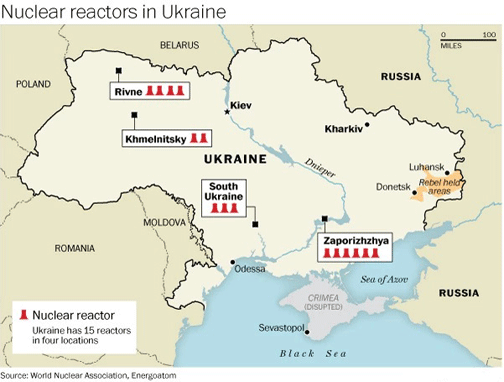
Nuclear proponents, Ukrainian governmental officials and the state nuclear power operator Energoatom argue these extensions are necessary. But is it really? And who benefits from the continued operation of Ukraine’s aging nuclear fleet? Continue reading
1 This month

of the week – Australians for War Powers Reform (AWPR)
To see nuclear-related stories in greater depth and intensity
 Antinuclear