Australia’s sinister nuclear history. Premier Jay Weatherill launches a new sinister phase
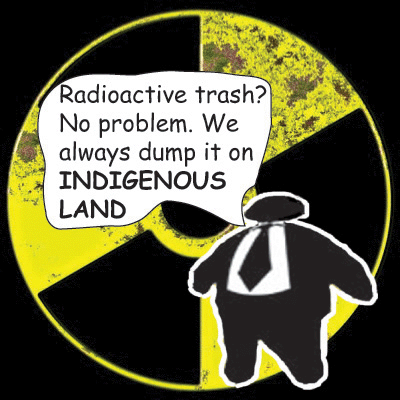
Ultimately, this dump is about helping the global nuclear industry. The current build-up of site-by-site waste acts as a brake on investment. They want somewhere to dump it forever so they can go on producing more of it.
South Australia to become global nuclear waste capital https://redflag.org.au/node/5521 Sixty years ago, Maralinga went up in a mushroom cloud. The British government had been given permission to test atomic weaponry in South Australia.
That is to say, they had been given permission by the right wing Menzies government. The local Maralinga Tjarutja people had no say in it at all. Many of them were not even forewarned of the first blast. Thunderous black clouds condemned them to radiation exposure, illness and death, the survivors being driven from their homeland during the long years of British testing and fallout.
South Australia has a dark history with the nuclear industry. Maralinga remains contaminated, despite cheap clean-up efforts. Uranium tailings have leaked from BHP’s Olympic Dam mine at Roxby Downs. Fukushima’s reactors held South Australian uranium when catastrophe struck in 2011.
Today, Jay Weatherill’s state Labor government is trying to open a new radioactive chapter. He wants South Australia to construct the world’s first international high-level nuclear waste dump. This would mean no fewer than 138,000 tonnes of waste (one-third of the world’s total) being shipped from the world’s reactors into South Australian ports, to be permanently buried in Aboriginal land.
This would be history’s largest nuclear dumping operation, and make South Australia the hazardous waste capital of the world. Continue reading
UN human rights expert finds that Australian government has lost trust of civil society

 Australian Government must re-build trust of civil society – UN human rights expert, CANBERRA / GENEVA (18 October 2016) – United Nations independent expert Michel Forst today called on the Government of Australia to urgently dispel civil society’s growing concerns about the combined ‘chilling effect’ of its recent laws, policies and actions constraining the rights of human rights defenders.
“I was astonished to observe mounting evidence of a range of cumulative measures that have concurrently levied enormous pressure on Australian civil society,” said the UN Special Rapporteur on the situation of human rights defenders at the end of his first fact-finding visit* to the country.
Recognizing Australia’s traditional safeguards of constitutional democracy, rule of law and free media, Mr Forst noted that his initial expectation from his official visit was to “encounter only laudable implementation of the State’s obligations under international human rights laws, aimed at ensuring a safe and enabling environment for human rights defenders.”
Instead, the expert found a number of detrimental measures which include a growing body of statutory laws, both at the federal and state levels, constraining the rights of defenders. “They have ranged from intensifying secrecy laws to proliferating anti-protest laws, from the stifling Border Force Act to the ‘Standing’ bill shrinking environmental access to courts,” Mr. Forst specified.
“Those laws have not only accentuated the disparity between Government’s declared commitments at the international forums and their implementation within the country,” he noted. “They have also aggravated the situation following the drastic defunding of peak bodies by the Government, following their advocacy or litigation on such topical issues as immigration, security, environment and land rights protection.” Continue reading
Claire Catt on Your Say – the ultimate financial disaster of the Nuclear Fuel Chain Royal Commission’s plan
Surely this is when it is at it’s most dangerous levels.
Why then cannot it go straight into the presumably “safe” method of storage deep underground that is promoted as “best practice” for storage of nuclear waste?
 Claire Catt > henry francis Your Say site 17 Oct 2016 We won’t have the money to built the facility until we have imported thousands of tonnes of waste for a price unknown and untested anywhere in the world.
We plan to built this repository without any idea how to actually do this since it has never been done before, not anywhere including Finland. There they have spent billions of dollars for a dump still unfinished, for waste produced by them requiring no transport to speak of. If it will work and for how long is unknown.
It is my guess this underground pipe dream will never be built and we will be left with mountains of toxic waste in the open, possibly covered with concrete, like in Chernobyl. We’ll have to keep it from all life, protect it from terror attacks, climate change threats and leakage into the environment.
But hey, we probably won’t have to worry about it just yet, more likely our children and grandchildren and a thousand generations after them.
America’s Mixed Oxide Fuel Fabrication Facility- a nuclear reprocessing boondoggle that will never work
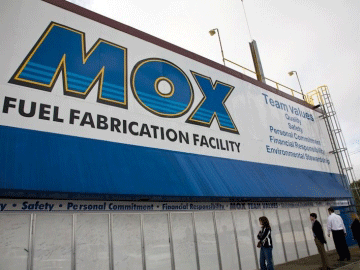 Nuke Fuel Facility Costs Ten Times Estimate, is 41 Years Behind Schedule http://www.pogo.org/straus/issues/nuclear-security/2016/nuke-fuel-facility-costs-ten-times-estimate-41-years-behind-schedule.html?referrer=https://t.co/yn7hBkHF1d By: Lydia Dennett | October 13, 2016 Imagine you have a contractor working on your house. They quoted you a price and told you the project would be done in no time. Sure, you realize costs will probably go up some and the schedule will slip due to an unexpected problem or two. But months turn into years, years turn into a decade, and now, 14 years later, you find that they’ve already spent five times their original estimate and they aren’t even halfway done!
That’s the situation the Department of Energy is facing with the contractor building a nuclear fuel facility in South Carolina. The Mixed Oxide Fuel Fabrication Facility, known as MOX, is a multi-billion dollar boondoggle that is behind schedule, is over budget, and will never be able to complete its mission. Now the Army Corps of Engineers has released an independent cost estimate for the project that reveals things are even worse than we thought. Continue reading
Absurdity of nuclear waste importing as solution to south Australia’s economic problems
Peter Mahoney, 17 Oct 16 Nuclear’s”back end” problem (the “disposal” of its waste). The search was on quickly to find a patsy state – and they think they have found it, here. Moral, economic and jobs arguments have been released in a barrage of coercive pressure on the SA public, when all Jacobs and their employers really want is a quick fix to their financial problems. The renewable energy industry is likely to overtake nuclear power generation in a few short decades, but if SA goes down this path we will be left with a very long term problem that the nuclear companies won’t be around to help with. The incredibly long timescales and ridiculously speculative nature of the economic modelling make any relevance to SA’s current economic challenges absurd. https://www.facebook.com/groups/1021186047913052/
Nuclear Royal Commission’s implausible arguments do not inspire trust
 Peter Mahoney, Your Say site, 17 Oct 2016 It is very difficult to trust a Royal
  Commission conducted by a former military officer and a large commercial consultant to the nuclear industry. It seems to me a bit like getting Coles or Woolworths to run a Royal Commission into milk pricing. The military culture is one traditionally based on loyalty and obedience, and is not recognised for its objective and dispassionate consideration of all angles. Our former Governor may be a very upright and affable chap, but it is difficult to believe he would hold an opinion contrary to what he has been told is in the best interests of his beloved State. You can’t blame him for this, but it does not engender trust.
Royal Commission silent on dangers of nuclear transport and security required
 Peter Mahoney, Your Say site 17 Oct 2016 The Royal Commission report appears to be silent on the details of how these radioactive materials would be transported to South Australia, and what sort of defence force support would be required to ensure that they are not the subject of terrorist attack. Who would be responsible for ensuring that they are correctly and securely sealed in their containers in the country of origin, say India or Pakistan? How would an SA facility ensure that proper standards are being followed at every step. The consequences of undetected, small or slow leaks would be enormous if they occur all the way from the country of origin, across the oceans and then across the land to SA.
Hillary Clinton on Climate Change and Renewable Energy
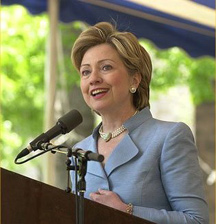 The Hillary Clinton Environmental Scorecard The former Secretary of State could inherit a number of ambitious eco-commitments established by President Obama. Here’s where she stands on each one. Outside By: Juliet Eilperin Oct 17, 2016 “…….
Climate Change and Renewable Energy
In contrast to Obama, who barely mentioned the issue when he was running for reelection in 2012, Clinton has made tackling climate change a major theme in her campaign. She’s mentioned it during both the primary and general election debates, mocking Trump during the first debate by saying, “Donald thinks that climate change is a hoax perpetrated by the Chinese. I think it’s real.” Trump replied, “I did not. I did not. I do not say that.” (He actually did tweet that, and he has also questioned whether global warming is even underway.)
Clinton has vowed to cut U.S. greenhouse gas emissions by as much as 30 percent below 2005 levels by 2025, and 80 percent by mid-century. She’s also pledged to cut U.S. oil consumption by a third, ensure that half a billion solar panels will be installed by 2020, and carry out a ten-fold increase in renewable energy production on public lands. On top of that, she aims to provide $60 billion to state and city officials through a “clean energy challenge fund” so they can reduce their carbon output and enhance their resilience to climate impacts, along with another $30 billion to struggling coal communities.
Such ideas make Clinton attractive to environmentalists. “It’s probably fair to say that, by the time his term is over, President Obama will be regarded as the most environmental president we’ve ever seen, and yet we’re confident Secretary Clinton will build on this record, and even do more,” says League of Conservation Voters President Gene Karpinski, whose group is pouring $10 million into the presidential race this cycle.
Clinton’s 2020 overall emissions target is more aggressive than what Obama has pledged under the Paris climate agreement. Her solar plan, for example, suggests that the U.S. will have 140 gigawatts of installed solar by the end of 2020, compared to the 100 gigawatts that’s now projected. But the question of whether she can deliver on her promises remains—especially since she has yet to embrace the idea of imposing a sweeping carbon tax, and it’s unlikely that Congress would hand over tens of billions of dollars to her administration if she’s elected. While Clinton has vowed to defend federal regulations limiting the carbon output of existing power plants, which are currently being challenged in court, she will have to do much more than that in order to meet her professed goals. …….http://www.outsideonline.com/2125806/hillary-clinton-environmental-scorecard
Biggest ever clean energy purchase by U.S. government
 The U.S. government just made its biggest clean energy purchase ever , WP, On Friday in Maricopa County, Ariz., the U.S. government will hit a clean energy milestone: What officials are calling the largest procurement ever of renewable energy by the federal government, in this case from a desert solar array.
The new 150-megawatt, or million-watt, Mesquite 3 solar array is located in Arizona, but the electricity it generates will be sent to California’s electric grid and will power roughly one-third of the electricity needs of 14 naval installations in the state, including San Diego’s naval base and the Marines’ Twentynine Palms and Camp Pendleton………
The move is being celebrated not only by the Navy, but also the Energy Department, which contends that the dramatic growth of large-scale solar plants in the Southwest is a direct result of major investments made by its Loan Programs Office as part of the stimulus legislation passed in the wake of the financial collapse in 2008-2009……..
The over 10 gigawatts of installed utility scale solar photovoltaic capacity in the United States today is just one part of the tremendous solar boom the country has seen. None of this takes into account more medium-sized arrays or individual rooftop solar installations. The Energy Department has also given loans for a different type of large-scale solar array, called concentrated solar power, many of which also have been built.
According to the Solar Energy Industries Association, there are 31.6 total gigawatts of solar photovoltaic capacity installed in the United States, capable of providing enough electricity for 6.2 million homes……. https://www.washingtonpost.com/news/energy-environment/wp/2016/10/14/the-u-s-government-just-made-its-biggest-clean-energy-purchase-ever-it-was-for-the-navy/?utm_term=.f407e98b78ca
Rare friendship event: Japanese and North Korean students
 Japanese and North Korean students forge bonds in rare meeting but remain apart over nuclear weapons, Japan Times, BY NATSUME WATANABE. 18 Oct 16 KYODO PYONGYANG – A group of Japanese college students made a rare visit to Pyongyang in late August — just before North Korea conducted its fifth nuclear test on Sept. 9 — for talks on war and peace with local students.
But three days of social exchanges and intense discussions left the groups at odds on issues such as how best to achieve world peace and whether nuclear disarmament is feasible……..
The student-to-student program was initiated in 2012 by a group of Japanese nongovernmental organizations. Among them was Tokyo-based Relief Campaign Committee for Children, Japan, which conducts cultural exchanges.
Participants in the annual program have gradually become able to take up political issues over the years, organizers said, despite the isolated communist regime’s strict controls on speech.
Jinguji was one of eight Japanese students who took part in this year’s program. The 11 North Koreans were all in their early 20s and majoring in Japanese language at the Pyongyang University of Foreign Studies……..
On the morning when the Japanese students were to return home, tears could be seen in the eyes of some of the North Korean students.
“I know that our current bilateral relations aren’t good, but I want to see you all again,” one North Korean student said upon departure at the airport. http://www.japantimes.co.jp/news/2016/10/18/national/politics-diplomacy/japanese-north-korean-students-forge-bonds-rare-meeting-remain-apart-nuclear-weapons/#.WAaWA-V97Gg
Rebuttal to Senator David Leyonhjelm’s enthusiasm for “cheap” nuclear power
Nuclear power, CEDA and manufacturing Nuclear power is not cheap, AFR, Reg Lawler, 17 Oct 16 Senator David Leyonhjelm wants a supply side revolution which includes reducing energy costs by ” .. in the longer term by removing the ban on nuclear power” (October 14).
The main costs in nuclear power are the cost of construction, the cost of fuel and operation, the cost of permanent disposal of waste, the cost of insurance and the cost of eventually dismantling the plant (which is more than twice as expensive as building it).
The proposed Hinckley plant in the UK will deliver power at about twice the cost of the current supply and be considerably more expensive than renewables. That is even though it already has a 2 billion pound subsidy from the government and only pays for costs of construction and fuel and operation. The government and the community carry all the other costs.
If there is an argument for nuclear power generation it cannot be because it is cheap. http://www.afr.com/opinion/letters-to-the-editor/letters-nuclear-power-ceda-and-manufacturing-20161017-gs40nh
How to stop BHP’s tax avoidance
 There is one way to put a stop to BHP’s tax avoidance, ABC NEWS The Conversation By Professor John Mangan, UQ , 18 Oct 16 One of the most common ways multinationals take advantage of current laws to reduce their tax bill is through what’s known as transfer pricing. Former Treasurer Wayne Swan last week accused mining giant BHP of “aggressive transfer pricing”, denying the Australian government $5.7 billion in tax revenue.
For most companies, transfer pricing is rational behaviour, driven by the commercial possibilities created by variations in company tax rates across the international economy.
Companies (particularly multinationals) use it to minimise their tax bill by artificially inflating input costs in high tax countries and reporting (and paying tax) profit in low tax countries.
For BHP, this means selling some of its minerals to its Singapore marketing hub, which is then responsible for on-selling them and declaring the profits in Singapore, a low tax country.
This activity is legal under current tax law, though reports suggest the Australian Taxation Office has audited the firm on this activity. Governments around the world are struggling with the issue of transfer pricing. This often leads to opportunistic and, ultimately self-defeating competition among countries in setting company tax rates.
Former big four accounting firm executive George Rozvany has estimated tax minimisation schemes, of which transfer pricing is the most important, cost governments $US1 trillion a year.
In Australia alone, transfer pricing among the 300 largest companies is estimated to reduce the income tax take by $50 billion. In terms of the current total tax revenue, tax policy consultant Martin Feil estimated in 2008 that the income tax amount accruing to Australia should be at least three times as big if all the companies were paying tax at the official rate……….
A possible solution Continue reading
1 This month

of the week – Australians for War Powers Reform (AWPR)
To see nuclear-related stories in greater depth and intensity
 Antinuclear
Citizens are also more likely to respond favourably to the government’s proposals when they are given special treatment in this way. I doubt that the citizens jury have heard presentations from the Australia Institute, Mark Parnell (Greens MLC) or Ian Lowe, or images and stories of accidents happenning monthly around the world.
The cooperation of the Murdoch press in this one-newspaper town makes it also very difficult for citizens to remain untouched by a sense of momentum and support that doesn’t actually exist. Governments are becoming masters of “consultation”, which are basically exercises to keep the masses busy while they get on with the planning and the deals in the background.