The role of Professor Ernest Titterton in deceiving Australians about nuclear weapons testing
 Chapter 16: A toxic legacy : British nuclear weapons testing in Australia Published in: Wayward governance : illegality and its control in the public sector / P N Grabosky Canberra : Australian Institute of Criminology, 1989 ISBN 0 642 14605 5(Australian studies in law, crime and justice series); pp. 235-253
“……….Another factor which underlay Australian deference during the course of the testing program was the role of Sir Ernest Titterton. A British physicist, Titterton had worked in the United States on the Manhattan Project, which developed the first nuclear weapon.
After the war, he held a position at the British Atomic Energy Research Establishment, and in 1950 he was appointed to the Chair of Nuclear Physics at the Australian National University. Among Titterton’s earliest tasks in Australia was that of an adviser to the British scientific team at the first Monte Bello tests. In 1956, the Australian government established an Atomic Weapons Tests Safety Committee (AWTSC) responsible for monitoring the British testing program to ensure that the safety of the Australian environment and population were not jeopardised. To this end, it was to review British test proposals, provide expert advice to the Australian government, and to monitor the outcome of tests. Titterton was a foundation member of the Committee and later, its Chairman.
While Menzies had envisaged that the Committee would act as an independent, objective body, evidence suggests that it was more sensitive to the needs of the British testing program than to its Australian constituents.
Members tended to be drawn from the nuclear weapons fraternity, as was Titterton; from the Defence establishment, from the Commonwealth Department of Supply, from the Commonwealth X-Ray and Radium Laboratory, and from the Australian Atomic Energy Commission. Although the expertise of these individuals is beyond dispute, one wonders if they may have been too closely identified with the ‘atomic establishment’ to provide independent critical advice. The nuclear weapons fraternity have often been criticised as a rather cavalier lot; no less a person than General Leslie Groves, who headed the Manhattan Project which developed the first atomic bomb, has been quoted as having said ‘Radiation death is a very pleasant way to die’ (Ball 1986, p. 8). In retrospect, the Australian safety committee suffered from the absence of biologists and environmental scientists in its ranks……..
In 1960, the British advised the AWTSC that ‘long lived fissile elements’ and ‘a toxic material’ would be used in the ‘Vixen B’ tests. Titterton requested that the materials be named, and later announced ‘They have answered everything we asked.’ The substances in question were not disclosed (Australia 1985, p. 414). In recommending that the Australian government agree to the tests, he appears to have been either insufficiently informed of the hazards at hand, or to have failed to communicate those hazards to the Safety Committee, and through it, to the Australian government. Earlier, before the Totem tests, he had reassured the Australian Prime Minister that
the time of firing will be chosen so that any risk to health due to radioactive contamination in our cities, or in fact to any human beings, is impossible. . . . [N]o habitations or living beings will suffer injury to health from the effects of the atomic explosions proposed for the trials (quoted in Australia 1985, p. 467).
There were other examples of Titterton’s role in filtering information to the Australian authorities, a role which has been described as ‘pivotal’ (Australia 1985, p. 513). He proposed that he be advised informally of certain details of proposed experiments. In one instance, he advised the British that ‘It would perhaps be wise to make it quite clear that the fission yield in all cases is zero’, knowing that this would be a misrepresentation of fact (Australia 1985, p. 519). Years later, the Royal Commission suggested that Titterton may have been more a de facto member of the British Atomic Weapons Research Establishment than a custodian of the Australian public interest.
The Royal Commission’s indictment of Titterton would be damning:
Titterton played a political as well as a safety role in the testing program, especially in the minor trials. He was prepared to conceal information from the Australian Government and his fellow Committee members if he believed to do so would suit the interests of the United Kingdom Government and the testing program (Australia 1985, p. 526)……… http://aic.gov.au/publications/previous%20series/lcj/1-20/wayward/ch16.html
No comments yet.
1 This month
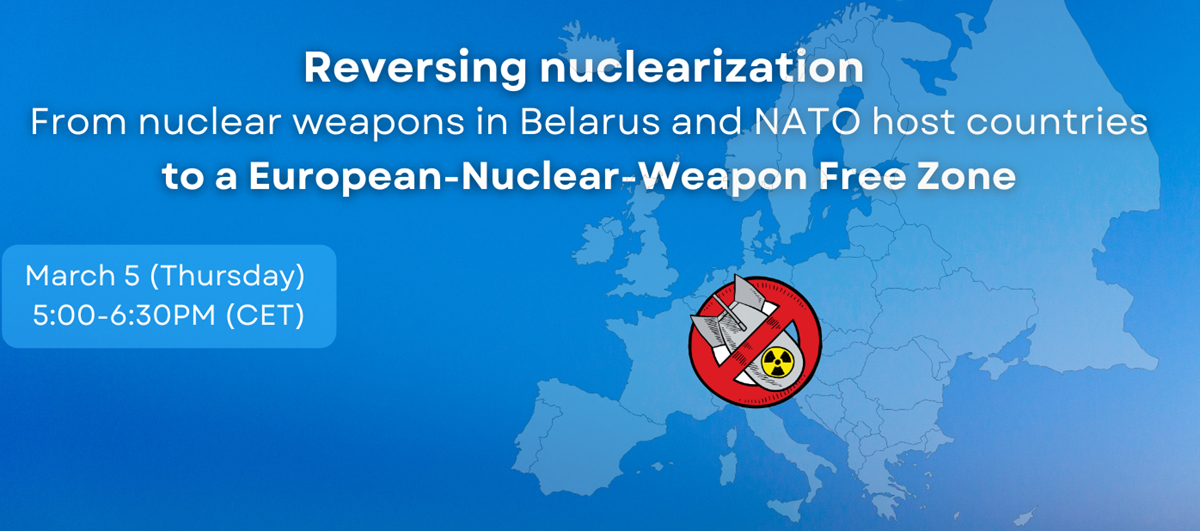
6 March -Online – Reversing nuclearization:
From nuclear weapons in Belarus and NATO host countries to a European-Nuclear-Weapon Free Zone
Mar 6, 2026 03:00 AM in Canberra, Melbourne, Sydney

of the week – Australians for War Powers Reform (AWPR)
To see nuclear-related stories in greater depth and intensity
 Antinuclear
Leave a comment