The sniff of desperation in Jay Weatherill’s latest nuclear manipulations
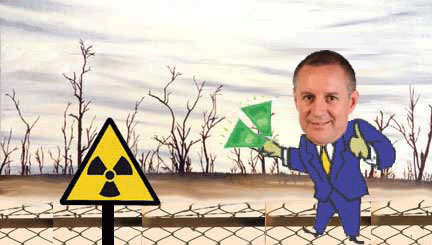
apparatchiks, advisors and academics from both the nuclear industry BHP-Billiton/Santos et al and those in Defence that are pushing for nuclear submarines/capabilities, the Business Council of SA, and in concert with the Murdoch/MSM press, have precision-engineered this campaign to simultaneously blitzkrieg the people of SA with pro-nuke propaganda whilst purposefully obfuscating the SA proposal with that of the Federal government’s search for a dump of our indigenous low-level nuclear waste.
The confusion is of volition and the strategy’s outcome has been immensely effective nationally in not only keeping the topic out of the national spotlight in general but also to make any trickle of dissent that does appear nationally, such as summarised in the slogan “not in our backyard”, appear to be driven by self-interest and, therefore, it’s SA’s problem.
It’s the old divide and conquer with huge resources from both industry and the public purse.
That said, there are fault lines starting to appear in the juggernaut, such as the limited accommodation of the critics in the 2nd Citizens Jury Economic forum, and Weatherill’s failure to attain a mandate motion at least weekend’s ALP State Conference. There will be consternation and increased applied effort from all pro-nuke actors both to guard Weatherill’s back and ramp up inertia through glamorised, potentially high profile events such as the yet-another Nuclear Conference in Adelaide next month.
South Australian Labor comes up with the delaying tactic that Weatherill wanted
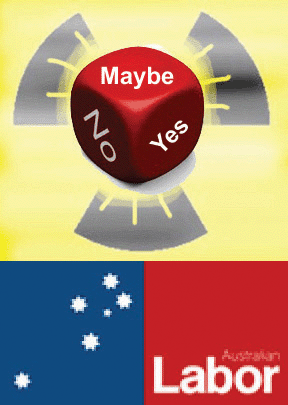 convention has delayed making a decision on the proposal for a nuclear waste dump in the state’s north. South Australian Premier Jay Weatherill has run the gauntlet of anti-nuclear protesters as Labor voted to put the question of establishing a high-level nuclear waste dump to a special party convention.
Mr Weatherill was heckled by several hundred anti-nuclear activists while entering the ALP state conference in Adelaide on Saturday, as they called on him to scrap the dump idea, which goes against current party policy.
Dave Sweeney, from the Australian Conservation Foundation, told the protesters South Australia was so much more than a dumping site.
“This is a bad idea, it’s a thought bubble that should have burst on day one,” Mr Sweeney said.
“We will not be burying waste, we will be burying this idea.”
The convention considered a number of motions related to the dump, including one calling for the government to hold a referendum on the issue.
Others called for the government to delay any decision until after the issue was discussed at the next national ALP conference while the Maritime Union of Australia urged the state government to “cease and desist” with any action to consider a dump of any kind.
However, the party endorsed a motion to have the issue put before a special convention at the conclusion of the community consultation process.
The state government remains committed to making a decision on the dump proposal by the end of the year ….http://www.sbs.com.au/news/article/2016/10/29/special-assembly-weigh-sa-nuclear-dump
Nuclear Power: Game Over — new analysis
Professor Derek Abbott, a physicist and electrical engineer at the University of Adelaide, Australia, shows why the pipe dreams of the pro-nuclear propagandists are precisely that. Using a wealth of empirical data illustrating global trends, he also ably debunks the pro-nuclear arguments. Read the full article, written in accessible, lay language.
http://www.beyondnuclear.org/home/2016/9/28/nuclear-power-game-over-new-analysis.html
The danger of nuclear waste transport, a topic pretty much ignored by the South Australian Nuclear Royal Commission
 Jim Green, Facebook, 31 Oct 16 Numerous train derailments involving nuclear materials transport have been documented (but not in the Royal Commission’s report, of course).
Transport incidents and accidents are routine in countries with significant nuclear industries. For example a UK government database contains information on 1018 events from 1958 to 2011 (an average of 19 incidents each year). There were 187 events during the shipment of spent nuclear fuel flasks from 1958−2004 in the UK (an average of four per year) – 46% involved excess contamination and 24% involved collisions and/or low speed derailments.
Tax-payer funding goes to South Australian nuclear propaganda event Nov 15-16
The Weatherill government continues to break South Australia’s law against tax-payer funding of promotion of nuclear waste importing. Of course, they’ve been doing this for nearly two years now, with close to $10 million on the Nuclear Fuel Chain Royal Commission, the Nuclear Citizens’ Juries and on the blanket of pro nuclear propaganda across the State.
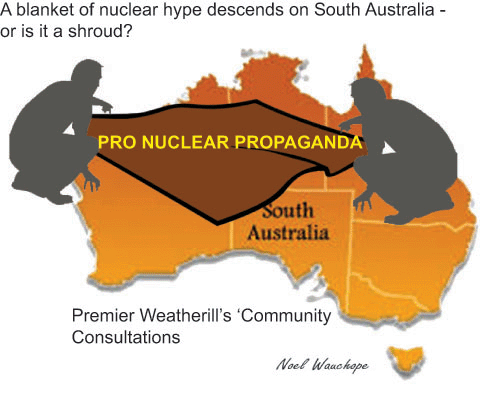
The latest is A new conference called “Australian Nuclear Fuel Cycle ’16 – Managing Radioactive Waste & Spent Nuclear Fuel” , being held in Adelaide on November 15-16 to discuss nuclear waste storage prospects.
Sponsors include the University of South Australia (a public university), ANSTO (a Federal gov’t agency) and UCL (whose Australian campus was publicly supported financially).
Victoria’s Point Lonsdale beach – just one example of rising sea levels
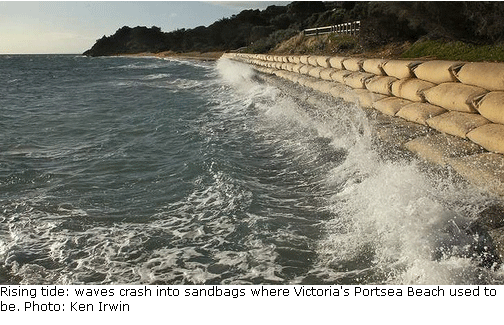 Rising sea levels, stronger waves speeding up Victorian coastal erosion, CSIRO says, ABC News 30 Oct 16 By Joanna Crothers Rising sea levels and more frequent storms are increasing the rate of erosion across Australia’s southern coastline, the CSIRO has said, while locals at one Victorian beach are concerned it is not safe for summer holidaymakers.
Key points:
- CSIRO warns of rising sea levels and a statewide trend of more storms
- Since 2010, Government has spent $450,000 on maintenance at Point Lonsdale
- In the past five years, erosion near Apollo Bay has increased from 8cm to one metre per year
Kathleen McInnes, a CSIRO sea level and coastal extremes expert, said more powerful waves were also contributing to the problem. “Sea levels have risen some 20 centimetres over the past 100 years, and are currently rising at about three millimetres per year,” she said. “There is also evidence that winds in the southern ocean are intensifying and this is driving a positive trend in wave energy reaching our coastline. “So this is creating a double whammy for coastal impacts.”
Individual storms have also become more frequent and intense, meaning beaches do not have as much time to recover after a harsh winter.”They’re driving higher waves which means a higher wave energy [is] reaching the shore,” Ms McInnes said.
Point Lonsdale beach ‘dangerous’, not ready for holidays The beachfront at Point Lonsdale, on the Bellarine Peninsula, has been badly eroded over the past decade and local residents said there was a risk children could slipping and cracking their heads open near the seawall…….http://www.abc.net.au/news/2016-10-30/rising-sea-levels-speeding-up-coastal-erosion-csiro-says/7972924
Leonardo DiCaprio’s Before The Flood debunks climate myths
Debunking climate myths with Leonardo DiCaprio’s Before The Flood http://www.skepticalscience.com/debunking-climate-myths-with-Leonardo-DiCaprio-Before-The-Flood.html 29 October 2016 by John Cook
On Sunday October 30, 9 PM EST, Leonardo DiCaprio’s film Before The Flood will screen free online as well as on National Geographic. The film explores the causes and impacts of climate change, arguing for urgent action and a rapid transition off fossil fuels.
It will be streamed all week on Facebook, Youtube, Hulu, Playstation, and can be viewed on demand on Apple iTunes, Amazon, and GooglePlay. Here’s more details on how to see the film and here’s the trailer: https://www.youtube.com/watch?v=D9xFFyUOpXo
I was invited to contribute to Beforetheflood.com, debunking some of the most common myths about climate change. Here are my pages on Leonardo DiCaprio’s site:
- 97% of climate scientists agree that humans are causing global warming (debunking the myth that “scientists don’t agree”).
- Our planet is warming at a rate of 4 atomic bombs per second (debunking the myth that “we’re in a period of cooling”).
- Climate patterns confirm humans are causing global warming (debunking the myth that “solar flares are to blame”).
- Climate change is having negative impacts on all parts of society (debunking the myth that “climate change is no big deal”).
- We have all the technology we need to solve climate change (debunking the myth that “there’s nothing we can do”)
We also embedded some key Denial101x videos in the debunkings, such as Consensus of Scientists and Daily & Yearly Cycle.
Beforetheflood.com is a rich website definitely worth exploring, with great info such as Brendan DeMelle’s The Climate Denial Industry. I’m looking forward to watching the film on Monday…
Social science can reveal hidden assumptions in nuclear discussions
 by opening up this kind of wider discussion, social science can undertake its trickiest – but arguably most useful – task in any controversy. The stakes in this particular case transcend nuclear debates alone – and raise questions about the overall health of British democracy.
Hinkley C shows the value of social science in the most toxic public debates
 Social science can help explain why people disagree over controversial technologies and – most importantly – surface hidden assumptions, Guardian, Andy Stirling and Phil Johnstone, 24 Oct 16, t’s been another turbulent month in the long-running saga over the Hinkley Point C nuclear power station. Having looked as if she might be contemplating a rethink, Theresa May unveiled an apparently decisive approval just before the Conservative Party conference. But with longstanding issues still unaddressed– and new problems emerging even since the PM’s announcement – the debate over Hinkley is far from over…….
For powerful interests in any setting, social research can also play a useful role in helping to justify, present or implement favoured policies. Here, social science can be part of the closing down of debate – helpfully enabling political attention to move on.
But what if, on deeper reflection, powerfully-backed policies are a bad idea (perhaps as with the Hinkley decision? History is replete with examples – like asbestos, heavy metals, carcinogenic pesticides, chlorine bleaches, toxic solvents and ozone depleting chemicals – where it only emerged in retrospect that the pictures being given of “sound science” or the “evidence base” at the time were unduly shaped by vested interests or constrained imaginations.
It is here that social science can play a further crucial role: helping to open up policy debates where they are being prematurely “locked-in”. Continue reading
Huge contamination of groundwater by USA’s Hanford nuclear wastes
 Groundwater 90 tons of contamination cleaner Tri City Herald BY ANNETTE CARY acary@tricityherald.com. 30 Oct 16 Hanford workers removed more than 90 tons of contaminants from groundwater beneath the nuclear reservation in the fiscal year that just ended, surpassing the amount removed the year before.
“There is an entire groundwater cleanup infrastructure our workers have been fine tuning to make sure we treat and remove the most amount of contamination practical,” said Michael Cline, director of the soil and groundwater division for the Department of Energy at Hanford.
In fiscal 2015 and 2016, a little more than 2.1 billion gallons of contaminated groundwater were pumped out of the ground for treatment at Hanford’s six “pump and treat” facilities.
But more contamination was removed in fiscal 2016 than the previous year, when the Department of Energy gave the total with fiscal 2015 not quite completed as exceeding 75 tons of contaminants removed……..
Extensive data about Hanford’s groundwater contamination and maps are posted at bit.ly/2eLTAR2. http://www.tri-cityherald.com/news/local/hanford/
The danger for Australia as Turnbull wants to change Australia’s environment act
None of these decisions would have been possible without the groups’ standing under Section 487 of the EPBC Act. Removing these provisions undermines the foundational objectives of Australia’s national environmental act at a time when its protective capabilities are needed most.
 Turnbull wants to change Australia’s environment act – here’s what we stand to lose, The Conversation, Director of the Centre for Energy and Natural Resources Law, Deakin Law School, Deakin University October 31, 2016 Prime Minister Malcolm Turnbull is seeking changes to Australia’s national environment act to stop conservation groups from challenging ministerial decisions on major resource developments and other matters of environmental importance.
Turnbull is reviving a bid made by former Prime Minister Tony Abbott to abolish Section 487 of the Environment Protection and Biodiversity Conservation Act (EPBC Act) – a bid rejected in the Senate in 2015. If it goes ahead, the change will significantly diminish the functionality of the act.
The EPBC Act, introduced by the Howard government in 1999, has an established record of success. Judicial oversight of ministerial discretion, enabled by expanded standing under Section 487, has been crucial to its success.
Section 487 allows individuals and groups to challenge ministerial decisions on resources, developments and other issues under the EPBC Act. An organisation can establish standing by showing they have engaged in activities for the “protection or conservation of, or research into, the environment” within the previous two years. They must also show that their purpose is environmental protection.
Repealing this provision would remove the standing of these groups to seek judicial review of decisions. Standing would then revert to the common law position. That means parties would need to prove they are a “person aggrieved” by showing that their interests have been impacted directly.
Many environmental groups will be unable to satisfy the common law test, leaving a very small group of people with the right to request judicial review – essentially, the right to check that federal ministerial power under the EPBC Act has been exercised properly.
This is likely to have a devastating impact on fragile ecological systems and biodiversity conservation strategies.
This is particularly concerning given the dramatic changes affecting the environment from the expansion of onshore resource development and the acceleration of climate change.
Why do we have the EPBC Act?
The hypocrisy of attack on ‘foreign-funded’ environment groups
Why only “environment groups”? Why not take a look at the tax-deductible recipient status of all charities, such as the Institute of Public Affairs?
The IPA is using its tax-deductibility status to raise cash for a third edition of its climate science denial book Climate Change: The Facts, with contributions from US-based and UK-based contrarian scientists, alongside the likes of Clive James and Bjørn Lomborg.
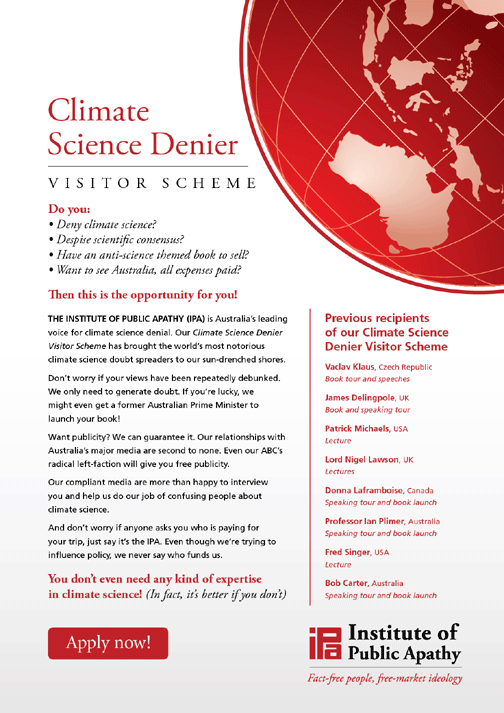
Why the attack on ‘foreign-funded’ environment groups stinks of hypocrisy, Guardian, 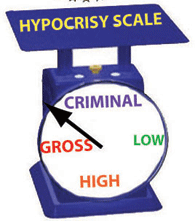 Graham Readfearn, 30 Oct 16 Supporters of coal projects want transparency and proper use of charity status – but only when they support their arguments You might have noticed that all of a sudden, Australians are supposed to be appalled by foreign interests getting in the way of us digging up as much coal as we want, thanks very much.
Last weekend the Australian newspaper started running stories based on a “revelation” from the inbox of John Podesta, the chairman of Democratic nominee for president Hillary Clinton’s election campaign.
One email forwarded to Podesta showed the philanthropic group the Sandler Foundation, based in San Francisco, was a funder of Australian group the Sunrise Project. The emails were published by WikiLeaks.
Sunrise, run by the former Greenpeace campaigner John Hepburn, has been involved in supporting some of the court cases brought against proposed coal projects – chiefly, the massive Adani coalmine in Queensland.
According to an editorial in the Australian, “thinking Australians” should be “appalled” by this news.
On the back of these stories, there have been shouts for more transparency, while Turnbull government ministers have used the coverage as a pivot to call for environment groups to be stripped of their charitable status. The climate change impacts of burning coal, meanwhile, have been summarily discounted or ignored.
So let us count the ways that Australians should not be “appalled” and, on the way, examine some of the bald hypocrisy that has been on display this week. Continue reading
China’s uncertain nuclear future, as power plant projects slow down


The challenge for the Chinese nuclear industry is to do what no other nuclear industry worldwide has been able to do; to bring the cost of nuclear generation down to levels at which it can compete with other forms of generation, particularly renewables.
If it is unable to do this, China cannot afford to carry on ordering nuclear plants and nuclear will retain a small proportion of the electricity mix. This leaves China’s nuclear export drive in a precarious position. If it is unable to do this, China cannot afford to carry on ordering nuclear plants.
China has had little export success so far
China’s Nuclear Power Plans Melting Down http://thediplomat.com/2016/10/chinas-nuclear-power-plans-melting-down/ China may scale down plans for nuclear power because of slowing demand for electricity and construction setbacks. By Steve Thomas October 29, 2016 For China’s nuclear industry, 2016 has been a frustrating year. So far, construction has started on only one new plant, and its target of bringing 58 gigawatts of nuclear capacity in service by 2020 seems impossible to meet.
Western Australia missing its opportunity to become a renewable energy superpower
WA must embrace dawn of renewable energy era or risk being left behind https://www.theguardian.com/sustainable-business/2016/oct/27/wa-must-embrace-dawn-of-renewable-energy-era-or-risk-being-left-behind Michael Lord
Western Australia could become a renewable energy superpower – if the government halts LNG expansion plans and creates an innovation fund
Last year the world’s governments finally got their act together on climate change, agreeing to limit global warming to well under two degrees. To meet this commitment, we need a rapid global transition to net zero greenhouse gas emissions. The fossil fuel age is over.
The new era, powered by renewable energy, will be swept in on a massive wave of investment. According to Beyond Zero Emissions’ report, Renewable Energy Superpower, the world will invest $US28tn in renewable energy and energy efficiency in the next 20 years.
But Western Australia risks being left behind. Here investors have poured more than $100bn into liquefied natural gas (LNG) over the past decade yet the state has little to show for it. Another $60bn is slated for LNG development, but with current low gas prices, the sense of that investment is questionable. Energy consumers fork out for coal-fired power that goes unused and endure endless debate about grid privatisation. Meanwhile Western Australia’s electricity-related emissions are rising, just as almost all other states are managing to reduce them.
The irony is that Western Australia should welcome the dawn of the renewable energy era. The state’s enormous resources of sunshine, wind and wave mean it could become a renewable energy superpower of the future. Our report shows how Australia’s world-beating renewable energy resources represent a huge economic opportunity. Incredibly the report shows that in Western Australia alone, there is enough wind and solar, available at competitive prices, to provide almost 9% of the world’s energy every year. In other words Western Australia has more renewable energy than fossil energy. Continue reading
British tax-payers will cop the costs of Hinkley nuclear accidents and nuclear waste storage
The UK government accepts that, in setting a cap, the residual risk, of the very worst-case scenarios where actual cost might exceed the cap, is being borne by the government.”
Separate documents confirm that the cap also applies should the cost of decommissioning the reactor at the end of its life balloon.
 Secret government papers show taxpayers will pick up costs of Hinkley nuclear waste storage https://www.theguardian.com/uk-news/2016/oct/30/hinkley-point-nuclear-waste-storage-costs Documents show steps Whitehall took to reassure French energy firm EDF and Chinese investors, Guardian, Jamie Doward, 30 Oct 16, Taxpayers will pick up the bill should the cost of storing radioactive waste produced by Britain’s newest nuclear power station soar, according to confidential documents which the government has battled to keep secret for more than a year.
The papers confirm the steps the government took to reassure French energy firm EDF and Chinese investors behind the £24bn Hinkley Point C plant that the amount they would have to pay for the storage would be capped.
The Department for Business, Energy & Industrial Strategy – in its previous incarnation as the Department for Energy and Climate Change – resisted repeated requests under the Freedom of Information Act for the release of the documents which were submitted to the European commission.
“The government has attempted to keep the costs to the taxpayer of Hinkley under wraps from the start,” said Dr Doug Parr, Greenpeace chief scientist. “It’s hardly surprising as it doesn’t look good for the government’s claim that they are trying to keep costs down for hardworking families.”
But, earlier this month, on the very last day before government officials had to submit their defence against an appeal for disclosure of the information, the department released a “Nuclear Waste Transfer Pricing Methodology Notification Paper”. Marked “commercial in confidence”, it states that “unlimited exposure to risks relating to the costs of disposing of their waste in a GDF [geological disposal facility], could not be accepted by the operator as they would prevent the operator from securing the finance necessary to undertake the project”. Continue reading
Wind energy a winner for communities
With wind, communities can win http://www.examiner.com.au/story/4258396/more-people-realising-that-with-wind-we-can-all-win/?cs=97 30 Oct 2016 You’ve probably come across the term NIMBY – the people who say “not in my backyard” when it comes to certain types of development in their neighbourhood.
But what about the YIMBYs? The people who are saying: “Yes please, put a wind turbine in my backyard”?!
I have met people who trim their hedges to see wind turbines spin around, and nanas who sew turbines into quilts. Communities across Australia are full of YIMBYs.
Wind turbines are powerful symbols of opportunity. The opportunity of new income for a struggling regional area. The opportunity of clean, renewable energy. The opportunity of an ethical, local investment. The opportunity to act on climate change.
Community-owned wind energy projects enable everyday Australians to co-own and directly benefit from wind developments.
In Denmark, Western Australia 116 people – most of whom are locals – built and now run two 800kW turbines. Last year, they received a 9 per cent dividend on their investment, on top of the satisfaction of knowing they supply their town with clean electricity that helps to secure its energy supply. The wind farm pumped $20,000 into local projects, too, ensuring the profits stay in and benefit the community.
Wind farms mean different things to different people like: “a symbol of what our community can achieve together”; “a great investment!”; “much-needed source of grants”; and even: “I use them to check the wind conditions before I head out for a surf”.
Research has shown that people embrace living near wind turbines when they have an opportunity to be genuinely involved in its design, the decision-making process and if they benefit. What other power source can do all of this? YIMBY, please!
Jarra Hicks is co-director of the Community Power Agency and her PhD is on the impacts community-owned clean energy projects have on regional Australia.
1 This month
Chernobyl: The Lost Tapes – A good documentary on Chernobyl on SBS available On Demand for the next 3 weeks– https://www.sbs.com.au/ondemand/tv-program/chernobyl-the-lost-tapes/2352741955560
15 April – Zoom –Nuclear Power is Not the Solution
Apr 15, 2026 01:00 AM in Canberra, Melbourne, Sydney

Join the International Physicians for the Prevention of Nuclear War (IPPNW) on Tuesday, April 14th for a timely webinar exploring the risks associated with nuclear power and challenging the myth that it offers a simple, safe, carbon-free solution to the climate crisis

21 April Webinar: No Nuclear Weapons in Australia
Start: 2026-04-21 18:00:00 UTC Canberra, Melbourne, Sydney (GMT+10:00)
End: 2026-04-21 19:30:00 UTC Canberra, Melbourne, Sydney (GMT+10:00)
Event Type: Virtual
A virtual link will be communicated before the event.
Host Contact Info: australia@icanw.org

of the week – Australians for War Powers Reform (AWPR)
To see nuclear-related stories in greater depth and intensity
 Antinuclear