Australia on the wrong side of nuclear disarmament history
 As the world pushes for a ban on nuclear weapons, Australia votes to stay on the wrong side of history, The Conversation, Associate Professor, International Education and Learning Unit, Nossal Institute for Global Health, School of Population and Global Health, University of Melbourne November 16, 2016 “………Australia’s role in fighting a nuclear weapon ban
In voting “no”, Australia stuck out like a sore thumb among Asia-Pacific nations in at October’s UN committee meeting. All of the Association of Southeast Asian Nations (ASEAN) members – including Indonesia, Malaysia, Singapore and Thailand – as well as New Zealand and ten out of 12 Pacific island countries voted yes.
Australia is signatory to all the key international treaties banning or controlling weapons. On some, like the Chemical Weapons Convention, Australia was a leader. Australia’s active opposition and efforts to undermine moves towards a treaty banning nuclear weapons stand in stark contrast.
Australia’s stated arguments for opposing a ban treaty have varied, including that there are no “shortcuts” to disarmament; that only measures with the support of the nuclear-armed states are worthwhile; that a ban would damage the nuclear non-proliferation treaty, causing instability and deepening divisions between states with and without nuclear weapons; that it wouldn’t address North Korea’s threatening behaviour; and that it does not take account of today’s security challenges.
Perhaps the most extraordinary justification of Australia’s position came from Department of Foreign Affairs and Trade’s first assistant secretary, Richard Sadleir, who said at a Senate estimates hearing on October 20, 2016:
it is not an auspicious time to be pushing for a treaty of this sort. Indeed, in order to be able to effectively carry forward disarmament, you need to have a world in which there is not a threat of nuclear weapons and people feel safe and secure.
Can anyone seriously imagine Australian officials arguing that we need to keep stockpiles of sarin nerve gas, plague bacteria, smallpox virus, or botulism toxin for deterrence, just in case, because we live in an uncertain world?
Yet that is what Australia continues to argue about nuclear weapons. Sadleir is saying that disarmament is only possible after it has happened, when we live in an impossibly perfect world. It’s a nonsensical argument that puts off nuclear disarmament indefinitely.
As revealed in Department of Foreign Affairs and Trade internal documents, released through a Freedom of Information request, the real reason that Australia opposes a ban treaty is that it would jeopardise our reliance on US nuclear weapons.
How Australia can help with disarmament
It’s 71 years since the Hiroshima bombing, and 46 years since the nuclear non-proliferation treaty came into force, committing all governments to bring about nuclear disarmament. But that treaty is too weak: no disarmament negotiations are underway or planned.
Instead, every nuclear armed state is investing massively in keeping and modernising their nuclear arsenals for the indefinite future. The US alone has said it plans to spend about US$348 billion over the next decade on its nuclear arsenal.
Nations like Australia cannot eliminate weapons they don’t own. But they can prohibit them, by international treaty and in domestic law. And they can push other nations to do more to reduce threats to humanity – just as Australia has done with every other weapon of mass destruction.
An overwhelming majority of Australians have said in the past that they support a treaty banning nuclear weapons: 84% according to a 2014 Nielsen poll commissioned by the International Campaign to Abolish Nuclear Weapons, with only 3% opposed.
This is an issue that should be above party politics. In 2015, the Labor Party adopted a new national policy platform committing to support the negotiation of a global treaty banning nuclear weapons. At a public meeting in Perth last month, Bill Shorten said that a Labor government would support the UN resolution for a ban treaty.
In October 2016, our government let us down by voting to be counted on the wrong side of history. Thankfully, we can still expect to see the United Nations ratify the move towards a new treaty banning nuclear weapons in December, with negotiations set to begin in March 2017 in New York. It’s still not too late for Australia to change its vote, and participate constructively in the negotiations next year. https://theconversation.com/as-the-world-pushes-for-a-ban-on-nuclear-weapons-australia-votes-to-stay-on-the-wrong-side-of-history-68337
South Australian Premier Weatherill – apolitical martyr for the nuclear lobby
 Stubborn Weatherill risks fallout from nuclear referendum, Crikey, 15 Nov 16
Significant opposition from all sides hasn’t been enough to deter the Premier, write InDaily journalists Tom Richardson and Bension Siebert. South Australian Premier Jay Weatherill has dramatically stared down his cabinet waverers and laid down the gauntlet to the Liberal opposition, vowing to continue down the nuclear path — with the question to be determined by a referendum……..
“I believe continued public debate about SA’s role in the nuclear fuel cycle is important and ultimately it is a matter that the people should decide, not political parties,” Weatherill said…….
The move effectively returns serve to Marshall, whose Liberals expected Labor to be backed into a corner by the public reaction to the divisive waste dump proposal.
However, it also means Weatherill will now become a key advocate, having resisted the overwhelming pressure to remove the issue from the political agenda altogether.
Crucially, Weatherill said local indigenous groups would be given a “right of veto” over any proposed dump “if a proposed facility would impact upon their lands” — a key factor in the citizens’ jury’s rejection……
The Premier said he had “reached out to the Liberal Party” to re-establish a bipartisan approach, saying: “There’s no point in promoting a referendum that has no chance of success.”
[Citizens’ jury decision spells nuclear disaster for Weatherill]
However, Marshall poured cold water over the prospect at a late afternoon media conference, saying: “Jay Weatherill is a desperate man trying to cling to some tiny shred of an economic framework.”
“Jay Weatherill’s entire leadership is on its last legs … I think we’re seeing the last weeks, the last months of [his premiership],” Marshall said.
“The people of SA don’t want this project, the Liberal party room in SA is against this.” Marshall emphasised that despite his unilateral move last week to “dump the dump”, the position was “passed without dissent” at yesterday’s party room meeting.
“The Liberal Party is 100% behind me,” he said.
“We do not support a referendum … if Jay Weatherill is so wedded to this, he can take it to the next election.”
The referendum proposal will need crossbench, if not opposition, support to pass Parliament, but Weatherill has indicated it can only proceed as a jointly sponsored proposal — a move that will now ramp up the political brinkmanship ahead of the state election in March 2018.
The Premier’s gambit will be met with incredulity from conservation campaigners who had all but declared the dump a dead issue.
“Most of state Parliament have said ‘no’, the Citizens’ Jury have said ‘no’, economists have said ‘no’, ordinary South Australians have said ‘no’, and most importantly, traditional owners have very clearly said ‘no’,” Conservation SA chief Craig Wilkins said today.
“There is clearly no support or consent for this investigation to continue.”
Greens MLC Mark Parnell said the “remarkable announcement … defies belief and shows a government completely out of touch with the public”.
“What the experience of the last few months shows is that if you give citizens more facts and allow them access to all sides of the debate — they vote no … that’s what the citizens’ jury delivered,” he said.
“With almost every other political party in state parliament declaring they are opposed to a nuclear waste dump, it is hard to see how the necessary legislation for a referendum would get through both houses of Parliament … a statewide referendum would be throwing good money after bad.
“The government has already wasted more than $10 million on this project and a referendum would cost tens of millions more … if the Premier wants this to be an issue for all South Australians, then he should go to the March 2018 state election with a nuclear waste dump as part of Labor’s platform — that would test public opinion.” https://www.crikey.com.au/2016/11/15/weatherill-referendum-on-sa-nuclear-dump/
Donald Trump’s Temper a dangerous consideration -risk of nuclear war
 Nuclear War with Russia Possible Scenario with Donald Trump’s Temper [RUMOR] http://www.citizenoracle.com/2016/11/14/nuclear-war-russia-possible-scenario-donald-trumps-temper-rumor/ By November 14, 2016 The possibility of a nuclear war with Russia could start anytime soon if the newly-elected U.S. President, Donald Trump, will not keep his cool. It was also said that Trump must avoid letting his short temper make its way into global affairs. Because of this news, some people feared that the U.S. may face a nuclear war with Russia, something that might cause “global destruction.”
President Barack Obama repeatedly stated he would not trust Donald Trump with the nuclear launch codes of the nuclear missiles, given Trump’s temperament. He added that emotions could cloud Trump’s judgment when making decisions that would annihilate millions of lives. The worse-case scenario would be the relationships turning more confrontational; Moscow might misread a situation over Trump’s administration.
Moreover, one of the shortcomings of President Obama’s administration is managing its relationship with Russia resulting to several war threats and misunderstandings in the past years. President-elect Donald Trump’s biggest test will be forming a good relationship with the Russian President, Vladimir Putin, in order to deal with the threat of nuclear war with Russia.
Indeed, the United States of America has not declared war since 1942. Apparently, China or North Korea could hit the United States with nuclear weapons, but the nuclear conflict with Russia is the greatest danger to the U.S., given the current nuclear strategies of the country.
The question of war and peace has been one of the major issues on the news and social media ever since Donald Trump was elected as the next President of the United States. The U.S. president’s power to execute war is quite extensive. Most importantly, he can take military actions without specific authorization from the Congress. Whether people like it or not, President Donald Trump will have a large say over the question of peace or a nuclear war with Russia.
India’s People’s Movement Against Nuclear Energy (PMANE) urges young people to oppose nuclear power
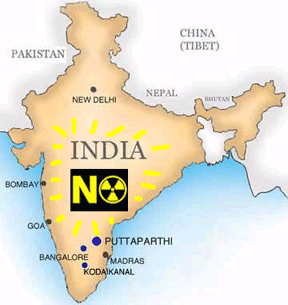 Signature campaign against nuclear energy http://www.thehindu.com/todays-paper/tp-national/tp-tamilnadu/signature-campaign-against-nuclear-energy/article9342726.ece C. JAISANKAR The People’s Movement Against Nuclear Energy (PMANE) on Sunday called upon the youngsters to speak up against nuclear energy.
Speaking at an awareness programme after launching the signature campaign against nuclear energy here, Suba. Udayakumar, PMANE coordinator, said that several countries including the United States, France and Japan had given up the policy of installing new nuclear plants several years ago following Chernobyl and Fukushima nuclear disasters.
They had realised the dangers of nuclear plants to humans and environment.
However, the Central government was continuing to promote nuclear energy. It has planned to set up more nuclear plants at Kudankulam without addressing the apprehensions of people. It showed that the government was not bothered to listen to the genuine grievances of people, he said.
Sundarrajan, coordinator, Poovulagin Nanbargal, said that the government had not come out with a proper plan to dispose the waste being generated from nuclear plants. It was high time to create awareness among the people on the ill effects of nuclear plants. The people, particularly youngsters, should come forward to join the movement against nuclear energy, he added.
South Aust Premier Weatherill wants a nuclear referendum – but no-one else does
 Karina Lester from the No Dump Alliance said Aboriginal people simply did not support the proposal and it was time the Premier stopped wasting time and money on an idea that most people were opposed to.
“I will certainly stand my ground and really say to our Premier that you are not listening to what Aboriginal people are saying and you need to be aware of this,” she said.
“Why continue to pursue this crazy idea?”.
SA nuclear referendum won’t happen before 2018 election, Premier Jay Weatherill says 891 ABC Adelaide , 15 Nov 16
Premier Jay Weatherill yesterday announced he wanted a referendum, with bipartisan support, held on the issue.
Last week Opposition Leader Steven Marshall said the Liberal Party would not support a waste facility, and earlier this month a citizen’s jury voted against the state pursuing a future in nuclear waste storage.
Its report outlined concerns with economics, along with issues of trust, safety and a lack of consent, particularly from Aboriginal elders.
Mr Weatherill said a referendum would give people a final say, which could be trusted.
Democracy is messy, especially when you take the time and effort to ask ordinary everyday citizens to get involved in these big decisions,” he said.
“I think what most people do want is greater say over the decisions that affect their lives and that’s what we’re trying to do, but we’ve never said that we’re abdicating our responsibility for making decisions.”
But Mr Weatherill told 891 ABC Adelaide a referendum would not be called before the next election.
“Obviously you wouldn’t promote a referendum unless you believed it had some prospects of success so as things presently stand you would not be presenting a referendum anytime soon,” Mr Weatherill said.
“Well, not in the life of this Parliament.”
Mr Weatherill has also pledged that if the referendum goes ahead and is successful, Aboriginal communities will have the right to veto the selected site. Continue reading
1 This month

of the week – Australians for War Powers Reform (AWPR)
To see nuclear-related stories in greater depth and intensity
 Antinuclear