Giant steel-covered tomb finally sealed off over Chernobyl’s nuclear wreck
Chernobyl reactor entombed in giant steel shield 30 years after worst nuclear disaster in history [Excellent photos] Mirror, 1 Dec 16 Thirty years after an explosion ripped apart the Chernobyl power plant and spewed radioactive dust across Europe, the devastated reactor number four has finally been sealed off. Built with bolts from Wrexham and overseen by a man from Bury, this gigantic steel shield encases the reactor responsible for the worst nuclear disaster in history.
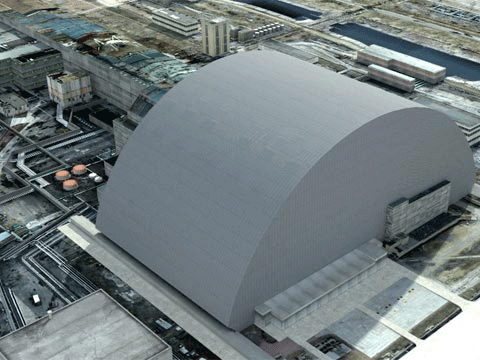
Thirty years after an explosion ripped apart the Chernobyl power plant and spewed radioactive dust across Europe, the devastated reactor number four has finally been sealed off. Six years in the making, the 108-metre-high arch is the largest moveable land structure ever built. Its completion brings an end to a nightmare that has scarred two generations.
At a ceremony inside the radiation exclusion zone in Ukraine, British engineer David Driscoll, 66, told of his vital role as health and safety manager overseeing one of the most daunting construction projects ever undertaken….
The shimmering steel structure looms large over the frozen wasteland rendered uninhabitable by the catastrophe on 26 April, 1986.
More than 200,000 people were evacuated from their homes in the weeks afterwards as the then Soviet Union government slowly reacted to the poisoned legacy of the leak.
Deserted houses by the roadside in the exclusion zone have been slowly devoured by the forest.
In Pripyat, the Soviet city next to Chernobyl, the shells of deserted apartment blocks serve as a permanent reminder of the scale of the catastrophe.
At the top of one tower block is a faded Communist hammer and sickle………
Waterproof and temperature-controlled, the structure is fitted with an overhead crane to allow for the future dismantling of the previous, crumbling Soviet-era shelter and the remains of reactor four.
Igor Gramotkin, director-general of the Chernobyl Nuclear Power Plant, said: “We were not building this arch for ourselves.
“We were building it for our children, our grandchildren and our great-grandchildren.
“This is our contribution to the future, in line with our responsibility for those who will come after us.”
Ostap Semerak, Ukraine’s Minister of Ecology and Natural Resources, said of the completion of the project: “The sliding of the arch over reactor four at the Chernobyl Nuclear Power Plant is the beginning of the end of a 30-year long fight with the consequences of the 1986 accident.” http://www.mirror.co.uk/news/world-news/chernobyl-reactor-entombed-giant-steel-9360959
Ireland could be bankrupted by a nuclear incident off the coast
 Nuclear incident off our coast has potential to bankrupt Ireland, Irish Times, 2 Dec 16 Expert model shows best-case consequence of minor episode implies €4bn cost to State Dick Ahlstrom
French nuclear companies EDF and AREVA in a deepening safety and cost mess
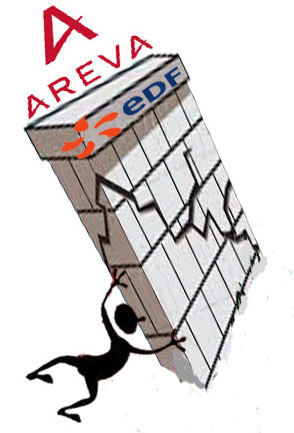 France’s nuclear-energy champion is in turmoil http://www.economist.com/news/business/21711087-electricit-de-france-has-had-shut-down-18-its-58-nuclear-reactors-frances-nuclear-energy Electricité de France has had to shut down 18 of its 58 nuclear reactors THESE are difficult times for Electricité de France (EDF), the country’s quasi-monopolistic electricity provider, serving 88% of homes. Outages at no fewer than 18 of the 58 EDF-owned nuclear reactors that provide three-quarters of France’s electricity have meant a slump in production: the company says annual nuclear output could fall to 378 terawatt hours (TWH), from 417 TWH last year. Eight reactors are currently lying idle and several may not restart for weeks or months. Power stations are burning coal at a rate not seen since the 1980s. As electricity imports and prices soar, officials are having to deny that a cold snap could bring blackouts.
The cause of the crisis—possibly faulty reactor parts throughout EDF’s fleet—suggests it may not be easily contained. France’s nuclear regulator, the Autorité de Sûreté Nucléaire (ASN), this summer ordered urgent tests of reactor parts, mostly bases of cylindrical steam generators. Inspectors are worried about high carbon levels found in steel forged by Creusot Forge, which is owned by Areva, another French firm, and by Japan Casting & Forging Corporation, a Japanese supplier. In some pieces carbon deposits are over 50% above permitted levels, risking fracture in case of a sudden change in the temperature of the steel.
Need to examine Australia’s electricity system – Victorian network fault
 Vic network fault causes outages in South Australia, conservatives blame renewables, REneweconomy By Giles Parkinson on 1 December 2016 A major fault on the Victorian transmission network overnight caused power outages in South Australia for up to an hour, and forced the Portland smelter in Victoria to also go offline.
The Australian Energy Market Operator (AEMO) said that at 01:33 AEDT on December 1, the South Australian power system separated from Victoria, due to an unknown issue on the Victorian transmission network
“The root cause still under investigation,” AEMO said, but added “it is important to note that this event was not related to the Black System event in South Australia on September 28.”
It is believed that the fault lay in an Ausnet feeder line to the Heywood Interconnector in Western Victoria, when a transmission line conductor “hit the ground.”…….
questions have been raised about the decisions by the market operator, which chose to take no preventative measures, and for many underlined the fragility of a centralised grid, and the risks of storms, bushfires and other outages on an elongated network.
It has led to calls for a think about the design of electricity markets, and a push to localised grid and local renewable generation. AGL CEO Andrew Vesey, and many others, said the best security could be offered by more localised generation, and that meant renewable energy, and more storage. http://reneweconomy.com.au/vic-network-fault-causes-outages-in-south-australia-conservatives-blame-renewables-84808/
Smart planning now will enable reliable renewable electricity
Reliable renewable electricity is possible if we make smart decisions now, The Conversation, December 1, 2016 The Australian government is reviewing our electricity market to make sure it can provide secure and reliable power in a rapidly changing world. Faced with the rise of renewable energy and limits on carbon pollution, The Conversation has asked experts what kind of future awaits the grid…….
Findings from research overseas and in Australia show people are more likely to die during power outages. This is because of the increased risk of accidents, extreme cold or heat, food poisoning and communications breakdowns that can delay emergency responders.
So whatever our electricity grid looks like in the future, it will need to be reliable………
The cost of reliability
Our recent research took a highly conservative approach to testing the cost question.
We assumed that there would be no future improvements in technology from what is currently viable and no future decrease in electricity demand. We also used renewable resource supply (sunshine and wind) from 2010 because this was one of the most challenging years for renewables.
Our findings indeed showed that strategies to manage the variability of renewable resources were effective in a 100% renewable energy mix of rooftop solar, wind, large-scale solar, hydro and biofuels.
In one scenario, for instance, current demand could be matched with supply at a cost of producing electricity around 20c per kilowatt hour (the current levelised cost of coal-fired electricity is 7.8-9.1c per kWh), with overall installed capacity of 162 gigawatts (2.5 to 3 times what is installed today), relatively low transmission losses and with less than 20% wasted electricity.
The interconnected eastern Australian transmission grid would need to be 2.5 times the current size, and would need to be linked to the grids in Western Australia and the Northern Territory.
Recent developments look positive for renewables
But recent developments mean that the costs and constraints for reliable renewable energy are not likely to be as conservative as our scenario.
Battery storage has benefited from rapid improvements in technology even in the short period since our research in 2015. Significant battery storage could even mean a restructuring of our largely centralised (big power stations) network to a more decentralised one that includes rooftop solar panels and battery storage.
Decentralisation of power generation opens up the possibility of using waste heat from power generation in buildings to reduce power demand (such as tri-generation).
Our research also indicates that investing in more dispatchable technologies can reduce wasted energy, the cost of energy, the grid expansion required, and overall generation capacity.
With the price of renewables decreasing, the transition to renewables may have benefits for power producers and power consumers.
Future constraints and opportunities for renewable energy are uncertain, but we can’t wait for perfect certainty before we plan and act. In Australia we have some of the world’s leading experts in the field with a range of sophisticated modelling capabilities at hand. These assets could be the foundation of collaboration with policymakers to transition to reliable renewable energy. https://theconversation.com/reliable-renewable-electricity-is-possible-if-we-make-smart-decisions-now-68585

Initiative to cope with climate refugees – Platform on Disaster Displacement.
How do we deal with the prospect of increased climate migration? The Conversation, December 1, 2016 On average, one person is displaced each second by a disaster-related hazard. In global terms, that’s about 26 million people a year.
Most move within their own countries, but some are forced across international borders. As climate change continues, more frequent and extreme weather events are expected to put more people in harm’s way.
In the Pacific region alone, this year’s Cyclone Winston was the strongest ever to hit Fiji, destroying whole villages. Last year, Cyclone Pamdisplaced thousands of people in Vanuatu and Tuvalu – more than 70% of Vanuatu’s population were left seeking shelter in the storm’s immediate aftermath.
However, future human catastrophes are not inevitable. The action – or inaction – of governments today will determine whether we see even greater suffering, or whether people movements can be effectively managed.
Human impact
International law does not generally regard people displaced by disasters as refugees, and national responses are ad hoc and unpredictable, resulting in protection gaps.
However, on July 1, a landmark new intergovernmental initiative kicked off: the Platform on Disaster Displacement. Led by the governments of Germany and Bangladesh, and with Australia as a founding member, it addresses how to protect and help people displaced by the impacts of disasters and climate change, one of the biggest humanitarian challenges of the 21st century.
The Platform does not merely envisage responses after disasters strike, but also policy options that governments can implement now to prevent future displacements………
Governments also need to develop more predictable humanitarian and temporary stay arrangements to assist those displaced across a border after a disaster. They also need to ensure that those displaced internally have their needs addressed and rights respected.
Facilitating migration away from at-risk areas can open up opportunities for new livelihoods, skills, knowledge and remittances, at the same time as relieving demographic and resource pressures.
Planned response
Indeed, in this context, the Australian government has acknowledged that the promotion of safe and well-managed migration schemes is a key part of building resilience.
The Kiribati–Australia Nursing Initiative is a good example. Kiribati is a Pacific Island nation that is very vulnerable to the impacts of climate change, and which lacks extensive educational and employment opportunities.
The Initiative enabled around 90 young people from Kiribati to train in Australia as nurses, providing them with an opportunity to secure a job in the healthcare sector either in Australia, overseas or back home.
On a larger scale, planned relocations can also help people to move out of harm’s way before disaster strikes, or to relocate to safer locations in the aftermath of a disaster if it’s not safe for them to go home. This requires careful consultation with those affected, ensuring that their rights and interests are safeguarded.
The Platform on Disaster Displacement will implement the Nansen Initiative’s Protection Agenda by building strong partnerships between policymakers, practitioners and experts……… https://theconversation.com/how-do-we-deal-with-the-prospect-of-increased-climate-migration-69614
Biggest-Ever Coral Die-Off Reported on Australia’s Great Barrier Reef #auspol

Warm seas have “essentially cooked” hundreds of kilometers of the landmark, a surveyor says.
By Tom Westbrook
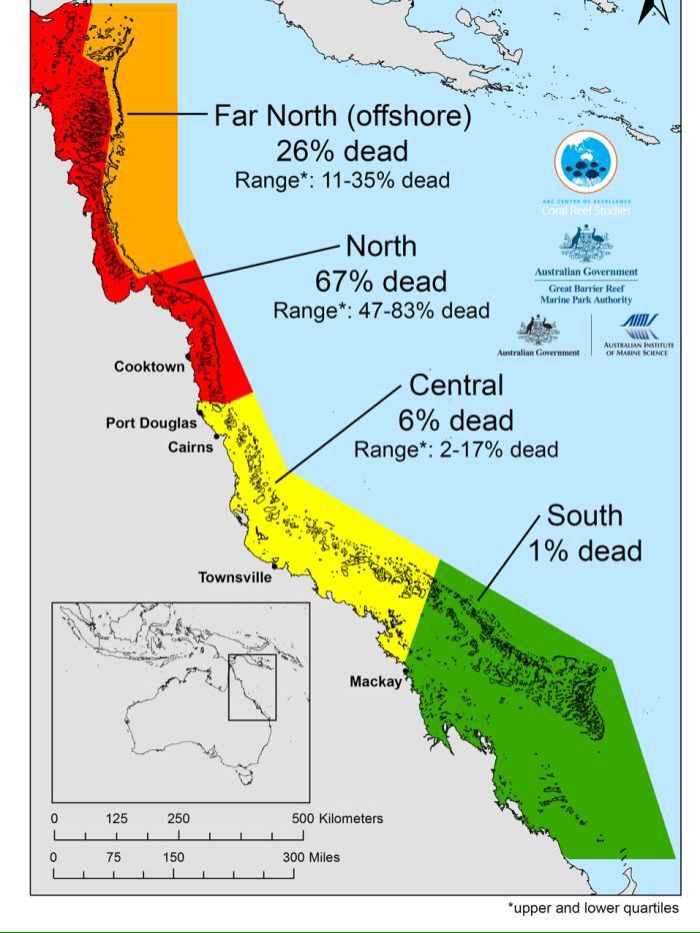
Warm seas around Australia’s Great Barrier Reef have killed two-thirds of a 700-km (435 miles) stretch of coral in the past nine months, the worst die-off ever recorded on the World Heritage site, scientists who surveyed the reef said on Tuesday.
Their finding of the die-off in the reef’s north is a major blow for tourism at reef which, according to a 2013 Deloitte Access Economics report, attracts about A$5.2 billion ($3.9 billion) in spending each year.
“The coral is essentially cooked,” professor Andrew Baird, a researcher at James Cook University who was part of the reef surveys, told Reuters by telephone from Townsville in Australia’s tropical north.
He said the die-off was “almost certainly” the largest ever recorded anywhere because of the size of the Barrier Reef, which at 348,000 sq km…
View original post 263 more words
1 This month
15 April – Zoom –Nuclear Power is Not the Solution
Apr 15, 2026 01:00 AM in Canberra, Melbourne, Sydney

Join the International Physicians for the Prevention of Nuclear War (IPPNW) on Tuesday, April 14th for a timely webinar exploring the risks associated with nuclear power and challenging the myth that it offers a simple, safe, carbon-free solution to the climate crisis

of the week – Australians for War Powers Reform (AWPR)
To see nuclear-related stories in greater depth and intensity
 Antinuclear