 14 Dec 16 The Conservation Council of Western Australia appealed to the Minister for Environmnent against the EPA’s approval of Cameco’s planned Yeelirrie uranium project.
The Appeals Convenor and the Minister for Environment have released the findings of the Appeals process. The Minister will continue to deliberate and make a decision soon. He has been clear to say that the EPA report will be considered along with economic considerations.
There is still every chance the Minister will approve the mine – but at this stage he has rejected Cameco’s appeal in regards to subterranean fauna:
In relation to subterranean fauna, the EPA’s report concluded that there remained too great a chance of a loss of 12 species that may be restricted to the impact area and therefore concluded that the proposal could not meet its objectives for this factor
December 14, 2016
Posted by Christina Macpherson |
politics, uranium, Western Australia |
Leave a comment
100% renewable grid not just feasible, but “reliable, robust and stable” http://reneweconomy.com.au/100-renewable-grid-not-just-feasible-reliable-robust-stable-12185/?utm_source=RE+Daily+Newsletter&utm_campaign=dd172b60b8-EMAIL_CAMPAIGN_2016_12_09&utm_medium=email&utm_term=0_46a1943223-dd172b60b8-15634933 By Sophie Vorrath on 9 December 2016
Yet another study has affirmed that Australia could – and should – shift to a 100 per cent renewable energy grid, as a “robust, reliable and stable” supply of clean electricity.
The discussion paper, released on Friday by not-for-profit group the Alternative Technology Association, found that a fully renewable electricity grid would provide long-term economic and social benefits for Australia, while also playing an important part in its commitments to fight climate change.
The publication of the paper coincides with Friday’s meeting of COAG, to discuss the preliminary report of the Finkel Review into the security and stability of the national electricity market.

The ATA report, 100% Renewable Grid – Feasible?, reviewed evidence from recent developments in Australia and overseas, as well as previous studies including those by the Australian Energy Market Operator.
“We found all experts agree that a 100% renewable grid will be reliable and stable, as long as it uses an appropriate mix of renewable generation sources, energy storage and upgraded infrastructure,” said Andrew Reddaway, the paper’s author and ATA energy analyst.
During periods of calm, cloudy weather electricity could be sourced from sunny or windy parts of the country and supplemented with energy stores such as hydroelectric dams, molten salt heat storage, batteries, renewable gas and stockpiles of pelletised woody waste, the report found.
“This grid would be robust, with smarter renewable generators and batteries automatically injecting extra electricity when required for grid stability,” Reddaway said.
“Similarly, smart appliances would detect disturbances in the grid and independently adjust their power level to compensate.”
The ATA report also found that the cost of such a smart and diverse grid would be manageable, and compared it to a “21st century version of the Snowy Mountains Scheme.”
The Snowy hydro scheme, said Reddaway, cost the equivalent of 16 per cent of Australia’s Gross Domestic Product in its commencement year, but these costs were spread over the project’s duration, and were balanced by the creation of many local industry jobs.
“During the transition energy costs are likely to be slightly higher than ‘business as usual’, but in the longer term it would place downward pressure on electricity bills because renewable energy generation is cheap to run,” Reddaway said.
“Widespread energy efficiency measures would further offset costs.”
On the technical side of things, the report noted that there were “many possible solutions to maintain grid stability as levels of wind and solar generation increase.”
For example, to maintain inertia in the grid, the report recommends retaining the steam turbines of decommissioned fossil fuel power plants, keeping them connected to the grid, and allowing them to continue to rotate in synch with grid frequency, without burning fuel.
For wind farms, the report notes, when a slowdown in grid frequency is detected, the wind turbine’s controller could immediately increase its power output by temporarily sacrificing some blade speed – an app roach known as synthetic inertia that ATA says is already required in part of Canada.
As for rooftop solar, the report says this is already evolving to help keep the future grid stable.
“As of October 2016, all new grid-connected inverters must be capable of reducing their generation or export, in response to a signal from the grid operator,” it says.
“Known as Demand Response Mode (DRM), this feature allows solar generation to be curtailed when it exceeds overall demand – although this is not expected to be implemented for many years, the ATA notes, and requires and additional device known as a Demand Response Enabling Device (DRED) to be plugged into the inverter.
And, like other reports released recently on this subject, the ATA notes that battery storage will play a big role in future renewables-heavy grids.
“Batteries are especially well suited to support grid stability,” the report says, “as they can discharge electricity into the grid with zero start-up time.
“Large batteries have already been installed in the grid for such purposes overseas,” it says, adding that household batteries can also provide this service, while also delivering savings and other benefits to consumers.
December 14, 2016
Posted by Christina Macpherson |
AUSTRALIA - NATIONAL, energy |
Leave a comment

 Dumping on Traditional Owners: the ugly face of Australian racism The Drum, 29 March 12 The nuclear industry has been responsible for some of the crudest racism in Australia’s history.
This racism dates from the British nuclear bomb tests in the 1950s but it can still be seen today.
The British government conducted 12 nuclear bomb tests in Australia in the 1950s, most of them at Maralinga in South Australia. Permission was not sought from affected Aboriginal groups such as the Pitjantjatjara, Yankunytjatjara, Tjarutja and Kokatha. Thousands of people were adversely affected and the impact on Aboriginal people was particularly profound.
Many Aboriginal people suffered from radiological poisoning. There are tragic accounts of families sleeping in the bomb craters. So-called ‘Native Patrol Officers’ patrolled thousands of square kilometres to try to ensure that Aboriginal people were removed before nuclear tests took place. Signs were erected in some places – written in English, which few in the affected Indigenous communities could understand. The 1985 Royal Commission found that regard for Aboriginal safety was characterised by “ignorance, incompetence and cynicism”. Many Aboriginal people were forcibly removed from their homelands and taken to places such as the Yalata mission in South Australia, which was effectively a prison camp.
In the late-1990s, the Australian government carried out a clean-up of the Maralinga nuclear test site. It was done on the cheap and many tonnes of debris contaminated with kilograms of plutonium remain buried in shallow, unlined pits in totally unsuitable geology. As nuclear engineer and whistleblower Alan Parkinson said of the ‘clean-up’ on ABC radio in August 2002:
“What was done at Maralinga was a cheap and nasty solution that wouldn’t be adopted on white-fellas land.”
Despite the residual contamination, the Federal Government has off-loaded responsibility for the land onto the Maralinga Tjarutja Traditional Owners. The Government portrays this land transfer as an act of reconciliation, but the real agenda was spelt out in a 1996 government document which states that the clean-up was “aimed at reducing Commonwealth liability arising from residual contamination.”….. http://www.abc.net.au/unleashed/3919296.html
December 14, 2016
Posted by Christina Macpherson |
aboriginal issues, AUSTRALIA - NATIONAL, history |
Leave a comment
Aside from the culture, environment and cost, is Adani a good investment?, The Age, Julien Vincent , 13 Dec 16,
The Australian public is the sole investor in Adani’s coal export plans.
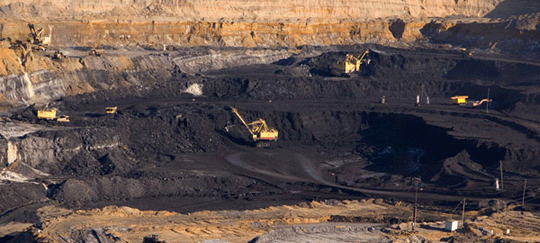
Adani is an Indian conglomerate that wants to build the largest thermal coal mine in Australia, a rail line of almost 400 kilometres connecting it to the coast, and a coal export terminal in the Great Barrier Reef World Heritage Area. The coal would be shipped out through the reef, giving it a perfect view of the bleaching and mortality that has been decimating our valuable natural icon recently before being burned in power stations overseas, only to further contribute to climate change and ocean acidification, considered the greatest long-term risks to the reef.
Given that the reef sustains 60,000 jobs and provides $6 billion per year of economic benefit to Australia, investors may want to consider conflicts of interest before moving ahead.
Some other niggling environmental risks investors might want to consider is the drainage of 12 billion litres per year of water from the Great Artesian Basin and the impacts of coal dust on people’s health along the transport corridor, along with particulate matter from the power stations as the coal is burned.
We’d also want to be content with supporting a mine that has not received free, prior and informed consent from traditional owners, potentially making this a major human rights issue.
But enough of the existential threats posed to culture, people, sites of natural World Heritage and the climate.
Let’s look at the numbers. Last week’s proposal by the Australian government of a $1 billion loan from the Northern Australia Infrastructure Fund means as investors we need to understand the business case.
First of all, don’t be put off by Adani’s corporate debt, which is two-and-a-half times the size of the company. Or the fact that Adani’s share price is down 20 per cent this year. This loan would actually be going to Adani’s private family company, based in Singapore and ultimately owned by Atulya Resources in the Cayman Islands, where we can be sure the money will be totally secure.
The mine will supply new coal power stations in India, whose power minister said yesterday would not be required until 2022, and who wants to get India off imported coal within the next few years. The power will only cost twice that of new renewable energy, and so an exciting market has been identified among those living in energy poverty.
Should the India option fail, the coal could be sold onto the seaborne market, which has declined by 10 per cent in recent years, Goldman Sachs, Deutsche Bank, Bernstein and others declaring it in structural decline.
Conditions like these have frightened off a few more faint-hearted commentators, such as the Queensland Treasury under the Newman government, which described the project as unbankable. Or Wood Mackenzie, which still considers the project as having a negative net present value.
Should the India option fail, the coal could be sold onto the seaborne market, which has declined by 10 per cent in recent years, Goldman Sachs, Deutsche Bank, Bernstein and others declaring it in structural decline.
Conditions like these have frightened off a few more faint-hearted commentators, such as the Queensland Treasury under the Newman government, which described the project as unbankable. Or Wood Mackenzie, which still considers the project as having a negative net present value…….
It’s clear that our investment is going to make a major difference. But will it be enough? $1 billion is a huge lifeline but depending on what assumptions you make about the scale of the project or who you’re prepared to believe, this project is going to cost anywhere from $7 billion to $21 billion……http://www.theage.com.au/business/mining-and-resources/aside-from-the-culture-environment-and-cost-is-adani-a-good-investment-20161213-gta0nq.html
December 14, 2016
Posted by Christina Macpherson |
AUSTRALIA - NATIONAL, business, climate change - global warming, Queensland |
Leave a comment

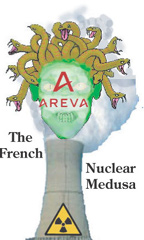
 Coverup at French Nuclear Supplier Sparks Global Review Inspectors say Areva unit’s files suggest manufacturing flaws in critical parts were covered up for decades, WSJ, By MATTHEW DALTON and INTI LANDAURO in Paris and REBECCA SMITH in San Francisco, Dec. 13, 2016
Inspectors from the U.S. and other countries are investigating a decadeslong coverup of manufacturing problems at a key supplier to the nuclear power industry, probing whether flaws introduced in a French factory represent a safety threat to reactors world-wide.
Inspectors from the U.S., China and four other nations visited ArevaSA’s Le Creusot Forge in central France earlier this month to examine the plant’s quality controls and comb through its internal records.
A string of discoveries triggered the newly expanded review: First, French investigators said they found steel components made at Le Creusot and used in nuclear-power plants across France had excess carbon levels, making them more vulnerable to rupture. Then, the investigators discovered files suggesting Le Creusot employees for decades had concealed manufacturing problems involving hundreds of components sold to customers around the world.
The disclosure of flaws covered up by Le Creusot led to two reactor shutdowns this summer in France, and in September authorities ordered Areva to check 6,000 manufacturing files by hand, covering every nuclear part made at Le Creusot since the 1960s.
“I’m concerned that there keep being more and more problems unveiled,” said Kerri Kavanagh, who leads the U.S. Nuclear Regulatory Commission’s unit inspecting Le Creusot. Regulators are considering returning to Le Creusot or inspecting Areva’s Lynchburg, Va., offices to deepen their probe of the plant, a U.S. official said.
On Wednesday, Paris prosecutors opened a preliminary investigation into whether Le Creusot’s activities were fraudulent and dangerous, according to a spokeswoman for prosecutors.
“What we see now at Le Creusot is clearly unacceptable,” said Julien Collet, assistant general manager at France’s Nuclear Safety Authority.
Areva executives have acknowledged the records falsifications and blamed them on a breakdown of manufacturing controls spanning many decades at Le Creusot. Areva has since tightened its controls and is cooperating with the regulators’ reviews, company officials said…….
Beyond France, regulators are trying to determine whether other nuclear facilities that relied on components from Le Creusot are safe. Finnish inspectors visiting the forge last week said they learned of potential flaws in a component slated for a reactor in the southwestern island of Olkiluoto. In the U.S., the NRC has identified at least nine nuclear plants that use large components from Le Creusot……..
Last week’s inspection has turned up a concern with one of Areva’s next-generation reactors, the European Pressurized Reactor under construction in Finland, versions of which are also planned for plants in China, France and the U.K…….http://www.wsj.com/articles/problems-at-nuclear-components-supplier-spark-global-reviews-1481625005
December 14, 2016
Posted by Christina Macpherson |
Uncategorized |
Leave a comment
 Heatwaves are more deadly than bushfires and they’re going to get worse, Canberra Times, Karl Kruszelnicki , 13 Dec 16 In 2009, the terrible Black Saturday bushfires killed 173 people. What most Australians don’t realise is that the crippling heat around the horrendous bushfires killed 374 people.
In the European heatwave of 2003, 50,000-70,000 people died between June and August. The Russian heatwave of 2010 killed about 55,000 people.
A bushfire leaves obvious signs of the cause of death (burns, blisters, etc), but a heatwave does not. Deaths from heatwaves are revealed indirectly. In Victoria in 2009, the first sign that the heatwaves were killing people was the morgues filling up. The unexpected extra corpses had to be stored in universities, mortuaries, funeral parlours and the like.
There are many definitions of a heatwave. The one from the World Meteorological Organisation (WMO) is widely accepted. According to the WMO, a heatwave happens when you have five days in a row, each with a daily maximum temperature five-or-more degrees higher than the average maximum temperature……..
The science is quite clear that climate change (which has been accepted as real since in 1988, and yes, we caused it) is worsening heatwaves. Dr Thomas Knutson and colleagues from the US Geophysical Fluids Dynamics Laboratory in Princeton University wrote a paper showing that (with a very high degree of confidence) climate change caused the extreme heat Australia experienced in 2013.
In Australia, heatwaves now arrive earlier, are hotter, and last longer……http://www.canberratimes.com.au/comment/heatwaves-are-more-deadly-than-bushfires-and-theyre-going-to-get-worse-20161212-gt9fyl.html
December 14, 2016
Posted by Christina Macpherson |
AUSTRALIA - NATIONAL, climate change - global warming |
Leave a comment
 As North Pole Melts in November, Wildfires Rage Across US Well Into Winter, 12 December 2016 By Dahr Jamail, Truthout | Report “……..During a time when winter usually sets in and the Arctic sea ice freezes up, ice has been melting instead of freezing. Temperatures in late November were akin to what they normally are at the end of August.
It was Gaia sending yet another unmistakable message, and it was profound enough that Bob Henson with the WeatherUnderground said, “There are weather and climate records, and then there are truly exceptional events that leave all others in the dust. Such has been the case across Earth’s high latitudes during this last quarter of 2016.”
For perspective, add 36 degrees to whatever your weather is right now, wherever you are. How normal is that? Think about how plants and animals in your area would or wouldn’t adapt to that. What would happen to your food and water supply?
To give you another idea of how dramatically things have already changed in the Arctic as the region is in the midst of an ecological disintegration, Captain Cook’s records of the region from 1778 reveal a literally different world. His expedition was stopped from sailing north of the Bering Strait by “ice which was as compact as a Wall and seemed to be ten or twelve feet high at least,” according to the captain’s journal.
In continued attempts to sail further north, Cook’s ships followed this ice edge all the way to Siberia, but to no avail.
Meanwhile, back in the 21st century, longtime climate scientists are emphasizing that we’re currently seeing an unprecedented situation. Two days after it was revealed that temperatures at the North Pole were 36 degrees above normal, Walt Meier, a research scientist with the Cryospheric Sciences Laboratory at NASA’s Goddard Space Flight Center, who has tracked sea ice data going back to 1979, announced, “It looks like, since the beginning of October, that for the first time we are seeing both the Arctic and Antarctic sea ice running at record low levels.”
According to a recent report by the World Meteorological Organization, Earth is now on track to hit 1.2 degrees Celsius hotter than preindustrial temperatures before the end of this year.
According to the recently released annual “Emissions Gap Report” from the UN’s Environmental Program (UNEP), current Paris Climate Agreement emissions cuts will still result in 3.5C of planetary warming by 2100. “Current commitments will reduce emissions by no more than a third of the levels required by 2030 to avert disaster,” two UNEP leaders warned in the report’s introduction.
Recently published research in a prestigious scientific journal shows that ACD is likely already progressing so rapidly that scientists are warning it could well already be “game over.” Because the research shows that Earth’s climate could be far more sensitive to greenhouse gases than previously believed, they are warning of a temperature rise that is on the “apocalyptic side of bad:” more than 7C within one lifetime from now.
Less importantly, but still shocking and useful to consider (especially since plenty of people seem to believe economics are more important than a habitable planet): Another recent report estimates that the world economy …… http://www.truth-out.org/news/item/38689-as-north-pole-melts-in-november-wildfires-rage-across-us-well-into-winter
December 14, 2016
Posted by Christina Macpherson |
Uncategorized |
Leave a comment
 Trump says ‘nobody really knows’ if climate change is real, WP, By Juliet Eilperin December 11
 President-elect Donald Trump said Sunday that “nobody really knows” whether climate change is real and that he is “studying” whether the United States should withdraw from the global warming agreement struck in Paris a year ago.
There is a broad scientific consensus that human activity — including the burning of fossil fuels for transportation, heating and industrial manufacturing — is driving recent climate change. In its most recent report, the Intergovernmental Panel on Climate Change concluded that it is “extremely likely” that, since the 1950s, humans and their greenhouse gas emissions have been the “dominant cause” of the planet’s warming trend. The top 10 hottest years on record have all been since 1998, and 2016 is expected to be the hottest year since formal record-keeping began in 1880.
But it’s not the first time that Trump has disregarded that established scientific view.
During the presidential campaign, Trump referred to climate change as a “hoax” perpetrated by the Chinese, a comment he later described as a joke. But during a town hall in New Hampshire, he also mocked the idea of global warming. …..https://www.washingtonpost.com/news/energy-environment/wp/2016/12/11/trump-says-nobody-really-knows-if-climate-change-is-real/?utm_term=.979247e98b71
December 14, 2016
Posted by Christina Macpherson |
Uncategorized |
Leave a comment
 Renewable jobs grow as ACT drives down emissions from government operations by 17 per cent in three years, Canberra Times, Katie Burgess, 13 Dec 16, Jobs growth in the ACT renewable energy sector in the past six years was 12 times faster than the national average, a report into the territory government’s action on climate change has revealed.
The Minister’s Report into Climate Change and Greenhouse Gas Reduction also showed the rate of job growth in the ACT’s renewables sector was six times higher than any other state and territory, as the government invested $12 million into a renewable energy industry development strategy.
Ahead of the COAG Energy Council meeting on Wednesday, climate change minister Shane Rattenbury said he would push other states and territories to take up their own renewable energy targets.
“We must not allow the federal government’s inaction to limit what we can achieve at a state and territory level. The ACT is a great example of what subnational governments can achieve. We are on track to meet our 100 per cent renewable electricity target by 2020 and to become Australia’s first zero emission jurisdiction by 2050,” Mr Rattenbury said.
Emissions from government operations have fallen 17 per cent since 2012-2013, the report also revealed. The ACT government is aiming to be carbon neutral in its own operations by 2020……http://www.canberratimes.com.au/environment/climate-change/renewable-jobs-grow-as-act-drives-down-emissions-from-government-operations-by-17-per-cent-in-three-years-20161213-gta1ha.html
December 14, 2016
Posted by Christina Macpherson |
ACT, employment, energy |
Leave a comment
OOPS: RICK PERRY TAPPED TO LEAD DEPARTMENT HE WANTED TO ELIMINATE
The brain-frozen Texas governor gets the last laugh. Vanity Fair, BY TINA NGUYEN , 13 Dec 16, Continuing his trend of appointing people to lead the same departments they want to destroy, Donald Trump will reportedly announce that he will appoint Rick Perry, who famously forgot during a 2011 debate that he wanted to eliminate the Department of Energy, to lead the Department of Energy.
Perry, the former governor of Texas, was previously briefly a frontrunner in the 2012 presidential race, until his fortunes cratered when he struggled to list the three departments he would eliminate as president. “Oops”, he offered sheepishly. Having forgotten that he wanted to eliminate the Department of Energy (in addition to the Commerce and Education departments) is hardly the most troublesome aspect of Perry’s nomination.
While Perry spent more than a decade as the executive of a state that is a major energy producer—promoting the expansion of fossil fuel extraction even as Texas itself became a leader in wind power, with over 10 percent of the state’s energy being drawn from wind farms—the D.O.E. is mostly concerned with nuclear energy, including the safe handling of nuclear materials, oversight of nuclear weapons and nuclear reactor production, energy-related research, and developing new energy technologies…..
……Judging from his 2012 platform and his position on the board of a natural gas company, Perry, a climate-change skeptic, would tout energy independence above all and push for an increase in North American drilling and “clean coal” technologies. Trump, too, has promised to increase America’s energy production by lifting regulations limiting the extraction and production of domestic oil, coal, and gas. But neither Trump nor Perry have said much about nuclear energy, which remains the central mission of the D.O.E. http://www.vanityfair.com/news/2016/12/donald-trump-rick-perry-energy-department
December 14, 2016
Posted by Christina Macpherson |
Uncategorized |
Leave a comment
The next 20 years will see unprecedented transformation in the power industry as it transitions to a low-carbon future, The Australian Energy Market Operator says.
It’s calling for major interconnector development, costing between $1 billion and $3 billion, to help the connection of renewable generation to existing infrastructure.
In the AEMO’s latest national transmission network development plan, it says a new interconnector could be built between South Australia and NSW or Victoria as well as a second Bass Strait link.
The network, historically designed to transport energy from traditional coal and gas generation centres, will be asked to support large-scale renewable generation, including 32 gigawatts of new wind and solar generation to be connected by 2036.
“In short – we’re projecting that a more decentralised grid must be a more interconnected grid,” AEMO chair Tony Marxsen said in Melbourne on Monday.
“We have to connect a lot of renewable power generation in new locations.
“More options in the market should provide more ways to not only lower the cost for customers but also add cost effective, agile solutions to support the security of the grid.”……..
The report does not mention emission intensity schemes despite an interim report on the national market’s security by chief scientist Dr Alan Finkel released on Friday concluding an EIS would take pressure off power prices while reducing blackouts and reducing climate change.http://www.heraldsun.com.au/news/breaking-news/aust-power-grid-needs-an-upgrade-report/news-story/e763c079048797cef4d97bb19b8f06a0
December 14, 2016
Posted by Christina Macpherson |
AUSTRALIA - NATIONAL, energy |
Leave a comment
 Rapid rise in methane emissions in 10 years surprises scientists Methane warms planet 20 times as much as similar CO2 volumes but lack of monitoring means scientists can’t be sure of sources, Guardian, Fiona Harvey, 13 Dec 16, Emissions of the powerful greenhouse gas methane have surged in the past decade, threatening to thwart global attempts to combat climate change.
Scientists have been surprised by the surge, which began just over 10 years ago in 2007 and then was boosted even further in 2014 and 2015. Concentrations of methane in the atmosphere over those two years alone rose by more than 20 parts per billion, bringing the total to 1,830ppb.
This is a cause for alarm among global warming scientists because emissions of the gas warm the planet by more than 20 times as much as similar volumes of carbon dioxide.
In the meantime, emissions of carbon dioxide – the main component of manmade greenhouse gases in the atmosphere – have been levelling off. The new research, published in the peer-review journal Environmental Research Letters, suggests that the world’s attempts to control greenhouse gases have failed to take account of the startling rises in methane.
The authors of the 2016 Global Methane Budget report found that in the early years of this century, concentrations of methane rose by only about 0.5ppb each year, compared with 10ppb in 2014 and 2015.
The scientists speculate that agriculture may be the main source of the additional methane that has been recorded. However, they cannot be sure of all the sources, owing to a lack of monitoring.
At least a third of methane comes from the exploitation of fossil fuels, including fracking and oil drilling and some coal mining, where methane is viewed as a waste gas and is frequently allowed to escape or, in some cases, flared off, which is less harmful.
Unlike carbon dioxide emissions, however, which have been tracked in various ways since the 1950s, emissions of methane are poorly understood and could represent a threat that scientists have still not accounted for.
For instance, the melting of the Arctic tundra releases methane as the vegetation underneath is gradually and sometimes suddenly exposed. This has been regarded by scientists as a potential “tipping point” whereby warming of the Arctic leads to greater releases of methane, therefore greater warming, in a runaway and uncontrollable cycle……. https://www.theguardian.com/environment/2016/dec/12/rapid-rise-methane-emissions-10-years-surprises-scientists
December 14, 2016
Posted by Christina Macpherson |
Uncategorized |
Leave a comment
 Fossil fuel divestment is worth $7tn globally yet Australia still clings to coal, Guardian,
Blair Palese, 13 Dec 16 While the Australian government lags behind on climate change action, consumers, local councils and energy companies lead the way to clean energy. The Turnbull government has been an utter disappointment on so many things but nowhere as much as on the biggest issue of our time: climate change.
Unable to shrug off the legacy of the climate-denying Abbott government, it has been bullied out of any climate change ambition by science-denying fringe elements on the right.
The list of dishonourable mentions are long. Despite signing the Paris agreement last year, the Australian government has consistently undermined any efforts to keep the world below the safe level of 2C. Last week’s backflip on the idea of a carbon-intensity emissions trading scheme – supported by most of the banks and the energy sector as the best way to reduce emissions and provide a level-playing field – is just the latest in a long line.
But the biggest worry is seeing Turnbull’s coal-loving ministers push through the Adani mega coalmine in Queensland, replete with the offer of a $1bn taxpayer-funded loan to build a railway line through rich farmland to a coal terminal on the Great Barrier Reef. If constructed, the Adani mine will almost certainly condemn the Great Barrier Reef to the annals of history, not to mention blowing almost any chance of us living in a safe climate future.
But while climate change is mired in partisanship and cheap political point-scoring on a federal level, Australian organisations, driven by a strong market shift away from polluting fossil fuels, particularly coal, are leading the way towards the clean economy.
On Tuesday a report by global financial outfit Arabella shows that fossil fuel divestment is now worth an astounding A$7tn globally. It spans almost 700 organisations as diverse as the Norwegian Sovereign Wealth Fund, the City of Newcastle and the Australian National University.
This $7tn that is not invested in coal, oil and gas provides a significant financial indicator to back up what we already know: fossil fuels are on the nose.
While Australia may be lagging on a government level, many of our businesses are leading the world in waking up to the risks posed by fossil fuels and the opportunities of the new clean economy.
The Arabella report highlights that Australia has the most divestments per capita of any developed nation. And these organisations that have divested are by no means radical. It is groups such as the Australian Capital Territory’s government, Australian Academy of Science, the Royal Australasian College of Physicians and the National Tertiary Education Union. Add to the mix almost 30 local government councils, 10 super funds, a handful of our top universities and you get the picture.
There is even a chance you live in a fossil-free council considering that more than one in 10 Australians now live in a council area that has sworn off fossil fuels…….https://www.theguardian.com/sustainable-business/2016/dec/13/fossil-fuel-divestment-is-worth-7tn-globally-yet-australia-still-clings-to-coal
December 14, 2016
Posted by Christina Macpherson |
AUSTRALIA - NATIONAL, climate change - global warming |
Leave a comment







 , Herald Sun,


 Antinuclear