Australia’s proponents of nuclear submarines are way behind the times
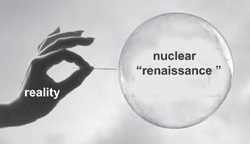 Nuclear Fuel Cycle Watch South Australia Paul Richards shared a link. 1 Jan 17
Emerging this decade are the many challenges to the whole nuclear industries range of products from; medicine, reactors, weapons
Not to mention the always present 1940s backdoor issue that’s never been solved, that of nuclear waste management
This submarine news makes a joke of our neocon naval purchase, particularly if the goal was to put nuclear reactors into the Shortfin Barracuda Block 1A at some future point
The whole biased process used by those enamoured the nuclear industry is becoming increasingly obvious. Particularly, when this Swedish technological development must have been known about but discarded in favour of the nuclear state, France. Who are a founding member of UN Security Council P5 and who as a group control all nuclear issues globally through the IAEA
Nonetheless, this is a notable problem with all nuclear infrastructure, that is, the slow technological development due to the magnitude of the complex physics difficulties. Issues that are becoming common knowledge and as such widely understood by the public as a secondary downside along with unsolved waste problem
Obsolescence is the biggest problem with all nuclear technology, and the whole industry struggles to survive without sovereign capital funding. Most importantly, because clean alternative technology is rapidly developed and easily recycled.
What is interesting is the catalytic conversion of C02 and water into diesel although in its infancy, has already been trialled as economically viable, as well as being CO2 neutral, and that is before the carbon industry started discounting oil. In all probability, blue or e-diesel will be a good, clean fuel for submarines given the exponential growth in German fuel technology and their incredible technological record as world leaders in catalytic technology
Is it any wonder Germany stepped off the whole nuclear cycle, with such advances rapidly developing, making current nuclear tech look so last century, dated and obsolete?
___________
https://themarketmogul.com/blue-crude-innovative-revolution/
source: the national interest: an American bi-monthly international affairs magazine published by the Center for the National Interest https://www.facebook.com/groups/1021186047913052/
Nuclear submarines now obsolete? New Swedish technology indicates this
 Did Sweden Make America’s Nuclear Submarines Obsolete? The National Interest, 30 Dec 16 Nuclear-powered submarines have traditionally held a decisive edge in endurance, stealth and speed over cheaper diesel submarines. However, new Air Independent Propulsion (AIP) technology has significantly narrowed the performance gap on a new generation of submarines that cost a fraction of the price of a nuclear-powered boat……..
Nuclear vs. AIP: Who Wins?:
Broadly speaking, how do AIP vessels compare in performance to nuclear submarines? Let’s consider the costs and benefits in terms of stealth, endurance, speed and cost.
Stealth:
Nuclear powered submarines have become very quiet—at least an order of magnitude quieter than a diesel submarine with its engine running. In fact, nuclear-powered submarines may be unable to detect each other using passive sonar, as evidenced by the 2009 collision of a British and French nuclear ballistic missile submarines, both oblivious to the presence of the other.
However, there’s reason to believe that AIP submarines can, if properly designed, swim underwater even more quietly. The hydraulics in a nuclear reactor produce noise as they pump coolant liquid, while an AIP’s submarine’s engines are virtually silent. Diesel-powered submarines can also approach this level of quietness while running on battery power, but can only do so for a few hours whereas an AIP submarine can keep it up for days.
Diesel and AIP powered submarines have on more than one occasion managed to slip through anti-submarine defenses and sink American aircraft carriers in war games. Of course, such feats have also been performed by nuclear submarines.
Endurance:
Nuclear submarines can operate underwater for three or four months at a time and cross oceans with ease. While some conventional submarines can handle the distance, none have comparable underwater endurance.
AIP submarines have narrowed the gap, however. While old diesel submarines needed to surface in a matter of hours or a few days at best to recharge batteries, new AIP powered vessels only need to surface every two to four weeks depending on type. (Some sources make the unconfirmed claim that the German Type 214 can even last more than 2 months.) Of course, surfaced submarines, or even those employing a snorkel, are comparatively easy to detect and attack.
Nuclear submarines still have a clear advantage in endurance over AIP boats, particularly on the long-distance patrols. However, for countries like Japan, Germany and China that mostly operate close to friendly shores, extreme endurance may be a lower priority.
Speed:……..Obviously, high maximum speed grants advantages in both strategic mobility and tactical agility. However, it should be kept in mind that even nuclear submarines rarely operate at maximum speed because of the additional noise produced.
On the other hand, an AIP submarine is likely to move at especially slow speeds when cruising sustainably using AIP compared to diesel or nuclear submarines. For example, a Gotland class submarine is reduced to just 6 miles per hour if it wishes to remain submerged at maximum endurance—which is simply too slow for long distance transits or traveling with surface ships. Current AIP technology doesn’t produce enough power for higher speeds, and thus most AIP submarines also come with noisy diesel engines as backup.
Cost:
Who would have guessed nuclear reactors are incredibly expensive? The contemporary U.S. Virginia class attack submarine costs $2.6 billion dollars, and the earlier Los Angeles class before it around $2 billion in inflation-adjusted dollars. Mid-life nuclear refueling costs add millions more.
By comparison, AIP powered submarines have generally cost between $200 and $600 million, meaning a country could easily buy three or four medium-sized AIP submarines instead of one nuclear attack submarine. Bear in mind, however, that the AIP submarines are mostly small or medium sized vessels with crews of around 30 and 60 respectively, while nuclear submarines are often larger with crews of 100 or more. They may also have heavier armament, such as Vertical Launch Systems, when compared to most AIP powered vessels.
Nevertheless, a torpedo or missile from a small submarine can hit just as hard as one fired from a large one, and having three times the number of submarine operating in a given stretch of ocean could increase the likelihood chancing upon an important target, and make it easier to overwhelm anti-submarine defenses.
While AIP vessels may not be able to do everything a nuclear submarine can, having a larger fleet of submarines would be very useful in hunting opposing ships and submarines for control of the seas. Nor would it be impossible to deploy larger AIP powered submarines; China has already deployed one, and France is marketing a cheaper AIP-powered version of the Barracuda-class nuclear attack submarine.
It is no surprise that navies that operate largely around coastal waters are turning to cheap AIP submarines, as their disadvantage are not as relevant when friendly ports are close at hand. ……..http://nationalinterest.org/blog/the-buzz/did-sweden-make-americas-nuclear-submarines-obsolete-18908?page=2
Multiple Studies Confirm Exposure To Low Levels Of Radiation Can Cause Cancer
http://fukushimawatch.com/2015-11-05-multiple-studies-confirm-exposure-to-low-levels-of-radiation-can-cause-cancer.html The World Health Organization (WHO) has confirmed what Fukushima Watch has been reporting for quite some time now — namely, that exposure to low doses of radiation overtime increases the risk of cancer.
The results of the study, published in the prestigious British Medical Journal (BMI), provide “direct evidence about cancer risks after protracted exposures to low-dose ionizing radiation,” said the International Agency for Research on Cancer (IARC), the cancer agency of the World Health Organization.
The findings demonstrate “a significant association between increasing radiation dose and risk of all solid cancers,” the study’s co-author, Dr. Ausrele Kesminiene, told sources.
“No matter whether people are exposed to protracted low doses or to high and acute doses, the observed association between dose and solid cancer risk is similar per unit of radiation dose,” he added.
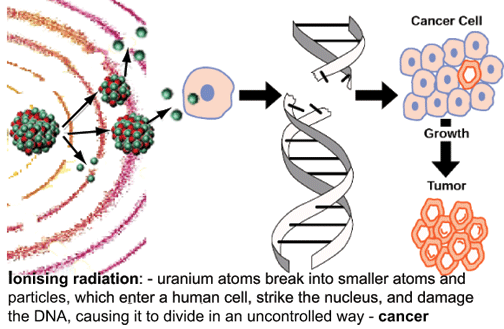
Nuclear workers around globe at heightened cancer risk Continue reading
China sees climate change, renewable energy as a business leadership opportunity
China is also seeking market dominance in clean energy technology.
The nation’s ambient air pollution and its greenhouse gas emissions would both decline if China could produce more electricity using clean renewables rather than relying on coal. It has been the largest producer of solar photovoltaic cells in the world since 2007, and overtook Germany as the nation with the largest installed photovoltaic capacity in 2015.
As the price of renewable power equipment declines, the law of demand predicts that more U.S. companies will go green.
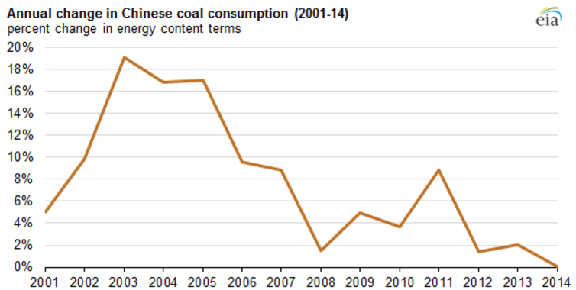
For China, Climate Change Is No Hoax – It’s a Business and Political Opportunity Desmogblog, , December 31, 2016 By Matthew Kahn, University of Southern California
Common Myths of the Nuclear Industry
 http://www.helencaldicott.com/common-myths-of-the-nuclear-industry/ by on 18 December 2015
Myth: the new generation of nuclear reactors are designed to recycle nuclear waste
BUST: These reactors don’t exist
These reactors often spoken of by advocates of nuclear energy are hypothetical. There are none of these “Generation IV” reactors commercially operating anywhere in the world:
- Even the demonstration plants are still decades away
- Various designs are still under investigation on paper and have been for many years.
- The first demonstration plants are projected to be in operation by 2030-2040, so they are yet to be tested and still many years away.
- Problems with earlier models
- The specific type of Generation IV reactor that would recycle waste – the Integral Fast Reactor – only exists on paper, but earlier models of fast reactors have been expensive, underperforming, and have had a history of fires and other accidents, with many countries abandoning the technology.
- These reactors would still produce some waste
- The Integral Fast Reactor is called “integral” because it would process used reactor fuel on-site, separating plutonium (a weapons explosive) and other long-lived radioactive isotopes from the used fuel, to be fed back into the reactor. It essentially converts long-lived waste into shorter lived waste. This waste would still remain dangerous for a minimum of 200 years (provided it is not contaminated with high level waste products), so we are still left with a waste problem that spans generations.
- The theory is that these reactors would eat through global stockpiles of plutonium
- When thinking about recycling waste it’s important not to confuse recycling existing stockpiles of waste with these reactors perpetually running off of their own waste, which they could also be operated to do. If they ran off their own waste, they would not consume existing waste beyond the initial fuel load.
Myth: nuclear is the only alternative to coal for baseload power
BUST: We don’t need baseload Continue reading
1 This month

of the week – Australians for War Powers Reform (AWPR)
To see nuclear-related stories in greater depth and intensity
 Antinuclear