 Early skirmishes point to a war over renewable energy lasting well into 2017, The Age, Peter Hannam, 15 Jan 17 “……Trenches are now being dug for what looms as a political battle that will probably last through 2017. On one side lie the Turnbull government, fossil fuel suppliers and right-wing pundits, who say the priority has to be affordable and reliable power.
 On the other, Labor and the Greens and clean-energy backers who argue ageing coal-fired power stations need to prepare for an orderly if not accelerated exit to meet Australia’s commitments agreed in the Paris climate treaty.
Josh Frydenberg, environment and energy minister, ended holidays early on Thursday to rail against states for curbing unconventional gas exploration, which also feeds into higher  electricity prices. That’s especially true in SA where gas provides all the power that’s not from wind or the sun.
He took particular aim at Queensland, where the Labor government under 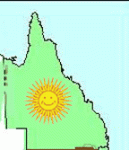 Annastacia Palaszczuk is aiming for a 50 per cent share of renewable by 2030, up from 4.4 per cent in 2015………
Frydenberg’s Labor counterpart, Mark Butler, though, says the Coalition’s energy policy was “being dictated by the hard right of the party with the likes of Tony Abbott and Cory Bernardi”.
“The culture-war element starts to blind people to pretty clear policy,” he says, noting three-quarters of Australia’s fleet of power stations were operating beyond the end of their design life and needed to be replaced.
“The Turnbull government leaves a policy vacuum at the federal level, the states will fill the void,” he says.
Federal Labor remains committed to a 50 per cent renewable share by 2030, he said, noting the Turnbull government has no target beyond 2020 nor is a target among the terms of reference for its 2017 climate policy review. NSW Labor shares the party’s national goal……
Abbott, as if on cue, weighed into the renewables debate on Saturday……
What is certain is that energy bills are on the rise – although the causes are highly debated…….
Bruce Mountain, an energy economist with CME Australia, says rising energy prices will prompt more people to add solar panels and also batteries as prices continue to tumble – much faster than regulators predict.
Tesla’s new 13.5-kilowatt-hour Powerwall 2, costing about $8800 before installation, already offers a lower battery price than AEMO had predicted for 2040, he says
An average household in Adelaide, where power prices have doubled in the past eight years to be among the highest in Australia, would now be better off with panels and storage.
While panels alone typically slash demand for electricity from the grid by a third, adding a battery will reduce grid purchases by about 95 per cent, he said.
‘Existential threat’
Dylan McConnell, a research fellow at the Melbourne Energy Institute, notes AEMO is predicting 15.5 gigawatts of coal-fired power plants will be shut by 2030. That’s about half of such stations and equivalent to 10 Hazelwoods.
Importantly, AEMO is betting 12GW of new gas-fired power will come on stream “assuming no alternative technologies come to fruition”, Mr McConnell said.
However, the open-cycle gas plants that can provide peaking power to complement variable suppliers such as wind and solar farms “face an existential threat from batteries”, he said……..
Without clear signals, investors won’t have the confidence to invest the billions needed to bring new, more efficient capacity online.
RET challenges
Bloomberg New Energy Finance underscored the scale of the challenge even meeting the 2020 Renewable Energy Target of supplying 33,000 gigawatt-hours from clean energy annually from 2020.
Last year, investment in large scale renewables under the RET bounced back from a meagre $US10 million in 2014 and 2015 after the Abbott government’s review of the sector threw it into a panic. In 2016, it recovered to $US1.1 billion ($1.45 billion).
“However it is still well below the $US2.9 billion per annum now needed to satisfy the notional 20 per cent target by 2020,” Bloomberg said.
Greens energy spokesman Adam Bandt says the Coalition will be tempted to stir up fears of rising electricity prices “in the hope that they can repeat 2013”, when Tony Abbott swept to power in part because of the carbon tax issue.
“They’ll try to beat the electricity bill drums but the prices are going up on their watch,” he says……… http://www.theage.com.au/environment/climate-change/early-skirmishes-point-to-a-war-over-renewable-energy-lasting-well-into-2017-20170111-gtpsd9.html
January 15, 2017
Posted by Christina Macpherson |
AUSTRALIA - NATIONAL, energy, politics, solar, storage |
Leave a comment



 Early skirmishes point to a war over renewable energy lasting well into 2017, The Age, Peter Hannam, 15 Jan 17 “……Trenches are now being dug for what looms as a political battle that will probably last through 2017. On one side lie the Turnbull government, fossil fuel suppliers and right-wing pundits, who say the priority has to be affordable and reliable power.




 Antinuclear