Local Winds Brought Radioactive Materials From Fukushima To Tokyo


Nocturnal local winds carried radioactive material from Fukushima to Tokyo following the 2011 Fukushimia Daiichi nuclear accident.
AsianScientist (Jan. 17, 2017) – Nocturnal local winds were responsible for transporting radioactive material over 200km from the Fukushimia Daiichi nuclear accident to the Tokyo metropolitan area.
These findings by researchers from the University of Tokyo have been published in Scientific Reports. A research group led by Project Researcher Takao Yoshikane and Associate Professor Kei Yoshimura analyzed observational data and ran computer simulations to determine whether the radioactive plumes were carried by chance haphazard activity in the air or by a regular mechanism in the atmosphere. They found that the radioactive plume moves along two local wind systems that appear during the night on calm days when the impact of northwesterly seasonal winds and low-pressure systems are low. These nighttime local winds were formed by a difference in temperature between the North and…
View original post 197 more words
Nuclear: Game Over
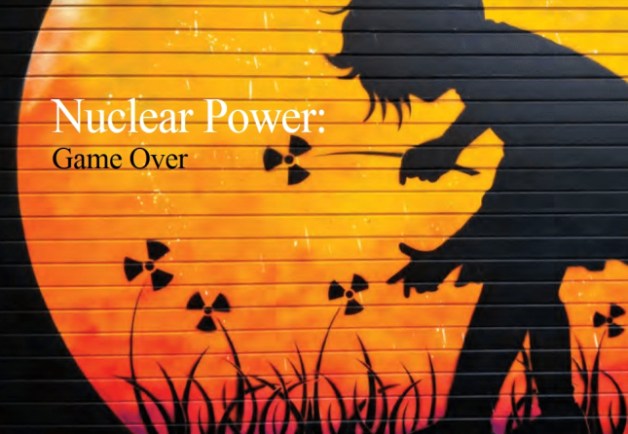
Nexit – Nuclear Exit
It took the world 48 years to gradually ramp up to a peak of 438 commercial nuclear power plants in 2002. Today, in 2016, we have dropped to 402 reactors with further closures foreshadowed.
There is about 200 years of uranium, if we consume it at the current rate. Scale up to 3000 reactors and we have only about 25 years of power left.
Humans globally consume roughly 15,000 gigawatts (GW) of power, in oil, coal, gas, nuclear, and renewables all added together.1 To put it another way, it means that, on average, we use 15,000 gigajoules (GJ) of energy every second of every day. That is an enormous number, equivalent to switching on 15 billion electric kettles.

On the other hand, 15,000 GW is a relatively small number as it is 5000 times less than the average solar power hitting the planet’s surface. And remarkably…
View original post 5,763 more words
How Nuclear Power Causes Global Warming
Supporters of nuclear power like to argue that nukes are the key to combatting climate change. Here’s why they are dead wrong.
Every nuclear generating station spews about two-thirds of the energy it burns inside its reactor core into the environment. Only one-third is converted into electricity. Another tenth of that is lost in transmission. According to the Union of Concerned Scientists:
Nuclear fission is the most water intensive method of the principal thermoelectric generation options in terms of the amount of water withdrawn from sources. In 2008, nuclear power plants withdrew eight times as much freshwater as natural gas plants per unit of energy produced, and up to 11 percent more than the average coal plant.
Every day, large reactors like the two at Diablo Canyon, California, individually dump about 1.25 billion gallons of water into the ocean at temperatures up to 20 degrees Fahrenheit warmer than…
View original post 976 more words
Ocean Acidification could have significant influence on marine animals. #auspol

Ocean Acidification and the extent to which marine species are able to deal with low pH levels in the Earth’s seas, could have a significant influence on shifting the distribution of marine animals in response to climate warming.

This is one the findings of a landmark new study that has taken a first-ever global scale integrative approach to the topic, bringing together population genetics, growth, shell mineralogy and metabolic data for marine snails found in the North Atlantic.
Published in this month’s Nature Communications, the report, Regional adaptation defines sensitivity to future ocean acidification, reveals that populations at the northern and southern range edges are the most sensitive to ocean acidification, and the least likely to be able deal with significant implications for biogeography and diversity.
Scientists at the University of Quebec in Rimouski (UQAR), Canada, the University of Plymouth, the Plymouth Marine Laboratory, and the University of Birmingham, launched…
View original post 587 more words
1 This month

of the week – Australians for War Powers Reform (AWPR)
To see nuclear-related stories in greater depth and intensity
 Antinuclear