Any economic argument for the nuclear industry was blown out of the water by the absolute discrediting of South Australia’s shonky Nuclear Royal Commission (NFCRC)’s push for importing nuclear wastes.
Australia’s nuclear lobby knew that the industry is not healthy, nor safe, nor clean, and is a disaster for the Aboriginal people. But, they didn’t care – saying that importing nuclear waste would make $billions. All thorough economic research said otherwise. Far from saving South Australia’s struggling economy, expanding the nuclear industry would most likely bring that State to bankruptcy.
Now the nuclear lobbyists are at it again – touting “new nukes” – small thorium nuclear reactors, (which would require importing enriched uranium or plutonium to get them working.) Even the pro nuclear NFCRC concluded that these would not be economic for South Australia.
The push for “new nukes” is driven partly by the vanity of a few would-be-famous young men, partly by the nuclear enthusiasts within the defence lobby, and partly by the general desperation of the global nuclear industry to make it look as if they’re succeeding.
Whichever way it is, South Australia will be the loser if nuclear lobbyists win. South Australia has the opportunity to lead in 21st Century renewable energy technologies. With no help from the climate-denying, anti-renewables, Turnbull government, South Australia is up against it.
The uranium market is in continual gloom. Any expansion of the nuclear industry in Australia is a recipe for economic disaster – and a ludicrous contrast to Australia’s wonderful opportunities in renewable energy and clean agriculture.
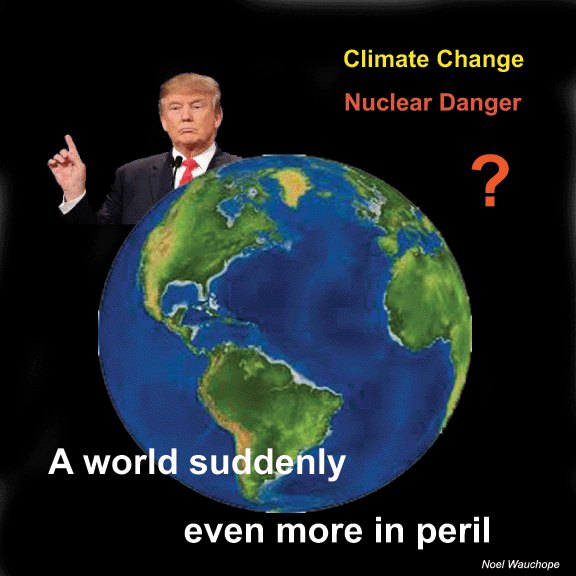
As I write, there’s a sort of an anxious lull in climate and nuclear news. Indeed, in other news, too. The media world seems to be waiting for the next event, on January 20, concerning a certain narcissistic American. I’ve decided to leave him out of this week’s newsletter, except, perhaps, for a picture (attached).
Why the public is not buying Coalition attack on wind and solar, REneweconomy By Jonathan Gifford on 20 January 2017 What is it that the general public appears knows about renewables and electricity prices that much in the conservative side of politics, and the federal energy minister Josh Frydenberg, do not?
2017 has kicked off with another round of attacks on renewable energy targets, both state and federal. They display fundamental misunderstandings of renewable energy, its deployment capabilities, costs and impacts on electricity prices. The good news: the public isn’t buying it.
As working life, business and the public debate gets back into full swing after the holiday period, attacks on renewable energy and targets have, unfortunately, also resumed. The Australian, unsurprisingly, is leading the charge, and elected officials have added their voices to the unrelenting campaign of misinformation.
Most worryingly Energy and Environment Minister Josh Frydenberg is playing a prominent role. On Wednesday he penned an OpEd in the Australian Financial Review in which he got stuck into the Victorian and Queensland state governments’ RETs.
On Friday, The Australian gave him a platform to attack renewable energy by way of a rebuttal to the Labor opposition climate change spokesman Mark Butler’s arguments for a 50 per cent by 2030 RET.
While Frydenberg’s argumentation in today’s Australian specifically addresses the Labor 50% RET, it is riddled with direct attacks on renewable energy itself.
Frydenberg argues that RETs lead to higher power prices. To support this he says that power prices rose rapidly under Labor, that a 50% RET will drive out coal generation – implicitly increasing prices – and that it will require $48 billion in new investment in generation capacity.
The Energy Minister then cites AEMC findings that the RET will have “the highest cost of abatement,” that it does not encourage emissions reductions beyond renewable generation.
Despite this and other lines of argument, it appears that the Australian public is just not buying it. There continues to be evidence that renewable energy remains widely popular with Australians, to which their continued adoption of rooftop solar and increasingly battery storage attests. And polling continues to confirm this.
GetUp released the findings of a ReachTEL poll it conducted on January 12 today, in which it asked 2,126 householders what they believe are behind rising power prices.
The leading response, with 58%, was that “privatization and the lack of competition between the big energy companies” were behind the price hikes. The next response was “undecided,” with 24.2% and renewable energy in third place, with 17.7%.
“The owners of the poles and wires have been gold-plating the grid, spending billions of their customers’ money building far more grid infrastructure than we needed.”
Taking the RET in isolation, as a policy to drive the shift towards less emission intensive electricity generation as Frydenburg does, is also mischevious.
In combination with overdue electricity market reforms and the pricing of externalities, such as carbon pricing, in combination with renewable targets has repeatedly been shown to deliver a lower-cost energy transition……..
GetUp’s Miriam Lyons weighs in on the South Australia debate, saying that it is indeed “an example of what’s wrong with the current system” with its botched electric utility privatisation and the lack of competition.
“The Liberal Olsen government didn’t break up the generators when it privatized electricity – they chose to make as much from the sell-off as possible in the short term, rather than creating a genuinely competitive market,” says Lyons. “The price-gouging by gas companies that we saw in South Australia last year is a direct result of that.”
GetUp notes that it is encouraging to see public support for renewables and RETs hold fast, but that the battle against the demonization of renewables on the basis that they leads to higher electricity prices is far from over.
“The Western Australian government has approved plans for a uranium mine at Yeelirrie on Aboriginal land 630 kilometres north-east of the state capital, Perth.
Aborigines have fought the plans as best they could, backed by non-indigenous and foreign activists.
Environmentalists warn the mine would wipe out species unique to the region.
Yeelirrie sits on one of the world’s most significant uranium deposits.
Approval of the mine, to be operated by Canadian mining giant Cameco, came despite a ruling by the government’s own Environmental Protection Authority (EPA) that a mine on the site posed a significant risk of extinction to species not known to exist anywhere else. …
“Anti-nuclear activist Mia Pepper writes that the government argued jobs and economics for its decision.
“Now we know that the project would employ a little over 200 fly-in, fly-out (FIFO) workers, but we also know that the uranium market is flooded and there is no economic justification for this mine to go ahead. … “
“We know Donald Trump and his proposed cabinet of millionaires are climate deniers. We’ve known that for years. It is no surprise that on day one they would proceed with their business plan of officially denying science for profit. It doesn’t change the science or the fact that the world wants a clean energy future. If there’s money to be made, Donald Trump will likely continue to officially deny climate change until the boiling seas swallow Mar-A-Lago whole. That’s why we have to resist. More people believe in climate action than voted for Donald Trump, and we will continue to resist as long as the official White House policy is climate denial.”
It also appeared to remove any reference to combating climate change, a topic that had been featured prominently on the White House site under President Barack Obama. The page that once detailed the potential consequences of climate change and the Obama administration’s efforts to address it vanished on Friday just as President Trump was sworn in. It now redirected to a broken link: “The requested page ‘/energy/climate-change’ could not be found.”
In its place, listed among the top issues of the Trump administration, was a page entitled, “An America First Energy Plan.”
The incoming administration vows to eliminate “harmful and unnecessary policies” such as the Climate Action Plan and the Waters of the United States rule. The first represents a variety of efforts Obama pursued to reduce U.S. greenhouse gas emissions, while the second is a rule issued by the EPA to protect not only the largest waterways but smaller tributaries that others believe should fall under the jurisdiction of states rather than the federal government.
The new White House site says that Trump would “refocus the EPA on its essential mission of protecting our air and water.”
It also says the incoming president will pursue “clean coal technology,” a reference to efforts to remove carbon dioxide emissions from coal-burning plants and bury those emissions in the ground to use them to enhance oil recovery. The Obama Energy Department has already been funding a variety of projects in this area. Though, without nearby enhanced oil recovery projects, the technology is not economic. Trump’s White House site says the new administration would aim at “reviving America’s coal industry.”
“Responsibly developed wind energy offers a substantial, economically feasible, and wildlife-friendly energy opportunity for America,” according to the National Wildlife Federation.
Here’s why they offer such strong endorsements.
Scientists overwhelmingly agree that excess carbon pollution threatens birds across the globe. This looms particularly large in North America, where the National Audobon Society finds CO2 pollution could cause 314 different bird species to lose up to 50 percent of their habitats in the coming decades.
Fortunately, wind power remains the biggest, fastest, and cheapest way to reduce carbon pollution, cutting 28 million cars’ worth every year. Wind also contributes to a cleaner environment for America’s birds by eliminating pollutants like nitrogen oxides and sulfur dioxide that create smog.
Working proactively to keep impacts low
The U.S. wind industry works closely with conservation organizations and government officials to understand and minimize the impacts it does have to the greatest degree possible. Here’s one example of groundbreaking research on ways to do this:
How else do wind developers ensure conservation happens? Some examples of the different methods they use include:
Thorough site monitoring to notice any unexpected impacts.
Creating wildlife preserves.
Partnering to create the American Wind Wildlife Institute to tackle wind and wildlife issues, identifying areas that need research and then making sure it happens.
Performing extensive pre-construction surveys to minimize impacts, and following best practices to maintain small effects during project operations.
Factors like this contributed to the New York State Energy and Research Development Authority’s finding that wind has the lowest impact on wildlife and their habitats of any way to generate electricity.
It is true that wind does have some impact on bird populations, and the U.S. wind industry takes that very seriously. However, this should also be put into context: wind causes less than 0.01 percent of all human-related bird deaths.
The reality is no human activity is completely impact-free. With decades of siting experience and comprehensive environmental impact assessments done before construction, wind greatly lessens the effects it does have.
And because wind power directly combats the greatest threat to birds, helps create a cleaner environment and preserves habitats through its small footprint, it creates a future where birds of all kinds can continue to flourish.
Solar power and other renewable energy sources are increasingly affordable as technologies continues to become more efficient and effective, and the opportunities to scale solutions brings costs down even further. As much as the transition from a fossil-fuel based economy to one powered by renewables is becoming more widely recognised, what is sometimes lost is just how rapid the change has been. Furthermore, it appears the next natural step is a renewable energy source inspired transformation of the way in which we design our future buildings and cities.
During the last six years in the US alone, “solar power has exploded into the energy sector with the kind of industrial vigour not seen since the 1950s”, wrote David Beckham in GreenBiz earlier this month. In 2010, the US had the equivalent of one gigawatt of solar generation capabilities, for perspective on what that means in terms of power demands, Disney Land uses roughly that amount every two weeks – it’s also less than the Doc needed to get the DeLorean running again in Back to the Future! Capacity has ballooned to 30 gigawatts of solar power generation at the beginning of 2016 and is continuing to grow at a rapid pace, mostly thanks to the lowering of costs with the average solar cell now costings $0.35 per watt, compared with around $4 in 2016, all while increasing efficiency by 20%.
Throw in increased volatility in fossil fuel prices – especially oil – and diminishing efficiency gains for non-renewable based technologies, and it should come as no surprise that there is increasing investment and innovation into solar power, not to mention demand, where more panels were installed in the US during 2016 than the previous 38 years combined. Furthermore, digital advances are enabling better understanding and control of complexity and data, a huge advantage for less consistent natural sources of power like solar and wind.
The flexibility of renewables enables designers and architects to adopt a new way of thinking and there are now a growing number of examples where the potential opportunities of integrating energy production into the design of buildings and cities from the outset are being exploited.
Joining up built environment construction and design with renewable energy to create a more diverse, distributed and resilient system of power production integrated directly into cities offers the possibility of producing a holistic solution to individual challenges, the AMIE prototype, produced by Oak Ridge National Laboratory (ORNL), which integrates solar panels, into a connected home and electric vehicle is one great recent example.
Photovoltaic technologies designed for integration into building components produced by corporates like Californian-based Solaria, who have developed especially effective solar tech so that they can produce glass that can be used in typical window openings, is fully see through and generates electricity, are predicted to become increasingly common. Indeed, the level of development and scale of Solaria itself may surprise some.
“Architectural solar” is still in relative infancy, but if anything can be learned by the growth of solar power generation, which few would have expected to be economically viable by 2016 looking at the 2010 landscape, it is that technology with potential can and will be developed exceptionally quickly in a context where there is demand for the solutions it provides. The ORNL experiment and current solutions sold by Solaria may only be a beginning, but anticipating rapid evolution looks like a good bet.
People of color are bracing for climate injustice under Trump, Guardian, Elizabeth C Yeampierre, 20 Jan 17 When things are bad for everyone, they are particularly bad for people of color – which doesn’t bode well as the Trump administration sets up shop. hen things are bad for everyone, they are particularly bad for people of color. The Trump administration is about to legitimize injustice in all of our communities. People of color have endured the extraction of our land and labor – and its legacy – since the creation of these United States. Now, we are bracing ourselves for worse things to come.
The environmental and climate justice movement has had substantial successes on both the local and national fronts. We have cleaned up brownfields, stopped the siting of power plants, facilitated community-based planning for climate adaption and resilience, all while developing a framework known as Just Transitions, which rejects the “dig, burn, dump” economy and wants to push it away from an extractive economy to a regenerative one.
Always frontline-led and solutions–oriented, we have been working diligently to operationalize this transition through such initiatives as community-owned solar, offshore wind and local cooperatives that model another way to live without a carbon footprint. Energized by the momentum created by the People’s Climate March and the breadth of knowledge shared by the Climate Justice Alliance’s Our Power Campaign, the last few years have been all about the possibilities.
And then Trump was elected.
The solutions to unresolved environmental justice crises in low-income communities of color that the environmental and climate justice movement and allies have been diligently working to resolve now suddenly appear unattainable……..
Our communities across the nation have struggled but survived with administrations that moved slowly. We have never faced an administration that on all underlying tenets of climate justice – including the very existence of climate change – is at best indifferent and at worst actively antagonistic.
The appointments of climate denier Scott Pruitt as head of the Environmental Protection Agency, fossil fuel-backed Ryan Zinke as head of Department of Interior, ExxonMobil CEO Rex Tillerson as secretary of state, neo-Confederate Jeff Sessions as attorney general and fast food executive Andrew Puzder as secretary of labor all constitute direct attacks on these tenets and communities of color.
Climate change will hurt crops more than it helps them, study suggests, WP By Chelsea HarveyJanuary 19Out of the many consequences of climate change, from melting glaciers to changing weather patterns, its effect on agriculture has emerged as one of the most complex issues for scientists to investigate. It’s also among the most globally significant.
As the world’s population approaches 8 billion people — and is expected to exceed 9 billion before midcentury — protecting global food security has become a top priority for scientists and policymakers alike. And figuring out how climate change might affect the world’s future crop yields is a major concern.
Previous studies have suggested a “nonlinear behavior of U.S. [crop] yields,” said Bernhard Schauberger, a PhD student and researcher at the Potsdam Institute for Climate Impact Research. One study suggested that in temperatures above 86 degrees, crops suddenly experience strong declines, he noted.
Why the public is not buying Coalition attack on wind and solar, REneweconomy By Jonathan Gifford on 20 January 2017 “…….The Energy Minister is clearly also ignoring the rapid price developments of large scale solar and wind, in his advocacy for “supercritical coal and gas” generation. Whether these lowe(er) emission generation sources can compete in the coming years given current large scale renewable cost trajectories is highly debateable.
Frydenberg, in his Australian opinion piece, then turns his attention to South Australia. He argues that the “forced” closure of coal in South Australia is behind high electricity prices and then says that low-income households are bearing the brunt of additional costs.
Strangely, Frydenberg didn’t mention Queensland. He should have, because then he would have understood that the issue is not about renewable energy, but market rules and market competition.
Queensland is similar to South Australia in that the wholesale electricity market is dominated by just a few companies who control some two thirds of the generation. In Queensland, the owners are government owned, and it has not yet got any large scale renewables to provide competition.
So the predictions for this summer was that prices in South Australia would soar, proving that renewables were a dangerous and costly diversion.
But wholesale prices in January in South Australia have been less than NSW, little more than in Victoria and Tasmania, and less than half what they have been in Queensland, where the lack of competition to the coal and gas generators (apart from rooftop solar) has meant prices have average more than $200/MWh.
There have been numerous spikes above $13,000MWh, which the regulator is to investigate, and days when the price has average near $500/MWh. The smelter in Gladstone is so appalled it has flagged possible downsizing.
There is a lot more to be written about Queensland, and its focus on LNG exports, the extra 1GW of demand that that is sucking from the grid.
The Labor government is trying to address that issue by encouraging 5,000MW of wind and solar in its own 50 per cent renewable target, a move it says will result in lower costs to consumers.








 Antinuclear