 Toshiba Likely To Exit Nuclear Plant Construction Business, Forbes, Rod Adams , 29 Jan 17
Westinghouse is “unlikely to carry out actual construction work for the future nuclear power plant projects to eliminate risk.”
Satoshi Tsunakawa, President and CEO of Toshiba, the Japanese company that owns Westinghouse and its CB&I Stone Webster subsidiary, made that statement during a recent press conference. The event, held on January 27, was called to provide a status report for restructuring actions first announced on December 27, 2016.
Computing Magnitude Of Lost Goodwill
The restructuring is required as a result of the growing realization that the value of Westinghouse’s CB&I Stone and Webster subsidiary is probably several hundred billion yen (several billion dollars) less than its current book value. Adjusting the company’s stated value with its real value will require taking a write off of “goodwill.”
The reduction in goodwill value is based on CB&I’s existing and predicted future liabilities associated with completing four nuclear plant construction projects, two at Plant Vogtle in northeast Georgia and two at the V.C. Summer site in northwest South Carolina. ……..
There is even a significant possibility that the projects will fail to be completed at all.
January 30, 2017
Posted by Christina Macpherson |
Uncategorized |
Leave a comment
 Skeptical Science 27 January 2017 This is a re-post from Significant Figures by Peter Gleick
National academies of sciences from around the world have published formal statements and declarations acknowledging the state of climate science, the fact that climate is changing, the compelling evidence that humans are responsible, and the need to debate and implement strategies to reduce emissions of greenhouse gases. Not a single national science academy disputes or denies the scientific consensus around human-caused climate change. A few examples of joint academy statements since 2000 on climate are listed here. Many national academies have, in addition, published their own reports and studies on climate issues. These are not included here.
The Science of Climate Change (Statement of 17 National Science Academies, 2001)
http://science.sciencemag.org/content/292/5520/1261
Following the release of the third in the ongoing series of international reviews of climatescience conducted by the Intergovernmental Panel on Climate Chang (IPCC), seventeen national science academies issued a joint statement, entitled “The Science of Climate Change,” acknowledging the IPCC study to be the scientific consensus on climate changescience.
The seventeen signatories were:
- Australian Academy of Sciences
- Royal Flemish Academy of Belgium for Sciences and the Arts
- Brazilian Academy of Sciences
- Royal Society of Canada
- Caribbean Academy of Sciences
- Chinese Academy of Sciences
- French Academy of Sciences
- German Academy of Sciences, Leopoldina
- Indian National Science Academy
- Indonesian Academy of Sciences
- Royal Irish Academy
- Accademia Nazionale dei Lincei (Italy)
- Academy of Sciences Malaysia
- Academy Council of the Royal Society of New Zealand
- Royal Swedish Academy of Sciences
- Turkish Academy of Sciences
- Royal Society (UK)
Joint science academies’ statement: Global response to climate change(Statement of 11 National Science Academies, 2005)
http://nationalacademies.org/onpi/06072005.pdf
Eleven national science academies, including all the largest emitters of greenhouse gases, signed a statement that the scientific understanding of climate change was sufficiently strong to justify prompt action. The statement explicitly endorsed the IPCC consensus and stated:
“…there is now strong evidence that significant global warming is occurring. The evidence comes from direct measurements of rising surface air temperatures and subsurface ocean temperatures and from phenomena such as increases in average global sea levels, retreating glaciers, and changes to many physical and biological systems. It is likely that most of the warming in recent decades can be attributed to human activities (IPCC 2001). This warming has already led to changes in the Earth’s climate.”………
Joint science academies’ statement: Global response to climate change(Statement of 11 National Science Academies, 2005)
http://nationalacademies.org/onpi/06072005.pdf………
Joint science academies’ statement on Growth and responsibility: sustainability, energy efficiency and climate protection (Statement of 13 National Science Academies, 2007)
http://www.pik-potsdam.de/aktuelles/nachrichten/dateien/G8_Academies%20Declaration.pdf……..
A joint statement on sustainability, energy efficiency, and climate change(Statement of 13 individual National Science Academies and the African Academy of Sciences, 2007)
http://www.interacademies.net/File.aspx?id=4825………..
Zmian klimatu, globalnego ocieplenia i ich alarmujących skutkow: “Climate change, global warming and its alarming consequences” (Statement of the Polish Academy of Sciences, December 2007)
http://bit.ly/2jwgtNL………
Joint Science Academies’ Statement: Climate Change Adaptation and the Transition to a Low Carbon Society (Statement of 13 National Academies of Sciences, June 2008)
http://www.nationalacademies.org/includes/climatechangestatement.pdf……..
Climate change and the transformation of energy technologies for a low carbon future (Statement of 13 National Academies of Sciences, May 2009)
http://www.leopoldina.org/en/press/press-releases/press-release/press/713/………
Health Effects of Climate Change (Statement of the Inter Academy Medical Panel/42 National Academies of Sciences, 2010)
http://www.leopoldina.org/de/publikationen/detailansicht/publication/health-effects-of-climate-change-2010/………
Climate Change: Evidence and Causes (Joint Statement of the Royal Society and the U.S. National Academy of Sciences, February 2014)
http://nas-sites.org/americasclimatechoices/events/a-discussion-on-climate-change-evidence-and-causes/……..
Position de l’Académie sur les Changements Climatiques (Statement of the Académie Royale des Science, des Lettres & des Beaux-Arts de Belgique, November 12, 2014)
https://t.co/SZT9VvU8vx………
U.K. Science Communiqué on Climate Change (Joint Statement of the Royal Society and member organizations, July 2015)
https://royalsociety.org/~/media/policy/Publications/2015/21-07-15-climate-communique.PDF…….
Facing critical decisions on climate change (Joint Statement of the European Academies Science Advisory Council and its 29 members, 2015)
http://www.leopoldina.org/de/publikationen/detailansicht/publication/facing-critical-decisions-on-climate-change-in-2015/
Facing critical decisions on climate change in 2015
The science of climate change reported by the IPCC Fourth Assessment (2007) and Fifth Assessment (2014) have been thoroughly evaluated by numerous national academies (e.g. Royal Society/National Academy of Sciences, Royal Swedish Academy of Sciences) and by international bodies. Advances in science and technology have increased our knowledge of how to mitigate climate change, uncertainties in the scientific analysis continue to be addressed, co-benefits of mitigation to health have been revealed, and new business opportunities have been found. EASAC remains concerned, however, that progress in turning this substantial evidence base into an international policy response has so far failed to match the full magnitude and urgency of the problem…
Even if emissions of GHG stopped altogether, existing concentrations of GHG in the atmosphere would continue to exert a warming effect for a long time. Whatever measures are put in place to reduce the intensity of global human-induced climate forcing, building resilience through adaptation will be necessary to provide more resilience to the risks already emerging as a result of climate change…
Signatories/Members of the European Academies Science Advisory Council
- Academia Europaea
- All European Academies (ALLEA)
- The Austrian Academy of Sciences
- The Royal Academies for Science and the Arts of Belgium
- The Bulgarian Academy of Sciences
- The Croatian Academy of Sciences and Arts
- The Czech Academy of Sciences
- The Royal Danish Academy of Sciences and Letters
- The Estonian Academy of Sciences
- TheCouncil of Finnish Academies
- The German Academy of Sciences Leopoldina
- The Academy of Athens
- The Hungarian Academy of Sciences
- The Royal Irish Academy
- The Accademia Nazionale dei Lincei
- The Latvian Academy of Sciences
- The Lithuanian Academy of Sciences
- The Royal Netherlands Academy of Arts and Sciences
- The Norwegian Academy of Science and Letters
- The Polish Academy of Sciences
- The Academy of Sciences of Lisbon
- The Romanian Academy
- The Slovak Academy of Sciences
- The Slovenian Academy of Sciences and Arts
- The Spanish Royal Academy of Sciences
- The Royal Swedish Academy of Sciences
- The Swiss Academies of Arts and Sciences
- The Royal Society
- The Federation of European Academies of Medicine (FEAM) (Observer)
[This list is not a complete summary of the many individual or joint statements of national academies of sciences. Please send additions and corrections to pgleick@pacinst.org) https://www.skepticalscience.com/joint-statements-on-climate-change-from-nas-around-world.html
January 30, 2017
Posted by Christina Macpherson |
Uncategorized |
Leave a comment
 Abbott to PM: scrap RET or face fury SIMON BENSON The Australian January 30, 2017
Tony Abbott has unleashed another critique on Malcolm Turnbull’s leadership, using his Achilles heel — climate change — to accuse the government of treating voters like “mugs” if it did not scrap the renewable energy target.
In his second swipe at the Prime Minister in as many weeks, his predecessor said the Coalition would lose all credibility if it did not move to quickly rein in the push to generate more renewable energy.
In a speech yesterday to a Young Liberals conference in Adelaide, Mr Abbott accused the government of “losing touch” with its traditional supporters. The escalation of rhetoric contained a charge that the government not only lacked leadership in Mr Turnbull but that the Coalition was at risk of electoral collapse. It also reveals Mr Abbott is willing to risk further alienation from his own government….
“……our first big fight this year must be to stop any further mandatory use of renewable power.”
The comments build on remarks Mr Abbott made two weeks ago but indicate that he has no intention of remaining silent as the government struggles to regain momentum after a horror start to the year.
They come as Mr Turnbull is due to deliver a major speech to the National Press Club in Canberra on Wednesday.
The Prime Minister will becoming increasingly frustrated with Mr Abbott’s intervention on the RET, knowing that the government is unlikely to go as far as Mr Abbott is suggesting……
“Australia has almost limitless reserves of clean coal and gas. We should have the world’s lowest power prices. Instead, we’re making it harder and harder to use coal and gas through the renewable energy target — so that power is getting more expensive and less reliable,” he said…..
“Alcoa is in trouble, Arrium is in trouble, Port Pirie is in trouble, even Roxby Downs has a problem.
……….“What used to be called the silent majority, Hillary Clinton’s ‘deplorables’, might often lack a voice but they sure haven’t lost their vote.
“Voters will punish governments and parties that they think have lost the plot — and so they should.
“So that’s our challenge for 2017: to tackle real problems in a meaningful way so that people’s lives get better, not worse — and to do so in ways that make sense to our strongest supporters.” fury http://www.theaustralian.com.au/news/nation/abbott-to-pm-scrap-ret-or-face-fury/news-story/944645cff4bbaff67fb4ee5da6980dde
January 30, 2017
Posted by Christina Macpherson |
AUSTRALIA - NATIONAL, energy, politics |
Leave a comment
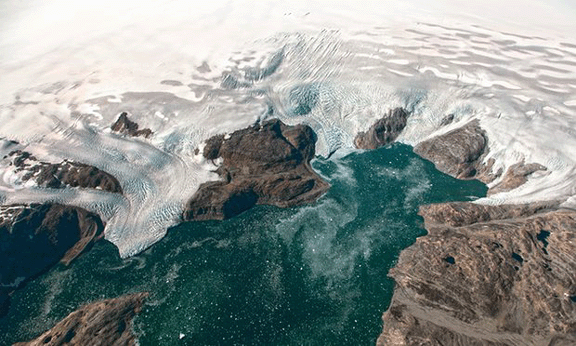
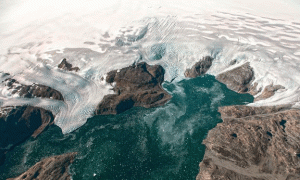 You can’t live in a museum’: the battle for Greenland’s uranium, Guardian, Maurice Walsh, 28 Jan 17 A tiny town in southern Greenland is fighting for its future. Behind it sits one of the world’s largest deposits of uranium. Should a controversial mine get the green light?
………….Since 2009, the island has been an “autonomous administrative division” within Denmark, giving its 56,000 inhabitants control over local resources. The idea of full independence within a generation or two is the dominant theme of local politics – even if the price of breaking free would be an annual Danish subsidy worth some £7,500 a head……
in 2013, the government granted four times the number of exploration licences approved in 2003 – so has the pressure to repeal a 1988 ban on uranium mining: this prevented the extraction of uranium, as well as any minerals that might have uranium as a byproduct. In 2013, after a debate that divided the country,
Greenland’s parliament voted narrowly to repeal the ban.
Kvanefjeld, near Narsaq, is one of many potential mines. Last month, an Australian company was given the green light to begin construction of a zinc and lead mine on the northern coast; there are currently
56 active licences to exploremining for gold, rubies, diamonds, nickel, copper and other minerals elsewhere.
But uranium has made Kvanefjeld the most controversial project, and the focus of a debate about whether this is the economic path that Greenland should pursue. (The most common argument raised against is the danger that radioactive dust will fall on neighbouring settlements and farmland.) An Australian-owned company, Greenland Minerals and Energy (GME), has spent nearly £60m developing a plan for an open pit mine here. It was due to submit an environmental impact assessment by the end of 2016, but the deadline has been extended……….
In a move that sounds counterintuitive, GME is promoting its mine as a contribution to the new global green economy. According to the company, 80% of the commercial deposits in Kvanefjeld are rare earth minerals, commonly used in wind turbines, hybrid cars and lasers; uranium accounts for only 10%. “The market for rare earth minerals is deciding this,” says operations manager Ib Laursen. “Everybody is looking for them. Instead of Greenland being a passive receiver of global warming from the western world, it could contribute to green technology.”
It is a clever pitch. Greenland’s ice sheet has become the benchmark measurement for the march of global warming; research published in September showed that ice loss is accelerating more rapidly than previously feared. Greenland is also the emblematic victim of climate change: Inuit hunters and fishermen are called on in international conferences, to describe how their traditional lifestyles are being destroyed by warming seas.
But what the rest of the world see as creeping ruination, local politicians see as an opportunity. The melting ice sheet will make some minerals more accessible, and reveal others that are so far unknown.
……….Most of the world’s rare earth minerals come from China (six state-owned enterprises control nearly 90% of the planet’s supply), and the scale of environmental degradation there has given open pit mining a bad reputation. Concerned locals in Greenland invoke images of wasted landscapes and pools of toxic and radioactive waste, gleaned from a Google search. Similarly, the history of uranium mining has been one of blithe disregard for the environment……
Laursen.presents his mine as an environmentally friendly alternative to Chinese mines, modelled on international standards of best practice. He says the fears of radioactive dust floating over south Greenland are groundless. The crushed rock discarded once the minerals have been extracted, known as tailings, will be turned into slurry and carried in a pipeline to the bottom of a nearby lake. “It would never surface as dust,” Laursen says: the lake will be sealed in perpetuity by an impermeable dam……..
Frederiksen (sheep farmer) was alert to the dangers of radioactive dust because he had studied sheep farming in Norway in the mid-90s, when animals there were still affected by the fallout from Chernobyl. The scientists said they would remove dust from the mine by sprinkling it with water. “Well, water is usually frozen here in the winter,” Frederiksen tells me now, “so I asked them, ‘How are you going to have water to sprinkle then?’ And they said they would answer that when the environmental impact assessment arrived. When someone asked if it was possible to have no pollution in a mining area, the elderly man told us there had never been mining without pollution.” Frederiksen and Lennert believe most of the sheep farmers oppose the mine, but they avoid too many conversations about it just in case: polarisation risks harmony, and they might need each other in difficult times……….
In the past two elections, the people have decided, by voting for parties that support the uranium mine. Now, Qujaukitsoq says, it is a decision for the government. “Are we hesitant? No. We have no reservations about creating jobs.” For him it is the only way of saving Narsaq from stagnation. Whatever image the rest of the world cherishes, one thing is clear: Greenland will make its own way in the age of climate change.
• Maurice Walsh travelled as part of the Arctic Times Project, an international team exploring the transformation of the Arctic.more https://www.theguardian.com/environment/2017/jan/28/greenland-narsaq-uranium-mine-dividing-town
January 30, 2017
Posted by Christina Macpherson |
AUSTRALIA - NATIONAL, politics international |
Leave a comment
Dennis Matthews , 30 Jan 17 Correspondents to The Advertiser make some useful points about electricity supply (The Advertiser, 30/1/17).
On the issue of the state government being responsible for providing reliable power. A role of privatisation, and outsourcing in general, is to distance governments from such responsibilities. Since electricity privatisation the state government has taken a back seat, being content to blame private providers and the opposition.
However, if the companies that the government put in charge of providing electricity don’t do their job then the government has the responsibility to find someone who can.
It is also important to understand the role of the Essential Services Commission (ESCoSA).
ESCoSA is the successor to the Olsen government’s SAIIR (SA Independent Industry Regulator), whose role was to make privatisation work, which it clearly hasn’t.
January 30, 2017
Posted by Christina Macpherson |
General News |
Leave a comment





 Antinuclear