
The hidden costs households must pay for nuclear disaster in 2011
There’s more to monthly electricity charges than meets the eye. For one thing, there’s a hidden cost.
This is charged to help Tokyo Electric Power Co. and other utilities meet costs for damages arising from the Fukushima nuclear disaster.
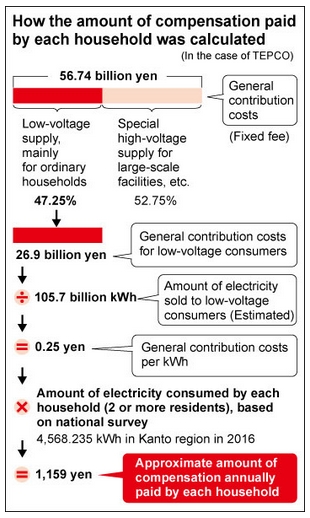
Annual amounts range from an estimated 587 yen ($5.25) to 1,484 yen, and although paltry, may raise eyebrows as the utilities offer no breakdown in their monthly charges.
The utilities are obliged by the government to pitch in on grounds that a kitty is needed in case of future nuclear accidents. But in reality, the money is being swallowed up to help TEPCO pay compensation.
Of the 7.9 trillion yen in estimated compensation costs for the triple meltdown at TEPCO’s Fukushima No. 1 nuclear plant in 2011, as calculated by the government, 5.5 trillion yen is being borne by the company and six other utilities across the nation as “general contribution”…
View original post 665 more words
Robots’ limitations exposed in search for melted nuclear fuel in Fukushima

OKUMA, Fukushima — In an attempt to minimize the risk to humans during the search for melted nuclear fuel at the Fukushima No. 1 Nuclear Power Plant, robots have also been deployed to help out with the task.
However, the robots have also encountered some problems. For instance, a Toshiba Corp. robot that was sent in to clear away deposited material inside the containment vessel of the No. 2 reactor failed to clear away much material, and within approximately two hours, its camera had broken.
According to Takahiro Kimoto of plant operator Tokyo Electric Power Co. (TEPCO), “The radiation inside the containment vessel was so intense that the images transmitted back from a camera attached to the robot were pitch black.” This was somewhat disappointing for the team working at the No. 2 reactor because by losing their robotic “eye” inside the containment vessel, they were unable to make the…
View original post 496 more words
Time to transform Japan’s nuclear plant inspection system
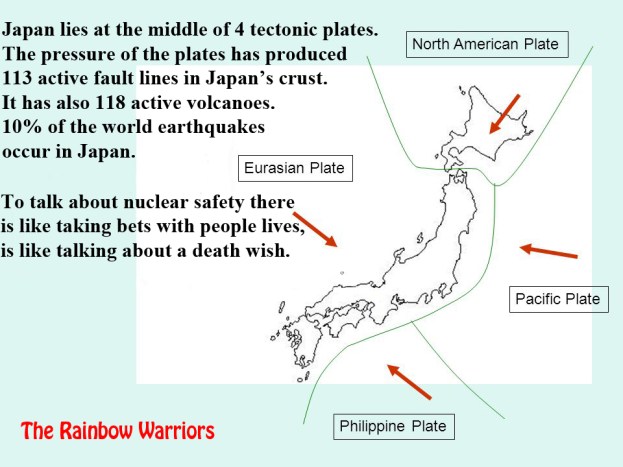
Japan lies at the middle of 4 tectonic plates. The pressure of the plates has produced 113 active fault lines in Japan’s crust. It has also 118 active volcanoes. 10% of the world earthquakes occur in Japan.
To talk about nuclear safety there is like taking bets with people lives, is like talking about a death wish.
The government has submitted to the Diet a bill to revise the Act on the Regulation of Nuclear Source Material, Nuclear Fuel Material and Reactors. The bill includes the introduction of surprise inspections at nuclear plants by inspectors from the Secretariat of the Nuclear Regulation Authority, which would allow them to enter any part of a nuclear plant at any time, as well as a system where the state gives an overall evaluation to each plant based on the results of the inspections and other factors and release the data. These new systems…
View original post 579 more words
Search for melted nuclear fuel at Fukushima plant’s No. 2 reactor faces obstacles

Although nearly six years have passed since the nuclear disaster at the Fukushima No. 1 Nuclear Power Plant in 2011, the search for the melted nuclear fuel inside the plant continues.
The operators of the plant, Tokyo Electric Power Co. (TEPCO), deployed over 800 workers inside the No. 2 reactor at the No. 1 plant between December 2016 and February 2017 — but so far, they have been unable to identify the location of the melted nuclear fuel.
TEPCO also plans to conduct studies inside the No. 1 and No. 3 reactors, but they are surely headed for a rough road as the search for the melted nuclear fuel continues to be extremely difficult. It is likely that struggles in that search will have a negative effect on the government and TEPCO’s target of completing the Fukushima decommissioning work between 2041 and 2051.
Apart from humans, robots have also been…
View original post 583 more words
Proud workers at Fukushima No. 1 nuke plant risk deadly radiation danger

Workers examine the inside of the No. 2 reactor containment vessel at the Fukushima No. 1 Nuclear Power Plant on Jan. 30, 2017.
Tokyo Electric Power Co. (TEPCO) has failed to grasp the entire picture of melted fuel possibly accumulating inside the container vessel of the No. 2 reactor at the Fukushima No. 1 Nuclear Power Plant. The radiation levels inside the vessel are extremely high, to the extent a human could be killed in less than a minute, and even a robot designed to conduct a probe inside went down quckly.
The Mainichi Shimbun visited the disaster-stricken plant late last year ahead of the sixth anniversary of the nuclear meltdowns at the facility in March.
On the early morning of Dec. 24, 2016, a group of 26 workers assembled at a building housing the No. 2 reactor when it was still dark outside. The workers were from heavy machinery…
View original post 418 more words

Media and nuclear – Australia – theme for March 2017
The new media landscape – what does it mean for Australia and nuclear issues? For one thing, the decline in mainstream media means that it’s cheaper and easier for mainstream media, particularly the Murdochracy, to abandon paying for true journalism and just regurgitate propaganda from government and the nuclear industry.

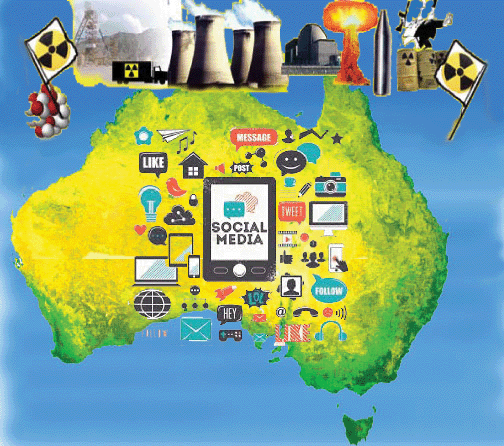
Meanwhile Australia’s pro nuclear lobbyistsare very active, and use sophisticated algorithms to churn out multiple tweets from just one source. Fortunately a lot of these seem quite stupid, spending much time on infantile trolling of Dr Caldicott. Examples: @totterdell91 @thjr19 and a lot of their fake clones, often adopting female names e.g Marcelina, EcoWife
1 This month

of the week – Australians for War Powers Reform (AWPR)
To see nuclear-related stories in greater depth and intensity
 Antinuclear