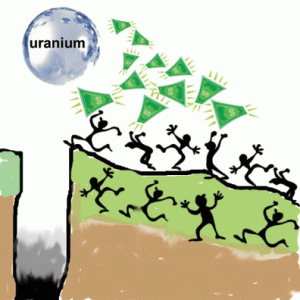
 The Federal Environment Minister Josh Frydenberg has given environmental approval to the Mulga Rock uranium mine in WA this week, just days ahead of the election, despite the lack of cross-party support for this toxic industry, the Australian Greens said.
Australian Greens Co-Deputy Leader and Nuclear Issues spokesperson Senator Scott Ludlam said, “This week’s federal environmental approval for the Mulga Rock uranium project is premature and deeply deficient.”
“This decision is a real departure from the norm with virtually no conditions for the environment, for mine closure and rehabilitation or for the management of radioactive mine waste.
“Frydenberg has set a dangerously low precedent for one of Australia’s most dangerous and toxic industries.
“The Mulga Rock uranium project is in a pristine environment, a Priority Ecological Community and home to many rare and endangered species. The project would use 15 million litres of water a day in one of Australia’s most arid regions, and turn that water into radioactive waste. The threat of radioactive mine waste in the environment will remain for thousands of years.
“With the uranium price sitting at $25 / lb, half the amount needed for the project to break even, there is certainly no immediate prospects for this mine to begin construction.
“This fast tracked approval seems to be driven by the politics of the WA State election rather than evidence and good process” concluded Senator Ludlam..
March 8, 2017
Posted by Christina Macpherson |
uranium, Western Australia |
Leave a comment
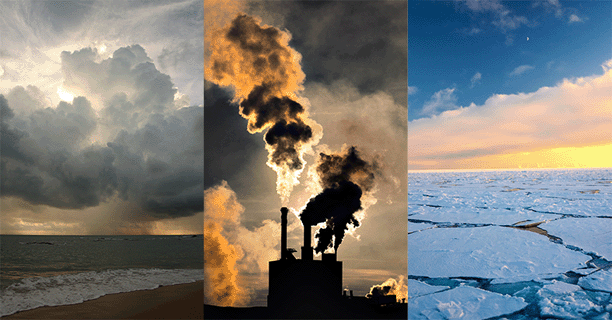
Climate change impact on Australia may be irreversible, five-yearly report says State of the Environment report says heritage and economic activity are being affected and the disadvantaged will be worst hit, Guardian, Katherine Murphy, 7 Mar 17, An independent review of the state of Australia’s environment has found the impacts of climate change are increasing and some of the changes could be irreversible.
The latest State of the Environment report, a scientific snapshot across nine areas released by the federal government every five years, says climate change is altering the structure and function of natural ecosystems in Australia, and is affecting heritage, economic activity and human wellbeing.
It warns climate change will result in “location specific vulnerabilities” and says the most severe impacts will be felt by people who are socially and economically disadvantaged.
Record high water temperatures caused “widespread coral bleaching, habitat destruction and species mortality” in the marine environment between 2011 and 2016, it says.
The minister for energy and the environment, Josh Frydenberg, was due to release the report card on Tuesday morning……
Australia’s heavily populated coastal areas are under pressure, as are “growth areas within urban environments, where human pressure is greatest”, the report finds.
Grazing and invasive species continue to pose a significant threat to biodiversity.
“The main pressures facing the Australian environment today are the same as in 2011: climate change, land use change, habitat fragmentation and degradation, and invasive species,” the report’s summary says. “In addition, the interactions between these and other pressures are resulting in cumulative impacts, amplifying the threats faced by the Australian environment……
The report criticises the lack of “an overarching national policy that establishes a clear vision for the protection and sustainable management of Australia’s environment to the year 2050”.
It points to poor collaboration, gaps in knowledge, data and monitoring and a lack of follow-though from policy to action.
“Providing for a sustainable environment both now and in the future is a national issue requiring leadership and action across all levels of government, business and the community,” it says. “The first step is recognising the importance and value of ecosystem services to our economy and society…….
Late last year, the government established a review of its Direct Actionclimate policy. The current policy has been widely criticised by experts as inadequate if Australia is to meet its international emissions reduction targets under the Paris climate change agreement.
Shortly after establishing the review, Frydenberg ruled out converting the Direct Action scheme to a form of carbon trading after a brief internal revolt. Many experts argue carbon trading would allow Australia to reduce emissions consistent with Paris commitments at least cost to households and businesses……https://www.theguardian.com/environment/2017/mar/07/climate-change-impact-australia-may-be-irreversible-report
March 8, 2017
Posted by Christina Macpherson |
AUSTRALIA - NATIONAL, climate change - global warming |
Leave a comment
A total of 32,760 workers at the Fukushima No. 1 nuclear plant had an annual radiation dose exceeding 5 millisieverts as of the end of January, according to an analysis of Tokyo Electric Power Co. data.
A reading of 5 millisieverts is one of the thresholds of whether nuclear plant workers suffering from leukemia can be eligible for compensation benefits for work-related injuries and illnesses.
Of those workers, 174 had a cumulative radiation dose of more than 100 millisieverts, a level considered to raise the risk of dying after developing cancer by 0.5 percent. Most of the exposure appears to have stemmed from work just after the start of the crisis on March 11, 2011.
The highest reading was 678.8 millisieverts.
Overall, a total of 46,490 workers were exposed to radiation, with the average at 12.7 millisieverts.
The number of workers with an annual dose of over 5 millisieverts increased 34 percent from fiscal 2013 to 6,600 in fiscal 2014, when workloads grew to address the increase in radiation-tainted water at the plant. The number was at 4,223 in the first 10 months of fiscal 2015, which ends this month, on track to mark an annual decline.
A labor standards supervision office in Fukushima Prefecture last October accepted a claim for workers compensation by a man who developed leukemia after working at the plant, the first recognition of cancer linked to work after the meltdowns as a work-related illness. Similar compensation claims have been rejected in three cases so far, according to the labor ministry.
The average radiation dose was higher among Tepco workers at the plant than among workers from subcontractors in fiscal 2010 and 2011. Starting in fiscal 2012, the reading was higher among subcontractor workers than among Tepco workers.
The average dose for subcontractor workers was 1.7 times the level of Tepco workers in fiscal 2013, 2.3 times in fiscal 2014 and 2.5 times in fiscal 2015 as of the end of January.
A separate analysis of data from the Nuclear Regulation Authority showed that the average radiation dose of workers at 15 nuclear power plants across the country, excluding the Fukushima No. 1 and No. 2 plants, fell to 0.22 millisievert in fiscal 2014, when none of the plants was in operation, down 78 percent from 0.99 millisievert in fiscal 2010.
March 8, 2017
Posted by Christina Macpherson |
Uncategorized |
Leave a comment
 Farmers back emissions trading scheme, THE AUSTRALIAN, SARAH MARTIN, 7 Mar 17, Australia’s peak farming group has thrown its support behind a carbon price to fix the country’s energy woes, calling on the government to reconsider its opposition to an emissions intensity scheme in the electricity sector.
In its submission to the Finkel review of the Australian energy market, the National Farmers Federation has warned the agriculture sector is struggling without “secure, reliable and affordable” power supply and urges a bipartisan approach to energy policy.
NFF president Fiona Simson said the sector believed the cheapest path to a low-emissions future was “some form of market-based approach”, which could include an emissions intensity scheme.
“For us it is about having everything on the table; we certainly want security of supply, we want affordable power, we are technology neutral and we know we’re moving towards lower emissions,” Ms Simson said.
“It is just how we can actually put everything on the table to guarantee a long-term national plan facilitating a smooth, reliable transition to lower emissions generation.”……
The federal government has ruled out adopting an EIS.
Chief Scientist Alan Finkel is reviewing the national energy market and is expected to finalise his report to the Council of Australian Governments by mid-year. http://www.theaustralian.com.au/national-affairs/climate/farmers-back-emissions-trading-scheme/news-story/04146e9fba702b03c5730c9034a36af4
The Australian Institute of Architects has told the review government needs to focus on the demand side of the energy equation, arguing that making changes to energy efficiency of buildings could deliver up to 28 per cent of the 2030 emissions reduction target and achieve $20 billion in energy savings.
“Buildings contribute to nearly half of the country’s electricity consumption and the building sector offers a great opportunity for more energy productivity gains,” said institute president Ken Maher.
March 8, 2017
Posted by Christina Macpherson |
AUSTRALIA - NATIONAL, climate change - global warming, politics |
Leave a comment
In addition to increasing the national debt, such a program will require cutting every sector of the civilian side of the budget — housing, transportation, environmental protection, biomedical research, education and health care. For many years, caps on these programs have continued to weaken them. The current proposal will essentially bankrupt the federal contribution to the civilian side of the economy.
The longer-term effects on the national economy are often obscured but will be even more devastating…..
Efforts to communicate to voters the role of weapons contractors in distorting national security policy are getting underway, following the lead of the European-based “Don’t Bank on the Bomb” campaign. Last spring, the Cambridge City Council voted unanimously to request that the Cambridge pension funds divest from stocks in companies involved in the manufacture of nuclear weapons. Subsequently, the US Conference of Mayors passed a supporting resolution. These are small but important first steps in focusing attention on these corporate drivers of dangerous and costly nuclear weapons policies

Trump Is Bankrupting Our Nation to Enrich the War Profiteers, March 06, 2017 By Jonathan King and Richard Krushnic, Truthout | News Analysis President Trump’s calls for a military buildup are opening the fiscal floodgates for congressional hawks and defense industry contractors. On January 27, Trump signed an executive order setting in motion a “great rebuilding of the Armed Forces” that will include new ships, planes and weapons and the “modernization” of the US nuclear arsenal. Presently, more than half of this year’s congressional budget — some $610 billion of our income tax dollars — is allocated to Pentagon accounts, including overseas military operations and nuclear weapons. Continue reading →
March 8, 2017
Posted by Christina Macpherson |
Uncategorized |
Leave a comment
 There is a war on media, and it’s time for journalism teachers to suit up, Crikey, 8 Mar 17, The biggest change for journalism lecturers this semester will be a darkly positive one, writes journalism lecturer at Curtin University Glynn Greensmith. “…….Trust in both politicians and the media is not high. This on-the-nosedness is apparently contributing to the rise of parties like One Nation (their unofficial slogan for the upcoming WA election, “Think Polio & Putin, think Pauline”, needs a little work, to be honest), other minor parties, and a polarising and divisive national discourse. Or, as former chief justice of the Australian High Court Robert French said last month:
“The spaces left by lack of awareness and misunderstanding are all too readily filled by snake oil salesmen coming in from the hinterland of our civil and political discourses.”……..
The one word we may be adding or emphasising in our teaching repertoire in 2017 is courage. The challenge against the means and modus of journalism is now more direct and deliberate than at any time in recent history. Fake news is simply the generation and distribution of knowingly untrue stories in order to garner a sense of misunderstanding and/or money. The co-opted Trump version means ‘If your truth conflicts with my politics, you’re a liar’.
Truth, and how to tell it, are the elements of journalism that media educators have long taken for granted, and taught. The real positive now is that audiences may once again be joining us at this base point for our relationship between journalism and democracy.
To start there is to expect — not hope — that better politicians and politics must follow. To start there is to expect — not hope — that journalism teachers across Australia can talk truth once again this semester, without having to duck to avoid flying lumps of coal. https://www.crikey.com.au/2017/03/08/there-is-a-war-on-media-and-its-time-for-journalism-teachers-to-suit-up/
March 8, 2017
Posted by Christina Macpherson |
General News |
Leave a comment
The tragedy is that all this could have been avoided if we had seized the opportunity in the 1990s to build a unified national grid, with a single authority running transmission networks and the interconnectors between them. This would still allow competition in generation, but would abandon the idea of market incentives in the provision of network services.
The question has been addressed by pollsters in Britain, which provided the model for Australia’s energy reforms. The results show overwhelming public support for renationalisation, even though the electricity industry has been in private ownership for decades. Even a majority of Conservative voters support public ownership.
The issue will have its next electoral test in Western Australia, where the Barnett government is proposing to sell its majority interest in its electricity distribution enterprise Western Power. While nothing is ever certain in politics, current polls suggest the government is headed for defeat.
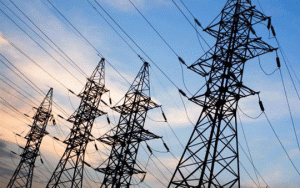 The case for renationalising Australia’s electricity grid https://theconversation.com/the-case-for-renationalising-australias-electricity-grid-73951 John Quiggin Professor, School of Economics, The University of Queensland March 6, 2017 The public debate over the problems of electricity supply displays a curious disconnect. On the one hand, there is virtually universal agreement that the system is in crisis. After 25 years, the promised outcomes of reform – cheaper and more reliable electricity, competitive markets and rational investment decisions – are further away than ever.
On the other hand, proposals to change the situation range from marginal tweaks to politically motivated mischief-making. The preliminary report of the Independent Review into the Future Security of the National Electricity Market, released last year, canvasses such options as the introduction of capacity markets for reserve power, which have done little to resolve problems overseas.
Meanwhile, the Turnbull government has used recent failures to score points against renewable energy (hated, for obscure historical-cultural reasons, by its right-wing base) and to promote the absurd idea of new coal-fired power stations.
A sorry state
This debate might make sense if the system had worked well in the past. In reality, however, the National Electricity Market (NEM) never produced lower prices or more reliable power for households. Continue reading →
March 8, 2017
Posted by Christina Macpherson |
AUSTRALIA - NATIONAL, energy, politics |
Leave a comment
 Lockheed Martin Used Pentagon Dollars to Lobby Congress for Nuclear Weapons Funding One of the uses of the billions of dollars from these contracts is to recycle them back into lobbying the government to push for additional conventional and nuclear weapons spending, as reported by William Hartung and Stephen Miles. Of course, in addition, these funds are used to support a general environment of fear and insecurity, through contributions supporting hawkish think tanks.
Trump Is Bankrupting Our Nation to Enrich the War Profiteers, March 06, 2017 By Jonathan King and Richard Krushnic, Truthout | News Analysis
“……..Corporations that contract with the Department of Defense (DOD) for nuclear weapons complex work do not report revenues and profits from this work separately from their other military work, although they do break up government work from civilian work, and sometimes break up military work from other government work. Hence, it is not possible to determine profits made from nuclear weapons complex work from the annual reports and Securities and Exchange Commission (SEC) filings of large military corporations. However, it is possible to estimate, and to demonstrate how a significant amount of military R&D and production not recorded as nuclear weapons work is in fact partially nuclear weapons work. The nuclear weapons work financed by the US Department of Energy (DOE) is (not surprisingly) carried out in a semi-secret insiders club that insulates it from public knowledge and oversight. The first contracts for the upgrading of the nuclear weapons triads have already been awarded — one to Northrop Grumman — for a new generation of long-range bomber. But the public remains in the dark as to how many tens of billions of their tax dollars will be spent on the project. Continue reading →
March 8, 2017
Posted by Christina Macpherson |
Uncategorized |
Leave a comment
Energy executives say gas market – not windfarms – to blame for South Australia’s woes
Main problem afflicting country’s grid is the lack of clear policy direction from Canberra, witnesses tell Senate inquiry, Guardian, Katherine Murphy, 7 Mar 17, Senior executives from AGL
Energy have given evidence that the main issue causing problems with reliable energy supply in South Australia is “dysfunction” in the gas market – not too many windfarms making the grid unreliable.Executives from AGL told a Senate inquiry in Melbourne on Tuesday they would like to build a new gas-fired power station in South Australia to increase base load capacity in the state, but gas supply was chronically unreliable in the eastern states.
Richard Wrightson, AGL’s general manager of wholesale markets, told Tuesday’s hearing the problem was so dire the company was contemplating building its own LNG hub in Queensland to help secure reliable supply downstream.
“Dysfunction in the gas market is causing most of the systemic problems we are seeing in South Australia,” Wrightson told the Senate select committee into resilience of electricity infrastructure in a warming world.
“We would love to be able to contract more in that marketplace but the main restriction on being able to do that is access to flexible gas contracts that we are able to trade in an out of.”
The Turnbull government has argued that ambitious state-based renewable energy targets are driving too large a share of low-emissions technologies, such as wind power, into the grid, and that is a significant factor behind the unreliable conditions in South Australia.
But a number of witnesses appearing before the Senate committee on Tuesday said the main problem afflicting Australia’s energy grid was not proliferating renewables, but a lack of a clear policy direction from Canberra. The policy vacuum had created a damaging investment strike in new assets at a time when old coal-fired power generators had reached their natural age of retirement.
Ross Garnaut, the economics professor who led the climate change policy review for the Rudd government and was the independent expert adviser to the multi-party climate change committee that developed the carbon pricing scheme subsequently repealed by Tony Abbott, said the political debate about climate and energy policy in Australia was “incoherent”……
The chief scientist, Alan Finkel – the official leading the energy review – has already provided implicit support for an emissions intensity scheme in his preliminary report to the government, saying it would integrate best “with the electricity market’s pricing and risk management framework” and “had the lowest economic costs and the lowest impact on electricity prices”.
But the energy and environment minister, Josh Frydenberg, has already ruled outconverting the government’s existing Direct Action scheme to a form of carbon trading after a brief internal revolt in the Coalition party room.https://www.theguardian.com/environment/2017/mar/07/energy-executives-say-gas-market-not-windfarms-to-blame-for-south-australias-woes
March 8, 2017
Posted by Christina Macpherson |
energy, South Australia |
1 Comment
SA power: Taxpayers should buy gas-fired electricity generator, top economic advisor says, ABC News 8 Mar 17 By political reporter Nick Harmsen The South Australian Government should consider buying or leasing a gas-fired electricity generator to help stabilise the state’s expensive and unreliable power supply, South Australia’s influential Economic Development Board says.
The recommendation was made to the Government late last month, according to evidence given to the SA Parliament’s Statutory Authorities Review Committee.
Board member Goran Roos told the committee in the absence of progress on energy policy at a national level, South Australia should consider going it alone.
“In the medium term, which is one to two years, the South Australian Government should consider direct control of electrical generation facilities either through acquisition or leasing arrangements coupled with long-term back-to-back take-or-pay contracts with end users,” Professor Roos told the committee.
“A suitable facility could be the second … Pelican Point gas turbine.”
The second unit at Pelican Point was mothballed in 2013, and was seldom used until the second half of last year.
The unit controversially remained idle while 90,000 homes and businesses had their power blacked out during load shedding last month.
“ENGIE has argued that the second Pelican Point gas turbine cannot compete with cheaper wind energy and it is commercially unviable to occasionally switch on the gas-fired power plant to meet requirements for a few high-demand days across the year,” Professor Roos said.
“As such, the acquisition costs or lease costs for the second gas turbine should be minimal on an NPD basis, should the Government choose to acquire or lease this facility.
Government should guarantee gas supply
The board has also recommended the Government consider guaranteeing the gas supply of generators on a short-term emergency basis if it believes the national Electricity Market Operator (AEMO) is failing to protect the state’s supply…….http://www.abc.net.au/news/2017-03-07/taxpayers-should-buy-gas-fired-power-station/8331228
March 8, 2017
Posted by Christina Macpherson |
energy, South Australia |
Leave a comment








 Antinuclear