6 Years Ongoing Fukushima Catastrophe

View original post 197 more words
Australia’s CSG industry — no longer such a gas

Australia’s controversial coal seam gas industry faces a deeply uncertain future. Environment editor Sandi Keane provides the full picture.
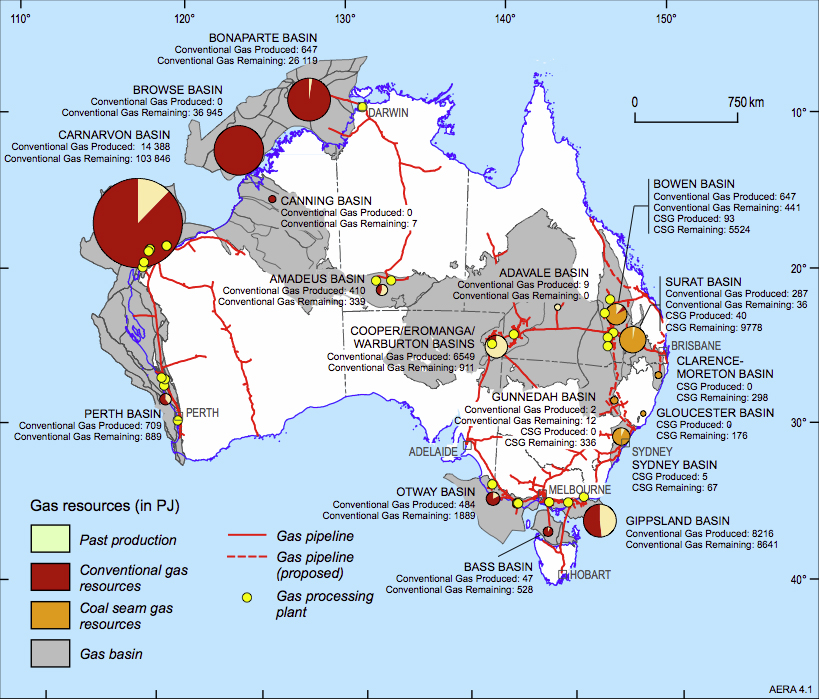
RISING GAS PRICES, the pitched battle over CSG between farmers and miners, the US threat to LNG’s $13.2 billionexport bonanza – are all set to spill over into the Federal election campaign. The Greens and Bob Katter are looking to capitalise.
The CSG industry’s hope of rivalling Qatar as the world’s biggest exporter of LNG could be snookered on a couple of fronts — the twin threat to Australia’s competitiveness in the face of a glut of natural gas from the US and the failure to overcome bitter resistance from farmers in key CSG tenements.
Thanks to world-leading extraction technology, oil and gas from the US’s massive shale reserves may see it regain its former “energy super power” title according to…
View original post 2,188 more words
Financial crunch time looms for Fukushima’s ‘voluntary evacuees’
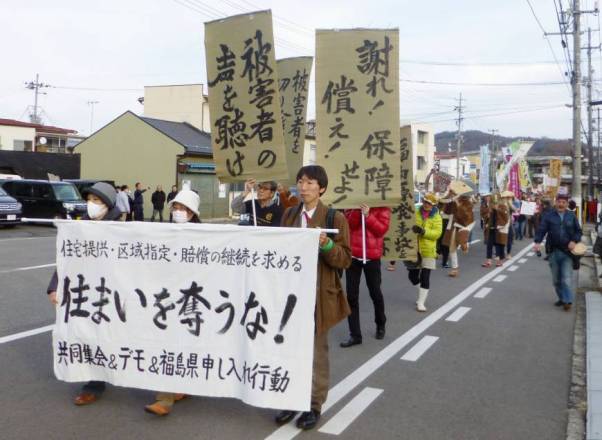
People march through the city of Fukushima in December to protest the impending end of housing subsidies for those who fled the nuclear disaster from areas other than the government-designated evacuation zones.
This month, housing subsidies run out for those who fled the Fukushima nuclear disaster from areas other than the government-designated evacuation zones, and as the clock ticks down, evacuees have had to decide whether to return or move once again.
Many of these so-called voluntary evacuees are mothers seeking to avoid risking their children’s health while their husbands remain in radiation-hit Fukushima Prefecture, according to freelance journalist Chia Yoshida.
This is why the term “voluntary evacuee” is misleading, as it gives the impression that they fled Fukushima for selfish reasons, Yoshida told a news conference in January in Tokyo.
At the same news conference, another journalist proposed using the term “domestic refugee” to describe them.
The Fukushima Prefectural…
View original post 767 more words
Fukushima: The Earthquake Question

The general view is the Fukushima reactor meltdowns in japan in 2011 were caused by the tsunami that knocked out backup power to the atomic plant. Nuclear engineers say it is not the full story.
Six years after the nuclear disaster in Fukushima, engineers remain vexed by a key question: What damage did the massive earthquake cause at the atomic plant before it was hit by the subsequent tsunami?
The answer matters because of the potential implications for the earthquake safety standards of other nuclear reactors in Japan, which sits on the seismically unstable Ring of Fire around the Pacific. The area accounts for about 90% of the planet’s earthquakes, with Japan being shaken by 10% of them, according to the US Geological Survey.
Just three out of Japan’s 42 usable reactors are running at present, as operators seek to clear regulatory, safety and legal hurdles and overcome community…
View original post 1,298 more words
2 TEPCO affiliates get tax exemption approval under disaster aid system
 Two Tokyo Electric Power Co. (TEPCO) affiliates received Fukushima gubernatorial approval for tax breaks designed to help local businesses affected by the Fukushima nuclear disaster, it has been learned.
The firms applied for the local tax exemptions with the Fukushima Prefectural Government. Under the disaster relief tax break system, the amounts exempted are covered by the reconstruction budget. However, in the case of the TEPCO affiliates, it means reconstruction funds will flow to firms associated with the very company that caused the nuclear disaster.
“It is wrong to give them (the TEPCO affiliates) preferential treatment from the standpoint of public sentiment,” one critic said.
The two companies are Kandenko Co., an engineering and construction company based in Tokyo’s Minato Ward, and Chuo Ward-based Tokyo Energy & Systems Inc., which does maintenance and other work. Both firms have been engaged in projects to decommission the crippled Fukushima No. 1 nuclear plant.
View original post 383 more words
1 This month

of the week – Australians for War Powers Reform (AWPR)
To see nuclear-related stories in greater depth and intensity
 Antinuclear