Fukushima nuclear facility not under control- failure of cleanup
Dying robots and failing hope: Fukushima clean-up falters six years after tsunami
Exploration work inside the nuclear plant’s failed reactors has barely begun, with the scale of the task described as ‘almost beyond comprehension’, Guardian, Justin McCurry at Fukushima Daiichi nuclear power plant, 9 Mar 17. B
Barely a fifth of the way into their mission, the engineers monitoring the Scorpion’s progress conceded defeat. With a remote-controlled snip of its cable, the latest robot sent into the bowels of one of Fukushima Daiichi’s damaged reactors was cut loose, its progress stalled by lumps of fuel that overheated when the nuclear plant suffered a triple meltdown six years ago this week.
As the 60cm-long Toshiba robot, equipped with a pair of cameras and sensors to gauge radiation levels was left to its fate last month, the plant’s operator, Tokyo Electric Power (Tepco), attempted to play down the failure of yet another reconnaissance mission to determine the exact location and condition of the melted fuel.
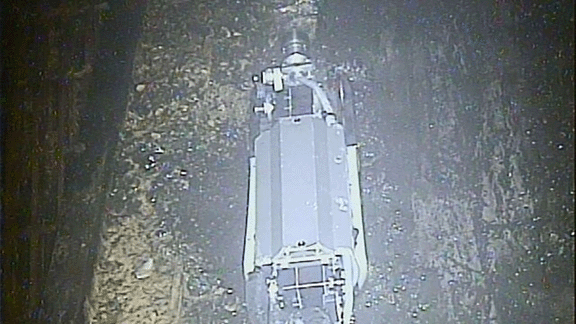
Even though its mission had been aborted, the utility said, “valuable information was obtained which will help us determine the methods to eventually remove fuel debris”.
The Scorpion mishap, two hours into an exploration that was supposed to last 10 hours, underlined the scale and difficulty of decommissioning Fukushima Daiichi – an unprecedented undertaking one expert has described as “almost beyond comprehension”.
Cleaning up the plant, scene of the world’s worst nuclear disaster since Chernobyl after it was struck by a magnitude-9 earthquake and tsunami on the afternoon of 11 March 2011, is expected to take 30 to 40 years, at a cost Japan’s trade and industry ministry recently estimated at 21.5tr yen ($189bn).
The device, along with other robots, may also have been damaged by an unseen enemy: radiation. Before it was abandoned, its dosimeter indicated that radiation levels inside the No 2 containment vessel were at 250 sieverts an hour. In an earlier probe using a remote-controlled camera, radiation at about the same spot was as high as 650 sieverts an hour – enough to kill a human within a minute.
Robotic mishaps aside, exploration work in the two other reactors, where radiation levels are even higher than in reactor No 2, has barely begun. There are plans to send a tiny waterproof robot into reactor No 1 in the next few weeks, but no date has been set for the more seriously damaged reactor No 3………
‘The situation is not under control’
On the surface, much has changed since the Guardian’s first visit to Fukushima Daiichi five years ago. Then, the site was still strewn with tsunami wreckage. Hoses, pipes and building materials covered the ground, as thousands of workers braved high radiation levels to bring a semblance of order to the scene of a nuclear disaster.
Six years later, damaged reactor buildings have been reinforced, and more than 1,300 spent fuel assemblies have been safely removed from a storage pool in reactor No 4. The ground has been covered with a special coating to prevent rainwater from adding to Tepco’s water-management woes.
Workers who once had to change into protective gear before they approached Fukushima Daiichi now wear light clothing and simple surgical masks in most areas of the plant. The 6,000 workers, including thousands of contract staff, can now eat hot meals and take breaks at a “rest house” that opened in 2015.
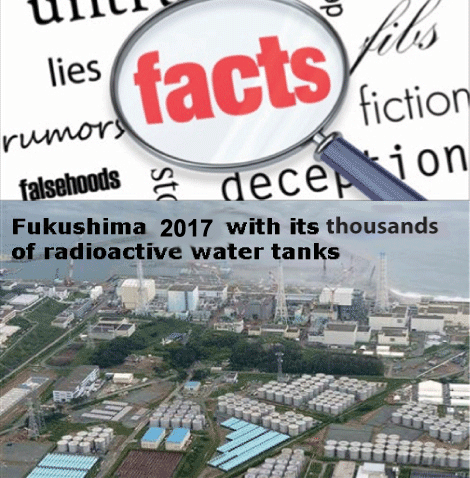
But further up the hill from the coastline, row upon row of steel tanks are a reminder of the decommissioning effort’s other great nemesis: contaminated water. The tanks now hold about 900,000 tons of water, with the quantity soon expected to reach 1m tons.
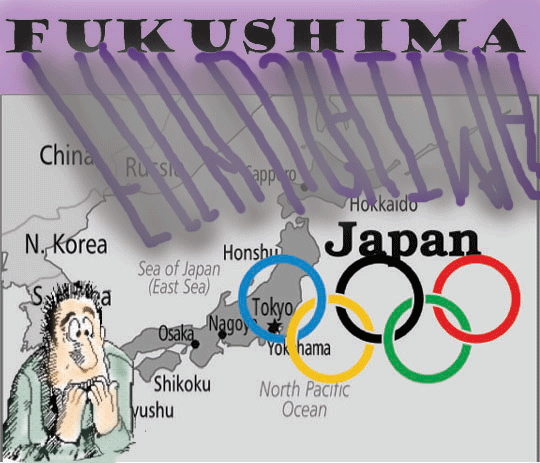
Critics of the clean-up note that 2020 is the year Tokyo is due to host the Olympics, having been awarded the Games after Abe assured the International Olympic Committee that Fukushima was “under control”.
Mitsuhiko Tanaka, a former Babcock-Hitachi nuclear engineer, accuses Abe and other government officials of playing down the severity of the decommissioning challenge in an attempt to win public support for the restart of nuclear reactors across the country.
“Abe said Fukushima was under control when he went overseas to promote the Tokyo Olympics, but he never said anything like that in Japan,” says Tanaka. “Anyone here could see that the situation was not under control.
No comments yet.
1 This month

of the week – Australians for War Powers Reform (AWPR)
To see nuclear-related stories in greater depth and intensity
 Antinuclear
Leave a comment