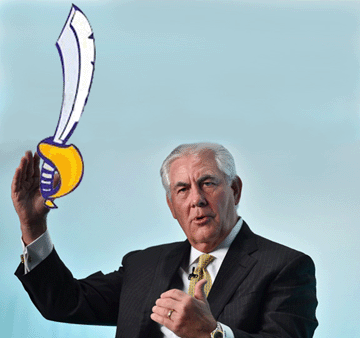
US Secretary of State Rex W. Tillerson rejects any negotiation with North Korea
In Asia, on his first major trip overseas as secretary of state, Mr. Tillerson has been heavily scripted in his few public comments, and he has gone out of his way to make sure he is not subject to questions beyond highly controlled news conferences, at which his staff chooses the questioners. In a breach of past practice, he traveled without the usual State Department press corps, which has flown on the secretary’s plane for roughly half a century.
Rex Tillerson Rejects Talks With North Korea on Nuclear Program, NYT, By DAVID E. SANGER MARCH 17, 2017 SEOUL, South Korea — Secretary of State Rex W. Tillerson ruled out on Friday opening any negotiation with North Korea to freeze its nuclear and missile programs and said for the first time that the Trump administration might be forced to take pre-emptive action “if they elevate the threat of their weapons program” to an unacceptable level.
Mr. Tillerson’s comments in Seoul, a day before he travels to Beijing to meet Chinese leaders, explicitly rejected any return to the bargaining table in an effort to buy time by halting North Korea’s accelerating testing program. The country’s leader, Kim Jong-un, said on New Year’s Day that North Korea was in the “final stage” of preparation for the first launch of an intercontinental ballistic missile that could reach the United States.
The secretary of state’s comments were the Trump administration’s first public hint at the options being considered, and they made clear that none involved a negotiated settlement or waiting for the North Korean government to collapse……Mr. Tillerson’s tougher line was echoed by President Trump on Twitter later Friday. “North Korea is behaving very badly,” he posted. “They have been “playing” the United States for years. China has done little to help!”
Almost exactly a year ago, when Mr. Trump was still a candidate, he threatened in an interview with The New York Times to pull troops back from the Pacific region unless South Korea and Japan paid a greater share of the cost of keeping them there. During Mr. Tillerson’s stops in South Korea and Japan, there was no public talk of that demand……..
Among many experts, the idea of a freeze has been favored as the least terrible of a series of bad options. Jon Wolfsthal, a nuclear expert who worked on Mr. Obama’s National Security Council, and Toby Dalton wrote recently in Politico, “A temporary freeze on missile and nuclear developments sounds better than an unconstrained and growing threat. It is also, possibly, the most logical and necessary first step toward an overall agreement between the U.S. and North Korea. But the risk that North Korea will cheat or hide facilities during a negotiated freeze is great.”
William J. Perry, who was secretary of defense under President Bill Clinton, argued in Beijing on Friday that it was no longer realistic to expect North Korea to commit to dismantling or surrendering its nuclear arsenal. The Trump administration, he said, should instead focus on persuading the North to commit to a long-term freeze in which it suspends testing of nuclear weapons and long-range missiles and pledges not to sell or transfer any of its nuclear technology.
“If we begin to negotiate again, it ought to be around a goal which has some chance of success,” he said.
Mr. Perry said the Trump administration would have to offer North Korea security assurances if it wanted to escape an increasingly dangerous spiral of confrontation. Previous administrations had mistakenly based their policies on the assumption that North Korea would collapse on their watch, Mr. Perry told a small group of reporters.
“I see very little prospect of a collapse,” he said.
“For eight years in the Obama administration and eight years in the Bush administration, they were expecting that to happen. As a consequence, their policies were not very effective. I would think that the United States and other countries as well should stop expecting a collapse in North Korea.”
Mr. Perry said that American policy makers needed to grasp that North Korea’s leaders regarded their own survival in power, and especially the continuation of the Kim dynasty, as more important than improving the economy. He said that as long as the goal of the United States remained completely eliminating North Korea’s nuclear weapons, “I think we will continue to be unsuccessful.”
“It will take initiative, primarily by the United States, to be willing to talk with North Korea,” he said.
In Asia, on his first major trip overseas as secretary of state, Mr. Tillerson has been heavily scripted in his few public comments, and he has gone out of his way to make sure he is not subject to questions beyond highly controlled news conferences, at which his staff chooses the questioners. In a breach of past practice, he traveled without the usual State Department press corps, which has flown on the secretary’s plane for roughly half a century.That group of reporters, many of them veterans of foreign policy and national security coverage, use the plane rides to try to get the secretary and other top State Department officials to explain American policy. Mr. Tillerson’s aides first said their plane was too small to accommodate the press corps and later said they were experimenting with new forms of coverage; then they opened a seat for a reporter from the web-based Independent Journal Review, which is aimed at younger, conservative-leaning readers. The site’s reporters have never traveled with the secretary before. There is also no “pool” reporter aboard, providing updates on the secretary’s activities to the rest of the press corps
That decision is a striking departure for the State Department. Last May, department officials protested when Egypt’s military leader, Gen. Abdel Fattah el-Sisi, blocked pool reporters traveling with Secretary John Kerry from entering the presidential palace, and China frequently imposes similar restrictions to avoid unwanted questions to the Chinese leadership. (There is no news conference scheduled in China on Saturday.)
Mr. Tillerson appears to be using similar tactics during his travels, though the two news conferences he held on the trip were his first since taking office at the beginning of February.
Related
March 18, 2017 - Posted by Christina Macpherson | Uncategorized
No comments yet.
1 This month

of the week – Disrupting War & Militarism in Oceania. Active solidarity. Radical practice.
Pages
- 1 This month
- Disclaimer
- Kimba waste dump Submissions
- – Alternative media
- – marketing nuclear power
- business and costs
- – Spinbuster 2011
- Nuclear and Uranium Spinbuster – theme for June 2013
- economics
- health
- radiation – ionising
- safety
- Aborigines
- Audiovisual
- Autralia’s Anti Nuclear Movement – Successes
- climate change – global warming
- energy
- environment
- Fukushima Facts
- future Australia
- HEALTH and ENVIRONMENT – post Fukushma
- media Australia
- Peace movement
- politics
- religion – Australia
- religion and ethics
- Religion and Ethics
- secrets and lies
- Spinbuster
- spinbuster
- wastes
- ethics and nuclear power – Australia
- nuclear medicine
- politics – election 2010
- secrecy – Australia
- SUBMISSIONS to 2019 INQUIRIES
- weapons and war
- Follow Antinuclear on WordPress.com
Blogroll
Categories
- 1
- ACTION
- Audiovisual
- AUSTRALIA – NATIONAL
- Christina reviews
- Christina themes
- Fukushima
- Fukushima 2022
- General News
- Japan
- Olympic Dam
- Opposition to nuclear
- reference
- religion and ethics
- Resources
- TOPICS
- aboriginal issues
- art and culture
- business
- civil liberties
- climate change – global warming
- culture
- energy
- environment
- health
- history
- legal
- media
- opposition to nuclear
- people
- personal stories
- politics
- politics international
- religion and ethics
- safety
- secrets and lies
- spinbuster
- technology
- uranium
- wastes
- weapons and war
- water
- Weekly Newsletter
- Wikileaks
- women
Leave a comment
