Turnbull warns party faithful against drift to the right, Adam Carey, Eryk Bagshaw, The Age, 2 Apr 17,
Malcolm Turnbull has stared down the right-wing of his own party which has hamstrung his leadership and asserted that the Liberals should be the party of the “sensible centre”…….
The party’s [Victorian] state council passed three motions to adopt new federal policies:…….
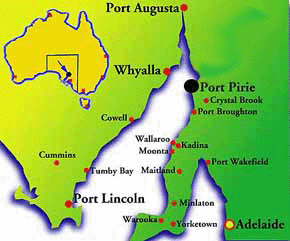
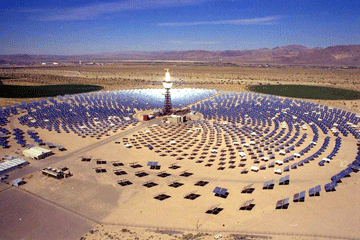
Port Augusta mayor Sam Johnson ‘absolutely ecstatic’ solar power plant will be finally funded Adam Langenberg, Political reporter, Sunday Mail (SA) April 2, 2017 THE city at the centre of South Australia’s power crisis is “buzzing” after a highly anticipated plan to build a 100MW solar thermal plant took one huge leap closer to reality.
Excited locals say the promise of a $110 million concessional loan to proponents is “absolutely huge” and transformative for the city, while project backers say the State Government must award its power supply contract to provide certainty.
Mayor Sam Johnson said he was “absolutely ecstatic” the project was a step closer but he took a shot at the Federal Government for only delivering on its promise as part of a deal with Senator Xenophon to support its company tax cut package.
“There was certainly a buzz around town because it’s no secret we’ve had a few bad shots in the arm in the last 18 months,’’ Mr Johnson said.
“We’re looking for that positivity and we know we can deliver the next chapter.”
Senator Xenophon said Prime Minister Malcolm Turnbull had assured him the project “was a goer” and welcomed the Government’s clear commitment to solar thermal generation at Port Augusta. “It will transform the town and be a beacon of hope. It will also change the way we look at energy, by providing virtual baseload with a molten salt storage,” Senator Xenophon said. “I just want it to happen. I’m happy to work with the Prime Minister………
..Repower Port Augusta Dan Spencer reiterated both proponents, SolarReserve and Solarstor, needed to clinch an electricity supply deal with the State Government before progressing further.
“It puts the ball right in Jay’s (Premier Weatherill) court,” Mr Spencer said.
“They’ve got the guarantee of the federal loan so they can lock it in now by providing the power contract.”
Watch out, Gold Coast, climate change is pushing cyclones further South Cyclone the size of Debbie could be catastrophic for Gold Coast, modelling shows, The Age, Eryk Bagshaw, 2 Apr 17,
A cyclone the size of Debbie could have catastrophic consequences on the Gold Coast, new modelling has shown, as climate change pushes cyclones further south and puts tens of billions of dollars worth of infrastructure at risk.
Under modelling compiled by Deloitte’s principal actuary Sharanjit Paddam and James Cook University, a shift in the cyclone-prone region of just three degrees would cause winds in excess of 260km/h to hit the Gold Coast and stretch as far as Brisbane, where many homes and towers do not meet cyclonic safety standards.
The “sting in the tail” of ex-Cyclone Debbie battered the Gold Coast this week with winds half as strong as those that hit Bowen and Proserpine, along with torrential downpours. Continue reading →
Britain’s airports and nuclear power stations have been placed on a terror alert following increased threats to electronic security systems. Security services have issued a series of alerts in the past 24 hours, warning airports and nuclear power plants to tighten their defences against terror attacks.
Intelligence agencies fear ISIS and other terrorist groups could have developed ways to plant explosives in laptops and mobile phones which can bypass airport security screening methods, the Telegraph reports. Last month, Britain and the US banned travellers from a number of countries carrying laptops and large electronic devices on board.
They also fear terrorists, foreign spies and hackers could try to break into nuclear power station security systems.
Jesse Norman, the energy minister, said nuclear plants must ensure they ‘remain resilient to evolving cyber threats’.
Mr Norman told the paper: ‘The Government is fully committed to defending the UK against cyber threats, with a £1.9 billion investment designed to transform this country’s cyber security.’
Terrorists are feared to have developed the technology after getting hold of airport screening equipment allowing them to experiment.
FBI experts have tested how explosives can be hidden inside laptop battery compartments so that it can still be turned on.They are said to have concluded that the technique would be achievable using everyday equipment.
In a statement, the US Department of Homeland Security said: ‘Evaluated intelligence indicates that terrorist groups continue to target commercial aviation, to include smuggling explosive devices in electronics.
‘The US government continually reassesses existing intelligence and collects new intelligence. ‘This allows us to constantly evaluate our aviation security processes and policies and make enhancements when they are deemed necessary to keep passengers safe.’
Last year al-Shabaab, an al-Qaeda affiliate group in Somalia, detonated a bomb on a flight from Mogadishu to Djibouti by hiding it in a part of a laptop where bomb-makers had removed a DVD drive.
Power games: The quick fix and unanswered questions on electricity, The Age Adam Morton 2 Apr 17,
Let’s assume that at some point in February next year it will reach 45 degrees in south-east Australia.
Let’s assume it will be more than 43 degrees for three days running. Let’s assume you are unlucky and the temperature tops 40 degrees for a week or more……..
As the climate control kicks in, home solar systems are also firing up. At the turn of the decade, rooftop solar panels were a novelty. Now, more than 1.5 million households have them. They provide some relief for the stretched electricity grid.
And the grid needs all the relief it can get. Like most of us, electricity infrastructure performs less well when it is hot. This applies to the ageing equipment in creaking old coal plants and gas-fired turbines. Some break down as the temperature rises. It also applies to solar photovoltaic panels, some of which lose nearly a fifth of their capacity as the temperature goes past 40……..
the extraordinary weather conditions means the annual threat of bushfire – which could knock out transmission lines and possibly affect generators – remains constant………
The scenario above is the picture today, but it will almost certainly have changed again by next summer. The energy industry has been acting as though on fast-forward over the past fortnight, and shows no sign of slowing down.
The Clean Energy Council says there is more than $5.5 billion worth of renewable energy projects under construction this year. On Thursday, Lyon Solar added plans for a $1 billion solar and battery plant in South Australia’s Riverland to be in place by next summer. Billed as the biggest of its type in the world, it includes a 330 megawatt solar farm and 100 megawatt battery system with four hours’ storage – enough, proponents say, to potentially make concerns about South Australia and Victoria’s supply redundant.
This is independent of the Weatherill government’s quick tender for Australia’s first large-scale battery system that could – if Tesla mogul Elon Musk is to be believed – be built in 100 days. It is one of a number of steps planned by the South Australian government. Less headline grabbing, but possibly just as important, is that Premier Jay Weatherill has assured the public there will be 200 megawatts of emergency back-up in place. Almost certainly, it will be met by bringing in cheap, reliable and emissions-intensive diesel generators. This was the path Tasmania took when its hydro dams were running low and the Basslink cable to Victoria was broken last year. It might seem antiquated, but works.
The Victorian government has also promised a battery tender, aiming to have 50 megawatts – enough to power a couple of regional cities for four hours – before Christmas. Another 50 is expected to follow in 2018……..
The ignored opportunity
Perhaps because it has no champion among industry or regulators, the potentially significant scope to quickly reduce electricity demand through smarter use of technology remains little explored.
A paper released last week by the awkwardly named Energy Efficiency Certificate Creators Association makes the case for the savings possible by cutting waste.
Victoria has been a leader in this area with an energy efficiency scheme that, until the Coalition walked away before the last election, had bipartisan support. Ric Brazzale, managing director of Green Energy Markets, estimates the cleaner lights and appliances it helped install last year alone reduced demand by about 120 megawatts – the equivalent of a small power plant.
Advocates want incentives for businesses to reduce production when necessary and to upgrade substandard equipment – think boilers, airconditioners, fridges and insulation. At a household level, the call is for greater support to install better whitegoods and battery packs.
Small steps can make a significant difference. Replacing old lights with LEDs, for example, can cut electricity consumption from that device by up to 80 per cent.
Unanswered questions
Better demand management will help, but it won’t avoid the need for more generation. The big, unaddressed question is what will the response be when the next large coal power plant closes – and the next one after that, and so on.
Australia has 23 remaining coal generators. As the federal government acknowledges, several more may shut over the next decade. According to modelling for the Climate Change Authority, all would need to be gone and replaced by cleaner technology by 2035 if Australia is to play its part under the Paris deal to keep global warming below 2 degrees.
Reviews into electricity security (by chief scientist Alan Finkel) and climate policy (by the Environment Department) are under way, but the government is fundamentally divided on the need to do anything. It is hard to see where it lands.
Nationally, the only significant large-scale policy designed to drive energy investment beyond this decade is Victoria’s ambitious and contested renewable energy target, which aims to build enough wind and solar farms to deliver 40 per cent of the state’s electricity needs by 2025. (The ACT has also a renewable target, but in other states the goals are purely aspirational.)
The Andrews government has not said what it thinks the rapid growth in clean energy means for the Latrobe Valley’s three remaining coal plants – Yallourn, Loy Yang A and Loy Yang B. The state opposition plans to abolish the renewable target if it wins power next year, but it hasn’t said what, if anything, it would do in its place. It has hinted it may subsidise coal plants to keep them open.
Survivors Speak Out As UN Negotiates Nuke Ban, Huffington Post, By Ariel Conn,31 Mar 17 “…….A Nuclear Rallying Cry
Not surprisingly, the horror of the effect nuclear bombs have on children provides some of the most compelling arguments for a ban treaty.
Fujimori Toshiki, a Hibakusha (survivor of the bombs dropped on Japan), described his personal experience to the General Assembly at the very start of the negotiations. He was a baby at the time, and he and his mother were just far enough away from the blast that a two-story home protected them somewhat.
“I had my entire body covered with bandages,” said Toshiki, “with only eyes, nose, and mouth uncovered. Everybody thought I would die over time. Yet, I survived. It is a miracle. I am here at the U.N., asking for an abolition of nuclear weapons. I am convinced that this is a mission I am given as a survivor of the atomic bomb.”
His 13-year-old sister was not so lucky. She was one of 6,300 teenagers to die near the blast site because their schools had sent them there to help “create firesafe [sic] areas against air raids.”
Toshiki added, “Every year, on Aug. 6, my mother would gather all of us children and would talk to us about her experience in tears. I once asked my mother why she would speak about it if recalling the experience makes her suffer. ‘I can’t make you go through the same experience.’ That was her answer. Her tears were her heartfelt appeal. She called, as a mother, for a world with no more hell on earth.”
Setsuko Thurlow, another Hibakusha, was also 13 when the bombs fell. She described witnessing the slow death of her 4-year-old nephew Eiji. He was “transformed into a charred, blackened and swollen child who kept asking in a faint voice for water until he died in agony.”
Thurlow continued, “Regardless of the passage of time, he remains in my memory as a 4-year-old child who came to represent all the innocent children of the world. And it is this death of innocents that has been the driving force for me to continue my struggle against the ultimate evil of nuclear weapons.”
However, unlike the stories of landmines and cluster munitions, which told of present-day children suffering and dying, these stories are over 70 years old. It can be difficult to relate to events that happened so long ago and that most people believe has not ― and cannot ― be repeated.
But Sue Coleman-Haseldine told the assembly of stories and concerns that were more recent. Coleman-Haseldine is an Aboriginal who lived near the atomic weapons testing sites in Australia. She was two when the testing first began in the 1950s.
“Our district is full of cancer now,” she said.
She continued, “I grew up hearing about the bombs, but I didn’t know about how the sickness went through the generations. When mining companies started eyeing off areas of my country I started to look more into it and I went to an Australian Nuclear Free Alliance meeting to learn more about fighting mining companies but also radiation fallout. What I learnt devastated me. To find out that our bush foods were possibly contaminated was a real blow to me.”
“Tell politicians it is no longer okay to stand by a giant coal mine and say “this is good for my electorate”.”
Blair Palese, chief executive officer, 350org Australia
“There are many reasons to oppose the mine, said speakers at the event, which was organised by Stop Adani, a coalition of groups including 350org, the Australian Conservation Foundation, the Australian Youth Climate Coalition and the Seed Indigenous Youth Climate Network.
“First, there is the environmental impact of the project. …
“Stranded assets and rights violations
“Danny Kennedy, a clean energy entrepreneur and founder of solar firm Sungevity, added that there is absolutely no economic case for the Adani project, from the perspective of job seekers and investors alike. …
“Amelia Telford, national co-director of the indigenous Seed climate network, said: “We feel the pain of future generations that are inheriting this mess.” ““We cannot stand by and let Adani trample over our land,” she added. … “
‘One of the biggest threats to Australia’s beloved Great Barrier Reef, Adani’s Carmichael coal mine is weeks away from being finalised. Concerned citizens have no time to lose in opposing it, say activists.’Vaidehi Shah
While those who want to argue whether climate change is real or some sort of Chinese conspiracy, those with real money at risk have moved on. The science is accepted, they have plenty of evidence to back up their own concerns, and now they want to find a way to deal with the financial repercussions.
Last year, after some extreme weather, a string of houses were left hanging in mid-air. The beach, and backyards, of these homes had simply disappeared.
It grabbed our attention. But it also grabbed the attention of the banks that had lent money to those homeowners and tens of thousands of others who like to live next to the beach.
If you’re a bank, you want to make sure that the people who you lend cash to can repay it.
That means taking into account their income levels as well as the value of the asset they’re purchasing.
There’s not much sense in giving someone a $500,000 mortgage that may be falling in value. In the case of a problem with repayments, and the bank is forced to sell the property, then there’s no chance it will get its money back.
Perfect banking sense. And so it is perfect banking sense to start taking into account the threat posed by climate change.
In the case of the homes on that Sydney beach, if climate change is washing away part of the property then — by definition — the value of that property is falling. Indeed, the property is actually getting smaller as it is swept out to sea.
So you would not be surprised to know that the nation’s banks are starting to look at what climate change might mean to the values of the assets that underpin the best part of $1.5 trillion in mortgages.
There is a growing risk that if your home loses value due to climate change — it’s in a flood-prone area, it’s not very high above sea level, it’s surrounded by increasingly bushfire-prone forests — then how much you can borrow could be curtailed.
You also shouldn’t be surprised that the insurance sector is also looking very closely at what climate change-induced events may mean for its coverage and its fees. Continue reading →
Survivors Speak Out As UN Negotiates Nuke Ban, Huffington Post, By Ariel Conn,31 Mar 17
“[My nephew was] transformed into a charred, blackened and swollen child who kept asking in a faint voice for water until he died in agony.”
To imagine innocence is to picture children playing. As such, most people and governments are horrified by the idea of children and other helpless civilians suffering and dying, even during war. Finding a way to prevent the unnecessary slaughter of innocents has brought over 115 countries to the United Nations in New York this week to begin negotiations of a historic treaty that would, once and for all, ban nuclear weapons.
The countries are united by concerns that tens or even hundreds of thousands of innocent men, women and children – mothers, sons, fathers, daughters, aunts, uncles, cousins, friends and neighbors – could be killed, quite literally, in a flash.
In a statement to the opening of negotiations, Peter Maurer, president of the International Committee of the Red Cross, or ICRC, said, “The prohibition and elimination of nuclear weapons is a humanitarian imperative.”
Responding to a Humanitarian Imperative
A ban on nuclear weapons is certainly historic, but it’s not without precedence. Prohibiting and eliminating other weapons because of their horrific humanitarian consequences has happened before. In fact, most of the world’s deadliest weapons are currently banned.
At a press conference, Beatrice Fihn, executive director of the International Campaign to Abolish Nuclear Weapons, ICAN, said, “The treaty will finally ban weapons designed to indiscriminately kill civilians, completing the prohibitions on weapons of mass destruction.”
For example, when adults around the world learned of the tens of thousands of children killed by landmines while simply pursuing childhood activities, such as playing in open fields, a global cry arose to bring an end to the indiscriminate weapons. In 1997, 133 countries signed the Mine Ban Treaty, and as of today 162 have signed. According to the International Campaign to Ban Landmines, “only 35 states remain outside the treaty, but most of them do not actually use or produce antipersonnel mines.”
A similar rallying cry heralded the Convention on Cluster Munitions. Cluster munitions often landed without exploding and remained unstable. Their toy-like appearance attracted thousands of children, who were killed and maimed by the weapons. The treaty was adopted in 2008 and is described by clusterconvention.org as an “international treaty of more than 100 States that addresses the humanitarian consequences and unacceptable harm caused to civilians by cluster munitions.”
Today, most countries abide by these treaties, and even countries like the United States, which has not signed either treaty, is either mostly in compliance or is showing signs of improvement………
Relegating Nukes to History A common concern about these negotiations is the notable absence of the nuclear states. However, history, as seen with the landmine and cluster munitions treaties, gives those supporting the negotiations reason to hope.
In his statement for the ICRC, Maurer added, “Of course, adopting a treaty to prohibit nuclear weapons will not make them immediately disappear. But it will reinforce the stigma against their use, support commitments to nuclear risk reduction, and be a disincentive for proliferation. … As with chemical and biological weapons, a clear and unambiguous prohibition is the cornerstone of their elimination.”
Susi Snyder, the nuclear disarmament program manager for PAX in the Netherlands, explained, “This is the start of a negotiation. The impact of the negotiation cannot be guessed or measured until the treaty is done. Even then, as with all treaties and growing norms, the impact will grow over time.”
A little-known ANC member and part-time lecturer at the University of KwaZulu-Natal put Facebook users into a tailspin on Sunday evening when she took to the platform to declare that she had knowledge that the new finance minister, Malusi Gigaba, has already signed off on a new nuclear deal.
Sibusisiwe Mngadi, who lists as among her occupations being a part-time lecturer at the University of KwaZulu-Natal Pietermaritzburg and an area manager at the Msunduzi Municipality, wrote: “The Nuclear Deal deadline was last night. Guess whose signature is on the paper? The new Finance Minister Malusi Gigaba.” She alleges the deal will benefit President Jacob Zuma’s controversial nephew Khulubuse Zuma to the tune of R50 billion by his company being given the contract to build nuclear plants. Continue reading →
02/04/2017 WASHINGTON — Famed anthropologist and conservationist Jane Goodall wants everyone to stand up to those working to undermine scientific research by joining this month’s “March for Science.”
“Many scientists have spent years collecting information about the effect of human actions on the climate,” said Goodall, who turns 83 on Monday. “There’s no question that the climate is changing, I’ve seen it all over the world. And the fact that people can deny that humans have influenced this change in climate is quite frankly absurd.”
Asked by The Huffington Post about Trump’s climate actions, Goodall called them “immensely disturbing.” However, she believes the Trump administration has woken people up, citing the numerous marches and demonstrations.
The “March for Science” is supported by a nonpartisan coalition of scientific groups and is scheduled for Earth Day — April 22. While the main rally will occur in Washington, D.C., satellite marches have been organized in more than 400 locations around the globe. The D.C. event is “a call for politicians to implement science-based policies, as well as a public celebration of science and the enormous public service it provides in our democracy, our economy, and in all our daily lives,” according to the official website of the march.
“I really hope that everybody who can will take part in this march,” Goodall said. “I so wish I could be marching with you. I can’t, I will be far away. But there will be a cardboard, life-size Jane marching, showing everybody that I want to be there and that I shall be there with you all in spirit.”
Germany Converts Coal Mine into Giant Battery to Store Renewable Energy for off-Hours EnviroNews World News on April 2, 2017 North Rhein Westphalia, Germany — The Prosper-Haniel hard coal mine, slated to be shut down in 2018 when government subsidies run out, is being repurposed to become a giant battery for excess power created by renewable energy sources. Located in North Rhein Westphalia, the coal mine’s conversion will allow Germany to store 200 MW of electricity for use during times when solar and wind are unavailable or unable to meet energy needs.
The storage is formed by a reservoir of water above the mine. The water can be released into the system when it is needed. As gravity pulls the water into the coal mine below, the water turns a turbine creating electricity. The water is then pumped back to the reservoir. This can be done when power prices are lower or when renewable energy sources are making more energy than people are using, as they did in Germany on May 12, 2016. This isn’t the first pumped hydroelectric storage station; however, it is the first one to use a coal mine for its lower reservoir.
Queensland Cyclone Debbie: Economic impact, Courier Mail, April 2, 2017 QUEENSLAND coal exports may have taken a $1.5 billion hit from Cyclone Debbie as more than 22 mines were forced to halt production while roads and ports were shut.
Economists also tip a hit to the state Budget, with a temporary loss of coal royalties and lost agricultural production. But they also warn that negative talk about the impact on resorts could hurt tourism operators unaffected by the weather.
Energy analysts IHS said about 10 million tonnes of coal production was lost as buyers went elsewhere.
Mines will also be affected by impassable roads and flooded pits, but the losses aren’t expected to be anywhere near those incurred by Cyclone Yasi, when about 40 million tonnes of production was lost.








 Antinuclear