 North Korea issues nuclear warning to Australia, Camden Narellan Advertiser ,23 Apr 2017 Beijing: North Korea’s foreign ministry has lashed out at Foreign Minister Julie Bishop and warned Australia was “coming within the range of the nuclear strike”. The threats were reported by the North Korean state news agency KCNA as being made on Friday, in response to a radio interview given by Ms Bishop.
According to a translation of the KCNA report, which was dated Friday, the same day US Vice-President Mike Pence arrived in Australia, Ms Bishop had said in the radio interview that North Korea seriously threatens regional peace and she supports the US policy that “all options are on the table”.
A spokesman for the Foreign Ministry of North Korea – officially the Democratic People’s Republic of Korea (DPRK) – was quoted as saying: “The present government of Australia is blindly and zealously toeing the US line. It is hard to expect good words from the foreign minister of such government.”….
“If Australia persists in following the US moves to isolate and stifle the DPRK and remains a shock brigade of the US master, this will be a suicidal act of coming within the range of the nuclear strike of the strategic force of the DPRK.”….
The KCNA report continued: “The Australian foreign minister had better think twice about the consequences to be entailed by her reckless tongue-lashing before flattering the US.”
Prime Minister Malcolm Turnbull on Saturday pledged support for the US policy on North Korea and again urged China to do more to place economic pressure on North Korea.
China has turned back coal shipments to North Korea in recent weeks, one of the regime’s few sources of funding. Chinese media have speculated the Chinese government is also considering cutting oil supplies.
There are renewed concerns that North Korea may conduct its sixth nuclear test on Tuesday, the 85th anniversary of its military, and China said this week it was “gravely concerned”.
China’s official People’s Daily newspaper on Saturday evening reported online that new satellite images of the North Korean nuclear test site had shown probable new trailer activity, citing US research website 38 North. http://www.camdenadvertiser.com.au/story/4614177/north-korea-issues-nuclear-warning-to-australia/?cs=5
April 24, 2017
Posted by Christina Macpherson |
AUSTRALIA - NATIONAL, politics international |
Leave a comment
The cold hard reality is there is no viable military option against North Korea. They have nuclear weapons, which they can respond with. They have formidable conventional artillery, which they can use to hit Seoul. A preventive strike may provoke the very action it is designed to prevent. As Bismarck warned, it is like committing suicide from fear of death.
A political settlement with Pyongyang is probably not plausible, so America and its allies have no choice but to contain North Korea as best we can. Deterrence and diplomacy have risks, to be sure, but the risks seem far lower than those involved in attacking or further isolating North Korea.
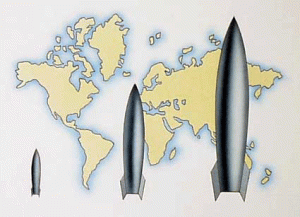 Of course North Korea wants nukes. We should learn to live with it
Deterrence and diplomacy carry risks, but attacking or further isolating North Korea could be worse. The Age , Tom Switzer, 23 Apr 17, “……I listen to the debates about North Korea’s nuclear ambitions. Once again, we are told that a rogue state is bent on developing nuclear weapons that threaten world peace and that either a preventive strike or regime change, or both, will disarm this strategic and moral threat.
But remember the realists were right about Iraq. Leave aside that Saddam’s regime did not even possess serious weapons of mass destruction capacity. Regime change was always fraught with the danger of unintended consequences. Iran and its Shiite militias acquired new influence within Iraq and the broader region while parts of Iraq fell into the hands of Sunni jihadists, who were even more fanatical than al-Qaeda.
Although anguish over a nuclear North Korea is understandable, it’s a fair bet the realists are also right today.
We are told Kim Jong-un is really a madman because he really has nuclear weapons. But although he is a nasty piece of work, the North Korean despot is not crazy. His primary goal is survival: the end of his regime means the end of Kim. From his perspective, it makes sense to develop nuclear weapons.
Why? Because nukes are the ultimate deterrent. North Korea is a minor power surrounded by three major powers – China, Japan, Russia – and with an outside power – the US – constantly threatening it with regime change. As Professor John Mearsheimer, the doyen of foreign-policy realism, told me recently, when Washington strikes Bashar al-Assad’s Syria, or helps topple Saddam’s Iraq or Colonel Gaddafi’s Libya, it gives Pyongyang a very powerful incentive to keep its nuclear weapons.
We are told that Beijing must force North Korea into giving up its nukes or at least not develop an intercontinental ballistic missile that can hit California and Darwin. Chinese co-operation would be ideal and Beijing’s leaders, as Malcolm Turnbull reiterated at the weekend, have some leverage with their communist comrade.
But China also needs North Korea for geopolitical reasons. It is a vital strategic asset. Remember that China entered the Korean War in late 1950 when the Americans crossed the 38th Parallel.
From Beijing’s standpoint, the collapse of North Korea would create a refugee crisis and mean a reunified Korea under a US nuclear security umbrella. If you think Russia is overly sensitive about Ukraine being a western bulwark on its doorstep, imagine how China would respond to a western bulwark on its doorstep. As unfashionable as it is to say, great powers still have spheres of influence.
We are told that regime change is an option in dealing with the North Korean menace. But if there is any hope of discouraging Pyongyang from using nuclear weapons, the West will need to stop threatening regime change and try to reach an accommodation with the Hermit Kingdom. The only way North Korea will jettison its nukes is if it feels relatively secure and has the sense that relations with the West are improving.
Alas, Donald Trump sounds tougher with Pyongyang than even Bush and Barack Obama. At the weekend, Vice-President Mike Pence told the Prime Minister the US will not relent until the Korean peninsula is free of nuclear weapons. That could box in Trump, limit his options, and force him on a path that could push him into a preventive war.
The cold hard reality is there is no viable military option against North Korea. They have nuclear weapons, which they can respond with. They have formidable conventional artillery, which they can use to hit Seoul. A preventive strike may provoke the very action it is designed to prevent. As Bismarck warned, it is like committing suicide from fear of death.
A political settlement with Pyongyang is probably not plausible, so America and its allies have no choice but to contain North Korea as best we can. Deterrence and diplomacy have risks, to be sure, but the risks seem far lower than those involved in attacking or further isolating North Korea. Just think of Iraq.
Tom Switzer is a Fairfax Media columnist and a presenter on the ABC’s Radio National. http://www.theage.com.au/comment/of-course-north-korea-wants-nukes-we-should-learn-to-live-with-it-20170423-gvqkbs.html
April 24, 2017
Posted by Christina Macpherson |
Uncategorized |
Leave a comment
But besides demanding North Korea give up its only trump card — no pun intended — some are pushing the administration to go even further: to consider launching a preemptive strike on Pyongyang.
What happens next is one of the worst military and human tragedies in history: Kim orders a nuclear strike on Seoul. While the missile lands four miles outside of the city thanks to a targeting error, millions of people are instantly killed with millions more poisoned by radioactive fallout. In a sheer panic, the millions of people who survive the attack rush south, creating a massive humanitarian crisis of the worst magnitude.
From here, things get even worse……the price of such a victory could be millions of people dead and large sections of Korea rendered uninhabitable for decades, if not longer.
No one wants to talk to the dictator of a nation with over 200,000 people or more in prison camps — but an attack that could lead to a conflict where millions could die in a nuclear war is far worse. The stakes are too great to at least not consider it.
 How a preemptive strike on North Korea could end up killing millions http://theweek.com/articles/692872/how-preemptive-strike-north-korea-could-end-killing-millions Harry J. Kazianis 21 Apr 17 While North Korea might not have tested another nuclear weapon in recent days, tensions in Asia keep rising — and Washington is at least partially to blame.
First, it seems the Trump administration is ready to take the toughest of lines when it comes to dealing with the Hermit Kingdom. In an interview with The Washington Post‘s Josh Rogin, Vice President Pence declared that North Korea must give up its nuclear and missile programs in exchange for nothing, not even talks. Continue reading →
April 24, 2017
Posted by Christina Macpherson |
Uncategorized |
Leave a comment
“We consider it a major victory,” said Karen Hadden of the Sustainable Energy & Economic Development Coalition, an environmental advocacy group that has opposed Waste Control Specialists’ expansion plans.
While the company’s questionable finances were a factor in its request, Hadden suggested that mounting public opposition might also have played a role.
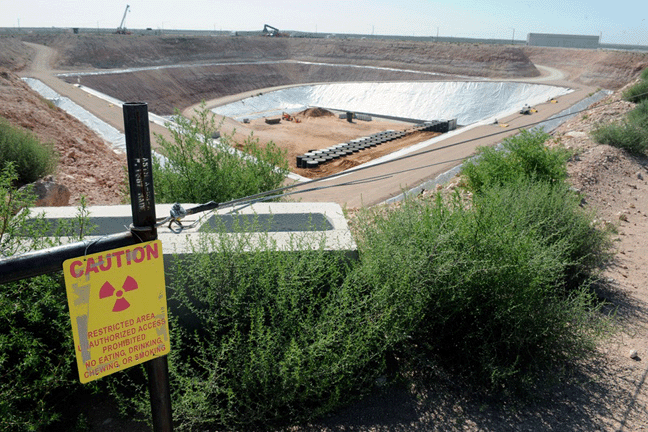
West Texas nuclear waste project on hold — for now Dallas-based Waste Control  Specialists has asked the U.S. Nuclear Regulatory Commission to temporarily suspend a review of its application to store tens of thousands of metric tons of spent nuclear fuel at its West Texas dump. The Texas Tribune BY JIM MALEWITZ AND KIAH COLLIER APRIL 19, 2017 A proposal to bring the nation’s spent nuclear fuel to West Texas appears to be on the ropes.
Waste Control Specialists, which currently stores low-level radioactive waste in Andrews County, has asked the U.S. Nuclear Regulatory Commission to temporarily suspend a review of its application to store tens of thousands of metric tons of spent nuclear fuel currently scattered at reactor sites throughout the country. The Dallas-based company pitched the massive expansion as a solution to a problem that has bedeviled policymakers for decades.
The reason for the requested freeze? The company, which runs the state’s only radioactive waste dump, is bleeding cash and is struggling to find the estimated $7.5 million needed to continue the licensing process. Continue reading →
April 24, 2017
Posted by Christina Macpherson |
Uncategorized |
Leave a comment
Area G, perhaps more than any other place at Los Alamos National Laboratory, represents the challenges that the U.S. Department of Energy faces in cleaning up the hundreds of waste sites at the lab while work continues to produce new or modernized nuclear weapons.
A report released this spring by the Energy Department’s Environmental Management Los Alamos Field Office says that out of 2,100 contaminated sites, including Area G, only about half of the cleanup at the lab has been completed after decades of work and billions of dollars spent.
If all goes as planned, it will take Los Alamos almost a century to clean up the remnants of the nation’s first generation of nuclear weapons. All the while, tiny, new nuclear bombs are being made.
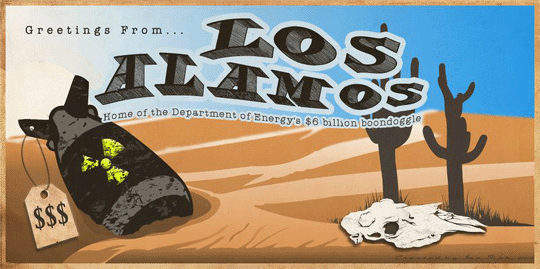
LANL’s Area G at center of nuclear cleanup effort, http://www.santafenewmexican.com/news/local_news/lanl-s-area-g-at-center-of-nuclear-cleanup-effort/article_31af6d36-e24c-5d63-b131-7877f813d6be.html By Rebecca Moss The New Mexican, 23 Apr 17 LOS ALAMOS — To stand at one of the largest radioactive dumps in the nation requires a drive through two security checkpoints, a clearance badge and, for outsiders, a three-to-one guard by federal employees.
Visitors cross the final checkpoint on foot. There is just a metal gate, with stop signs and notifications that crossing this threshold means entering a nuclear facility.
The 63-acre Material Disposal Area G at Los Alamos National Laboratory holds radioactive and other hazardous waste generated by nuclear weapons production during the Manhattan Project of World War II and the Cold War that followed.
Just three feet below the dusty ground, there are nearly 40 pits and 200 shafts, containing somewhere between several hundred thousand and 11 million cubic feet of waste. Large, white structures, like joyless wedding tents, dot the mesa’s surface, holding drums of waste that are intended to be shipped to the Waste Isolation Pilot Plant near Carlsbad and disposed of forever.
Many of these drums are especially volatile. They belong to a waste stream that was improperly packaged, causing one drum to explode at WIPP in 2014, leaking radiation and shutting down the facility for nearly three years at a $2 billion cleanup cost. Continue reading →
April 24, 2017
Posted by Christina Macpherson |
Uncategorized |
Leave a comment
http://www.smh.com.au/nsw/taxpayer-loan-for-railway-to-adani-mine-not-in-the-interests-of-nsw-report-20170423-gvqr1r.html ~ Matt Wade @MattWadeSMH http://www.smh.com.au/nsw/by/Matt-Wade-hvejy 24 April 2017:
“The fairness of a proposed Commonwealth loan of nearly $1 billion to fund a rail link to the giant Adani coal mine in Queensland’s Galilee Basin has been called into question by economic modelling showing
it may cost NSW hundreds of millions of dollars a year.
“Adani’s Carmichael mine will increase the global supply of coal by about 6 per cent, putting downward pressure on prices received by NSW coal exporters and slashing mining royalties paid to the state government, the report by the Australia Institute says. … “
April 24, 2017
Posted by Christina Macpherson |
AUSTRALIA - NATIONAL, business |
Leave a comment
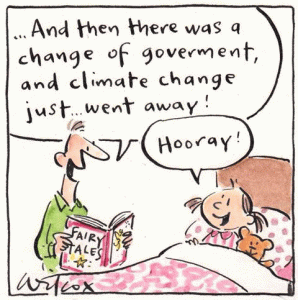 Fake news, politicians’ dishonesty skewing climate debate, John Hewson warns, ABC News, 23 Apr 17 Politicians are getting away with flagrant dishonesty as a shift from fact to opinion colours the political debate around climate change, former Liberal leader John Hewson says.
Key points:
- There’s a a lack of evidence in public debate, John Hewson says
- He says politicians either ignore climate change or attempt to use issue to score points
- Australia has reached a point where facts are of lesser value than opinions, he says
Dr Hewson was speaking in the run-up to today’s Global March for Science, with gatherings taking place in 12 Australian cities and towns as well as in Washington DC and other centres worldwide.
He told AM he initially decided to get involved because he was concerned about the “the lack of evidence being used as the basis of public policy”.
“I think science is probably more useful and more relevant to society today than it’s probably ever been. But there’s been a widening gap between science and the public,” he said.
“We see science funding being cut. We see, obviously, a lack of evidence in public debate. We see attacks on scientists, as we’ve seen in the climate change debate.
“And I think we need to stop and recognise the significance of science and the importance of funding it properly and using the evidence that it produces as the basis of good public policy.”
He said climate change was the most significant challenge faced by society today, but said politicians were playing politics with it…….
“People like John Howard in the past have admitted that they did deliberately play short-term politics and they remain an agnostic when it comes to climate. But you know, it’s not a question of religion. It is a question of science and scientific fact.”
Asked if Australians were seeing “more flagrant dishonesty” from their politicians”, he said “yes”……http://www.abc.net.au/news/2017-04-22/john-hewson-pleads-for-politicians-to-go-back-to-evidence/8463782
April 24, 2017
Posted by Christina Macpherson |
General News |
Leave a comment
 New power generation: Home battery sharing could build virtual public utilities, The Age, Brian Robins, 23 Apr 17 It was one of the disasters of recent energy policy: the boom in sales of air conditioners without taking into account the impact their mass sale would have in forcing up power prices for all.
Those without air conditioners have had thousands of dollars added to their electricity bill to pay for the network upgrades to cope with air conditioners, since much of the extra “poles and wires” are used only a few hours a year, when the weather is very hot or very cold.
Now, mass adoption of battery storage systems poses the same risk for those who don’t install them. Their adoption will allow households to slash their use of the grid which will leave fewer users faced with higher bills to maintain the network.
Communities of battery users But for German battery challenger Sonnen, batteries are only part of the energy equation. More fundamental is creating “communities” of connected battery users to create virtual power plant. Continue reading →
April 24, 2017
Posted by Christina Macpherson |
AUSTRALIA - NATIONAL, storage |
1 Comment
Renewables the medicine our regional towns deserve http://www.examiner.com.au/story/4606820/renewables-the-medicine-our-regional-towns-deserve/?cs=9723 Apr 2017 Renewable energy is the doctor’s prescription for better health. The world needs to move away from electricity generated from coal and gas. It’s polluting our air and producing greenhouse gases causing global warming.
The federal government’s State of the Environment report estimates 3000 deaths are caused by urban air pollution in Australia each year – more than the national road toll. Based on the sources of pollution in urban areas, up to half of these deaths can be attributed to the burning of coal. This means every wind farm or solar installation – whether it be on your roof or large scale the size of a small town – is saving lives.
Thousands suffer heart and lung diseases from this air pollution at great cost to health services. Yes, coal is cheap but only because it’s subsidised by the health costs paid by thousands of our fellow Australians.
Doctors for the Environment Australia seeks to bring health benefits of renewable solar and wind energy to many rural and regional communities. In Port Augusta, South Australia we helped the community close a coal power station that caused lung cancer and asthma. A solar thermal plant is now foreshadowed. Across Australia, communities benefit from solar plants with local jobs, energy security and income. Barcaldine, in central west Queensland, has just installed the state’s largest solar plant, which according the mayor Rob Chandler has “brought a lot of dollars into the community.”
The best thing about this medicine is there are no negative side effects. Anxieties have arisen over wind farms, but no medical or scientific organisation here or overseas has identified any cause or harm. The prescription of renewable energy will help bring health and stability to rural communities. Demand treatment!
Dr David Shearman is secretary of Doctors for the Environment Australia and former professor of medicine at the University of Adelaide.
April 24, 2017
Posted by Christina Macpherson |
General News |
Leave a comment





 Antinuclear