Wildfire rages in highly radioactive Fukushima mountain forest

This is bad news. Fires like this in contaminated forests aerosolize the radiation that covers the plants and has been taken up in the soil and redistributes it through the smoke. It makes no sense to bring people back to the territories in the vicinity of the highly radio-contaminated forests.
NAMIE, Fukushima — A fire broke out in a mountain forest near the crippled Fukushima No. 1 Nuclear Power Plant on the evening of April 29, consuming an area approximately 20 hectares in size, according to prefectural authorities.
The fire started on 448-meter-high Mount Juman in Namie, Fukushima Prefecture, prompting the prefectural government to request the dispatch of the Ground Self-Defense Force (GSDF) on a disaster relief mission on April 30. A total of eight helicopters from Fukushima, Miyagi and Gunma prefectures as well as the SDF discharged water on the site to combat the fire.
As the fire…
View original post 146 more words
Transfer sites for 610 tons of spent nuclear fuel undecided; decommissioning plans may be affected

Spent nuclear fuel is stored in a pool at the La Hague reprocessing facility in northwestern France in October. It is one of the most dangerous sites in the world, with its 10,000 tons of spent fuel. We were afraid of the Fukushima Daiichi fuel pool 4 but it was nothing: The whole fuel of the Hague corresponds to radiotoxicity 360 times greater than Chernobyl.
About 610 tons of spent nuclear fuel stored at seven of the 17 reactors in Japan that are set to be decommissioned have no fixed transfer destination, it was learned Sunday, threatening to hold up the decommissioning process.
If it remains undecided where to transfer the spent nuclear fuel, work to dismantle reactor buildings and other structures may not be carried out as planned.
The tally excludes the six reactors at Tokyo Electric Power Co. Holdings Inc.’s Fukushima No. 1 plant, which was heavily damaged…
View original post 555 more words
‘Yoshida’s Dilemma: One Man’s Struggle to Avert Nuclear Catastrophe’: But for him, Fukushima could have been much worse

Hero: Masao Yoshida disregarded orders to abandon the Fukushima No. 1 nuclear power plant. The actions of him and his team are credited with averting further disaster.
Disaster response, even at its most heroic, can fall to people who would rather be somewhere else.
So it was for Masao Yoshida, who, while helming the Fukushima No. 1 nuclear power plant during the disaster in 2011, gave the groan, “Why does this happen on my shift?”
But in some ways Yoshida, an industry veteran of 32 years, was the right man to handle the crisis. His leadership during those days on the edge, at times in defiance of orders from the top of the utility that employed him, is at the center of Rob Gilhooly’s new book “Yoshida’s Dilemma: One Man’s Struggle to Avert Nuclear Catastrophe.”
Gilhooly writes from the eye of the storm, putting the reader in the plant’s control…
View original post 772 more words
Fukushima: Dispossession or Denuclearization?

Summary of the book:
The Fukushima nuclear power plant explosions and the Hiroshima and Nagasaki bombings are intimately connected events, bound together across time by a nuclear will to power that holds little regard for life itself. In Fukushima: Dispossession or Denuclearization? contributors document and explore diverse dispossession effects stemming from this nuclear will to power, including market distortions, radiation damage to personal property, wrecked livelihoods, and transgenerational mutations potentially eroding human health and happiness. Liberal democratic capitalism is itself disclosed as vulnerable to the corrupting influences of the nuclear will to power. Contributors contend that denuclearization stands as the only viable path forward capable of freeing humans from the catastrophic risks engineered into global nuclear networks. They conclude that the choice of dispossession or denuclearization through the pursuit of alternative technologies will determine human survival across the twenty-first century.
Contributing editors to Fukushima: Dispossession or Denuclearization? are Majia Nadesan, Antony Boys, Andrew McKillop…
View original post 192 more words
Donald Trump could get Australia involved in war
every US ally is now on notice – you cannot rely on Trump’s America in a crisis
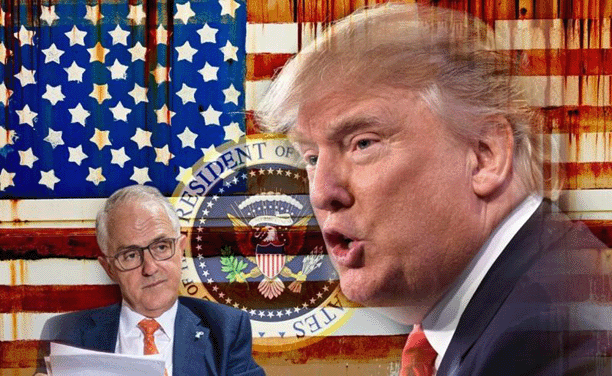
US Allies Now On Notice, The Age, Peter Hartcher, 2 May 17 It was five years ago that a senior US official brought to Canberra the sobering news that North Korea was turning its missiles towards Australia for the first time. He [Campbell, a former senior Pentagon official] has an update…….. .
“But the devastation of the South would be horrific – millions killed.”
A further restraint on any idea of a preemptive US strike to destroy North Korea’s nuclear facilities, says Campbell, is that there is recent evidence that the regime has distributed the nuclear infrastructure around the country and the US could not be fully confident that it knows every location.
There are no easy options. Trump has said that he’s expecting China’s Xi Jinping to do the hard work of deterring Kim from any further provocation. Xi says that Washington and Beijing are united in seeking to prevent the nuclearisation of the Korean peninsula.
But North Korea is nonetheless one of only two allies of China, and there are limits to how far it will go in pressing its ally. Campbell says he expects that “in the end, China will disappoint” American expectations……
He’s not impressed by Trump’s handling of the problem to date: “In a crisis like this the tendency is for the US to bring its allies closer. The president has instead roiled South Korea with his comments – it’s crazy….. In the midst of a crisis that Donald Trump has described his most urgent national security priority, he has picked a fight not with his adversary but with his ally.
In the past week or so, even as North Korea threatens an imminent attack on South Korea, Trump has chosen to denounce the US free trade agreement with Seoul as the “worst deal ever” and demanded renegotiations.
He has insulted his South Korean ally by saying in an interview that the country was once “part of China”, a falsehood that seems to concede to China a greater scope for legitimate influence over Seoul.
And, astonishingly, he has even demanded publicly that the South Korean government, which goes to an election in a month’s time, must pay for the defensive missile interception system that the US is installing on South Korean soil.
Malcolm Turnbull will strike a pose with Trump this week on the deck of a retired warship in New York Harbour to affirm the strength of the alliance with the US. Everyone will play happy allied families in a carefully choreographed performance.
But the reality of US alliances under Trump is not the cheerful one to be played out on the USS Missouri but Trump’s treatment of America’s South Korean ally.
Every US ally needs to note that, exactly when South Korea needs America most, Trump is putting pressure on it, picking a fight with it on trade and defence, publicly belittling it.
Turnbull has to do what he can to preserve as much of the alliance as he can. But every US ally is now on notice – you cannot rely on Trump’s America in a crisis. ….http://www.theage.com.au/comment/donald-trump-is-learning-a-lesson-from-north-korea–and-so-are-us-allies-20170501-gvwpbm.html
1 This month

of the week – Australians for War Powers Reform (AWPR)
To see nuclear-related stories in greater depth and intensity
 Antinuclear