Newhouse and Rep. Chris Collins, R-N.Y., led an effort to get 17 Republican representatives to send a letter to Trump last week asking that he include money for the Department of Energy’s small modular reactors in his fiscal 2018 budget request to Congress. Continue reading →
Health dangers from climate change are already with us
 Health and climate change, The Saturday Paper, The World Health Organisation’s director-general describes climate change as ‘the fifth horseman’ of the apocalypse, as doctors are encouraged to speak out more about illness and death caused by extreme weather. By Marie McInerney. 6 May 17, “……….The World Health Organisation is clear, declaring climate change “the defining issue” for this century. The WHO’s director-general, Dr Margaret Chan, has described it as “the fifth horseman” of the apocalypse, a new threat riding across the public health landscape.
The health risks posed for Australia have been catalogued by the Climate and Health Alliance (CAHA), a coalition of health and social policy groups that has developed a framework for a national strategy on climate, health and wellbeing in the absence of government or departmental leadership.
At the top of the list of risks are increasing frequency and ferocity of extreme weather events such as heatwaves, floods and storms such as cyclone Debbie. A warmer climate and changing rainfall patterns will increase the range and prevalence of food, water and vector-borne diseases. The evidence also warns of mental health impacts, worsening allergies and asthma, disrupted food and water supplies, and health issues for people who work in the outdoors or respond to escalating disasters.
Groups such as CAHA say a big struggle on climate change has been to persuade people that it’s not just an environmental issue, and that the health urgency is personal and immediate.
That’s where Dr Bastian Seidel sees a role for GPs as “climate witnesses”. Seidel moved to Tasmania a decade ago from Germany and was recently elected president of the Royal Australian College of General Practitioners, Australia’s largest medical organisation.
He says not a day goes by in his rural Huon Valley practice that he doesn’t hear about a climate change impact for his patients. Seasons are now pretty much unpredictable. He sees cherry farmers struggling to get crops out at Christmas, graziers dealing with prolonged drought, salmon producers worried about unseasonably hot weather. Hayfever cases now seem to go all year round.
The trouble is, he says, that not enough questions are being asked – by politicians, the media, public service, and also the medical profession – about what is causing these shifts and what health services need to do about them.
Seidel points to the recent thunderstorm asthma outbreak in Victoria that resulted in nine deaths and overwhelmed services – Victoria’s health minister Jill Hennessy likened it to 150 bombs going off in different places at once. While the government’s report into the event briefly acknowledges the influence of climate change on key conditions, Seidel says there was barely any scrutiny of its role.
“It looks like climate change has almost become the Voldemort of health impact research and policy – it shall not be named,” he says.
Seidel says GPs have to be bold enough to nominate climate change as a cause of illness and to campaign to have health policies “blueprinted” against climate change effects.
A priority example, he says, is the federal government’s Closing the Gap report. While many Aboriginal and Torres Strait Islander people and communities are at heightened risk from climate change, he says the term is only mentioned once in the 2017 report – in reference to the number of Indigenous employees at the Climate Change Authority.
While others may still shy away from the debate, Simon Judkins sees speaking out on climate change as a growing professional responsibility based on two core principles of healthcare: that prevention is better than cure, and that doctors have a duty of care for patients such as Ruby and others most immediately susceptible to climate change effects.
“Obviously there is the science to support, and we are scientists,” he said. “But we also need to advocate for the people we look after. The people who are going to be most affected by climate change are those who need a very robust public health system and GP support system because they can’t buy their way out of this. We do have a voice that is hopefully respected and I don’t think we use that voice enough in this space.” https://www.thesaturdaypaper.com.au/2017/05/06/health-and-climate-change/14939928004580
Don’t use the word “mother” to describe a bomb – Pope Francis
Pope Francis slams use of ‘mother’ to label US’ biggest non-nuclear explosive, http://www.smh.com.au/world/pope-francis-slams-use-of-mother-to-label-us-biggest-nonnuclear-explosive-20170506-gvznqa.html Milan: Pope Francis has criticised naming the US military’s biggest non-nuclear explosive the “mother of all bombs”, saying the word “mother” should not be used in reference to a deadly weapon.

The US Air Force dropped such a bomb, officially designated the GBU-43 Massive Ordnance Air Blast (MOAB) on suspected Islamic State fighters in eastern Afghanistan last month.
The nickname was widely used in briefings and reporting on the attack.
“I was ashamed when I heard the name,” Pope Francis told an audience of students on Saturday. “A mother gives life and this one gives death, and we call this device a mother. What is happening?”
Pope Francis is set to meet US President Donald Trump on May 24 in a potentially awkward encounter, given their opposing positions on immigration, refugees and climate change.
Small Modular Nuclear Reactor lobby pushing for tax-payer funding
However, nuclear critics point out that the small modular reactors remain unproven. Because none has been built, questions remain about whether they would be safer or more economical than full-size reactors

 Newhouse asks Trump for small modular reactor money, Tri City Herald, BY ANNETTE CARY acary@tricityherald.com, 6 May 17 Federal money to establish the United States as a leader in small modular nuclear reactors would pay off with economic and security benefits, Rep. Dan Newhouse, R-Wash., has told President Donald Trump.
Britain’s Moorside nuclear power plan stalls
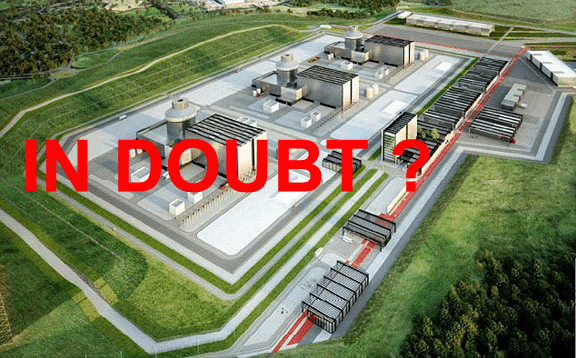 Moorside nuclear plant ‘on hold’ as review announced, BBC News 4 May 2017 A plan to build a nuclear power station in Cumbria has been put on hold while the company behind it carries out a strategic review.
Britain’s Moorside nuclear power project may now not go ahead
Toshiba bankruptcy threatens Moorside, http://www.telegraph.co.uk/business/2017/05/06/toshiba-bankruptcy-threatens-moorside/ 6 MAY 2017
Toshiba’s bankrupt nuclear arm may be prevented from providing any emergency funds to its overseas interests, throwing the future of the Moorside nuclear plant in Cumbria into fresh doubt.
It has emerged that Westinghouse, the Toshiba-owned American nuclear reactor developer, faces orders not to prop up any joint venture agreements that it entered into before the company filed for Chapter 11 bankruptcy in March. Continue reading
Fukushima nuclear disaster caused tiny increase in exposure to ionising radiation to evry person on Earth
 Fukushima accident gave everyone an X-ray’s worth of radiation By
“We don’t need to worry,” says Nikolaos Evangeliou at the Norwegian Institute for Air Research, whose team has conducted the first global survey of radiation exposure caused by the meltdown of three nuclear reactors at the Fukushima-Daiichi nuclear plant in Japan after a tsunami struck in 2011.
Evangeliou’s team has calculated the approximate exposure of everyone on Earth to two radioactive isotopes of caesium, using all the data available so far. Most of this came from the Comprehensive Test Ban Treaty Organization, which monitors radiation in the environment using a global network of measuring stations.
“More than 80 per cent of the radiation was deposited in the ocean and poles, so I think the global population got the least exposure,” Evangeliou told the annual meeting of the European Geosciences Union in Vienna, Austria, last month. He has estimated the dose that most individuals received to be 0.1 millisievert. “What I found was that we got one extra X-ray each,” says Evangeliou.
Impact on wildlife
Even in Japan, the average person’s radiation dose was low: 0.5 millisieverts, which is close to the annual recommended limit for breathing in naturally occurring radon gas. In comparison, the average annual exposure from background levels of radiation in the UK is around 2.7 millisieverts a year.
Doses were unsurprisingly higher for residents of Fukushima and neighbouring areas during the first three months of the accident, ranging from 1 to 5 millisieverts. But such doses are still relatively low – a typical CT scan delivers 15 millisieverts, for example, while it takes 1000 millisieverts to cause radiation sickness.
But Evangeliou says that the effects on wildlife around the plant might be more severe. Already, he says, increased levels of radiation around Fukushima have been linked to declines in bird populations there between 2011 and 2014. “There have also been reports of declines in other species such as insects and some mammals,” he says.
However overall, Evangeliou says the hazards posed by fallout from the Chernobyl nuclear accident in Ukraine in 1986 are still much greater than those from Fukushima, because the fallout was larger, and it fell upon more densely populated areas.
Queensland 20,000 jobs in solar power proposal
 Queensland
20,000 jobs in solar power proposal
A US firm is scouting sites in Queensland for up to six solar thermal power stations, each of which would cost about $600m to build and need 4000 construction workers…..
http://www.couriermail.com.au/business/solar-power-queensland-plans-for-up-to-six-solar-thermal-stations/news-story/500edfdd61cdd0603bb876a8a558e3b0
News on fracking in Australia
Renowned scientist Tim Flannery warns NT against investing in gas
The former chief commissioner of Australia’s Climate Council says the NT should take heed of the risks posed by hydraulic fracturing when considering gas projects such as the proposed Jemena pipeline.
http://www.abc.net.au/news/2017-05-06/tim-flannery-warns-against-nt-pipeline/8502186
Western Australia
Tribunal rules against Indigenous anti-fracking protestor in WA
An Aboriginal man who has spent more than two years protesting mining companies from a makeshift camp in northern WA declares victory, despite a tribunal ruling likely to end his campaign.
http://www.abc.net.au/news/2017-05-05/tribunal-rules-against-anti-fracking-protester/8501544
Firefighters faced with wildfire in radioactive area near Fukushima Nuclear Power Plant

 Above: wildfire near the Fukushima Nuclear Power Plant. Screengrab from KYODO News video.
Firefighters are struggling to contain a wildfire in an area that is contaminated with radiation near the Fukushima Nuclear Power Plant that melted down after the 2011 earthquake and tsunami off the coast of Japan (map).
The blaze, estimated at about 50 acres, started April 29 near the town of Namie. The video below shows helicopters dropping water on the fire.
Firefighters faced with wildfire in radioactive area near Fukushima Nuclear Power Plant
Group creates film and story series based on interviews with Fukushima evacuees
 Hidenobu Fukumoto (right), head of a group that produces picture-story shows, visits the home of Yoko Oka in Namie, Fukushima Prefecture, in January. Namie was a restricted zone until the government lifted an evacuation order in March.
Six years ago in March, a firefighter in the town of Namie in Fukushima Prefecture couldn’t save tsunami victims in the wake of the Great East Japan Earthquake, because he himself had to evacuate due to the nuclear crisis at the Fukushima No. 1 power plant.
His anguish has been illustrated in the animated film “Munen” (“Remorse”), which was shown in France at Maison du Japon of Cite Internationale Universitaire de Paris on March 25 this year following screenings at various places in Japan.
The film begins with a scene in which the wife of the firefighter explains to her niece why her husband puts his hands together everyday and looks toward…
View original post 998 more words
Wildfires in Fukushima: reliable data or disinformation?
The forest fire in the Ide area of Namie in Fukushima prefecture, which occurred on April 29, has been going on for almost a week.
See video 消火活動動画
Video and photo sources 写真と動画の出典 : 陸上自衛隊第6師団; JGSD 6th Division

The major media reported it at the time of the outbreak, but except for some local television news, the fire has not been covered much. Furthermore, the news does not pop out immediately on web sites, and we have to make a considerable effort to find the information. Let’s keep in mind that most of the nuclear accident victims have only cellphones, and not PCs, which makes it very difficult to search for the information if it involves several clicks and the opening of PDF documents.
he danger of the secondary dispersion of the radioactive substances is not mentioned at all in the announcement of Fukushima prefecture (see the…
View original post 975 more words
1 This month
7 April – WEBINAR – Australia and the Doomsday Clock – Preventing nuclear war through NoFirstUse and other policies
Online | Tuesday April 7, 4:00-5:30pm, Australian Eastern Time / 8:00-9:30am Central Europe Time
– Access the registration link
15 April – Zoom –Nuclear Power is Not the Solution
Apr 15, 2026 01:00 AM in Canberra, Melbourne, Sydney

Join the International Physicians for the Prevention of Nuclear War (IPPNW) on Tuesday, April 14th for a timely webinar exploring the risks associated with nuclear power and challenging the myth that it offers a simple, safe, carbon-free solution to the climate crisis

21 April Webinar: No Nuclear Weapons in Australia
Start: 2026-04-21 18:00:00 UTC Canberra, Melbourne, Sydney (GMT+10:00)
End: 2026-04-21 19:30:00 UTC Canberra, Melbourne, Sydney (GMT+10:00)
Event Type: Virtual
A virtual link will be communicated before the event.
Host Contact Info: australia@icanw.org

of the week – Australians for War Powers Reform (AWPR)
To see nuclear-related stories in greater depth and intensity
 Antinuclear