Finally, some justice for Australia’s nuclear test veterans
 https://nick.nxtmps.org.au/media/releases/finally-some-justice-for-
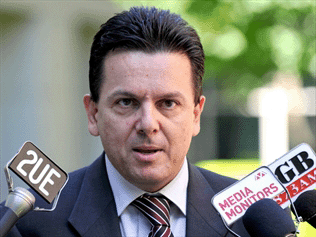 australias-nuclear-test-veterans/7 MAY 2017 Negotiations with the Nick Xenophon Team were instrumental in finally securing the Gold Card benefit for Australian veterans who served in the British Occupation Forces in Japan from 1945-1952 and also those involved in the British nuclear tests in Australia from 1952-1967.
Until the Federal Government’s announcement today, Australian nuclear veterans were not eligible for the Gold Card – which covers medical expenses and treatment for all of a veteran’s medical conditions.
It is automatically available for all veterans who served in theatres of war – but inexplicably was denied to those who were subjected to a nuclear blast.
Until now, Australia’s nuclear veterans had to jump over the onerous hurdle of proving their illness and medical conditions were directly linked to the exposure to radiation.
Senator Nick Xenophon has pursued this issue for over six years in the Senate, moving amendments to extend the Gold Card to nuclear veterans, including those Australians who served in the British Occupation Forces in Japan from 1945-1952, involved in the clean up and occupation of Hiroshima and Nagasaki.
More recently he has been joined in advocacy for the veterans by his NXT colleagues in Canberra, particularly Senator Skye Kakoschke-Moore.
“Ignored, and treated with contempt by successive governments since the 1950s, these nuclear veterans will finally get the recognition and assistance they so strongly deserve,” Nick said.
“Getting access to the Gold Card will make a very big difference to the surviving veterans – many of whom have suffered terrible health and illnesses as a result of their exposure to radiation.”
Of the 17,000 Australian soldiers and civilians directly involved in the British nuclear tests in Australia, at Emu Field and Maralinga in SA and Monte Bello Islands off the coast of WA, it is believed only about 1,100 are still alive. “This has been a shameful episode of Australian history. This at least is a belated recognition for the hazardous warlike service these veterans endured,” said Nick.
Indigenous opposition and dismal market prices stop AREVA’s Canadian uranium mine
 Areva pulls out of Baker Lake, Nunavut uranium mine remains mothballed, NUNATSIAQ ONLINE, Nunavut May 05, 2017, JANE GEORGE Areva Resources Canada, the proponent of the Kiggavik uranium project, has decided to close shop in Baker Lake and put its office building up for sale.
“After over 10 years exploring in the territory, studying the possibility of developing the Kiggavik Project and making numerous friends in the Kivalliq region, it’s time to say good bye,” the company said in an advertisement in the Nunatsiaq News print newspaper of May 5…..
The decision to sell the building comes after Areva opted to place its uranium mining project on hold.That followed a 2015 recommendation from the Nunavut Impact Review Board that the project, 80 kilometres east of Baker Lake, should not proceed.
Then, in July 2016, the four federal ministers with authority over the project said they accepted the NIRB’s recommendation.
Kiggavik will remain in care and maintenance for an “indefinite period,” McCallum said May 4.
Meanwhile, its permits will be maintained and the property will be secured and visited once a year, he said. The uranium mine to be located at two sites, Kiggavik and Sissons, would have comprised four open pits and an underground operation. Areva said the project, with an estimated lifespan of about 12 years, would have been operating by some time in the 2020s or 2030s.
But opponents, such as the Nunavummiut Makitagunarningit group, said uranium mining posed a serious risk to the Kivalliq region’s caribou herds and that the environmental risks associated with the operation would outweigh its economic benefits.
While the mine would have cost $2 billion to build, McCallum said Areva had spent $80 million on developing the project, with $30 million going to northern contractors since 2006—numbers he recently shared in a meeting with the mayor of Baker Lake and the Kivalliq Inuit Association……The price of uranium currently stands at about $22 per pound—down nearly by half since 2013 and much lower than its high of more than $136 per pound in 2007. http://www.nunatsiaqonline.ca/stories/article/65674areva_pulls_out_of_baker_lake_as_nunavut_uranium_mine_mothballed/#.WQzPWFlWLhM.twitter
1 This month
7 April – WEBINAR – Australia and the Doomsday Clock – Preventing nuclear war through NoFirstUse and other policies
Online | Tuesday April 7, 4:00-5:30pm, Australian Eastern Time / 8:00-9:30am Central Europe Time
– Access the registration link
15 April – Zoom –Nuclear Power is Not the Solution
Apr 15, 2026 01:00 AM in Canberra, Melbourne, Sydney

Join the International Physicians for the Prevention of Nuclear War (IPPNW) on Tuesday, April 14th for a timely webinar exploring the risks associated with nuclear power and challenging the myth that it offers a simple, safe, carbon-free solution to the climate crisis

21 April Webinar: No Nuclear Weapons in Australia
Start: 2026-04-21 18:00:00 UTC Canberra, Melbourne, Sydney (GMT+10:00)
End: 2026-04-21 19:30:00 UTC Canberra, Melbourne, Sydney (GMT+10:00)
Event Type: Virtual
A virtual link will be communicated before the event.
Host Contact Info: australia@icanw.org

of the week – Australians for War Powers Reform (AWPR)
To see nuclear-related stories in greater depth and intensity
 Antinuclear