Native Title laws haven’t quite been “fixed”, as the PM promised Adani.
https://www.buzzfeed.com/robstott/the-adani-mega-coal-mine-just-suffered-a-big-setback?utm_term=.hwBOzQKwDm ~ Rob Stott – BuzzFeed News Reporter, Australia
‘The Senate has delayed voting on changes to Native Title laws that would have made it easier for mining giant Adani to build its controversial proposed Carmichael coal mine.’
“Labor joined with the Greens on Thursday to delay voting on the amendments to the Native Title Act, saying the government had not properly consulted with them or traditional owners.
“The amendments would make it easier for companies such as Adani to secure Indigenous Land Use Agreements (ILUAs) from traditional owners, as they would only need agreement from a majority of traditional owners, not unanimous consent. … “
May 12, 2017
Posted by Christina Macpherson |
General News |
Leave a comment
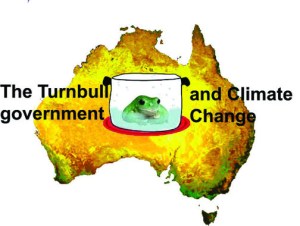 Nobody Mentioned It, But Do We Stand To Lose Our Best Defence Against Climate Change? Huff Post, Anthony Sharwood, 11 May 17 Good luck, Australia. We’re going to need it. 10/05/2017
 You’ve probably never heard of the National Climate Change Adaptation Research Facility. We hadn’t. And after reading the 2017 Federal Budget, the indications are we never will again.
Here’s why this matters.
The NCCARF, in its own words, “works to support decision makers throughout Australia as they prepare for and manage the risks of climate change and sea-level rise”.
This means it’s Australia’s only government-funded body which takes established climate science, assesses the likely impacts of climate change, then tells us what the heck we should do about it.
You can see examples of NCCARF’S excellent work
here,
here or
here. It provides solid, practical advice and strategies for dealing with things which affect so many Australians — like more intense heatwaves and bushfires, and increased coastal erosion.
Budget Paper No. 2 confirms confirms that its modest funding of $600,000 will continue for another year.
The Government will provide $0.6 million in 2017‑18 to the Commonwealth Scientific and Industrial Research Organisation and National Climate Change Adaptation Research Facility. This measure supports existing online platforms that inform decision makers seeking to adapt to changes in climate.
And then? Well down on page 57 of the Environment Portfolio Budget Statements, the funding looks like it dries up after the end of the 2017/18 financial year. No more NCCARF. It may merge with the CSIRO, or it may just be lost.
“I think it’s got another year to find a funding mechanism that is stable, that’s my reading of the situation,” NCARFF Director Professor Jean Palutikof told HuffPost Australia…….
Australian Conservation Foundation CEO Kelly O’Shanassy told HuffPost Australia that NCCARF was now “a research facility without funding for research”.
“The budget commitment is for $600,000 next year with CSIRO to maintain an online database of specific parts of its research. It has no funding after that.”………
More broadly, this was a budget in which the term “climate change” barely rated a mention.
“There’s nothing on climate change and very little on the environment. It’s like someone’s gone ‘Control Alt Delete’ and the whole thing’s disappeared from the budget papers,” Greens Senator Sarah Hanson-Young told HuffPost Australia politics editor Karen Barlow.
Gemma Borgo-Caratti, the National Director of the Australian Youth Climate Coalition, said “the Budget ignores climate change which in turn handballs Australia’s biggest problem to the next generation to deal with”.
Greenpeace Asia Pacific said “the Turnbull government has continued to ignore climate change and the need to fund renewable energy at a time when the country is demanding leadership on the most serious threat of our age”……http://www.huffingtonpost.com.au/2017/05/10/nobody-mentioned-it-but-we-stand-to-lose-our-best-defense-again_a_22078630/
May 12, 2017
Posted by Christina Macpherson |
AUSTRALIA - NATIONAL, climate change - global warming |
Leave a comment
Renewable hydrogen could fuel Australia’s next export boom after CSIRO breakthrough, ABC News, 11 May 17, By Rebecca Turner Australia’s next big export industry could be its sunlight and wind, as game-changing technology makes it easier to transport and deliver their energy as hydrogen.
Industry players are even talking up renewable hydrogen as the next liquefied natural gas (LNG) industry, which could supply hydrogen to power cars, buses, trucks and trains in Japan, South Korea and even Europe.
Their plans have been given a boost by a CSIRO-developed metal membrane, which allows the high-purity hydrogen needed for hydrogen-powered cars to be separated from ammonia.
What is renewable hydrogen?
- Hydrogen is a carrier of energy
- Renewable hydrogen is produced by purifying seawater, then separating the hydrogen and oxygen via electrolysis
- The process of separation is powered by solar or wind energy
- The hydrogen becomes a vehicle for storing renewable energy such as solar or wind
- It is converted into transportable forms for export
CSIRO principal research scientist Michael Dolan said the technology, now being trialled on an industrial scale in Australia, was “the missing link” which allowed hydrogen to be transported and used as an energy source.
“There’s potentially a very big market for the technology, given these cars are starting to get onto the road in pretty big numbers in Asian and Europe,” Dr Dolan said.
While there are only four hydrogen cars in Australia — produced by Hyundai and Toyota — South Korea already has hydrogen-powered taxis on its streets……http://www.abc.net.au/news/2017-05-11/hydrogen-breakthrough-could-fuel-renewable-energy-export-boom/8518916
May 12, 2017
Posted by Christina Macpherson |
AUSTRALIA - NATIONAL, energy |
Leave a comment
 AusNet trial successfully takes part of Melbourne suburb off-grid http://reneweconomy.com.au/ausnet-trial-successfully-takes-part-melbourne-suburb-off-grid-21015/ By Sophie Vorrath on 11 May 2017 A solar and battery storage mini-grid trial by Victorian network operator AusNet Services has succeeded in taking part of a Melbourne suburb completely off grid, demonstrating how utilities can use solar, battery storage and the internet of things to boost energy security and reliability in the future.
AusNet said on Wednesday that eight homes had been successfully separated from Victoria’s main electricity grid and operated together as a stand-alone solar and battery storage powered mini grid, as part of the company’s Mooroolbark Mini Grid trial.
The homes, including two that had neither solar or batteries, were able to maintain power by sharing electricity via AusNet’s powerlines that connect the mini grid, before being successfully re-integrated with the main grid.
AusNet said the cloud-based mini grid control system – which has been provided by locally-based energy technology company GreenSync – and the stabiliser took the mini grid through a sequence of stages to test the stability of the mini grid as an independent, unified renewable energy system.
The stabiliser, developed by Power Technology Engineered Solutions, is essentially a smart battery storage system that smooths renewable energy supply and consumption across the mini grid by either delivering or absorbing power when needed.
Parker, speaking at Energy Network Australia’s Welcome to the Grid Edge conference on Wednesday, said that the achievement was a “major milestone” on the road to a future grid with high penetration of solar and storage.
“The electricity network will continue to play an important role in our energy future, but we need to make sure it is able to support technology such as solar panels and battery storage for the benefit of all customers,” he said.
“In the future, we may be able to use this technology to keep homes powered during major storm events.
“We could also use (it) to smooth peak demand on our network, helping to reduce the need to build expensive power stations and therefore reducing costs to customers.”
The next step for the trial is to test additional control functionality to manage peak loads and generation on the network, as well as further testing of the stand-alone supply scenario involving additional customers being integrated into the stand-alone mini grid.
May 12, 2017
Posted by Christina Macpherson |
solar, Victoria |
Leave a comment





 Antinuclear