ANSTO must be transparent on costs of its nuclear research: Generation IV nuclear reactors – high cost for little benefit
 Here’s another fine submission to Australia’s Parliamentary Inquiry into Australia joining the Framework Agreement for Generation IV Nuclear Energy Systems . This one blows out of the water any idea that these so far non existent reactors could solve any nuclear waste problem, or be in any way economically viable. It also throws the spotlight on The Australian Nuclear Science and Technology Organisation (ANSTO). Just how much of tax-payers’ money is going to this secretive organisation?
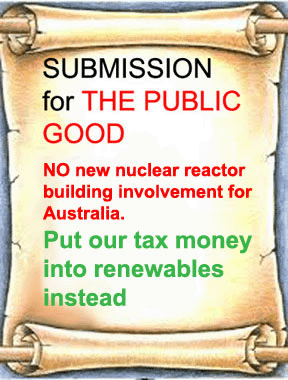 The latest reason for generation IV reactors centres on the unsolved problem of how to safely dispose of spent nuclear fuel. The proposition is that plutonium and other long lived transuranics in reactor fuel (that like plutonium also create a disposal problem) could be used up in so called “burner” reactors.
Analysis by the US National Academy of Sciences found this proposal to have such very high cost and so little benefit that it would take hundreds of years of recycling to reduce most of the global inventory.
Should ANSTO propose collaboration can occur without further cost to the taxpayer, then a funding review should be conducted to establish what research is already being done by ANSTO, at what cost, for what purpose and at whose behest. With an average loss of A$200 million annually, ANSTO should be able to provide disaggregated accounts for both transparency and accountability.
Generation IV Nuclear Energy – Accession Submission Medical Association for Prevention of War (MAPW) PO Box 1379, Carlton VIC 3053 Australia (03) 9023 195 m. 0431 475 465 e. eo@mapw.org.au w. http://www.mapw.org.au
Executive Summary
MAPW recommends strongly against Australia becoming a party to this agreement. There is no proposal for Australia to get a nuclear power program.
This framework agreement applies to technologies that are economically, socially, environmentally, and from a nuclear security perspective, very dubious. Generation IV reactors are an assortment of proposed technologies that have been put forward over the last 70 years, tried and failed.
ANSTO is already very heavily subsidised by the Australian government, and extending its operations into this research sphere will require further scientific effort, expertise and funding. This is highly inappropriate given the current major constraints on government spending, and the urgent need to focus research energies on realistic, financially viable and proven measures to contain emissions from electricity generation.
Collaboration would mean taxpayer subsidies would go to an industry which has already wasted many billions in public funds and resulted in major adverse legacies. No private industry is prepared to invest in this research without large government subsidies because none are prepared to lose so much money.
It is also clear that Australia has no policy to use these long promised and never commercially delivered reactors. Therefore any involvement just subsidises those who hope to use them. If Australia wishes to expand its nuclear expertise, then research into “non nuclear waste” generating technologies (such as those to produce medical isotopes) would be much more productive and also be of positive benefit to the Australian population.
Background
Objectives of GIF Framework Agreement Continue reading
The plight of Kiribati Island – desperate need for Australia’s help
Our country will vanish’: Pacific islanders bring desperate message to Australia, Guardian, 14 May 17, Kiribati and other low-lying countries are under threat from climate change, and while their people would rather stay behind, they may be left with no choice “……… i-Kiribati man Erietera Aram is in Australia delivering his message about the reality of climate change in his country, and of its immediacy. Each discussion, he says, is like a drop of water, adding to the one before it, slowly building understanding of the existential threat to his people and place.
“Climate change is not something off in the future, it’s not a problem for later. We are living it now,” he says.
The archipelago of Kiribati – 33 tiny coral atolls spanning 3.5m square kilometres of ocean – is the world’s lowest-lying country, with an average height above sea level of just two metres.
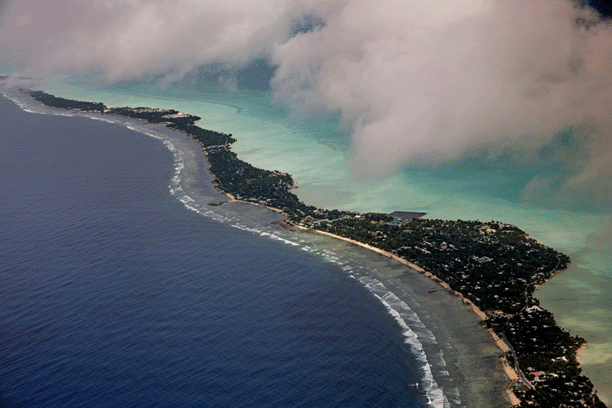
Most of the 113,000 i-Kiribati live crammed on to Tarawa, the administrative centre, a chain of islets that curve in a horseshoe shape around a lagoon.
“My place is very small,” Aram says. “If you stand in the middle, you can see water on both sides. We are vulnerable. One tsunami, one tsunami and our whole country will disappear.”
Already, there is less and less of Kiribati for its inhabitants. The coastline is regularly being lost to king tides and to creeping sea levels, and in a very real sense, there is nowhere to go.
The loss of land is causing conflict – Tarawa is growing ever more densely crowded, as families living on the coastline are forced inwards, infringing on another’s claim.
The next round of multinational climate talks in November – COP 23 – will be chaired by Fiji, and is expected to swing particular focus of the global climate debate to the Pacific, where comparatively minuscule amounts of carbon are produced, but the effects of climate change have been felt first, and most acutely.
Assuming the COP presidency, the Fijian prime minister, Frank Bainimarama, said he would “bring a particular perspective to these negotiations on behalf of some of those who are most vulnerable to the effects of climate change – Pacific Islanders and the residents of other small island developing states and low-lying areas of the world”…….https://www.theguardian.com/world/2017/may/14/our-country-will-vanish-pacific-islanders-bring-desperate-message-to-australia
Protestors, part of a global anti nuclear movement, march to Utah uranium mill
Marcus Atkinson, of Australia, is touring the U.S. promoting a film opposing uranium mining in his country and heard about the White Mesa protest.
“We would like to use this case in our next film to raise international awareness that uranium is too dangerous and is not the answer to our energy needs,” he said.

 Ute protesters march to Utah uranium mill, Ute Mountain Utes concerned about health impacts from White Mesa mill, The Journal, By Jim Mimiaga Journal Staff Writer May 13, 2017 White Mesa, Utah – About 80 protesters opposed to the White Mesa uranium mill in southeast Utah marched three miles along U.S. Highway 191 to the mill’s entrance Saturday.
The protest was organized by members of Ute Mountain Ute tribe, which has a small reservation community three miles from the mill. The mill, which is owned by Energy Fuels, of Toronto, is the only conventional uranium mill operating in the country.
Protesters carried anti-nuclear signs, including “No Uranium, Protect Sacred Lands,” “Water is Life,” and “No Toxic Waste.”
They are concerned about the mill’s potential health impacts on air and water quality, and they object to containment cells at the mill that accept radioactive waste from around the country.
“The dust blowing from uranium ore piles is a concern. Our water comes from wells that are not far from those waste cells. Those things are a big worry for the community,” said Antonio Cly, 22, of the Ute Mountain tribe. He is studying the mill as a student at the University of Utah.
Thelma Whiskers, a Ute elder and founder of the White Mesa Concerned Community group, said her family has been fighting the mill all their lives, and the march was a way to raise awareness of the issues to pass on to the younger generation. Continue reading
South Africa’s anti nuclear women – a formidable, and effective, force
These are some of the women whose names will go down in history for saving South Africa (for now, at least) from a disastrous nuclear deal with Russia that would’ve cost us trillions and most likely bankrupted the country.
For more than two years they lived and breathed the nuclear deal, getting up while it’s still dark to attend meetings, and going to bed after midnight to organise pickets, protests, public meetings and petitions. None of them would even attempt to calculate how much time went into the effort.
Yet, true to form, none of them wants the credit for the court victory that nullified the nuclear deal. “It was easy. It was easy to identify with because it was about our children’s future and our children’s children’s future,” says Makan (50), an activist from Right to Know (R2K) in Cape Town.
“You want to see your grandchildren live in a world free from these bad things. The legacy you leave for the next generation is what drives you. Maybe women are closer to that, bearing the burden of child birth,” says McDaid (55), spokesperson for the Southern African Faith Communities’ Environment Institute (Safcei). Continue reading
The enormous problem of Adani’s mine rehabilitation plans
 ‘Monumental experiment’: Concerns raised over Adani’s mine rehab plans, Brisbane Times, Peter Hannam , 15 May 17 Mine rehabilitation plans for the proposed giant Carmichael coal mine in Queensland fall far short of best practice and will expose the environment and taxpayers to huge risks, according to anti-mine group Lock the Gate.
On its submitted plans, the $16 billion-plus mine would disturb some 280 square kilometres of land, with 1.85 billion tonnes of potentially acid-forming material unearthed, and six giant voids left unfilled, Lock the Gate said in a new report. Some 88 kilometres of streams would also be disrupted and not restored.
“This is a monumental experiment on altering a landscape to a scale we’ve never seen before and believing a company that is saying already it doesn’t think it can put it back to remotely close to what was there before,” said Rick Humphries, co-ordinator of the group’s mine rehabilitation reform campaign.
“We are asking them to be shifted from a low-end, minimalist cheapest [rehab] option to leading practice,” said Mr Humphries, an environmental scientist who previously helped Rio Tinto develop their rehab plans.
The federal and state governments are backing the giant mine, which could produce as much as 60 million tonnes of coal for export a year. Carmichael’s development could also help open up other coal mines in the Galilee Basin.
A report last week by the NSW Auditor-General found that state’s mine rehabilitation guarantees held by the government to be inadequate and requirements for restoring land after a mine’s closure to be vague. The state’s rules, though, were superior to those in Queensland and Victoria, it said…….
According to Lock the Gate, Adani wouldn’t have to begin rehabilitation work until 39 years into its operations, well shy of the “continuous” rehab work that is considered best practice.
Adani may be offered as much as $1 billion in loans from the federal government to help build the rail link from the mine to the coast. Its board still aims to give its final investment decision in the next few weeks, the spokesman said.
Financial closure would then be sought by the end of the year, and pre-construction works starting by the September quarter, he said. http://www.brisbanetimes.com.au/environment/monumental-experiment-concerns-raised-over-adanis-mine-rehab-plans-20170513-gw46v9.html
In Fukushima, a land where few return
the cleanup extends to only 20 meters around each house, and three-quarters of the village is forested mountains. In windy weather, radioactive elements are blown back onto the fields and homes.
The government is forcing people to go back, some argued, employing a form of economic blackmail, or worse, kimin seisaku — abandoning them to their fate.
The evacuation orders for most of the village of Iitate have been lifted. But where are the people?, Japan Times, BY DAVID MCNEILL AND CHIE MATSUMOTO, 14 May 17
“…….A cluster of 20 small hamlets spread over 230 square kilometers, Iitate was undone by a quirk of the weather in the days that followed the nuclear accident in March 2011. Wind carried radioactive particles from the Fukushima No. 1 nuclear power plant, which is located about 45 kilometers away, that fell in rain and snow on the night of March 15, 2011. After more than a month of indecision, during which the villagers lived with some of the highest radiation recorded in the disaster (the reading outside the village office on the evening of March 15 was a startling 44.7 microsieverts per hour), the government ordered them to leave.
Now, the government says it is safe to go back. With great fanfare, all but the still heavily contaminated south of Iitate, Nagadoro, was reopened on March 31. Continue reading
Internationally respected Australian climate scientist calls on CSIRO to get back to a science culture
 CSIRO: Time for a ‘science culture’ again, says leading climatologist John Church ABC, Gregg Borschmann for The Science Show 13 May 17
“The commitments … we’re locking in — in terms of future climate change, both for sea level but also for temperatures and impacts on society — you can see these impacts accelerating, but we’re not making a lot of headway on real mitigation efforts,” Dr Church said.
He said the threshold for locking in long-term global sea-level rise would be crossed if carbon emissions continue unabated into the 22nd century.
In addition, there will be significant contributions from Antarctica plus smaller country contributions from melting of glaciers and ocean thermal expansion.
“We won’t get to tens of metres of sea level rise in 500 years, but we’ll be on that path of very substantial sea level rises if we don’t start mitigating emissions as urgently as we possibly can.” http://www.abc.net.au/news/science/2017-05-13/time-for-a-science-culture-again-at-csiro:-john-church/8516770
American media failing to address Trump’s attack on the planet

 The media is failing to challenge Trump’s attack on the planet, Grist on May 12, 2017 It may seem like a distant memory now, given President Donald Trump’s firing of FBI Director James Comey, but the top political news at the beginning of this week was the administration’s unexpected dismissal of nine government scientists from the 18-member Environmental Protection Agency board that oversees the department’s scientific research. The EPA reportedly plans to replace some of those board members with representatives from the polluting industries the agency is supposed to regulate.
Jeremy Corbyn on nuclear weapons

 Jeremy Corbyn Explains Why He Can’t Envisage Using Nuclear Weapons, HuffPost UK, 14 May 17, May’s closeness to Trump is the real ‘coalition of risk and insecurity’
The Labour leader said that nuclear warfare would mean “the indiscriminate killing of millions of people” and risk long-lasting radiation that would wipe out all life across much of the planet.
In a keynote speech on defence and security at the Chatham House think tank, Corbyn stressed that his “first duty” would be to protect Britain by using diplomacy and defusing tensions around the world.
He also said that the UK’s Trident nuclear deterrent would be renewed by Labour and then placed into a strategic defence review to look at new, long-term threats such as cyber warfare.
Corbyn also said that he wouldn’t “take any lectures” from the Tories on humanitarian intervention after the Thatcher government refused to apply sanctions on South Africa in the wake of apartheid shootings of children in Soweto.
And he claimed that the Conservatives were the party putting Britons in danger as “Theresa May seeks to build a coalition of risk and insecurity with Donald Trump”.
A Labour government would “step back, learn the lessons of the past and find new ways to solve and prevent conflicts”, he said.
And it would seek to build cooperation with China and India, unlike the Prime Minister, who in January said that the two Eastern giants were threatening to ‘eclipse’ the West in military terms.
Corbyn, a long-time advocate of unilateral nuclear disarmament, said earlier this year that his instructions in any nuclear conflict would be to “follow orders when given”, rather than writing a letter automatically granting prior authority to fire off missiles.
In his speech in London on Friday, he said set out his position on his using the deterrent. ……..http://www.huffingtonpost.co.uk/entry/jeremy-corbyn-trident-cant-envisage-using-nuclear-weapons-indiscriminate-killing-of-millions-catclysmic-failure_uk_5915cbdbe4b00f308cf4c3fd
1 This month
7 April – WEBINAR – Australia and the Doomsday Clock – Preventing nuclear war through NoFirstUse and other policies
Online | Tuesday April 7, 4:00-5:30pm, Australian Eastern Time / 8:00-9:30am Central Europe Time
– Access the registration link
15 April – Zoom –Nuclear Power is Not the Solution
Apr 15, 2026 01:00 AM in Canberra, Melbourne, Sydney

Join the International Physicians for the Prevention of Nuclear War (IPPNW) on Tuesday, April 14th for a timely webinar exploring the risks associated with nuclear power and challenging the myth that it offers a simple, safe, carbon-free solution to the climate crisis

21 April Webinar: No Nuclear Weapons in Australia
Start: 2026-04-21 18:00:00 UTC Canberra, Melbourne, Sydney (GMT+10:00)
End: 2026-04-21 19:30:00 UTC Canberra, Melbourne, Sydney (GMT+10:00)
Event Type: Virtual
A virtual link will be communicated before the event.
Host Contact Info: australia@icanw.org

of the week – Australians for War Powers Reform (AWPR)
To see nuclear-related stories in greater depth and intensity
 Antinuclear