Australian government about to secretly sign up to developing Generation IV nuclear reactors?
Should Australia invest funds and resources in developing Generation IV nuclear reactors? Online opinion,
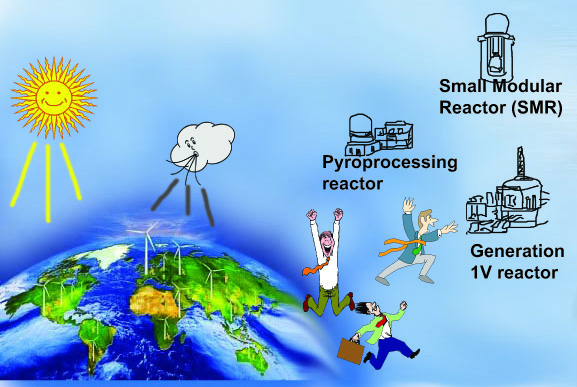
| By Noel Wauchope, 23 May 2017 Without any fanfare, with no media coverage, Australia’s Parliamentary Joint Standing Committee on Treaties (JSCOT) is presently considering Australia signing up to the International Framework for Generation IV Nuclear Energy Systems (GIF), which will commit this nation to take part in developing new nuclear reactors.Dr Adi Paterson, CEO of the Australia Nuclear Science and Technology Organisation, signed up to this GIF Framework last year. However, that does require confirmation by the Australian government. Hence there was the need for the JSCOT Committee to at least take a look at it, before the government completes the membership. Apparently there is no need for public discussion, or probably even Parliamentary discussion.
This Committee very quietly invited submissions, and very few were in the know about this. Now the received submissions have been published – at http://www.aph.gov.au/Parliamentary_Business/Committees/Joint/Treaties/NuclearEnergy/Submissions. Anyway, it looks as if ANSTO is the driving force behind this process, and judging by the submissions received, the nuclear lobby was in the know, even if the public was not. Fourteen submissions were received. Of these, eleven were strongly pro- nuclear, and three were opposed. The opposing submissions came from Friends of the Earth (FOE), (jointly with the Australian Conservation Foundation (ACF ), Medical Association For The Prevention of War (MAPW), and myself, (I came upon the Parliamentary website just by chance). In assessing these submissions, of course, I have to admit to bias on my part. Still, I think that any reader would find that there is one submission that stands out for clarity, and a detailed, factual discussion of the GIF plan. That is the one written by Jim Green and Dave Sweeney, for FOE and ACF. Green and Sweeney respond to assertions made in ANSTO’s National Interest Analysis. They question claims that the new reactors reduce weapons proliferation risks, are economic, efficient, and solve waste problems. They rebuke the claim of ANSTO that “a significant expansion in nuclear power production is underway “, listing the overall decline in nuclear power growth, with the exception of China. They discuss at length the very long time frame expected even by nuclear industry experts, before any Generation IV reactors could be commercially viable. They go on to discuss each of the six proposed new nuclear reactors, giving a detailed history of the attempts to develop each, and factual information that refutes those claims made by ANSTO. For all of their statements, Green and Sweeney provide evidence and references. The Medical Association for Prevention of War (MAPW)’s submission questions the government’s high subsidising of ANSTO, and points out the poor prospects for private investment in new nuclear power. It refutes the argument that Gen IV reactors would solve the nuclear waste problem, quoting analysis by the US National Academy of Sciences. They discuss the history of attempts to develop Gen IV nuclear reactors: ” a track record of repeated failure and massive cost”. They discuss the direct and indirect costs, and ANSTO’s secrecy about nuclear costs. Safety and reliability issues, and proliferation risks, are examined. They also point out that the recent Nuclear Fuel Cycle Royal Commission (NFCRC) was not supportive of new nuclear technology. The Commission proposed:
|
Legal action against Northern Australia Infrastructure Facility directors if they fund Adani coal mine?
 Australian Conservation Foundation vows to pursue all avenues to stop Adani loan
Environmental group warns it will take legal action against Northern Australia Infrastructure Facility directors if funding granted for rail line, Guardian, Katharine Murphy, 24 May 17, Infrastructure Australia produces a priority list of nationally significant investments which is supposed to guide government investment decisions.
Infrastructure Australia’s chief executive, Philip Davies, said he had not yet discussed the Adani project with the Naif, even though the rail project has completed a preliminary assessment and been referred for further consideration.
Cousins said the evidence given in Senate estimates this week indicated the loan was nowhere near being granted. “Clearly all the rumours that this loan is about to be granted are untrue,” he said.
“I cannot see from this evidence that there is any way this loan can be granted.”
Cousins contends the directors of the Naif could be in breach of their fiduciary duties if they approve a loan to the project…….https://www.theguardian.com/environment/2017/may/23/australian-conservation-foundation-vows-to-pursue-all-avenues-to-stop-adani-loan
Final investment decision postponed by Adani, regarding Carmichael coal mine
 Adani indefinitely postpones final investment decision on Carmichael coal mine, ABC News, 23 May 17 Senior Queensland Government members were in meetings on Monday night, discussing how to urgently convince Indian company Adani to proceed with a board meeting to fund the proposed Carmichael coal mine.
The mining giant has postponed its final investment decision on the $16.5-billion project in central Queensland until the State Government gives “clarity” over lower or deferred royalties.
A company spokesman said they were waiting for the State Government to advise on whether it would offer a lower royalty rate or deferred royalties.
The Adani board was to meet in India next week for final approval but has postponed the meeting.
The State Cabinet on Monday discussed whether to give Adani a royalty discount or deferral, but no decision has been made…….
The proposed royalty deal is understood to have caused division among Labor factions.
Deputy Premier Jackie Trad and Roads Minister Mark Bailey, from the Left faction, have publicly opposed any government subsidy of the mine and said that had been Labor’s position since before the 2015 state election.
However earlier on Monday, Agriculture Minister Bill Byrne said royalty arrangements were being considered by the Government…….
Greens, activists accuse Adani of bullying
Queensland Greens senator Larissa Waters said the mining company was trying to bully the State Government into handing over $320 million in free coal.
“So far, Adani is in line for a $1 billion handout, unlimited free water, new legal loopholes, special changes to Native Title, a free pass on reef destruction,” she said.
She called on the Queensland and Federal Governments to abandon their support for the project.
Activist group Get Up said if Adani could not afford the project without a royalty holiday, it was not financially viable. http://www.abc.net.au/news/2017-05-22/adani-indefinitely-postpones-final-carmichael-coal-mine-decision/8548164
‘Dirty Deeds’ – The shady web behind potential Adani coal mine finance
https://www.acf.org.au/dirty_deeds STOP ADANI 24 MAY 2017
An Australian Conservation Foundation (ACF) investigation has discovered the publically funded Export Finance Investment Corporation (Efic) could be used as a backdoor option to finance Adani’s Carmichael coal mine.
An Australian Conservation Foundation (ACF) investigation has discovered the publically funded Export Finance Investment Corporation (Efic) could be used as a backdoor option to finance Adani’s Carmichael coal mine.
Efic could provide loan insurance to private investors for Adani’s Carmichael coal mine, leaving Australians exposed to billions of dollars being lost to a useless stranded asset.
These findings are part of a new report from ACF exposing the web of ties between the fossil fuels industry, the government, the Northern Australia Infrastructure Facility (NAIF) and Efic.
- Five of the seven NAIF directors have close connections to the fossil fuel industry.
- NAIF Board has lack of experience with industries such as communications and renewable energy which are critical to the development from Northern Australia.
- NAIF’s chief adviser, Efic, has a track record of investing in large fossil fuel projects, backing fossil fuels over renewables at a rate of more than 100:1.
- Efic could insure private investment in Adani coal mine – Turnbull government has refused to rule it out.
Download the investigation, and watch a video below showing the web of NAIF and Efic coal interests.
“That public money could be put on the line to protect private profit from the Adani coal mine that will help destroy the Reef and Australian tourism jobs is a truly gobsmacking and outrageous idea.” said Kelly O’Shanassy, Australian Conservation Foundation CEO.
“Both NAIF and Efic must be prevented from supporting a mine that will end up being a stranded asset, potentially wasting billions in public money. The Turnbull government must take responsibility and rule it out immediately.
“When the Adani mine fails, the Australian public will be the very last people to get their money back and probably won’t.
“Public investment in coal is a losing proposition for public money, the Reef and the 70,000 tourism jobs that rely on it.”
Draft treaty released by UN panel on banning possession and use of nuclear weapons
Australia, citing the deterrent effect of the US nuclear umbrella, has been the most outspoken of the non-nuclear states [i.e in opposing the treaty] .
During months of negotiations, Australia has lobbied other countries, pressing the case for what it describes as a “building blocks” approach of engaging with nuclear powers to reduce the global stockpile of 15,000 weapons.
 UN panel releases draft treaty banning possession and use of nuclear weapons https://www.theguardian.com/world/2017/may/23/un-panel-releases-draft-treaty-banning-possession-and-use-of-nuclear-weapons
States would have to destroy any nuclear weapons they have and would be forbidden from transferring them, Guardian, Ben Doherty , 23 May 17, A United Nations-backed panel has publicly released a draft treaty banning the possession and use of all nuclear weapons.
The draft treaty is the culmination of a sustained campaign, supported by more than 130 non-nuclear states frustrated with the sclerotic pace of disarmament, to prohibit nuclear weapons and persuade nuclear-armed states to disarm.
Nine countries are known or believed to possess nuclear weapons: the US, UK, Russia, China, France, India, Pakistan, North Korea and Israel. None has supported the draft plan.
The draft treaty obliges state parties to “never under any circumstances … develop, produce, manufacture, otherwise acquire, possess or stockpile nuclear weapons or other nuclear explosive devices … use nuclear weapons … [or] carry out any nuclear weapon test”.
States would also be obliged to destroy any nuclear weapons they possess and would be forbidden from transferring nuclear weapons to any other recipient.
Costa Rica’s ambassador to the UN, Elayne Whyte Gómez, who chaired the treaty drafting conference, said she expected revisions and there was “a good level of convergence among the delegations, especially on the core prohibitions”.
Disarmament advocates say the draft treaty, supported by dozens of countries, is now on track to be discussed at a second session in New York in mid-June that could end with the document’s adoption as a UN treaty in July. Continue reading
Australian Renewable Energy Association funding next generation solar PV
 ARENA opens $20m funding round for next generation solar PV
ARENA switches focus of solar PV support back to R&D, in bid to achieve more cost savings and ensure solar can provide nearly one third
http://reneweconomy.com.au/arena-opens-20m-funding-round-for-next-generation-solar-pv-98140/
Spark’s bright on energy changes
Spark Infrastructure believes changes to the grid to accommodate renewable energy and batteries are an opportunity.
http://www.theaustralian.com.au/business/mining-energy/spark-hails-energy-changes-as-an-opportunity/news-story/af7d888c88376e006517e6195bbdedcc
Is the Australian govt secretly planning for tax-payers to finance Adani coal mine?
Report; EFIC may finance Adani coal mine, Michael West, May 23, 2017 Is the government secretly planning to put taxpayers on the hook to build the world’s biggest new thermal coal mine? It is refusing to rule it out.
Until now, speculation has centred on a $1 billion discount loan from the Northern Australia Infrastructure Facility (NAIF) to Indian billionaire Gautam Adani to build a rail line from the Galilee Basin to Abbot Point on the Queensland coast. This is a “cart before the horse” proposition however. There can be no rail line without a mining project, and Adani is yet to attract project finance from commercial banks to build its mine.
A new report by the Australian Conservation Foundation notes that a number of approaches were made to the Federal Government and its credit agency, Export Finance and Insurance Corporation (EFIC), asking whether the agency was considering supporting the Carmichael thermal coal project. Already EFIC has a team working within NAIF on project evaluation. Continue reading
India moving rapidly to renewables, becoming cheaper than coal power
 FT 23rd May 2017, Until recently, the answer was overwhelmingly coal, which accounts for about 60 per cent of Indian power generation. Coal capacity has almost tripled in the past decade to 192GW and a further 65GW is under construction.
The fastest growth, however, is coming from renewables. Significant amounts of hydro and wind generation have already pushed the share of green energy to about 30 per cent. This is now being supplemented by rapid expansion in solar power. A landmark was reached this May when an auction to supply 500MW of new solar capacity at a 10,000 hectare facility on the edge of the Thar desert secured a record low price of Rs2.44 ($0.04) per kilowatt-hour — down two-thirds from three years ago and, for the first time, cheaper than coal-fired generation.
Plummeting costs have spurred forecasts that Indian solar capacity could double this year to 18GW, which would be more than six times greater than when Mr Modi’s government took power three years ago…..https://www.ft.com/content/a106c468-3567-11e7-99bd-13beb0903fa3
How Donald Trump was fooled by a false climate story
Trump’s Fox News deputy national security adviser fooled him with climate fake news https://www.skepticalscience.com/trump-mcfarland-fox-news-70s-ice-age-myth.html 22 May 2017 by dana1981
As Politico reported, Trump’s deputy national security adviser, KT McFarland, gave him a fake 1970s Time magazine cover warning of a coming ice age. The Photoshopped magazine cover circulated around the internet several years ago, but was debunked in 2013. Four years later, McFarland put the fake document in Trump’s hands, and he reportedly “quickly got lathered up about the media’s hypocrisy … Staff chased down the truth and intervened before Trump tweeted or talked publicly about it”.
Global warming vs global cooling
A triply wrong myth Continue reading
Australian cities becoming urban heat islands
Urban island heat effect: Rising temperatures in Aussie cities could create death traps
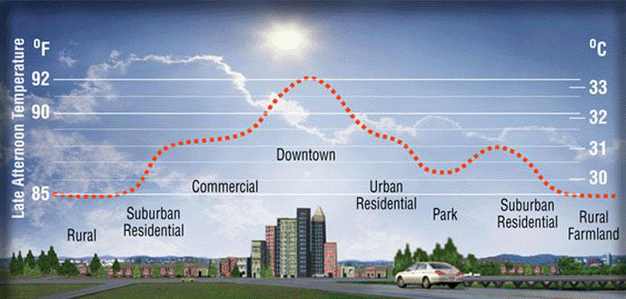
SOME parts of Australia are very hot – unnaturally hot, in fact. They’re turning into death traps, and it’s our own fault. news.com.au Megan Palin@megan_palin 23 May 17 AUSTRALIAN cities are 5C hotter compared to surrounding areas because of a phenomenon known as the ‘Urban Island Heat’ effect that could eventually turn them into death traps.Densely populated urban areas including Sydney, Melbourne and Brisbane are baring the brunt of the UHI across the country and not even a looming winter can stop it.
The UHI occurs when natural permeable surfaces including grass, plants or bush land are replaced with concrete, asphalt and infrastructure.
According to the Centre for Science
AUSTRALIAN cities are 5C hotter compared to surrounding areas because of a phenomenon known as the ‘Urban Island Heat’ effect that could eventually turn them into death traps.
Densely populated urban areas including Sydney, Melbourne and Brisbane are baring the brunt of the UHI across the country and not even a looming winter can stop it.
The UHI occurs when natural permeable surfaces including grass, plants or bush land are replaced with concrete, asphalt and infrastructure.
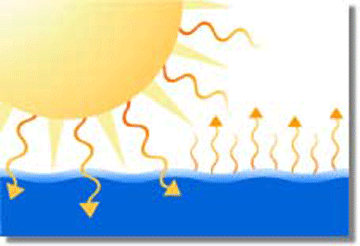
According to the Centre for Science Education (UCAR), urban development causes surfaces that were once permeable and moist to become impermeable and dry. They heat up during the day and retain the warmth but infrastructure prevents it from escaping into the cold night.
These changes cause urban regions to become warmer than their rural surroundings, forming an “island” of higher temperatures in the area.
“These surfaces absorb — rather than reflect — the sun’s heat, causing surface temperatures and overall ambient temperatures to rise,” according to a statement from UCAR.
“Displacing trees and vegetation minimised the natural cooling effects of shading and evaporation of water from soil and leaves.
“Tall buildings and narrow streets can heat air trapped between them and reduce air flow. Waste heat from vehicles, factories, and air conditioners may add warmth to their surroundings, further exacerbating the heat island effect.”
The UHI is perpetuated by residents in urban areas who suffer from the effects and increase usage of electric fans and airconditioners for relief. The increased energy demands strain resources which often leads to ‘rolling blackouts’ or power outages and contributed to an even hotter UHI.
But that’s not the only significant impact of the phenomenon.
According to UNSW researchers, extreme city heat could cause train lines to crumble and could cause heat stress, damaging our organs.
“Since 1900, extreme heat events have killed more Australians than bushfires, cyclones, earthquakes, floods and severe storms combined,” the researchers said.
WHAT’S BEING DONE ABOUT IT?……. http://www.news. com.au/technology/environment/ climate-change/urban-island- heat-effect-rising- temperatures-in-aussie-cities- could-create-death-traps/news- story/ 0b035c4707ea8f81e32ee0df4fa546 bf
Australia’s energy future at a critical turning point

The hope is that the Finkel Review – due in just over two weeks – might convince more people that we can do without the waving of red flags. The change is upon us and it’s all OK. We just need our regulators and our politicians to catch up.
The great divide over Australia’s energy future, REneweconomy By Giles Parkinson on 22 May 2017 It was the head of the biggest electric network operator in the world, China State Grid, that summed up best the challenge of moving to a high renewable energy grid: It is not so much a technical problem, but a cultural one.
In other words, there are those who say it can be done, arguing that it offers a smart, cleaner and ultimately cheaper and more reliable alternative. And there are those who say it can’t be done, and are reluctant to adopt the new technologies and the new ways of managing a complex electricity grid.
In Australia in the past few weeks, we have been getting a clear signal as to which authorities fall into which camp, and the obstacles facing those who want to get on with the job and go with the technology, rather than fight it. Continue reading
CSIRO is back on the world climate stage, in alliance with China’s largest marine science research institute
 Science is the winner from alliance, PETER BOYER, Mercury May 23, 2017 CSIRO is back in town and back on the world climate research stage. That was the real news in yesterday’s welcome announcement of a new Hobart-based Centre for Southern Hemisphere Oceans Research.
China cutting back on coal, investing massively in solar power
In September 2016, China’s cancelled more than 103 under-construction and planned coal-fired power plants, a total of 120 gigawatt hours (GWh) of capacity. In March this year, premier Li Keqiang announced that an additional 50GWh would be shut down or postponed. The coal power stopped in China so far is equivalent to the combined coal power capacity of the UK and Spain. China’s era of one coal-fired station a week is over.
China’s covering a Football field with Solar Panels Every Hour in Quest to End Coal, https://www.juancole.com/2017/05/chinas-covering-football.html | May. 10, 2017 By Janet Xuanli Liao | (The Conversation) | – –
China’s remarkable growth over the past three decades has elevated it to global superpower status. But its economic miracle has also attracted attention for the wrong reasons: the country is now the world’s largest energy consumer, oil importer, and CO₂ emitter. It led to the line that China builds a new coal-fired power station each week being faithfully and unquestioningly repeated. However, this is no longer a fair reflection of the country’s energy situation. Continue reading
Australia could use hydrogen to export solar energy
Guardian 19th May 2017 Using hydrogen on a large scale – either for electricity generation or transportation fuel – requires significant infrastructure investment; for example in hydrogen fuelling stations.
Zhang points out that Australia’s geography and scattered population makes that an expensive prospect, at least for the time being. Because of this, some are focusing on the perhaps more achievable prospect of Australia becoming an exporter of energy in the form of hydrogen.
Dr Michael Dolan, principal research scientist at CSIRO, says this is an attractive scenario because Australia has such an enormous capacity to generate renewable energy compared to a country like Japan, which has limited free land and sunshine…. https://www.theguardian.com/sustainable-business/2017/may/19/how-australia-can-use-hydrogen-to-export-its-solar-power-around-the-world
Federal and State policies betray Australia’s environment, and fail climate action
ClimateFail: Turnbull Government abandons any pretence of climate policy, Independent Australia Sue Arnold 22 May 2017 ‘A mountain of strategies, plans, reviews, meetings of ministers and promises substitute for any action at a time when climate change is wreaking havoc on the environment and wildlife.’A MASSIVE BETRAYAL of environmental issues is now entrenched in Federal and state government policies.
The failure to provide adequate funding in the Turnbull/Morrison 2017 Budget should eradicate any lingering doubts over the attitude and policy failures of this appalling Coalition Government and the spin-off impacts at the State level. The Budget miserliness is a clue to a much bigger picture.
In essence, the environment has been pushed to the back of the bus. International obligations under conventions that Australia has ratified are ignored. Entire forests must have disappeared to provide for the mountains of paper and verbiage paying lip service to Australia’s unique biodiversity and environmental heritage.
In 2010, the Federal Government published ‘Australia’s Biodiversity Conservation Strategy‘ under the auspices of the National Resource Management Ministerial Council (NRMMC). The strategy stretched from 2010-2030 and was tasked to the National Biodiversity Strategy Review Task Group.
The report is described as:
‘ … the guiding framework for governments to conserve our national biodiversity to 2030. It provides an overview of the state of Australia’s biodiversity and outlines collective priorities for conservation.’
Not only is the strategy a national framework for biodiversity conservation, it also acts as Australia’s principal instrument for implementing the United Nations Convention on Biodiversity.
Ten national targets were identified in the strategy to be completed by 2015:……….
In the meantime, the NRMMC disappeared, as did the National Biodiversity Strategy Review Task Group. A spokesperson from the Department of the Environment and Energy was unable to detail who exactly did away with these two bodies, but it appears that under PM Tony Abbott at the 2013 COAG meeting, COAG agreed that its council system should be streamlined and refocussed on COAG’s priorities over the next 12–18 months. 22 councils were reduced to eight, including the eradication of the Council on Environmental Regulation Reform.
Nevertheless, in 2015 as required under the strategy, a review of the first five years conducted by the Australian Government, State and Territory governments and the Australian Local Government Association examined the operation and implementation of the strategy.
The results are a damning indictment of not only a national failure to uphold any of the ten national targets but also a failure by state and local governments………
An analysis of the Federal Government’s Listed Key Threatening Processes demonstrates a bizarre list, which completely fails to include loss of habitat, the primary cause of extinction. The focus is on damage caused by rabbits, goats, fire ants and cane toads. Human created developments such as mining, forestry, dams and other environmentally damaging practices are ignored.
Listed species are required to have recovery plans under the Environment Protection & Biodiversity Conservation Act l999 (EPBC). Under the Act, the minister can and does delay recovery plans for up to six years. There is no legal process that allows the public interest to force the minister to speed up the finalisation or implementation of any Recovery Plan.
The procedure to nominate listing a species starts off with a minimum time frame of 4.5 months to overcome bureaucratic hurdles and an infinite time for the Minister to make a final decision.
His decision does not have to take into account any recommendations made by the Threatened Species Committee.
There is little doubt that the environment has become the lowest policy priority for state and Federal governments.
Instead, a mountain of strategies, plans, reviews, meetings of ministers and promises substitute for any action at a time when climate change is wreaking havoc on the environment and wildlife.
You can follow Sue Arnold on Twitter @koalacrisis and Koala Crisis on Facebook here. https://independentaustralia.net/politics/politics-display/climatefail-turnbull-government-abandons-any-pretence-of-climate-policy,10322
1 This month

of the week – Australians for War Powers Reform (AWPR)
To see nuclear-related stories in greater depth and intensity
 Antinuclear