New South Wales Labor leader to debate NSW Nationals leader John Barilaro on nuclear power for the State
 Mayor welcomes Labor vs Nats debate on nuclear power, Northern Star 5th Jun 2017: LISMORE mayor Isaac Smith has said he welcomed any debate on energy, following the news that NSW Labor leader Luke Foley had accepted a challenge by the NSW Nationals leader John Barilaro to engage in a debate nuclear power in NSW. Mr Foley suggested a public forum in Lismore as the venue for the debate…..
LISMORE mayor Isaac Smith has said he welcomed any debate on energy, following the news that NSW Labor leader Luke Foley had accepted a challenge by the NSW Nationals leader John Barilaro to engage in a debate nuclear power in NSW.
Mr Foley suggested a public forum in Lismore as the venue for the debate. In the letter, Mr Foley described nuclear power as “both risky and irresponsible” and said:
“While I most profoundly disagree that nuclear power is a serious option for our State, I accept your call for a debate and propose that we hold a public debate in Lismore to discuss the issues at stake.
“Lismore would be an appropriate location for such a debate as it is one of the most environmentally conscious communities in NSW.
“I profoundly disagree with your support for nuclear power as there is no secure solution to the problem of safely managing toxic radioactive waste that can be lethal for the next 500,000 years.”
“Labor proposes that the debate would be moderated by an impartial local North Coast media identity with questions from the audience.”
Mr Secord (NSW Labor) said the Nationals needed a mandate from the community on nuclear power and the community had a right to know about their plans.
“It is time the Nationals leader John Barilaro explained his position to the community and the North Coast would provide the perfect venue to do so,” Mr Secord said.
“Sadly, there is a cloak of secrecy surrounding the decisions by the State Liberal-National Government and the community has a right to know about the government’s intentions on nuclear power.
“I am also on the record expressing my concerns about nuclear power. In March 2012, I spoke against the Mining Legislation Amendment (Uranium Exploration) Bill 2012 when the Liberals and Nationals overturned Labor’s long standing ban on uranium exploration in NSW.
“I believe that the North Coast views are clear. The community is against the expansion of nuclear power – and so is NSW Labor.
“Lismore would be a perfect location to debate this important issue. I look forward to helping to organise the debate between Mr Foley and Mr Barilaro.” https://www.northernstar.com.au/news/labor-accepts-nationals-challenge-to-debate-nuclea/3185820/
Another obstacle has arisen to the Adani coal rail line plan
Adani white elephant hits another snag as GVK teeters at brink https://www.michaelwest.com.au/adani-white-elephant-hits-another-snag-as-gvk-teeters-at-brink/June 4, 2017 Never was a white elephant so white … and elephantine.
Besides their empty cries that coal from Australia is good for the poor people of India, while delivering monumental “jobs and growth” at home, the shrinking coterie of ideologues and thermal coal apostles has hit another hurdle.
Part of the push for a rail line from the Galilee Basin to Abbot point has hung on the argument that this railway will be a “common-user facility”; that is, it will not only be used to freight Adani coal but also that of GVK. GVK is a smaller Indian company, teetering on the brink of obsolescence, which apparently still harbours hopes that its Alpha coal project in the Galilee will one day be developed.
GVK Hancock is a joint venture between GVK and Gina Rinehart’s Hancock Prospecting. It is partnering with rail group Aurizon in the southern end of the Galilee Basin while Adani’s Carmichael project lies to the north.
In another blow to those who wish the Galilee to be developed with thermal coal mines, GVK Power & Infrastructure announced on Friday it had sold its remaining 10 per cent stake in Bangalore International Airport to Fairfax India Holdings for $US200 million.
It seems GVK has been reduced to selling core assets to stay afloat. Net debt is now $US1.8 billion versus a market value of equity at $US145 million.
GVK has suffered six years of losses, last reporting a net loss of $US209 million for 2017 as its auditor raised questions as to whether it was a “going concern”. Meanwhile, Adani is still holding out for taxpayer subsidies in a bizarre negotiating process knowing full well that, in India, the cost of building new solar capacity is cheaper that new thermal coal.
Adani Power Management recently conceded that almost $US9 billion in existing thermal coal plants fired by imported coal at Mundra, Gujarat, are no longer viable. It referred to the prohibitively high costs of imported coal.
No doubt, while coal futures languish well below the spot price, rendering Adani’s hopes (if they really still harbour them without taxpayers backing the lot) futile, the Carmichael cheer-squad will gloss over these small details as somehow bad for the poor people of India while they continue to promote this most effulgent of white elephants.
It will never happen, nor should it.
Frydenberg’s carbon capture and storage – it’s a joke, really
 Frydenberg’s carbon capture pipe dream, The Saturday Paper Paul
  Bongiorno , 3 June 17
“…..it was with some bemusement that some of the old hacks who were on that trip greeted Energy and Environment Minister Josh Frydenberg’s announcement that he would remove the legislative prohibition on the Clean Energy Finance Corporation (CEFC) to allow it to support investment in carbon capture and storage (CCS). The very optimistic minister said such technology could reduce emissions by up to 90 per cent.
This week Frydenberg pointed out that government has invested $590 million in CCS and said it is now being successfully employed in three overseas power plants. But a closer look shows the lessons learnt from those plants mean its use has already peaked. The proponents of these plants are on the record stating they won’t be investing in any more. Renewables entrepreneur Simon Holmes à Court told the ABC that exponential cost blowouts and disappointing results are the rule.
One plant visited by the energy minister – Petra Nova in Texas – cost $US1 billion. It’s touted as the world’s largest and most successful operation, yet it captures only about 6 per cent of the output of its adjacent power station. That’s “an incredibly low bang for buck”, concludes Holmes à Court. Another CCS plant targeted to cost $US2 billion will open three years late and with an incredible final bill of $US7.5 billion.
Holmes à Court agrees with Frydenberg that CCS has a role to play in cutting emissions in industrial processes such as cement or steel production. Carbon can be captured in these cases for about $15 to $30 a tonne. “So with a healthy carbon price, those projects make sense,” he says. And there’s the rub. The very government wanting to be a champion of CCS for industry is denying it any incentive to spend a cent pursuing it. It’s commercially cheaper to keep polluting. Industry may get away with that but finance markets are now pricing climate change into lending for major energy projects. Bloomberg New Energy Finance earlier this year costed CCS coal at $352 a megawatt hour, compared with wind and solar at between $61 and $140 megawatts an hour.
It’s little wonder that experts can’t see private industry investing in new coal-fired power stations without substantial government input. But none of this seems to deter the resources and Northern Australia minister, the Nationals’ Matt Canavan……..https://www.thesaturdaypaper.com.au/opinion/topic/2017/06/03/frydenbergs-carbon-capture-pipe-dream/14964120004723
Former new York Mayor Michael Bloomberg will personally fund the UN climate fund
 Independent 2nd June 2017, Former New York City mayor Michael Bloomberg has said he will personally make up the $15m in funding that the United Nations will lose after Donald Trump pulled the US out of the Paris climate accord.
The US would have been required to contribute that amount towards efforts to prevent catastrophic
climate change under the historic agreement between 195 countries to reduce greenhouse gas emissions.“Americans are not walking away from the Paris climate agreement,” Mr Bloomberg said on Thursday, according to the Washington Examiner. “Just the opposite – we are forging ahead.
Mayors, governors, and business leaders from both political parties are signing on to a statement of support that we will submit to the UN and together, we will reach the emission reduction goals the United States made in Paris in 2015. The billionaire philanthropist added: “Americans will honour and
fulfil the Paris agreement by leading from the bottom up — and there isn’t anything Washington can do to stop us.” http://www.independent.co.uk/news/business/news/former-new-york-city-mayor-michael-bloomberg-has-said-he-will-personally-make-up-the-15m-in-funding-a7769416.html
Investor warning on continued poor future for Cameco’s uranium business
 it is highly unlikely that its financial performance will improve drastically, making it an unappealing investment.
Don’t Try to Catch This Falling Knife https://www.fool.ca/2017/06/01/dont-try-to-catch-this-falling-knife/ Matt Smith | June 1, 2017 The world?s second-largest uranium producer Cameco Corp. (TSX:CCO)(NYSE:CCJ) continues to suffer, posting a first-quarter 2017 net loss which dragged its stock lower; it’s almost 13% down for the year to date. This has attracted the usual bargain hunters who believe that Cameco is now an appealing, undervalued investment but this couldn?t be further from the truth.
Now what?
Cameco?s woes can be directly attributed to the prolonged slump in uranium which has lasted for longer than a decade; prices fell to a 13-year low late last year. The embattled uranium miner posted a first-quarter adjusted net loss of $29 million. According to some analysts, wind power is now cheaper than nuclear power, while solar and geothermal electricity generation can have lower costs. These forms of power generation don’t produce highly toxic waste or the potential to create catastrophic environmental damage in the event of failure.
For these reasons, it is difficult to see a huge upswing in demand for uranium over coming years, especially with renewables technology advancing at a rapid rate. This means that Cameco may find itself in the position where it is producing a product that is suffering from a terminal decline in demand. Worse yet, uranium prices remain under pressure because of high global inventories and a growing supply which is expected to expand by over 40% to reach 80,383 tonnes by 2020.
Cameco’s woes can be directly attributed to the prolonged slump in uranium which has lasted for longer than a decade; prices fell to a 13-year low late last year. The embattled uranium miner posted a first-quarter adjusted net loss of $29 million, which was 3.5 times greater than the net loss reported for the same quarter in 2016 and that predicted by analysts.
A key reason for the massive net loss was the decision by Tokyo Electric Power Company, the operator of Japan’s disabled Fukushima nuclear plant, to terminate its contract with Cameco for the supply of 9.3 million pounds of uranium through to 2028. The contract was worth $1.3 billion in revenue.
Nonetheless, Cameco has pitched its hopes on a surge in demand for uranium as the 57 reactors currently under construction across the globe come online. While there won’t be an immediate ramp-up in demand, according to industry consultants, it will lead to cumulative uncovered requirements for uranium to total around 800 million pounds of the fissile material over the next nine years.
This may be a positive for company that has been battling significant headwinds for some time, but it does not necessarily guarantee a return to profitability.
You see, nuclear power has been falling into disfavour for some time, and this only gained momentum in the wake of the Fukushima disaster in 2011. While nuclear plants do not emit pollutants, there are the serious issues associated with the leakage of radiation and the disposal of fissile waste.
Radiation can have a catastrophic impact on the environment, animals, and humans. High-level nuclear waste such as a spent fuel assembly, according to the United States Nuclear Regulatory Commission, produces 20 times the fatal dose of radiation for humans for 10 years after being removed from a reactor.
This makes the correct handling and storage of this waste essential, costly, and highly onerous.
The Fukushima disaster highlighted just how vulnerable nuclear plants can be to environmental catastrophes, although, fortunately, there was no leakage of fissile material or polluted water in that case.
However, these aren’t the only reasons for the growing unpopularity of nuclear power.
The cost of safer forms of renewable energy continues to fall.
According to some analysts, wind power is now cheaper than nuclear power, while solar and geothermal electricity generation can have lower costs. These forms of power generation don’t produce highly toxic waste or the potential to create catastrophic environmental damage in the event of failure.
For these reasons, it is difficult to see a huge upswing in demand for uranium over coming years, especially with renewables technology advancing at a rapid rate. This means that Cameco may find itself in the position where it is producing a product that is suffering from a terminal decline in demand. Worse yet, uranium prices remain under pressure because of high global inventories and a growing supply which is expected to expand by over 40% to reach 80,383 tonnes by 2020.
So what?
The loss of the Tokyo Electric Power Company contract is a major blow for Cameco, costing it around $1.3 billion in revenue in what is already a difficult operating environment. When considered with the growing unpopularity of nuclear power, the inexorable advance of renewable energy, and growing uranium supplies, it is difficult to see any significant bounce in the price of uranium occurring.
This makes difficult to see Cameco ever returning the halcyon days when uranium traded at US$67 per pound, meaning that it is highly unlikely that its financial performance will improve drastically, making it an unappealing investment.
Calls to cut support for coal mines after latest Great Barrier Reef report
 Greens believe Great Barrier Reef future at crucial crossroads after new report released, Brisbane Times Toby Crockford
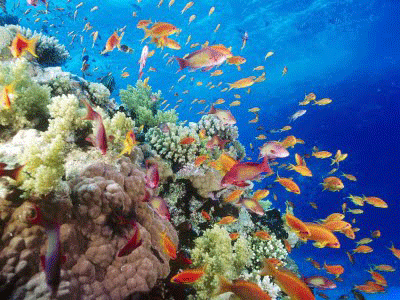
 JUNE 3 2017 The Greens have issued an ultimatum to the state and federal governments after the latest report expressed “serious concern” regarding the Great Barrier Reef rescue plan.UNESCO, which advises the World Heritage Committee, said on Saturday that key targets in the Reef 2050 plan “are not expected to be achieved” and urged Australia “to accelerate efforts”. In response to the fresh concerns, Queensland Greens Senator Larissa Waters launched a scathing attack on the state and federal governments.
“Meanwhile, Queensland Labor and Turnbull roll out the red carpet and public money for Adani for their deadly mega-coal mine,” Senator Waters said.
“As many scientists have said, our governments must choose between new coal or the reef.
“Will the two old parties back the 70,000 people with reef jobs? Or will they pay back the millions in donations from the mining industry, sign the reef’s death warrant and continue to back Adani?”
Queensland Environment Minister Steven Miles admitted progress had been slow in implemented measures outlined in the reef rescue plan, particularly towards 2018 targets.
In a report released in Paris on Saturday, UNESCO praised progress in the inception and initial implementation of the rescue plan but said reef rescue work “must move faster”.
“Progress towards achieving water quality targets has been slow and the most immediate water quality targets … are not expected to be achieved within the foreseen time frame,” the report said.
A previous report revealed coral bleaching at the Great barrier Reef in 2016 was even worse than expected. The most severe bleaching was found north of Port Douglas where an estimated 70 per cent of shallow water corals had died. http://www.brisbanetimes.com.au/queensland/greens-believe-great-barrier-reef-future-at-crucial-crossroads-after-new-report-released-20170603-gwjrgv.html
In sunny Broome, residents are fed up with restrictions on accessing solar power
Broome residents tire of cap on solar power installations http://www.abc.net.au/news/2017-06-03/broome-residents-tire-of-waiting-for-solar/8584060
Key points
- Horizon Power only allows 10 per cent of the town’s power to come from solar due to issues with grid fluctuations
- This leaves some residents unable to install a solar system that connects to the grid
- Horizon is trialling battery storage technology in other WA towns and hopes to expand this to Broome
State-owned energy utility Horizon Power allows just 10 per cent of the town’s power to be generated from solar to protect the grid from fluctuations during periods of high and low light.
Small business owner Cameron White has been trying to switch to solar for two years in a bid to reduce his power bill but said he has been blocked at every turn.
“We’re in the sunniest place in Australia, probably, but we can’t use it,” he said.
Mr White said the high cost of electricity in regional areas, combined with the inability to access solar was putting added financial stress on homes and businesses already suffering in a post-mining boom era.
“Businesses in town are struggling at the moment, including myself, and you know these power bills [are] enough to tip people over the edge,” he said.
Horizon Power acknowledges the problem and is currently trialling battery-supported solar systems in the WA towns of Carnarvon and Onslow which can store the power to deal with the fluctuations in supply.
Spokesman Frank Tudor said Horizon ultimately wanted regional towns to generate half their energy from the sun. “Broome will be part of the trials that we are looking at across all of our different systems, if that proves worthwhile then we will gradually roll it out,” he said.
But Mr White said he was not going to wait any longer, opting instead to disconnect from the grid and rely solely on the sun. “I’m going it alone, I’m determined to do it myself,” he said.
Australians’ opposition to subsidising Adano coal project – ranges from 70 to 86 per cent
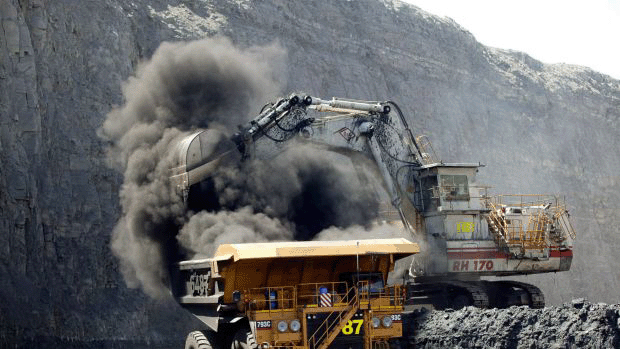 Frydenberg’s carbon capture pipe dream, The Saturday Paper Paul Bongiorno , 3 June 17 “….. no matter what voters think of the [Adani coal] project, they are overwhelmingly against any taxpayer funds bankrolling the Indian billionaire Gautam Adani. Research by the advocacy group GetUp! in marginal seats in Queensland and elsewhere has found resolute opposition to any government loan. Paul Oosting from GetUp! says opposition ranges from 70 to 86 per cent depending on the seat. He has mobilised dozens of his 350,000 members to make 50,000 scripted phone calls into marginal seats in Queensland and around the nation.
It sort of worked with the Palaszczuk Labor government. Much to the delight of Adani, the premier organised a royalties pause. The miner will be given 60 years to pay the tax, although he will attract an interest charge for any delay. That puts all the risk on taxpayers if the project fails to perform as promised or Adani’s labyrinthine company structure for the mine collapses. With some companies registered in the Cayman Islands the existence of a lucrative escape hatch for Adani cannot be ruled out.
Ominously, Indian newspapers are reporting Adani is under pressure to sell its Australian assets. The Reserve Bank of India is worried about a looming debt crisis and is pressuring banks to demand repayment of loans worth billions of dollars. The influential Hindu newspaper noted that the Standard Chartered Bank recalled loans of $2.5 billion from Adani and that “global lenders have backed out from funding the $US10 billion coalmine development project. State Bank of India also declined to offer a loan despite signing an MoU [memorandum of understanding] to fund the group with $1 billion”. What all of this means for Adani’s bid to get a concessional billion-dollar loan from the federal government’s Northern Australia Infrastructure Facility is not yet known. It should make it highly unlikely, but given the zealotry of Canavan and his leader Barnaby Joyce for the project such concerns are a mere bagatelle.
Again we have seen Turnbull’s need for pragmatic appeasement of the conservatives in his ranks undermine his brand on the environment and climate change. It probably goes a long way to explain why again in this week’s opinion polls he is still deep in negative territory for approval of his performance and Labor’s lead looks entrenched.
The resignation of Dr Peter Hendy from the inner sanctum of the prime minister’s offices is being read by some in the Liberal Party as a sign the government’s days are numbered. The economist, long-time Liberal apparatchik and former MP is planning to hang up his shingle as a consultant. “He wants to cash in on his contacts while they are still in power,” was one explanation. Another was: “Peter’s been around a long time and knows when a vote is cemented in.”
On that view Hendy is not waiting to see if the handful of pro-Adani seats in Queensland will be enough to save the federal government. Its chances are up in smoke and out the chimney – like the Beijing carbon capture pilot project. https://www.thesaturdaypaper.com.au/opinion/topic/2017/06/03/frydenbergs-carbon-capture-pipe-dream/14964120004723
Rare earth’ s mining and processing needs expensive but essential environmental safeguards
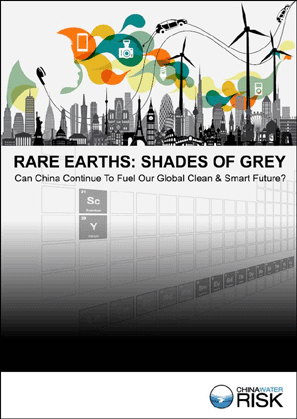
 New CWR Report! Rare Earths: Shades Of Grey http://chinawaterrisk.org/notices/cwr-rare-earths-shades-of-grey/

Last December in Paris, an epic agreement on climate change was reached, setting the world on the long road towards de-carbonizing global economic growth. Promising technological innovations on clean energy, energy storage and efficiency are considered major drivers of the upcoming “clean, green & smart” revolution.
A deep-dive into the underlying new technologies however, leads to a severe yet overlooked problem. Rare earths, a cluster of 17 elements often called the “vitamins of industry”, may prove to be a bottleneck to such “clean, green & smart” innovations like wind turbines, smartphones, electric cars and more.
Rare earth mining and processing is a polluting and toxic process impacting China’s water resources and arable land. It is really only economically viable because environmental costs are not taken into account.
The question is, can we build a sustainable clean, green and smart future on the back of pollution and a black market? We take a close look at these issues in our new report, “Rare Earths: Shades Of Grey – Can China continue to fuel our clean and smart future?” Key highlights from the report below.
Key highlights:
- Current non-fossil fuel, highly smart and climate-friendly technologies do not work without rare earths;
- China has been the top global producer since the mid-1990s with 85-90% of global rare earth production;
- Southern China is where the majority of global Medium Heavy Rare Earth Elements (MHREEs) – the more strategic & less available compared to Light Rare Earth Elements (LREEs) – originate; some MHREEs are solely sourced from China;
- China has been paying the environmental cost of massive, unregulated rare earth mining and processing with low margins;
- Mines with their severely polluting extraction activities have contaminated drinking water sources and agricultural fields of local communities. China’s mega-cities further downstream like Guangzhou, Shenzhen and Hong Kong may be at risk from the toxic contamination upstream;
- A RMB38 billion environmental bill to clean-up mines in southern Ganzhou city was estimated by the Ministry of Industry and Information Technology remains unpaid with little media attention;
- Naturally the black market, an open dirty secret, hasn’t helped;
- Since 2006 China has been trying to regulate the industry; latest change in 2016 is the consolidation of the industry into six groups, which account for 99.9% of the country’s production quota for the first half of 2016;
- In July 2010, China cut its export quotas by 22.5%. This stirred protests from the largest recipients of China’s rare earth supply, the US, Japan and Europe. Complaints were brought to the World Trade Organisation; and
- Forecasts show rare earth demand increasing vastly, both in China & globally, but will China be able to continue to feed this demand?
Business leaders, policy makers and consumers, all need to rethink how we are going to achieve our low-carbon future in a more environmental and climate-friendly way. Especially since it appears that the only direction for global rare earth prices is up if environmental costs are factored in and remember China is fighting a war on pollution.
Global warming and the disappearance of coral reefs
Scientists warn US coral reefs are on course to disappear within decades
New Noaa research shows that strict conservation measures in Hawaii have not spared corals from a warming ocean in one of its most prized bays, Guardian, Oliver Milman, 30 May 17, Some of America’s most protected corals have been blighted by bleaching, with scientists warning that US reefs are on course to largely disappear within just a few decades because of global warming.
“I’m concerned because we could very well see bleaching return to Florida, parts of the Caribbean and Hawaii,” said Mark Eakin, a coral reef specialist at Noaa.
“It won’t be as severe as 2015, but we’ve now moved into a general pattern where warmer than normal temperatures are the new normal. US reefs have taken a severe beating. We are looking at the loss or at least severe degradation of most reefs in the the coming decades.”
A global coral bleaching event has shifted between the northern and southern hemispheres since 2014, affecting around 70% of the world’s reefs. The “terminal” condition of Australia’s sprawling Great Barrier Reef, which suffered bleaching along two-thirds of its 1,400-mile length in 2016 and 2017, has provoked the greatest alarm.
“The idea we will sustain reefs in the US 100 years from now is pure imagination. At the current rate it will be just 20 or 30 years, it’s just a question of time,” said Kim Cobb, an oceanographer at Georgia Tech. “The overall health of reefs will be severely compromised by the mid-point of the century and we are already seeing the first steps in that process.”
Bleaching occurs when prolonged high temperatures in the ocean cause coral to expel the symbiotic algae that provides it with food and colour. The coral turns a ghostly white, and can die if tolerable conditions don’t return. The world’s oceans have absorbed more than 90% of the extra heat generated by the release of greenhouse gases from human activity.
Cobb said regular annual bleaching events, which recent research has forecast happening by the 2040s, will “undercut the resilience of these ecosystems”. Corals not killed off by bleaching are left weakened by the process and are less likely to survive if repeatedly subjected to above-average temperatures.
“As scientists we are breathlessly trying to catch up,” said Cobb. “Things started to run away from us around 10 years ago but we were perhaps a little naive in not realizing that.”
In 2014 and 2015, Hawaii’s coral reefs suffered up to 90% bleaching, with some areas losing half of their coral cover. New research now shows that even one of the most protected parts of the Hawaiian coast was ravaged by coral bleaching………
Severe bleaching has swept across the Pacific Ocean, Indian Ocean and the Caribbean, with some areas altered beyond recognition. More than 80% of shallow water reefs off Christmas Island, an Australian territory in the Indian Ocean, have died, while images released from a survey last year showed 90% bleaching of reefs around Okinawa, Japan……..
Coral reefs are found in less than 1% of the world’s oceans but support a riot of colour and life, with around a quarter of all marine species relying upon the nooks and crannies of reefs for food or shelter. Reefs also act as a crucial coastal buffer from storms and provide food and livelihoods for millions of people. A study published this month foundthe global reef tourism industry is worth around $36bn.
“In the US our reefs are worth a huge amount but I don’t know if people realize that, more attention would not hurt,” said Dona, co-author of the Hawaii reef study.
“There are places in the world that have lost a tremendous amount of coral and we have the same prognosis if we continue to burn fossil fuels in the way we are doing. We need to cut our carbon emissions because the corals just can’t handle it.”https://www.theguardian.com/environment/2017/may/30/us-coral-reefs-global-warming-climate-change
1 This month

of the week – Australians for War Powers Reform (AWPR)
To see nuclear-related stories in greater depth and intensity
 Antinuclear