0.24 to 0.72 microsievert per hour at five schools in Kashiwa city, 47km from Tokyo

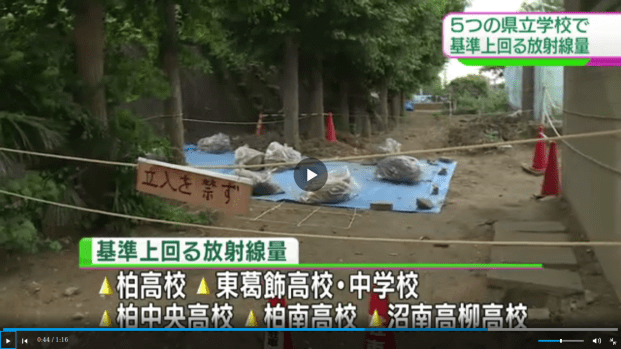
In January 2017, the Chiba Prefectural Board of Education was notified that radiation above the national standard level was measured at the Kashiwa city central gymnasium.
Following that reportthe Chiba Prefectural Board of Educationconducted an investigation in Kashiwa cityfrom late April to the middle of May2017.
A radiation level exceeding the national standard of 0.23 microsievert per hour was detected on the premisesof five schools in Kashiwa City, The radiation measured at1 meter above ground level ranged from 0.24 to 0.72 microsievert.
At Kashiwa High School, Higashi Tsukuba High School and Middle School, Kashiwa Chuo High School, Kashiwanami High School and Kusanami Takayanagi High School, at placeswhere usually no one enters: near a pool, at the back of abicycle parking lot, etc..
The prefectural Board of Education decidedto cordon those hot spots, to prohibit the entry and to decontaminatethose places…
View original post 26 more words
Senator Scott Ludlam probes the Australian government’s plan to dump Lucas Heights’ nuclear waste on rural South Australia
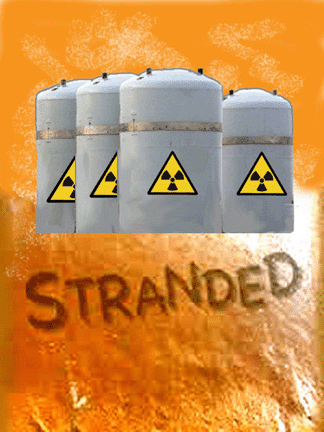 Assuming that the long-lived intermediate-level stuff does go to the sites that you are busy characterising at the moment, how long is it envisaged that it actually stays there before it gets taken somewhere else?
Mr B Wilson: We cannot give a definitive answer on that because we have not commenced a process to identify a permanent disposal solution for the long-lived intermediate-level waste—
Senator LUDLAM: Ouch!
if the really dangerous intermediate-level stuff is to be stored there you cannot tell them how long it is meant to be there for
so we kind of do not really know what is going on there or how long it is meant to be there for.
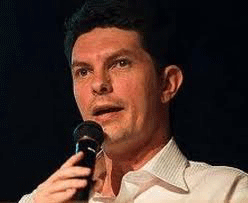 ECONOMICS LEGISLATION COMMITTEE, Department of Industry – RADIOACTIVE WASTE 1st June 2017
Full Transcript here: http://parlinfo.aph.gov.au/parlInfo/download/committees/estimate/e3ddf88b-3e9c-4546-9d90-8f646689a98c/toc_pdf/Economics%20Legislation%20Committee_2017_06_01_5134.pdf;fileType=application%2Fpdf
Senator Canavan: I have been to Hawker and I am going there again tomorrow, and I would like to put on record my thanks to many in the Hawker community who engage in this process. Some have certainly changed their mind as they have come to have more understanding of it. I think you have probably been to Lucas Heights, and it I think it makes a big difference to people when they see it. There is a lot of misinformation spread about this, and we are trying to engage with people in a genuine way in good faith to give them the information to make informed decisions.
Senator LUDLAM: Who is spreading this information, Senator Canavan?
Senator Canavan: I hear it from time to time. I do not have any particular allegations to make about individual groups here, but you do hear lots of information from time to time about the potential danger of this material. But, of course, as you would probably know, much of the low-level waste is stored safely at Lucas Heights, a place where people go to and from work every day.
Senator LUDLAM: That begs the question of why it needs to move. ……
Senator LUDLAM: Staying in South Australia: has there been any consideration at all—this is for the department or the minister, whoever wants to take this one on—of the tension between the proposed national radioactive waste facility and the existing South Australian legislation, which would be the Nuclear Waste Storage Facility (Prohibition) Act 2000? The tension between the fact that your entire project is presently illegal under South Australian law: what is being done about that?
Mr B Wilson: We are certainly aware of the South Australian prohibition under their law. However, the National Radioactive Waste Management Act that we operate under overrides South Australian law.
Senator LUDLAM: And that is it? You are just going to squash them? Or are there discussions progressing with the South Australian government?….
Senator LUDLAM: Is the department, or you, Senator Canavan, or any of the federal agencies or other actors in communication with the South Australian government environment or heritage departments, or representatives of any body, actually, in relation to the tension between the two acts?
Senator Canavan: I have raised it with the South Australian government. They have indicated that they may seek to make changes. I am not aware of the status of that at the moment. Obviously, they have their own process, which is a separate to ours, on radioactive waste. Certainly, the issue has been raised. Mr Wilson is also right that we are confident that is not a barrier to this project. But Mr Wilson will be giving you that.
Mr B Wilson: We engage—I would have to characterise it as infrequently—with the South Australian government. It is more in the line of updating where we are. We have not had any recent engagements. They are certainly very well aware of the prohibitions under their law about what the South Australian government and its officials can do in this space….
When I said that the National Radioactive Waste Management Act overrides South Australian law, that is the fact. But what we are trying to do in the development of this project is to develop it and act in a way that is consistent with requirements under other South Australian legislation. For instance, in terms of Indigenous heritage protection and other aspects. While we are not necessarily bound by those laws we want to act in a way that is consistent with them.
Senator LUDLAM: With waste that is as dangerous as this, I am very glad to hear it! Is the department still accepting site nominations?
Senator Canavan: The government remains open to further nominations, as we announced on selecting the Hawker site last year. But the ones we have announced are those that we are proceeding with at this stage.
Senator LUDLAM: Wallerberdina and two at Kimba. Continue reading
1 This month
7 April – WEBINAR – Australia and the Doomsday Clock – Preventing nuclear war through NoFirstUse and other policies
Online | Tuesday April 7, 4:00-5:30pm, Australian Eastern Time / 8:00-9:30am Central Europe Time
– Access the registration link
15 April – Zoom –Nuclear Power is Not the Solution
Apr 15, 2026 01:00 AM in Canberra, Melbourne, Sydney

Join the International Physicians for the Prevention of Nuclear War (IPPNW) on Tuesday, April 14th for a timely webinar exploring the risks associated with nuclear power and challenging the myth that it offers a simple, safe, carbon-free solution to the climate crisis

21 April Webinar: No Nuclear Weapons in Australia
Start: 2026-04-21 18:00:00 UTC Canberra, Melbourne, Sydney (GMT+10:00)
End: 2026-04-21 19:30:00 UTC Canberra, Melbourne, Sydney (GMT+10:00)
Event Type: Virtual
A virtual link will be communicated before the event.
Host Contact Info: australia@icanw.org

of the week – Australians for War Powers Reform (AWPR)
To see nuclear-related stories in greater depth and intensity
 Antinuclear