 Thanks to those who reminded me that the British PM is NOT Theresa Merkel, (as I wrote last week). As one reader suggested, I must have been doing some wishful thinking – a Freudian slip. Now I know that the PM is Theresa Mayhem.
17 June, as delegates gather in New York for UN negotiations on nuclear weapons ban treaty, women and men and children around the world will be marching in support of that treaty plan.
Collapsing ice shelves will further accelerate global sea level rise. Cities and states may be able to officially join the Paris Climate Agreement. The “growth economy” must end, along with the coal industry. Record drop in global coal production. Solar power speeding the death of coal-fired power.
AUSTRALIA
Congratulations to those who received Queen’s Birthday awards for work on the environment.
NUCLEAR
Ukraine uranium sales plan: Unreasonable, unstable and unsafe.
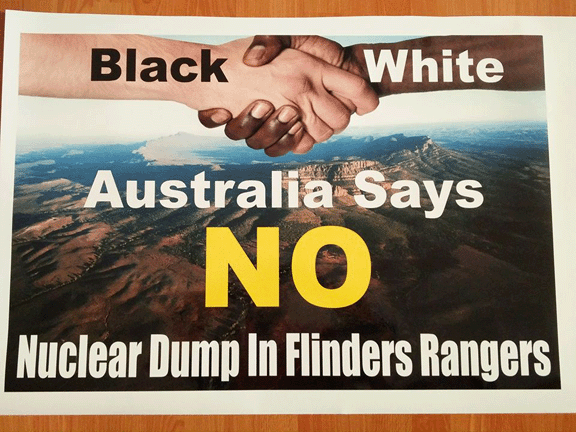
Senator Scott Ludlam probes the Australian government’s plan to dump Lucas Heights’ nuclear waste on rural South Australia.
South Australians very definitely dumped the nuclear dump plan, but a new battle looms.
Liberal MP Jane Prentice speaks out in favour of nuclear power. New South Wales DEPUTY Premier John Barilaro renews calls for nuclear power. Tomago Aluminium boss wants government to invest in nuclear energy.
CLIMATE and ENERGY
Adani coal project Green light for massive coal mine? Adani has not secured the financing it needs for the project. Aboriginal leader, previous supporter of Adani coal project, now rejects it. Federal Inquiry needed: Adani should be questioned on history on environment and ‘allegations of fraud, corruption. Adani Group embroiled in corrupt arms deal in South Africa. Adani could be looking for an excuse to back out of unviable Carmichael coal project.
Aboriginal issues Traditional Owners slam passage of Native Title amendments. Professor Marcia Langton promoting Big Coal, not Aboriginal Rights. Marcia Langton “poorly informed” on Adani coal mine, says leading native title lawyer.
June 16, 2017
Posted by Christina Macpherson |
Christina reviews |
Leave a comment
http://thebulletin.org/women-and-ban-bomb-movement, Ray Acheson, 15 JUNE 2017This week at the United Nations in New York City, governments, international organizations and civil society groups are gathering to resume negotiations on a treaty banning nuclear weapons. And women are at the forefront of this effort—as they have been at the forefront of the anti-nuclear resistance since the beginning of the nuclear age.

The Women’s International League for Peace and Freedom (WILPF) —where I work as director—was one of the first civil society groups to condemn the bombings of Hiroshima and Nagasaki. (The term “civil society” gets used a lot and has many different definitions, but is generally accepted to mean groups working in the interests of citizens but outside of government or business; some examples include charities and non-governmental organizations such as the Red Cross.) Women were leaders in the campaign to ban nuclear weapon testing in the United States, using powerful symbols such as a collection of baby teeth to show evidence of radioactive contamination. Women led the Nuclear Freeze movement in the 1980s, calling on the Soviet Union and the United States to stop the arms race. Now, women are the leading edge of the movement to ban nuclear weapons in the International Campaign to Abolish Nuclear Weapons.
When the three-week-long negotiations at the UN resume on June 15, women will be continuing this tradition, both in the conference room and on the streets. As part of its efforts to ban nuclear weapons, the WILPF is organizing the Women’s March to Ban the Bomb, on June 17, to be held in mid-town Manhattan. Other events will be held across the globe to show solidarity with the march, in places as far apart as Australia and Scotland. The event has over 30 sponsors and endorsers from around the world.
In my opinion, the process of banning nuclear weapons serves another purpose as well: It acts as a challenge to much of the existing discourse, which has been distinctly patriarchal in tone.
In fact, much of the opposition to the nuclear ban process has been highly gendered. Those who talk about the humanitarian consequences of nuclear weapons and call for the prohibition of weapons of mass destruction are accused of being divisive, polarizing, ignorant, and emotional. Meanwhile, opponents to the ban say that they support “reasonable,” “realistic,” “practical” or “pragmatic” steps, and call anything else “irrational” and “irresponsible.”
Many women may recognize this rhetorical assault. When a certain type of man—think Donald Trump—wants to assert his power and dominance and make women (or other men) feel small and marginalized, he often accuses them of being emotional, overwrought, relentless, repetitive, or irrational. This technique has been employed for as long as gender hierarchies have existed.
In the case of the ban treaty, this approach links caring about humanitarian concerns to being weak, and asserts that “real men” have to “protect” their countries. It not only suggests that caring about the use of nuclear weapons is spineless and silly, but also implies that the pursuit of disarmament is an unrealistic, irrational, and even effeminate objective.
Of course, the fact that masculinity is equated across so many cultures with the willingness to use force and violence is a social phenomenon, not a biological one. Boys come to learn to define themselves as men through violence. The way that norms of masculinity such as toughness, strength, and bravado are displayed in the media, at home, and in school teaches boys to exercise dominance through violent acts. Boys learn to think of violence as a form of communication.
Nuclear weapons are themselves loaded with symbolism—of potency, protection and the power to “deter” through material “strength.” For many, such symbolism obscures the real point of the existence of these arms—to destroy—and their horrendous effects.
Nuclear weapons are not just symbolically gendered. Women face unique devastation from the effects of the use of nuclear weapons, such as the impacts of radiation on their reproductive and maternal health. Women who have survived these radioactive effects also face unique social challenges; they are often treated as pariahs in their communities.
Consequently, denying the rationality of those that support a nuclear weapons ban is also a denying of the lived experience of everyone who has ever suffered from the use or testing of nuclear weapons.
This is why it’s essential to ensure gender diversity in negotiations, and why it’s important to include a gender perspective in those negotiations. To celebrate the nuclear ban—and women’s leadership in achieving it—there will be the Women’s March to Ban the Bomb.
This post is part of Ban Brief, a series of updates on the historic 2017 negotiations to create a treaty banning nuclear weapons. Ban Brief is written by Tim Wright, Asia-Pacific director of the International Campaign to Abolish Nuclear Weapons, and Ray Acheson, director of Reaching Critical Will.
June 16, 2017
Posted by Christina Macpherson |
Uncategorized |
Leave a comment
We have the chance to change the world with this instrument. The ban will not magically eliminate these weapons, but it will be a chink in the nuclear armour of those who continue to claim some “security benefit” from these indiscriminate, immoral, genocidal weapons. Nuclear weapons do not provide security. The majority of the world does not have them or need them. It’s time to codify this in international law and set the stage for total elimination.
The world is watching. It’s time to ban the bomb.

We’re Off! to Ban Nuclear Weapons http://www.globalresearch.ca/were-off-to-ban-nuclear-weapons/5594766, By Ray Acheson, Global Research, June 15, 2017 Reaching Critical Will It’s game on for round two of the nuclear ban negotiations! Delegations from governments, civil society, and international organisations are rallying in New York City at the United Nations to start deliberating over the President’s draft treaty text—and to start crafting one of the most ambitious piece of international law ever attempted. People from around the world are also preparing to rally outside of the UN building, and in their home cities, in two days in support of these talks. The Women’s March to Ban the Bomb will see actions in Australia, Canada, Cameroon, Denmark, Germany, Italy, Japan, New Zealand, the Philippines, the United Kingdom, and the United States! The world is watching: it’s time to ban the bomb.
June 16, 2017
Posted by Christina Macpherson |
Uncategorized |
Leave a comment
 What about nuclear energy, Liberal MP asks https://au.news.yahoo.com/a/35957568/what-about-nuclear-energy-liberal-mp-asks/#page1 Jennifer Rajca – AAP on June 14, 2017 As the federal coalition debates the future of energy policy, one Liberal MP believes nuclear power should be on the table.
If the government was going to look to the future all sources of energy must be considered, Queenslander Jane Prentice said. “I think it’s another discussion we need to have,” she told reporters in Canberra the morning after the coalition party room debated Chief Scientist Alan Finkel’s energy security report.
“It’s clean.”
Labor’s assistant energy spokesman Pat Conroy said it would take 15 years to build up a nuclear industry, which would be more expensive than renewables. “It is a red herring by people who aren’t serious about combating climate change,” he said on Wednesday.
“Leave aside the environmental implications, if you want to get cheap energy in this country that’s reliable you need to invest in renewables.”
Former treasurer Wayne Swan doesn’t think nuclear power has a role in Australia. “They sound pretty desperate don’t they,” he said of the coalition.
June 16, 2017
Posted by Christina Macpherson |
AUSTRALIA - NATIONAL, politics |
Leave a comment
Australia’s handful of self-styled ‘ecomodernists’ or ‘pro-nuclear environmentalists’ united behind a push to import spent fuel and to use some of it to fuel Generation IV fast neutron reactors. They would have expected to persuade the stridently pro-nuclear Royal Commission to endorse their ideas. But the Royal Commission completely rejected the proposal
Another dump proposal is very much alive: the federal government’s plan to establish a national nuclear waste dump in SA, either in the Flinders Ranges or on farming land near Kimba, west of Port Augusta.
 How the South Australians who dumped a nuclear
  dump may soon have another fight on their hands http://www.theecologist.org/News/news_analysis/2989048/how_the_south_australians_who_dumped_a_nuclear_dump_may_soon_have_another_fight_on_their_hands.html 15th June, 2017 The rejection of a plan to import vast amounts of high-level nuclear waste from around the world for profit was a significant result for campaigners but that threat is still far from over, writes JIM GREEN
Last November, two-thirds of the 350 members of a South Australian-government initiated Citizens’ Jury rejected “under any circumstances” the plan to import vast amounts of high-level nuclear waste from around the world as a money-making venture.
The following week, SA Liberal Party Opposition leader Steven Marshall said that “[Premier] Jay Weatherill’s dream of turning South Australia into a nuclear waste dump is now dead.” Business SA chief Nigel McBride said: “Between the Liberals and the citizens’ jury, the thing is dead.”
And after months of uncertainty, Premier Weatherill has said in the past fortnight that the plan is “dead”, there is “no foreseeable opportunity for this”, and it is “not something that will be progressed by the Labor Party in Government”.
So is the plan dead? The Premier left himself some wriggle room, but the plan is as dead as it ever can be. If there was some life in the plan, it would be loudly proclaimed by SA’s Murdoch tabloid, The Advertiser. But The Advertiser responded to the Premier’s recent comments, to the death of the dump, with a deafening, deathly silence.
Royal Commission
It has been quite a ride to get to this point. Continue reading →
June 16, 2017
Posted by Christina Macpherson |
Federal nuclear waste dump, reference, South Australia, wastes |
Leave a comment
 The main stumbling block that leads policy makers to twist their logic into pretzels is economic growth. Remove the requirement for growth, and it’s barely possible (not easy, but possible) to reconcile carbon reserves, emissions, energy sources, and warming targets—if governments somehow dedicate enough money and policy effort to the job.
If we’re smart, we will recognize that deeper trend and adapt to it in ways that preserve the best of what we have accomplished, and make life as fulfilling as it can be for as many people as possible, even while the amount of energy available to us ratchets downward. We’ll act to rein in population growth and aim for a gradual overall population decline, so that per capita energy use does not have to decline as fast as total use. We’ll act to minimize ecological disruption by protecting habitat and species. We’ll make happiness, not consumption, the centerpiece of economic policy.
If we’re not so smart, we’ll join the dinosaurs.
 Coal Is a Dinosaur and so is the growth economy, Post Carbon Institute, Richard Heinberg, June 15, 2017 “……Every few years, the IPCC issues a major new “assessment” crammed with data and models, aimed at informing policy makers. Unfortunately, these assessments are also filled with what Oliver Gedens has called “magical thinking……
The only realistic solution to our climate crisis is not to put so much carbon in the atmosphere in the first place. But that path runs counter to expectations about economic growth—which requires energy. And that is almost surely at the root of the IPCC’s assumptions about future fossil fuel consumption (regardless of whether those fossil fuels are actually available to be consumed). Continue reading →
June 16, 2017
Posted by Christina Macpherson |
Uncategorized |
Leave a comment
Doing nothing, as Abbott and other non-readers seem to want, doesn’t offer a way out.
Worse, it allows the system to become more fragile.
Finkel wants to keep the lights on and wants to keep the system stable so that new operators feel able to invest. Abbott is standing in the way.
 Finkel review: a bluffer’s guide for those who haven’t read it How Finkel would keep the lights on, and why Abbott’s not so keen http://www.brisbanetimes.com.au/comment/how-finkel-would-keep-the-electricity-on-20170614-gwqwqo.html Peter Martin So much does Tony Abbott dislike the Finkel review of the electricity market that he hasn’t read it. On Monday, three full days after it was released, he branded its key recommendation a “magic pudding” and a “tax on coal” while conceding that he had been guided by “reports of the report” rather than the report itself.
I understand where he is coming from. Who wants to wade through 200 pages of a report they won’t like? But I’d feel better about it if I thought that at least some of the 20 or so other backbenchers who spoke out against the Finkel Report at the Coalition party room meeting on Tuesday had taken the time to read it.
I fear that most haven’t, and I reckon you probably won’t as well.
So in the interest of ensuring the people deciding the future of our electricity system have some idea of what they are talking about, here’s my potted summary.
First up, electricity prices. While the wholesale price accounts for only 31 per cent of the typical bill (the rest is distribution, retailing and the like), wholesale prices have been soaring in recent months.
It’s happening because unreasonably cheap electricity is leaving the system. Until March the Hazelwood power station in the La Trobe Valley supplied as much as 25 per cent of Victoria’s electricity and 5 per cent of the nation’s. It was cheap partly because the brown coal that fed it wasn’t good enough for much else, and especially because its owner, a French firm called Engie, had bought it for next to nothing. It didn’t need to recoup the cost of building it.
It’s the same at the nearby Loy Yang A power station. Its owner, AGL, bought much of it from the Tokyo Electric Power Company in a fire sale after the Fukushima nuclear disaster. Whatever replaces Loy Yang A and Hazelwood will cost real money, which will have to be recouped.
Seven coal-fired power stations are due to close in the next 20 years, each having reached the “retirement age” of 50. Each is roughly the size of Hazelwood.
But for a decade now scarcely anyone has felt confident enough to put up real money to build a new conventional power station. The rules about carbon prices and targets keep changing against the ever-present backdrop of an official emissions reduction target that means they will have to change again.
Plenty of investors have been prepared to build new wind and solar plants (having little to fear from a change in the rules) but those wind and solar plants don’t operate around the clock, meaning gas has had to close the gap. Continue reading →
June 16, 2017
Posted by Christina Macpherson |
AUSTRALIA - NATIONAL, energy |
Leave a comment
 Call for nuclear debate as NSW government arrives in Singleton, Newcastle Herald, MICHAEL McGOWAN 15 Jun 2017, DEPUTY Premier John Barilaro renewed his calls for nuclear power to be “part of the debate” about the state’s future energy mix before a cabinet meeting in Singleton on Thursday.
As debates about the role of coal-fired electricity in Australia’s energy mix heat up, and plants like Liddell and Bayswater in the Hunter approach their use-by date, Mr Barilaro said nuclear “should always be on the table” as a replacement source of energy.
“Right now those power stations are run by those companies and they will make those long-term decisions [but] when it comes to baseload energy gas, coal and nuclear should always be on the table,” he said.
“As a nation we’re going to export uranium, we’re going to possibly bring back waste, but yet we don’t want to use it for our own energy sources.”
Those comments come in the wake of the release of the Finkel Review into energy security released last week, which recommended governments implement a new Clean Energy Target which would provide incentives for new generators that produce electricity below an emissions baseline…..http://www.theherald.com.au/story/4731625/call-for-nuclear-debate-as-nsw-government-arrives-in-singleton/
June 16, 2017
Posted by Christina Macpherson |
New South Wales, politics |
Leave a comment
 World Coal Production Just Had Its Biggest Drop on Record, Bloomberg ,by Rakteem Katakey June 14, 2017,
- Fossil fuel sees ‘decisive break’ from period of demand growth
It’s the end of an era for coal.
Production of the fossil fuel dropped by a record amount in 2016, according to BP Plc’s annual review of global energy trends. China, the world’s biggest energy consumer, burned the least coal in six years and use dropped in the U.S to a level last seen in the 1970s, the company’s data show.
Coal, the most polluting fuel that was once the world’s fastest growing energy source, has been a target of countries and companies alike as the world begins to work toward the goals of the Paris climate agreement. Consumption is falling as the world’s biggest energy companies promote cleaner-burning natural gas, China’s economy evolves to focus more on services than heavy manufacturing and renewable energy like wind and solar becomes cheaper……https://www.bloomberg.com/news/articles/2017-06-13/coal-s-era-starts-to-wane-as-world-shifts-to-cleaner-energy
June 16, 2017
Posted by Christina Macpherson |
Uncategorized |
Leave a comment
“I want to withdraw my signature on the Ilua,” he said. “I take this position because I do not believe that the Ilua adequately compensates us for the destruction the project will wreak upon the traditional culture and lands of our people.”
He said that most in the meeting, which was boycotted by those opposing the deal, were “people I did not recognise as being members of our claim group”.
“Most importantly, I believe that QSNTS failed us by not ensuring that we were properly and independently advised on the benefits of entering the Adani Ilua,” Dallen said. “Only the benefits of entering the Ilua were discussed.””..…
Adani mine loses majority support of traditional owner representatives
Wangan and Jagalingou representative who had backed an Indigenous land use agreement now says he opposes the mine, Guardian, Joshua Robertson, 15 June 17 Adani has lost majority support from traditional owner representatives for a land access deal for its Queensland mine, casting doubt on moves to implement the agreement.
Craig Dallen, a Wangan and Jagalingou representative who last year backed an Indigenous land use agreement (Ilua) with the miner, now says he opposes a deal that will not make up for “the destruction the project will wreak upon the traditional culture and lands of our people”.
Dallen’s reversal, which came while he was sidelined from the decision-making process while in custody in a Queensland jail, has left the W&J representative group deadlocked on the Adani deal, with six in favour and six against.
But federal government native title amendments passed on Wednesday mean Adani’s agreement, unlike all future Iluas, do not need majority support to proceed. Continue reading →
June 16, 2017
Posted by Christina Macpherson |
aboriginal issues, Queensland |
Leave a comment
Plastic is everywhere; here’s how it conquered the world ABC, RN By Keri Philips and Tiger Webb for Rear Vision, 15 June 17 A hundred years ago, almost everything in our daily lives would have been made of natural materials like wood, leather and cotton. Today, the world we live in is full of things made of plastic. The first plastics were developed as an alternative to ivory. One of the earliest was called celluloid. Semi-synthetic, it was made through mixing camphor and cellulose into a material that, according to historian Jeff Meikle, resembled a kind of baking dough……
The first totally synthetic plastic
In the first decade of the 20th century, a Belgian-American inventor, Leo Baekeland, stumbled upon a form of plastic that could replace shellac…….
World War II fuelled a demand for new plastics. Commercial production exploded in the 1950s, as the big chemical companies — and sole entrepreneurs — looked for ways to turn their wartime discoveries into domestic consumer goods…..
The rise of the plastic bag
By the early 1970s, “plastics” included single-use items: drink bottles, plastic wrap, dry-cleaning bags, garbage bags. There was, Freinkel says, only one place where paper bags still reigned supreme: the checkout……
Professor Sella says, “We now have a real legacy of plastic in the environment.”
Large chunks of plastics take a long time to degrade and end up in gyres at the centre of oceans. On the other side of the scale, micro-plastics are ingested by organisms at every level of the food chain.
“We don’t really understand where this will take us,” says Professor Sella.
Our plastic addiction
Over the last century, plastic has gradually crept into every corner of our lives. For historian Jeff Miekle, it is difficult to imagine life today without it. “Plastics have … created an array of products that could not have existed before.”
As for the negatives, Freinkel reminds us that plastic isn’t the agent: we are. “We use this stuff, and what it does to our lives depends on how we do that.”
“We can take that ingenuity that created some amazing plastic stuff and use it to make useful things for us.
“Or, we can use it to fill the world with silly crap that nobody needs and is going to last for centuries.”http://www.abc.net.au/news/2017-06-14/plastic-how-it-conquered-the-world/8614236
June 16, 2017
Posted by Christina Macpherson |
General News |
Leave a comment
 robertscribbler
“In West Antarctica, we have a tug-of-war going on between the influence of El Niños and the westerly winds, and it looks like the El Niños are winning. It’s a pattern that is emerging. And because we expect stronger, more frequent El Niños in the future with a warming climate, we can expect more major surface melt events in West Antarctica (emphasis added).” — David Bromwhich, co-author of a recent study identifying massive summer surface melt in West Antarctica during 2016.
******
If you’re concerned about human-caused global warming, then you should also be concerned about ice. In particular — how warming might melt a miles-high pile of the frozen stuff covering the massive continent of Antarctica.
During recent years, scientists have become more and more worried as they’ve observed warming oceans eating away at the undersides of floating ice sheets. This particular process threatens numerous cities and coastal…
View original post 737 more words
June 16, 2017
Posted by Christina Macpherson |
Uncategorized |
Leave a comment
Finkel review: Tomago Aluminium chief executive says nuclear energy should be an option, Newcastle Herald, 14 Jun 2017, THE boss of NSW’s largest electricity user, Tomago Aluminium, has welcomed increased energy security requirements recommended in the Chief Scientist Alan Finkel’s energy market reform report.But the smelter’s chief executive, Matt Howell, says he believes that if Australia’s politicians were “brave” they would consider nuclear energy……
The Clean Energy Target (CET) would provide incentives for new generators that produce electricity below an emissions baseline that, for the purposes of the Finkel Review, was modeled using 0.6 tonnes of carbon per megawatt hour.
While it’s prompted dissent in some parts of the government because it points investment incentives away from coal-fired electricity, the scheme has been welcomed by others because it’s essentially technology neutral.
That’s prompted some to call for the government to consider investment in nuclear energy, and Mr Howell is one of them. …..
But Shortland MP Pat Conroy says nuclear isn’t an option because it’s too expensive.
“One, it would take 15 years to build up a nuclear industry and secondly, the levelised cost of energy for nuclear is well above the cost of renewables,” he told reporters in Canberra on Wednesday.
“Leaving aside the environmental implications, if you want to get cheap energy in this country that’s reliable, you need to invest in renewables.”
NSW Deputy Premier John Barilaro has previously called for a debate about introducing nuclear energy to the state’s energy mix, and on Thursday Port Stephens MP Kate Washington accused the Nationals of wanting “to discuss any energy alternative except renewables”. http://www.theherald.com.au/story/4730851/be-brave-and-use-nuclear/
June 16, 2017
Posted by Christina Macpherson |
AUSTRALIA - NATIONAL, politics |
Leave a comment
Push for Adani to appear before Senate inquiry into infrastructure fund https://www.theguardian.com/business/2017/jun/15/push-for-adani-to-appear-before-senate-inquiry-into-infrastructure-fund Greens say miner should be grilled on environmental history and ‘allegations of fraud, corruption and the use of tax havens’,  Guardian, Joshua Robertson 15 June 17, The Greens will push for Adani to front a federal Senate inquiry into Australia’s infrastructure fund and “grill” the miner on its overseas environmental and business record.
The Senate on Wednesday passed a motion for an inquiry into the Northern Australia Infrastructure Facility, which is considering a $900m concessional loan to Adani for a railway as part of its massive proposed Queensland coal project.
The Queensland Greens senator Larissa Waters said she would seek to have Adani appear before the inquiry to “grill them” on their environmental history and “the allegations of fraud, corruption and the use of tax havens”.
Waters said the company would be asked why it needed “a billion taxpayer dollars” if the mine, which would export up to 60m tonnes of coal a year to Asia, was financially viable.
A spokesman for Adani, which has denied any wrongdoing in relation to claims of invoicing fraud under investigation in India, did not immediately respond to a request for comment.
The inquiry motion came a day after reports emerged that Adani Enterprises, the parent company of the Australian mine venture, had been in talks about establishing a weapons venture with an arms business that had earlier been banned in India amid a corruption probe. An Adani spokesman told the Economic Times of India that the company abandoned early talks with the arms business as it was not comfortable with the idea.
The motion was passed with Labor and Greens support in the face of opposition by the government.
The inquiry, to be run by the economics references committee, will examine the “adequacy and transparency” of the $5b infrastructure fund’s project assessment and approval processes.
It will also scrutinise processes around Naif board appointments, including assessments of conflict of interest, and policies to manage these.
Jason Clare, the Labor shadow minister for resources and northern Australia, told parliament there had been a “cover up” around governance questions surrounding a Naif board member, Karla Way-McPhail.
Clare said an estimates hearing a fortnight ago had established that Way-McPhail, the CEO of two mining services companies that could benefit from Adani’s success, was a “personal friend” of the minister overseeing the Naif, Matthew Canavan, and was put forward by him as a board candidate.
“And this government refuses to say whether she was in the room for [Naif board] discussions about these projects or whether she recused herself,” Clare said.
Governance questions like that had prompted the inquiry and a separate Labor call for the Australian National Audit Office to investigate NAIF, he said.
The inquiry will look at the adequacy of Naif’s investment mandate, risk appetite statement and public interest test guiding decisions of its board.
It will also examine the role of state and territory governments, and any agreements with the federal government, around the fund.
Waters claimed the NAIF was “not about encouraging investment in Northern Australia” but “creating a slush fund to prop up the dying coal industry”.
Clare said it was a “fair bet” that Pippa Middleton’s Northern Territory honeymoon would “probably deliver more economic development to the north” than the Naif in its first two years.
No projects had yet been funded yet more than $600,000 had been spent on salaries and expenses for board members, he said.
“All we know is that over the last two years they have had 119 enquires for funding, they are apparently considering 60 active deals, but there are only four that are currently subject to due diligence.”
A spokeswoman for Canavan said: “The NAIF is accountable to the parliament and will cooperate with requests, as it always has done including through appearances at Senate estimates.
“This inquiry does not add any level of accountability as it is already possible for the Senate to call the NAIF before a committee, even if it’s not on a scheduled estimates day.”
June 16, 2017
Posted by Christina Macpherson |
AUSTRALIA - NATIONAL, politics |
Leave a comment
Traditional Owners fighting Adani’s proposed coal mine have expressed profound disappointment at the passage of Attorney General Brandis’ amendments to the Native Title Act, stressing that while Mabo’s legacy has been diminished they will continue to fight for their rights.
Senior spokesperson for the W&J Traditional Owners Council, Adrian Burragubba, says, “Adani’s problems with the Wangan and Jagalingou people are not solved this week. The trial to decide the fate of Adani’s supposed deal with the Wangan and Jagalingou Traditional Owners is scheduled for the Federal Court in March 2018.
“Our people are the last line of legal defence against this mine and its corrosive impact on our rights, and the destruction of country that would occur.
“Senator Brandis has been disingenuous in prosecuting his argument for these changes to native title laws, while the hands of native title bureaucrats and the mining lobby are all over the outcome.
“This swift overturning of a Federal Court decision, without adequate consultation with Indigenous people, was a significant move, not a mere technical consideration as the Turnbull Government has tried to make out.
“It is appalling and false for George Brandis to pretend that by holding a ‘workshop’ with the CEOs of the native title service bodies, he has the unanimous agreement of Traditional Owners across Australia. No amount of claimed ‘beseeching’ by the head of the Native Title Council, Glen Kelly, can disguise this.
“The public were not properly informed about the bill, and nor were Indigenous people around the country, who were not consulted and did not consent to these changes.
“We draw the line today. We declare our right to our land. There is no surrender. There is no land use agreement. We are the people from that land. We’re the rightful Traditional Owners of Wangan and Jagalingou country, and we are in court to prove that others are usurping our rights”, he said.
Spokesperson for the W&J Traditional Owners Council, Ms Murrawah Johnson, says, “Whatever else this change does, we know that the Turnbull Government went into overdrive for Adani’s interests.
“Brandis’ intervention in our court case challenging the sham ILUA was about Adani. Most of what Senator Matt Canavan had to say in argueing his ill-informed case for native title changes was about Adani. The Chairman of Senate Committee inquiring into the bill, Senator Ian McFarlane, referring to the native title amendments as “the Adani bill” was about Adani. And the PM telling Chairman Gautam Adani that he’d fix native title was about Adani”.
“We are continuing to fight Adani in court and our grounds are strong. If anyone tells you this is settled because the bill was passed, they are lying”, she said.
Adrian Burragubba says, “The Labor Opposition seems to understand this, even though they supported passage of the bill. Senator Pat Dodson went so far as to say this bill does not provide some kind of green light for the Adani mine, as some suggest.
“Pat Dodson acknowledged that W&J have several legal actions afoot against Adani and we are glad that in the midst of this dismal response to the rights of Indigenous people some MPs, including the Greens who voted against the bill, recognise the serious claim we have to justice.
Mr Dodson said in the Senate that: “most of this litigation will be entirely unaffected by the passage of this bill. In particular, there are very serious allegations of fraud that have been made against Adani regarding the processes under which agreements with the Wangan and Jagalingou people were purportedly reached. And those proceedings, which may impact on the validity of any ILUA, will only commence hearings in March next year. Other legal action is also underway, including a case challenging the validity of the licences issued by the Queensland government.”
This week researchers from the University of Queensland released a report titled ‘Unfinished Business: Adani, the state, and the Indigenous rights struggle of the Wangan and Jagalingou Traditional Owners Council‘.
June 16, 2017
Posted by Christina Macpherson |
aboriginal issues, AUSTRALIA - NATIONAL |
Leave a comment











 Antinuclear