Australia’s energy problems – solved by battery storage?
Battery storage: How it could solve our energy problems http://www.abc.net.au/news/2017-06-16/how-does-battery-storage-work/8624378 7.30 By Matt Peacock If chief scientist Alan Finkel gets his way, battery energy storage will be central to Australia’s energy future.
The move to battery technology is a worldwide trend and three state governments — South Australia, Victoria and Queensland — are already going it alone, commissioning their own battery storage to ensure energy security.
So how does it work?
Batteries are used to store energy from renewable sources like solar and wind. Dr Finkel recommends all large scale wind and solar generators in Australia should have energy storage capacity.
The batteries will be particularly helpful on days when the sun doesn’t shine and the wind doesn’t blow.
“It can be used alongside a solar farm to help smooth the output and make any disruptions less likely and much more manageable,” said Kobad Bhavnagri, head of Asia Pacific economics and policy at Bloomberg New Energy Finance.
“Storage is also very likely to go in at your local substation. Your suburb is probably going to have a lot of storage in it because it adds a lot of resilience to the system. It makes operating the network better, stronger and also cheaper.”
A growing number of Australian homeowners are installing their own energy storage batteries for personal use.

The most common technology being used is lithium ion batteries.
“[It’s] the same battery that sits on your mobile phone and it’s actually the exact same battery pack that is being put into all these electric vehicles that are now coming to market,” Mr Bhavnagri said.
“So it’s a huge new industry that’s been created to manufacture large-scale battery packs for electric vehicles and for energy storage.”
Mr Bhavnagri predicts solar-plus-batteries will carve out a major slice of the Australian grid.
“We forecast that by 2040 almost half of [all] buildings in Australia, be that a factory or a household, will have a solar system. And a quarter of all those buildings will have a storage system as well,” he said.
“So when you add all of that together, we see distributed energy supplying about a quarter of Australia’s national energy needs in 2040.”
In South Australia, after a string of damaging blackouts Premier Jay Wetherill announced a major grid-scale battery storage facility to be completed this year.
Not to be outdone, the Prime Minister is investigating another form of stored energy, with a study into expanding the Snowy Mountains Scheme, where at the touch of a switch water can be released to drive the turbines.
Now both Victoria and Queensland have also commissioned huge battery storage units to be up and running within three years.
“All of those governments now are turning to storage as a way to bolster the system and the beauty of storage is that you can get that built in six months,” Mr Bhavnagri said.
“And you can also build a new solar farm in under 12 months, whereas it would take three or four years to build a new gas-fired power station or a coal-fired power station.”
Which other countries are doing it? Ike Hong represents the massive South Korean battery manufacturer Kokam, which is bidding for the power storage contracts in South Australia, Victoria and Queensland.
South Korea has already adopted battery technology, even though almost a third of its power is generated by nuclear reactors. Last year when a nuclear reactor tripped the batteries saved the day.
As battery prices continue to fall other countries are getting on board.
“In the United States, UK, Asia, and everywhere globally, the utilities start picking up the storage system. They understand the need of the storage system,” Mr Hong said.
Report on Environmental Change Migration
IOM, EU Launch First Comparative Report on Environmental Change Migration http://reliefweb.int/report/world/iom-eu-launch-first-comparative-report-environmental-change-migration REPORT\ from International Organization for Migration Published on 16 Jun 2017 —View Original
Belgium – The International Organization for Migration (IOM) Global Migration Data Analysis Centre (GMDAC) and the European Union launched in Brussels today (16 June) the report, “Making Mobility Work for Adaptation to Environmental Changes: Results from the MECLEP Project’s Global Research”.
The ground-breaking research was conducted in six pilot countries: Dominican Republic, Haiti, Kenya, Mauritius, Papua New Guinea and Viet Nam. A major finding of the study is that migration often has a positive impact on adaptation as it allows households affected by environmental and climate change to diversify income, to improve their employment, health and education opportunities and to increase their preparedness for future hazards. Moreover, the study suggests that at least 40 per cent of the migrant households surveyed learnt new skills through migration. On the other hand, displacement due to natural hazards poses more challenges to adaptation, often linked to increasing vulnerability of those displaced.
The report is the final publication of the European Union-funded “Migration, Environment and Climate Change: Evidence for Policy” (MECLEP) project, a three-year research project which aimed at contributing to the global knowledge base on the relationship between migration and environmental and climate change. MECLEP was implemented by IOM in a consortium of six universities.
The final comparative report builds on desk reviews, household surveys and qualitative interviews conducted in the six project countries to assess the extent to which migration, including displacement and planned relocation, can benefit or undermine adaptation to environmental and climate change.
“Data analysis allows for a proactive, coherent and informed approach to policy development,” stated Frank Laczko, Director of IOM’s Data Analysis Centre. “By assessing in which ways migration can represent an adaptation strategy to environmental and climate change, the MECLEP data facilitates the development of informed policy responses,” he stressed.
Many policy implications emerge from this unique comparative study. Among others, the importance of integrating migration into urban planning to reduce challenges for both migrant households and the communities of destination and the need of paying particular attention to gender issues and to the needs of vulnerable groups, such as the elderly and trapped populations that cannot move.
The report is launched jointly with the European Commission Directorate-General for International Cooperation and Development (DG DEVCO) at the IOM Regional Office in Brussels. The conceptual approach that guided the study and the research methodology were also presented during the launch event.
In addition to this final comparative report, the MECLEP project produced other publications focusing on the migration and environment nexus: six national assessments, six country survey reports, 20 policy briefs, a training manual in five languages, a methodology paper and a glossary in three languages. All the publications are available on the Environmental Migration Portal, the knowledge platform developed in the context of the MECLEP project.
For further information, please contact Susanne Melde at IOM GMDAC in Berlin, Tel. +49 171 5474 165, Email: smelde@iom.int
The risks, if a poorly designed energy scheme is rushed through Parliament
While the politics of Queensland’s Liberal National Party has our country subsidising the enormous Adani coal mine, the science of climate change says we must urgently act to reduce emissions. But if we rush a poorly designed scheme through Parliament, we might encourage the construction of new gas and even coal-fired power stations that would lock in higher emissions for decades to come.
Making a meal out of energy policy, Canberra Times, Richard Denniss, 17 June 17 “…..For more than 20 years now, the Australian political and business elite have been unable to act on the clear scientific evidence of the risks of climate change and the clear economic evidence that taxing pollution provided a simple, and lucrative, solution. The Turnbull government has tied itself in bigger knots than most. John Howard invented the renewable energy target that his Coalition now rages against. John Howard, Brendan Nelson, Malcolm Turnbull and Tony Abbott all spent time supporting, and opposing, emissions trading. Abbott once even expressed a preference for a simple carbon tax. Josh Frydenberg was briefly a fan of an emissions intensity scheme until Cory Bernardi convinced him otherwise and now the Coalition may, or may not, support a clean energy target. When it comes to climate policy, the Coalition have been pretty fussy eaters.
For a government that opposes carbon taxes, emissions trading and expanding the RET or an EIS, a CET may well be the best way forward. But whether the Coalition can build both public and parliamentary support for such a scheme is yet to be determined.
Chief Scientist Professor Alan Finkel proposed the design principles of a clean energy target with the specific intention of helping the Coalition navigate around its own self-inflicted dietary constraints. It’s a strange task to set for a chief scientist, but he did it pretty well……. Continue reading
Finkel Energy Review – a test of Australia’s political system
 Does our political system still work? Finkel test will provide the answer, Guardian, Katharine Murphy, 16 June 17 Neither the Coalition nor Labor has the perfect solution for a pressing energy problem that is affecting everyone in the country “…..The challenge imposed by the Finkel review is more substantial than whether Australia should adopt a clean energy target to deliver policy certainty and help reduce carbon pollution.
I’ve said before it is a litmus test of whether our political system still works.
The case for action is obvious. Australia needs an energy grid that functions and we need to reduce carbon emissions. No ifs, buts or maybes – for any responsible government, that’s the task.
But climate policy remains a form of political kryptonite. Rational action must always run the gauntlet of, first, the blowhards of the reactionary, hate-spewing media, intent on substituting culture war for fact and wrapping their thuggishness in a cloak of victimhood; and, second, the lingering fog of special interests.
Past dynamics have poisoned this debate so comprehensively that we are now reduced to squabbling over a third or fourth best policy option to solve a pressing problem that directly affects every person in the country.
That’s what a clean energy target is. It’s not a magic bullet, or a perfect solution that has fallen, fortuitously, from the sky.
In fact as policy goes, it’s pretty suboptimal.
It’s what you get when you reach a policy nadir so shameful that even the immaculately suited short-termists, who worked to sink Labor’s carbon price a couple of years ago, are too embarrassed to own their own misjudgment, and are largely lining up on the side of action.
So, as both contributor to the sum of these parts, and inheritor of the consequences, the Coalition has to work out whether it can set aside its taste for lethal factionalism, for jostling, preening and indulging its own operatic yet entirely dull and predictable feelpinions – and remember that the voting public wants answers……..
in the real world, it’s clear that no one wants to build a new “clean” coal plant, given the risk of it being a stranded asset. Governments could, of course, intervene if they were inclined to make a deeply stupid investment more attractive, but the economics of coal investment won’t shift decisively as a consequence of coal-fired power operators being eligible for a small proportion of certificates under a clean energy target.
With that in mind, hard heads in Labor will say sign on, because we have to hold coal seats ourselves at the next election, we are only really talking about theoretical coal, and we can also reserve the right to adjust the scheme in government.
But that won’t be the universal view in the opposition.
For MPs defending seats targeted by the Greens, defending support for a clean energy target with coal in the mix is a pretty tough proposition.
Labor has been trying to hover at a point in its own climate policy deliberations where it can sound negative about coal without totally abandoning coal.
But at some point that artful levitation will have to end – and clear lines will have to be drawn. https://www.theguardian.com/australia-news/2017/jun/16/does-our-political-system-still-work-finkel-test-will-provide-the-answer
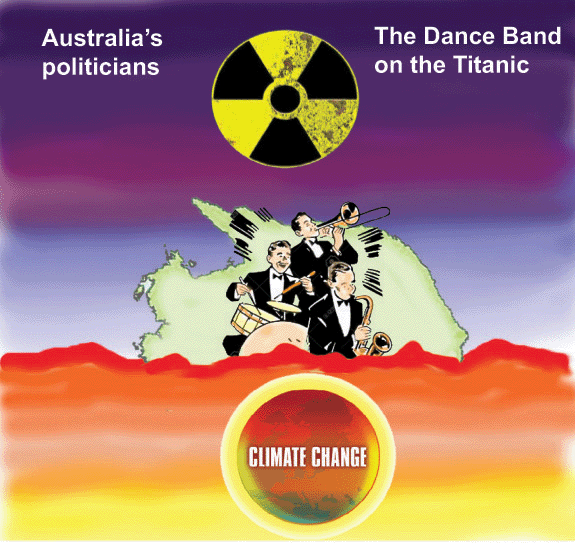
Australia’s politicians protect the coal industry, not the Australian people
Politicians protecting coal industry at our expense , stop wasting precious time and money on protecting this un-investable industry. more http://www.examiner.com.au/story/4736285/politicians-protecting-coal-industry-at-our-expense/?cs=97 Andrew Bray, 18 June 17 The level of ‘stupid’ engulfing Canberra has hit new heights. No matter what problem with energy policy is raised, some politicians instantly shout “coal!”
Businesses and householders across the country are screaming at the government for relief from spiraling electricity bills. A broad and unlikely coalition of bodies representing industry, energy users, farmers and social services have all come together to call for policy certainty around a low emissions electricity grid.
But the government is ignoring their pleas and are instead obsessed with whether the coal industry is being properly looked after.
Coal doesn’t stack up economically or environmentally, so it’s time to stop wasting precious time and money on protecting this un-investable industry.
1 This month
15 April – Zoom –Nuclear Power is Not the Solution
Apr 15, 2026 01:00 AM in Canberra, Melbourne, Sydney

Join the International Physicians for the Prevention of Nuclear War (IPPNW) on Tuesday, April 14th for a timely webinar exploring the risks associated with nuclear power and challenging the myth that it offers a simple, safe, carbon-free solution to the climate crisis

21 April Webinar: No Nuclear Weapons in Australia
Start: 2026-04-21 18:00:00 UTC Canberra, Melbourne, Sydney (GMT+10:00)
End: 2026-04-21 19:30:00 UTC Canberra, Melbourne, Sydney (GMT+10:00)
Event Type: Virtual
A virtual link will be communicated before the event.
Host Contact Info: australia@icanw.org

of the week – Australians for War Powers Reform (AWPR)
To see nuclear-related stories in greater depth and intensity
 Antinuclear