 South Australian woman Karina Lester presents anti-nuclear speech to United Nations in New York http://www.adelaidenow.com.au/news/south-australia/south-australian-woman-karina-lester-presents-antinuclear-speech-to-united-nations-in-new-york/news-story/be7b9ecb4ae5e0f0c568908f117c4be9 Erin Jones, The AdvertiserJune 23, 2017
KARINA Lester’s family remembers the ground shaking and a black mist rolling towards them when nuclear tests were carried out at Emu Field, in the state’s Far North. The residents of Walatina community, 150km south of the explosion, were given no notice of the British tests, in 1953, but they would suffer from lifelong health affects.
Her father, Yankunytjatjara elder Yami Lester, became blind as a result of the testing, while others suffered skin infections, auto-immune diseases and severe vomiting.
Ms Lester shared the poignant story with world leaders in New York this month in a four minute address to the United Nations conference on a nuclear weapons ban treaty. “It was certainly a once-in-a-lifetime opportunity to present to the UN,” Ms Lester said. “It’s really important to be able to share these stories otherwise we forget. “We learn so much about world wars but we don’t hear the history of what happened here.”
The treaty talks have been supported by more than 120 countries, but Australia and those with nuclear powers, including Russia and the United States have boycotted the conference.
Countries which signed the treaty would be forbidden from developing or manufacturing nuclear weapons and they would need to get rid of any weapons they already possess.
“It was disappointing as an Australian person to speak about what happened in our own backyard, when your country wasn’t even in the room,” Ms Lester said.
“This is an opportunity for nations to get together and completely ban nuclear weapons, instead of spending trillions of dollars to improve their technology.”
Ms Lester, of North Plympton, also took part in sessions with Hiroshima survivors to further share stories of the how nuclear weapons affect humanity.
“You can’t help but be moved when you hear those stories from people who survived and what they remember from when the blast when off,” she said.
The 42-year-old senior Aboriginal language worker has advocated against nuclear testing since she was a teenager and, more recently, fought against the Australian Government’s plan for an international waste dump in SA.
Talks on the global treaty to outlaw nuclear weapons conclude on July 7.
June 26, 2017
Posted by Christina Macpherson |
aboriginal issues, AUSTRALIA - NATIONAL, politics international, weapons and war |
1 Comment
What IS the army testing in the South Australian desert? Mysterious mushroom cloud erupts over historic Woomera range just after a drone flying near the secretive site was ‘forced to the ground’ http://www.dailymail.co.uk/news/article-4616616/Mystery-mushroom-cloud-erupts-Woomera-range.html By Bryant Hevesi For Daily Mail Australia, 20 June 2017
A man has captured image of ‘mushroom cloud’ near Lake Hart, South Australia Jason Wright said loud explosion occurred after his drone was forced to ground . The cloud formed over the Woomera Prohibited Area, used for military testing The prohibited area is known as ‘the largest land testing range in the world’
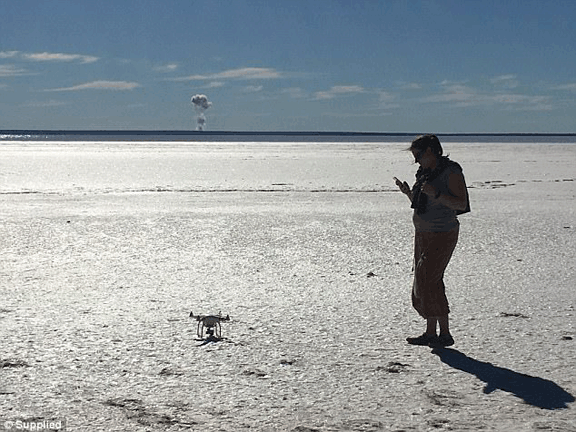
A man has captured the moment a mysterious ‘mushroom cloud’ formed over the Woomera military testing range in outback South Australia.

Jason Wright snapped images of the cloud shortly after he says his drone was forced to the ground prior to hearing a loud explosion while he was near the testing range.
Mr Wright told Daily Mail Australia he had stopped off along the Sturt Highway with his partner and children to see Lake Hart on Saturday when the unusual incident occurred. The experienced drone flyer had set-up his drone to take photos near the Lake Hart tourist rest area on the edge of the salt lake when he says it came down out of his control and made a hard landing.
Mr Wright, who lives in Coober Pedy, believes the drone’s GPS-based tracker may have been interfered with. About a minute after the drone fell, a ‘fireball’ erupted in the far distance, estimated to be as high as a 30-storey building, with the ‘mushroom cloud’ forming.
‘It was quite a spectacular explosion. It was very bright and there was a lot of heat in it,’ he said.
Mr Wright said despite criticisms he should not have been flying a drone in the area, he said the Civil Aviation Safety Authority’s ‘Can I fly there?’ app showed was able to have a drone up to 45 metres where he was standing.
The Woomera Prohibited Area ‘is used for the testing of war materiel’ and is ‘the largest land testing range in the world’.
Exclusion zones are in place at various locations within the prohibited area at different times of the year while military equipment is tested.
One is currently in place until June 30.
In a statement to Daily Mail Australia, the Department of Defence said: ‘No weapons were being tested; the activity was a demolition of war materiel’.
Defence did not carry out any action to impact the unmanned aircraft,’ the statement said.
‘Defence carries out operations for the testing of war materiel within the Woomera Prohibited Area. This includes capability being developed and tested for use for defence purposes. The photograph was the result of the demolition of war materiel.
‘An unauthorised person must obtain a permit or approval to enter the Woomera Prohibited Area.
‘In addition to the entry requirements, all unmanned aerial vehicle or remotely piloted aircraft operators must comply with the requirements of Part 101 of the Civil Aviation Safety Regulations 1998, this includes requirements associated with operating within a designated restricted area (for the purpose of regulation 6 of the Airspace Regulations 2007).
‘The Woomera Prohibited Area includes restricted areas for the purposes of the Airspace Regulations 2007 and these areas may be active during periods of defence testing activities.’
June 26, 2017
Posted by Christina Macpherson |
secrets and lies, South Australia, weapons and war |
Leave a comment
UNESCO warns climate change means time is running out for World Heritage Great Barrier Reef http://www.couriermail.com.au/news/queensland/unesco-warns-climate-change-means-time-is-running-out-for-world-heritage-great-barrier-reef/news-story/4765a338156dd9e5b9b2c1d2b357d655?nk=ba26857f63080120cbd5fc74c94d3959-1498465693, Daryl Passmore, The Courier-Mail, June 25, 2017
THE Great Barrier Reef will be dead by the end of this century without a reduction in greenhouse gas emissions, a world-first study warns.
The threat to Australia’s natural wonder is detailed in the first global assessment of climate change impacts on coral, released yesterday by the United Nations Educational, Scientific and Cultural Organisation (UNESCO).
It comes just a month before the World Heritage Committee meets in Poland to consider the condition of the Great Barrier Reef and the effectiveness of a management plan introduced by the Queensland and federal governments to protect it.
“Soaring ocean temperatures in the past three years have subjected 21 of 29 World Heritage reefs to severe and/or repeated heat stress, and caused some of the worst bleaching ever observed at iconic sites like the Great Barrier Reef,’’ it says.
“The analysis predicts that all 29 coral-containing World Heritage sites would cease to exist as functioning coral reef ecosystems by the end of this century under a business-as-usual emissions scenario.”
The report calls on all countries with World Heritage coral reefs to act to reduce net greenhouse emissions to zero in order to save them.
On current trends, the assessment predicts, global warming will increase by 4.3C by 2100.
Under that scenario, the Great Barrier Reef would suffer severe coral bleaching twice a decade by 2035 – “a frequency that will rapidly kill most corals present and prevent successful reproduction necessary for recovery of corals.’’
The diversity of life on reefs has led to them being been dubbed the “rainforests of the sea”. Covering less than 0.1 per cent of the ocean floor, they host more than a quarter of all marine fish species.
Australian Marine Conservation Society spokeswoman Imogen Zethoven said the Great Barrier Reef and other World Heritage reefs were in grave danger from climate change, mainly driven by the burning of coal.
“Yet the Australian government appears hell-bent on making the problem worse by pushing ahead with Adani’s monstrous coal mine (planned for central Queensland), talking up a coal-fired power station next to the Great barrier Reef and failing to do its fair share of global pollution reduction,” she said.
“The Australian government is not only placing our Great Barrier Reef and the 70,000 jobs that depend on it at grave risk, it is endangering the future of World Heritage coral reefs around the world,” Ms Zethoven said.
“The majority of Australians believe the state of our reef is a national emergency, but the Australian government doesn’t care.”
June 26, 2017
Posted by Christina Macpherson |
climate change - global warming, environment, Queensland |
Leave a comment
Great Barrier Reef ‘too big to fail’ at $56b, Deloitte Access Economics report says http://www.abc.net.au/news/2017-06-26/great-barrier-reef-valued-56b-deloitte/8649936, By Louisa Rebgetz The Great Barrier Reef has a total asset value of $56 billion and is “too big to fail”, according to a new report.
Key points:
- Deloitte Access Economics says GBR has calculated economic, social and iconic value of $56 billion
- Tourism is the biggest contributor to the total asset value making up $29 billion
- But tourist figures are down 50 per cent in the Whitsundays — operators say “this is as bad as it was during the GFC”
Deloitte Access Economics has calculated the economic, social and iconic value of the world heritage site in a report commissioned by the Great Barrier Reef Foundation.
Tourism is the biggest contributor to the total asset value making up $29 billion.
The Great Barrier Reef generates 64,000 jobs in Australia and contributes $6.4 billion dollars to the national economy, the report said.
It states the brand value, or Australians that have not yet visited the Reef but value knowing it exists, as $24 billion.
Recreational users including divers and boaters make up $3 billion.
The report does not include quantified estimates of the value traditional owners place on the Great Barrier Reef and it said governments should consider doing more to protect it.
Climate change remains biggest threat
It also references the back to back coral bleaching events which have devastated the reef and says climate change remains the most serious threat to the entire structure.
“We have already lost around 50 per cent of the corals on the GBR in the last 30 years. Severe changes in the ocean will see a continued decline ahead of us,” the report states.
“Today, our Reef is under threat like never before. Two consecutive years of global coral bleaching are unprecedented, while increasingly frequent extreme weather events and water quality issues continue to affect reef health,” said Dr John Schubert AO, Chair of the Great Barrier Reef Foundation.
Association of Marine Park Tourism Operators executive director Col McKenzie said the reef is crucial to the industry.
“We don’t have an industry without the Barrier Reef being in good condition.”
He said the negative coverage of the reef relating to the destruction caused by Cyclone Debbie earlier this year and the bleaching event is having an impact on visitor numbers.
Mr McKenzie said tourist figures are down 50 per cent in the Whitsundays and it is being felt along the Queensland coast.
June 26, 2017
Posted by Christina Macpherson |
business, climate change - global warming, Queensland |
Leave a comment
 Russian hackers trade passwords used by managers at British nuclear power plants – including ‘Rad1at10n’ and ‘Nuclear1’ http://www.dailymail.co.uk/news/article-4635420/Russian-hackers-trade-passwords-UK-nuclear-plant-staff.html
- The passwords of two senior EDF nuclear plant managers were traded online
- French-owned firm EDF Energy operates all 15 of Britain’s nuclear reactors
- Comes as thousands of government officials – including MPs – were hacked
By Iain Burns For Mailonline, 25 June 2017 Two senior managers at nuclear plants operated by EDF Energy had their passwords listed on Russian hacking sites. The passwords – ‘Nuclear1’ and ‘Radiat10n’ – are thought to have been used on the business site LinkedIn. They were being traded by hackers who had easily guessed the letters and numbers.
EDF, which operates Britain’s 15 nuclear reactors, did not comment about the breach. But the French-owned firm did say, according to The Times, that it is ‘continually reviewing its defences and preparedness in this area’.
The lists on which the passwords appeared were traded privately before being made public.
It comes as around 1,000 British MPs and parliamentary staff, 7,000 police employees and more than 1,000 Foreign Office officials were all understood to have had confidential information traded online without their knowledge.Even some of the prime minister’s closest government ministers, including education secretary, Justine Greening, and business secretary, Greg Clark, are thought to have been affected by the hack.
The huge database was being sold for just £2, with the low price justified by the fact it had already spent months being passed around. Its original price is likely to have been much higher.
Hackers can easily guess many passwords, especially those which are merely a word associated with a certain person but with ‘3’ instead of ‘E’ or ‘1’ instead of ‘I’. There have been warnings that the hacked passwords could be used to blackmail workers in sensitive jobs, or even to break into government servers.
June 26, 2017
Posted by Christina Macpherson |
Uncategorized |
Leave a comment
 These are the super-expensive dream of the nuclear lobby to save its industry – the ones that Australian Nuclear Science and Technology Organisation wants to waste our tax-payers’ money on.
Environmental groups challenge TVA plans for small nuclear reactors in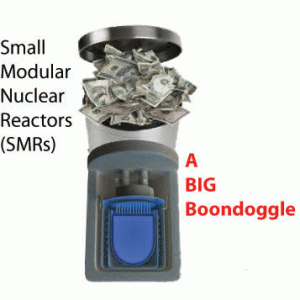 Oak Ridge, Times Free Press June 25th, 2017by Dave Flessner The Tennessee Valley Authority wants to use the site of a nuclear reactor design abandoned in the 1970s to develop a new technology of small modular reactors.
But environmental critics of the Oak Ridge project say the new small modular reactors are still untested, unsafe and unneeded.
Sara Barczak, the high risk energy choices program director with the Southern Alliance for Clean Energy, likened TVA’s proposal to locate the new small reactor designs in Oak Ridge to the Clinch River Breeder Reactor that was planned for the same site in the 1970s. Ultimately, then President Jimmy Carter killed the project because he feared the liquid metal fast breeder reactor might lead to more nuclear proliferation around the globe, and he complained about the escalating price for the innovative technologyy.
“The Clinch River site has a very long, troubled and expensive history because of a failed nuclear experiment, which was one of the most expensive plants for never generating any power,” Barczak said. “We are very concerned that history is once again repeating itself and we are concerned that billions of dollars could be spent on a technology that is unproven, untested and significantly more expensive than other types of power technology that are available to TVA.”
In 1971, the Atomic Energy Commission estimated the Clinch River project would cost about $400 million. But ultimately, the project was projected to cost $8 billion to complete, and it was finally scrapped in 1983. Barczak said she fears the proposed Small Modular Reactor concept, which has yet to get an approved design from the Nuclear Regulatory Commission, will prove too costly and not be adequately tested before one is built……..
The Southern Alliance for Clean Power and the Union of Concerned Scientists have joined the Blue Ridge Environmental Defense League in petitioning the NRC to deny the early site permit for the small reactors in Oak Ridge. The environmental groups argue TVA has failed to justify its bid to reduce the size of the emergency planning zone around the proposed reactors from the standard 10-mile zone to the site boundary of about two miles.
“TVA expects the public near the Clinch River site to accept on faith that the fantasy nuclear reactors it wants to build there will be so safe that no evacuation plan is needed, even in the event of a core meltdown or a spent fuel pool fire,” Lyman said. “TVA has apparently failed to learn a major lesson of the Fukushima disaster: Public safety during a nuclear emergency depends critically on being prepared for the unthinkable.”
M.V. Ramana, a professor and chair of the Disarmament, Global and Human Security at the Liu Institute for Global Issues at the University of British Columbia in Vancouver, Canada, said TVA’s site application for the small reactors is “more like an advertisement brochure than an examination of the environmental impacts of constructing these reactors.
“There is a long history of experimentation with small nuclear reactors, and the evidence so far suggests that small reactors cost too much for the little electricity they produce,” Ramana said……..
The NRC is expected to consider TVA’s early site permit over the next couple of years, NRC spokesman Roger Hannah said. http://www.timesfreepress.com/news/business/aroundregion/story/2017/jun/25/environmental-groups-challenge-tvplans-small/434802/
June 26, 2017
Posted by Christina Macpherson |
Uncategorized |
Leave a comment
When I heard that [SA premier] Jay Weatherill had announced the Nuclear Fuel Cycle Royal Commission in March 2015, I knew I had to campaign against the nuclear waste dump. I asked Sis to support me because she helped Nanna – Dad’s aunt, Eileen Kampakuta Brown – with the successful Irati Wanti Campaign against a nuclear dump in Coober Pedy in 2004. So we’re fighting it together.
Rose and Karina Lester: How illness has driven our anti-nuclear campaign work http://www.smh.com.au/good-weekend/two-of-us/rose-and-karina-lester-how-illness-has-driven-our-antinuclear-campaign-work-20170619-gwu0em.html Rosamund Burton , 24 June 17
Indigenous activists Rose Lester, 47, and her sister Karina, 42, are the daughters of Yami Lester, who went blind after the “black mist” fallout from the British nuclear tests in 1953 came over his family’s camp.
ROSE: When Mum went to hospital to have Karina, my grandparents came to Alice Springs to look after my older brother, Leroy, and me. They were proper traditional, and built a little humpy in our backyard and camped there. I was chuffed I had a sister. She was a gorgeous, dark, chubby thing. Continue reading →
June 26, 2017
Posted by Christina Macpherson |
aboriginal issues, opposition to nuclear, personal stories, South Australia |
Leave a comment
The World’s Largest Coal Mining Company Is Closing 37 Sites https://motherboard.vice.com/en_us/article/kzqdme/the-worlds-largest-coal-mining-company-is-closing-37-sites, ANKITA RAO Jun 23 2017, As solar energy becomes cheaper than coal, India’s growth will depend on renewables.
Coal India—a government-back coal company–is reportedly closing 37 of its “unviable” mines in the next year to cut back on losses.
India is primed for an energy revolution. The country’s ongoing economic growth has been powered by fossil fuels in the past, making it one of the top five largest energy consumers in the world. But it has also invested heavily in renewables, and the cost of solar power is now cheaper than ever. In some instances, villages in India have avoided coal-powered electricity altogether, and “leapfrogged” straight to solar power.
Partly because of this shift, Coal India, which produced 554.13 million tonnes of coal in the 2016-2017 fiscal year (for comparison, the largest company in the US produced about 175 million in 2015) saw demand dip in recent months. This is not the first sign that coal is no longer the most economic option for emerging economies like India and China. Earlier this year, the heavily industrial state of Gujarat cancelled its proposed coal power plants. And a few weeks ago The Hindu reported that Coal India had identified another 65 mines in losses.
India’s energy situation is changing so fast that even expert predictions about its switch to renewables are wildly off: A study from last year claimed India would be building more than 300 coal plants in the next 10 years, but experts said the data was already outdated by the time the report was published, and that India would be moving toward renewables instead.
We are collectively moving away from fossil fuels“For the first time, solar is cheaper than coal in India and the implications this has for transforming global energy markets are profound,” said Tim Buckley, Director of the Institute for Energy Economics and Financial Analysis (IEEFA) in a statement. The decline of Coal India, which produces 80 percent of the country’s domestic coal output, is more evidence that we are collectively moving away from fossil fuels as cleaner, renewable technologies become more widely available. This reality is important to grasp in every country where coal used to be king. Even as Donald Trump promises coal jobs, let’s remember that those jobs don’t are unlikely to come back.
“One of the most popular mines today employs [a couple hundred people] who are doing the work that used to be done by thousands,” Jerome Scott, a left-leaning activist with the League of Revolutionaries for a New America, said at the Left Forum earlier this month in Manhattan. “That’s the fundamental contradiction within capitalism—it’s being disrupted because they’re able to hire fewer and fewer workers.”
And for countries like India, where companies like Coal India employ more than 300,000 people, training people to work in more viable energy markets will be increasingly important to provide sustainable livelihoods. Luckily, it looks like the solar industry will have some job openings.
June 26, 2017
Posted by Christina Macpherson |
Uncategorized |
Leave a comment





 Antinuclear