Australia’s nuclear lobby hoping for nuclear submarines as a ‘foot in the door’
Steve Dale No Nuclear Waste Dump Anywhere in South Australia 3 JUNE 17 The nuclear submarine push seems to have become the preferred “foot in the door” for nuclear. If we had nuclear submarines, refueling and the disposal of waste would still be in South Australia (according to Abbott) – out of mind of the Sydney/Melbourne populations.
Politicians talking about small nuclear reactors backfires for them because that implies the reactors will need to be near Sydney and Melbourne and that will stir up a lot of nuclear push back. So despite the questionable benefits of Australia having nuclear submarines, the nuclear lobby thinks it will get us “hooked” into the nuclear waste cycle.
The Cape Hardy port development and the large purchases of land around the port are probably already earmarked as the nuclear submarine maintenance location. The Abbott/lobbyists are even talking about “leasing” nuclear subs – they are so desperate to suck us in. https://www.facebook.com/groups/1314655315214929/
Mystery of fireball seen in sky near Port Lincoln
 South Aussies mystified as blazing fireball tears through sky https://au.news.yahoo.com/a/36231067/port-lincoln-fireball-in-sky-video-mystifies-south-australia/?cmp=st#page1 on July 1, 2017,
Experts are not sure if it’s a meteor or a piece of space junk.
Nor are they sure where, or if, it landed.
Russia facing up to nuclear waste threat, with international help
 Russia begins cleaning up the Soviets’ top-secret nuclear waste dump https://www.theguardian.com/environment/2017/jul/02/russia-begins-cleaning-up-the-soviets-top-secret-nuclear-waste-dump
When the Soviet Union collapsed a vast store of spent nuclear fuel was abandoned in the Russian Arctic – an environmental disaster waiting to happen. Decades later an international clean-up has finally begun, Guardian, Shaun Walker in Andreyeva Bay, 2 July 17,
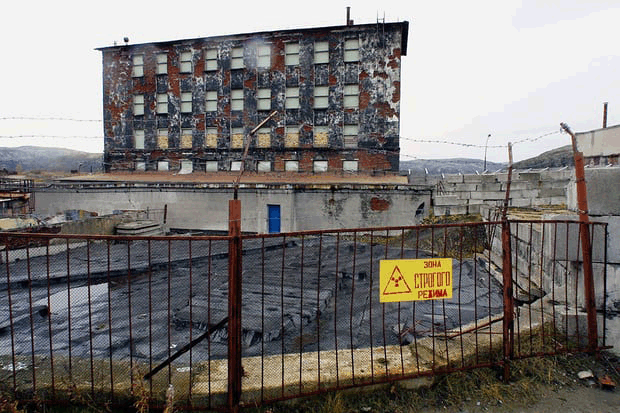
As the Rossita pulled away from the pier at Andreyeva Bay, sounding a long boom of its horn, a military band struck up a jaunty march. On board the ship were nine sealed metal casks, each four metres high and weighing 45 tonnes, containing canisters of spent nuclear fuel. Dozens of Russian and foreign nuclear specialists looked on applauding, as the chilly rain of a northern summer fell on the bay deep inside the Russian Arctic.
The ceremony, held on Tuesday afternoon, marks the culmination of a long international project to begin removing nuclear fuel from the site, formerly a top-secret Soviet installation. Nuclear specialists say Andreyeva Bay contains the largest reserves of spent nuclear fuel in the world, in fragile conditions that have disturbed the international community for years.
During the Cold War period, nuclear submarines were refuelled at sea, and the spent nuclear fuel was then shipped to Andreyeva Bay, where it was placed in a special storage facility to cool off before being transported to a reprocessing plant at Mayak, in the Urals. But in the early 1980s, leaks sprung up in the storage system, causing high levels of radioactive contamination.
When the Soviet Union collapsed, transfers of the spent fuel ceased, and about 22,000 spent nuclear fuel caskets were left at Andreyeva Bay in leaky dry storage units, creating the potential for an environmental catastrophe.
“I’ve been all over the world to pretty much every country that uses nuclear power and I’ve never seen anything so awful before,” said Alexander Nikitin, a former naval officer and environmentalist who has been monitoring the site for years.
“With nuclear material, everything should be done very carefully, and here they just took the material and threw it into an even more dangerous situation.”
In the decade after the Soviet collapse, the main concern was that poorly maintained facilities could lead to an onsite disaster. Nearly 250 nuclear submarines were decommissioned in the aftermath of the Soviet collapse, and facilities such as Andreyeva Bay were left in a perilous state.
“There wouldn’t have been a big explosion, but it could still have been something serious,” said Nikitin. “With nuclear fuel, once processes start, you have no way of knowing how they will develop.”
Over the next decade, security fears also increased. “Before 9/11, nobody would really think anyone would be crazy enough to try to handle spent nuclear fuel, but with the new type of terrorist threat we face, this became a bigger worry,” said Balthasar Lindauer of the European Bank for Reconstruction and Development (EBRD), which has managed the donor funds from western countries to help with the clean-up.
The facility at Andreyeva Bay was one of many top-secret installations in the Soviet Arctic. A two-hour drive from the regional centre of Murmansk along a road cut out of mossy rocks, still dusted with snow in late June, the entire area around Andreyeva Bay is closed to all foreigners and even Russians who are not registered there. A heavily armed military checkpoint on the outskirts of town keeps out all those who do not have security clearance . This is partly because Russia has a working nuclear submarine base on the other side of the bay at Zaozyorsk.
It might seem odd that, as Russia ploughs more money into its current military budget, western nations who see Moscow as a military threat are helping to fund the clean-up of the mess the Soviet military left behind. 13 countries have provided €165m in funding since 2003 for nuclear decommissioning in Russia’s north-west. There have also been a number of bilateral projects, with Britain, Norway and other countries funding a long project to help clean up Andreyeva Bay.
The Norwegian foreign minister, who was present at Tuesday’s ceremony, said the funding for the project was committed nearly two decades ago, when Russia was in no economic state to deal with the problems alone. He also pointed out that the Andreyeva Bay facility is only about 40 miles from the Norwegian border, making the decommissioning issue one in which Norway has long taken a strong interest.
“Nuclear challenges recognise no borders, and it is in our common interest to deal with nuclear waste now rather leaving the problems to future generations,” said the Norwegian foreign minister, Børge Brende.
A suite of new buildings has been constructed around the area where the spent nuclear fuel caskets are kept, replacing the decaying structures that stood there previously. Work to load canisters into the giant protective casks can now be done using specially commissioned machinery.
The Rossita, a ship constructed for the task, will take the huge fuel casks to Murmansk, where they will be put on fortified trains which will proceed under armed guard on the long journey from the Arctic to the Mayak reprocessing site. At the Mayak facility, the spent fuel will be recycled and the Russians say they will turn it into fuel to be used in civilian nuclear reactors.
Specialists at the plant estimate it could take 10 years to remove all the fuel. About half of the caskets have some kind of surface damage to their containers and will be dealt with after the non-problematic batches have been removed.
“This is the end of a long process, but also the beginning of another long stage in the clean-up,” said Marina Kovtun, the governor of Murmansk region. “Despite international tensions, work went on every day. Everyone who was working on this project understood that they were doing this for all of humanity and for protecting our environment.”
Indeed, in the current climate of hostility between Russia and the west, it was an unusual tale of bonhomie and cooperation, as the ceremony included the flags of 10 western nations as well as the Russian tricolour.
“The Barents Sea is maybe the cleanest sea in the world, and if something had happened here, it would have affected the whole Arctic,” said Brende. “This process is not completely without risk, but compared to doing nothing, the risks are now much lower.”
“Temporary” nuclear waste dump likely to become permanent
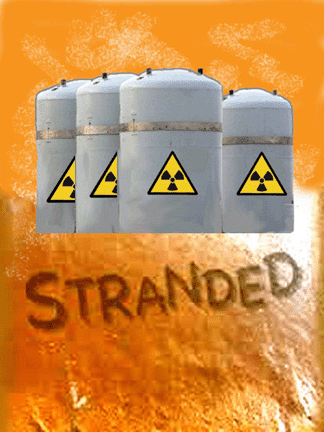
 1,800 tons of radioactive waste has an ocean view
 and nowhere to go, LA Times, By RALPH VARTABEDIAN | PHOTOGRAPHY BY ALLEN J. SCHABEN 2 July 17“………Transportation to an interim site would cost the federal government billions of dollars under the pending legislation. Aides at the House Energy and Commerce Committee said those costs would be recovered when the federal government no longer has to pay for legal settlements for failing to take the waste in the first place.
Even if an interim site is built, it is uncertain who would get to ship waste there first. The timing of waste shipments to a permanent site is determined by the so-called standard contract queue, a legal document so complex that federal bureaucrats have dedicated their entire careers to managing it.
The queue was structured so that the oldest waste would go into a future dump first. In the unlikely event that Yucca Mountain were opened in 2024, Edison’s fuel would be in line to start shipping in 2028 with the last bit of waste arriving in 2049, Palmisano said.
Whether that queue would apply to an interim site is unclear, even under the pending legislation.
The dry casks are designed to keep spent fuel confined only for decades, while the health standard for a permanent repository covers hundreds of thousands of years — longer than humans have roamed Earth. If the radioactive waste sits around in temporary storage for hundreds of years, it could be neglected and eventually forgotten.
So one outcome that nobody seems to want is for a temporary site to eventually become permanent by default.
“It would derail momentum for a permanent repository,” said Edwin Lyman, a nuclear physicist at the Union of Concerned Scientists. “This issue has always pitted one community against another and those in between.”http://www.latimes.com/local/california/la-me-stranded-nuclear-waste-20170702-htmlstory.html
Ten years of the Northern Territory intervention. Time it stopped
 Ten years too long — stop the intervention https://www.greenleft.org.au/content/ten-years-too-long-stop-intervention Alice Springs, June 30, 2017
The following is a statement issued by participants of the StandUp2017 conference that concluded with a rally in Mbantua (Alice Springs) on June 26.
Rosalie Kunoth Monks: “You better believe it, when the Intervention first hit in 2007 community councils were decimated.”
Matthew Ryan: “Trying to get the government to listen to us, is like a brick wall.”
Elaine Peckham: “When the Intervention came they took away services from homelands. No health services. I had to move back to town. I didn’t want to.”
Yarrentye Arltere Larapinta Valley Town Camp: “Ten years too long. Ten years of hardship, neglect and broken promises. We want Aboriginal control for Aboriginal people by Aboriginal people.”
We need to keep our culture strong. We need to be in control of decision making. We want self-determination.
After ten years the Intervention has met none of its objectives. There are more people in jail, more children being taken away, there is more unemployment.
This StandUp2017 conference makes the following comments and call outs:
Repeal racist Intervention laws
Racist laws introduced through the Intervention have created apartheid and are still with us. Repeal the stronger futures laws.
Repeal changes to social security law that allow for control over our money. End the ban on consideration of customary law in bail and sentencing. Bring back the permit system.
Community governance Continue reading
A second Hanford nuclear waste tunnel at risk of collapsing
2nd Hanford tunnel storing radioactive waste at risk of failing, federal study says Seattle Times, July 1, 2017 “This makes it clear that the second tunnel may also pose a risk to human health and the environment,” said Alex Smith, nuclear-waste program manager for the state Department of Ecology. Hal Bernton A second tunnel storing radioactive waste at the Hanford nuclear reservation has structural problems and is at risk of failing, according to a U.S. Energy Department investigation released Friday.

1 This month
Chernobyl: The Lost Tapes – A good documentary on Chernobyl on SBS available On Demand for the next 3 weeks– https://www.sbs.com.au/ondemand/tv-program/chernobyl-the-lost-tapes/2352741955560
15 April – Zoom –Nuclear Power is Not the Solution
Apr 15, 2026 01:00 AM in Canberra, Melbourne, Sydney

Join the International Physicians for the Prevention of Nuclear War (IPPNW) on Tuesday, April 14th for a timely webinar exploring the risks associated with nuclear power and challenging the myth that it offers a simple, safe, carbon-free solution to the climate crisis

21 April Webinar: No Nuclear Weapons in Australia
Start: 2026-04-21 18:00:00 UTC Canberra, Melbourne, Sydney (GMT+10:00)
End: 2026-04-21 19:30:00 UTC Canberra, Melbourne, Sydney (GMT+10:00)
Event Type: Virtual
A virtual link will be communicated before the event.
Host Contact Info: australia@icanw.org

of the week – Australians for War Powers Reform (AWPR)
To see nuclear-related stories in greater depth and intensity
 Antinuclear