Serious delays in breast cancer diagnosis in Fukushima: study


Serious delays have been seen in breast cancer diagnosis among women living in the northern coastal area of Fukushima devastated by the March 2011 earthquake-triggered tsunami and ensuing nuclear disaster, according to a study by a local doctor.
After the crisis, the proportion of women who consulted with doctors more than three months after noticing breast cancer symptoms rose to 29.9 percent of those who consulted with them about symptoms, compared with 18.0 percent before the disaster, the study found.
Many women who saw a doctor about their symptoms only did so after being encouraged by family members, according to the study. A rise in the number of single-person households and that of those composed only of elderly couples due to protracted evacuation is believed to be behind the trend.
The study was conducted by Akihiko Ozaki, a doctor at Minamisoma Municipal General Hospital in Minamisoma, Fukushima Prefecture, after he…
View original post 270 more words
Scrapping Tokai facility will cost 1 trillion yen and take 70 years
 The Tokai reprocessing site in Tokai village, Ibaraki Prefecture
The planned decommissioning of the Tokai spent nuclear fuel reprocessing plant in Ibaraki Prefecture will take 70 years and cost taxpayers about 1 trillion yen ($8.9 billion), according to the Japan Atomic Energy Agency.
The JAEA submitted its estimate to the Nuclear Regulation Authority on June 30 for approval.
By any measure, it will be a Herculean task to dismantle the facilities in the village of Tokai. Whether it will be possible to remove the high-level radioactive waste liquids and materials according to schedule is by no means certain.
Under the JAEA plan, the immediate task will be to assess the level of on-site contamination, decontaminate facilities and implement measures to secure safety of the site and workers, including enhancing earthquake-resistance of the facilities. That alone would take 10 years.
At the same time, the agency said it would start work…
View original post 195 more words
Anti-tsunami policy shift key to criminal trial of ex-TEPCO execs
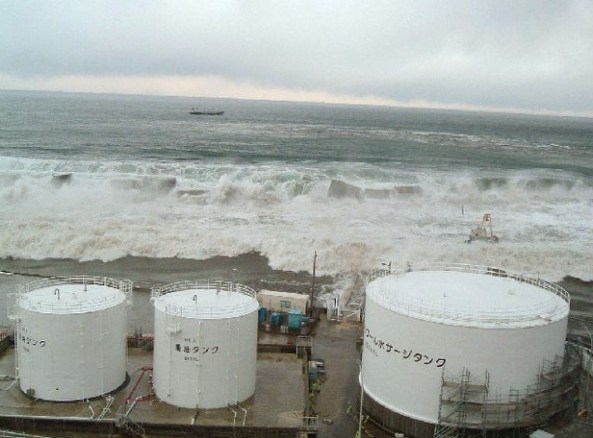 In this March 11, 2011 file photo, waves are seen washing over a 10-meter-high breakwater and approaching the Fukushima No. 1 nuclear plant
The key point of contention in the criminal trial of former top Tokyo Electric Power Co. (TEPCO) executives over the 2011 nuclear crisis will likely be their decisions on tsunami prevention measures after the utility itself estimated in 2008 that tsunami with a maximum height of 15.7 meters could hit its Fukushima No. 1 nuclear plant.
Former TEPCO Chairman Tsunehisa Katsumata and former vice presidents Ichiro Takekuro and Sakae Muto were slapped with mandatory indictments by lay reviewers after public prosecutors twice decided not to press charges. Their trial began on June 30, when all three pleaded not guilty and emphasized that it was impossible for management to predict the nuclear accident.
In his opening statement, lawyer Hiroshi Kamiyama, who has been appointed prosecutor by the court…
View original post 563 more words
1 This month
7 April – WEBINAR – Australia and the Doomsday Clock – Preventing nuclear war through NoFirstUse and other policies
Online | Tuesday April 7, 4:00-5:30pm, Australian Eastern Time / 8:00-9:30am Central Europe Time
– Access the registration link
15 April – Zoom –Nuclear Power is Not the Solution
Apr 15, 2026 01:00 AM in Canberra, Melbourne, Sydney

Join the International Physicians for the Prevention of Nuclear War (IPPNW) on Tuesday, April 14th for a timely webinar exploring the risks associated with nuclear power and challenging the myth that it offers a simple, safe, carbon-free solution to the climate crisis

21 April Webinar: No Nuclear Weapons in Australia
Start: 2026-04-21 18:00:00 UTC Canberra, Melbourne, Sydney (GMT+10:00)
End: 2026-04-21 19:30:00 UTC Canberra, Melbourne, Sydney (GMT+10:00)
Event Type: Virtual
A virtual link will be communicated before the event.
Host Contact Info: australia@icanw.org

of the week – Australians for War Powers Reform (AWPR)
To see nuclear-related stories in greater depth and intensity
 Antinuclear