2017 – the nuclear industry’s truly horrible year
 Global Meltdown? Nuclear Power’s Annus Horribilis, Jim Green, New Matilda, 9 July 2017 https://newmatilda.com/2017/07/09/global-meltdown-nuclear-powers-annus-horribilis/
This year will go down with 1979 (Three Mile Island), 1986 (Chernobyl) and 2011 (Fukushima) as one of the nuclear industry’s worst ever ‒ and there’s still another six months to go, writes Dr Jim Green.
Two of the industry’s worst-ever years have been in the past decade and there will be many more bad years ahead as the trickle of closures of ageing reactors becomes a flood ‒ the International Energy Agency expects almost 200 reactor closures between 2014 and 2040. The likelihood of reactor start-ups matching closures over that time period has become vanishingly small.
In January, the World Nuclear Association anticipated 18 power reactor start-ups this year. The projection has been revised down to 14 and even that seems more than a stretch. There has only been one reactor start-up in the first half of the year according to the IAEA’s Power Reactor Information System, and two permanent reactor closures.
The number of power reactors under construction is on a downward trajectory ‒ 59 reactors are under construction as of May 2017, the first time since 2010 that the number has fallen below 60.
Pro-nuclear journalist Fred Pearce wrote on May 15: “Is the nuclear power industry in its death throes? Even some nuclear enthusiasts believe so. With the exception of China, most nations are moving away from nuclear ‒ existing power plants across the United States are being shut early; new reactor designs are falling foul of regulators, and public support remains in free fall. Now come the bankruptcies…. The industry is in crisis. It looks ever more like a 20th century industrial dinosaur, unloved by investors, the public, and policymakers alike. The crisis could prove terminal.”
Pro-nuclear lobby groups are warning about nuclear power’s “rapidly accelerating crisis“, a “crisis that threatens the death of nuclear energy in the West“, and noting that “the industry is on life support in the United States and other developed economies“.
United States
No plans for real development of Adani coal mine expansion. Adani family will benefit most, if it happens
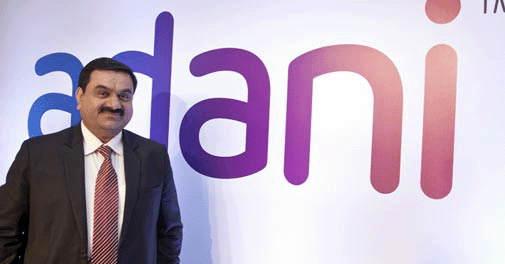 Adani’s Carmichael coal mine has slow ‘official start’ planned, leaked document shows, ABC News, by Stephen Long , 9 Jul 17 Flanked by Commonwealth and Queensland politicians, the giant Indian conglomerate Adani last month announced that its board had given final investment approval to its controversial mega-mine in North Queensland, and declared the “official start” of the Carmichael coal mining project.
But what does that mean in practice? For the moment, it seems, not much.
The ABC has obtained the plan of operations for the Carmichael coal mine project submitted to the Queensland Government last month.
It covers just six months and involves next to nothing: just re-establishing signage at the site, recommissioning an existing temporary camp and installing some additional demountable buildings.
“The plan of operations will be amended in due course to include all early works related to commencement of construction activities for the mine and related infrastructure works,” it says.
The lack of a substantive plan for development of the mine “is a huge embarrassment for the Adani cheer squad including the Prime Minister, the Premier of Queensland and [Minister for Resources and Northern Australia] Matt Canavan, who have bent over backwards to get this project over the line,” said Rick Humphries, co-ordinator of the mine rehabilitation campaign for the Lock the Gate Alliance — a group established by farmers to fight “inappropriate” coal and gas mining.
“It only really commits Adani to maintaining the existing temporary camp and looking after the signs and roads,” he said.
“It raises serious doubts about the project’s financial viability……..
Adani’s mine project, if it were to proceed to full scale, would be the largest-ever coal mining development in Australia and the biggest export coal project in the world, involving a series of open cut mines and underground pit with a capacity of 60 million tonnes a year.
Adani would also have to build an additional port at the Abbot Point Coal Terminal — which it owns — to accommodate output from the mine, though there has been speculation that Adani intends to scale down the mining venture to less than half the initial planned capacity.
Despite the question marks about Adani’s ability to finance the venture there are clear incentives for the Adani family to make the project happen.
An “overarching royalty deed” at the project will see $2 from each tonne of coal mined beyond the first 400,000 tonnes each year go a private company ultimately owned by an Adani family entity registered in the Cayman Islands.
This could potentially mean that hundreds of millions, or billions of dollars, from the venture could flow to the Adani family rather than to shareholders of the publicly-listed company that owns the Carmichael mine.
The ABC has also been told that the response of Adani’s billionaire chairman Gautam Adani to years of activism and opposition to the mine in Australia is a determination to see the project realised. http://www.abc.net.au/news/2017-07-10/adani-queensland-coal-mine-plan-raises-doubts-on-viability/8691020
Child climate refugees in Africa
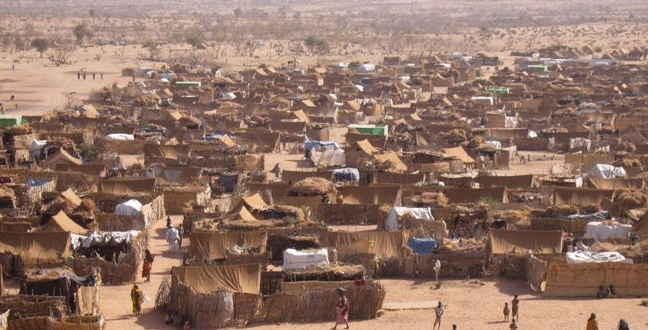 Climate change’s brutal toll on Africa, newsroom, 9 Jul 17 United Nations International Children’s Emergency Fund The vast majority of child migrants uprooted by violence, poverty and climate change remain in Africa, write UNICEF’s Lachlan Forsyth and Patrick Rose
The vast majority of child migrants uprooted by violence, poverty and climate change remain in Africa, according to a new report by child rights organisation UNICEF.
It is a bitter irony that the countries that have done the least to cause climate change are going to suffer the most. Countries that have minuscule carbon footprints are going to be the first to suffer the consequences of flooding, drought and displacement.
In West and Central Africa, the impact of climate change will be especially severe, with the region set to experience a 3 to 4 degree rise in temperature this century – more than one and a half times higher than anywhere else on the planet.
For the millions of people living in this vast region, longer droughts and intense storms will make farming and herding more difficult, and people will be forced to seek a better life.
Already, children account for more than half of the 12 million West and Central African people on the move each year. Contrary to many opinions, 75 percent of them remain in sub-Saharan Africa, with fewer than one in five heading to Europe.
This current wave of migrants is just the start of a swelling humanitarian crisis. Migration involving children and young people is likely to increase due to rapid population growth and urbanisation, climate change, inequitable economic development, and persistent conflict.
Poverty is a powerful driver of migration in West and Central Africa. Countries with high levels of poverty are more likely to be a source of migration as people look to improve their lot in life. In interviews conducted by UNICEF, migrants describe the feeling of ‘having nothing to lose,’ aware that by migrating they are taking a risk, but it is a gamble that might pay off.
Helene is one of them. She is 14 years old, holding a sign saying “I am a child, and not a commodity.”……..
With drought and temperatures intensifying in West and Central Africa, tensions in accessing scarce resources for cattle are also increasing hostilities in many rural areas, pushing greater numbers of people towards cities. But with more than 100 million people living in coastal cities less than one metre above sea level, even conservative estimates of a sea-level rise could result in the forced displacement of millions of climate refugees as people seek safety for their families and children.
For organisations like UNICEF, the challenges are enormous and complex. Aid money can only fix so much, when monumental societal changes are required also. Until the root causes of poverty are addressed, and solutions provided in the form of economic opportunities, access to health care and access to quality education, people are likely to continue to take dangerous risks migrating for better opportunities.
Unless the long-term planning of governments and civil society is equipped to anticipate these climate shocks and subsequent migration, the unmitigated impact of these forces will create detrimental outcomes for children across the region.
To read the full UNICEF report, click here https://www.newsroom.co.nz/2017/07/09/37772/climate-changes-brutal-toll-on-africa
Trump’s America on the outer as G19 firm about acting on climate change
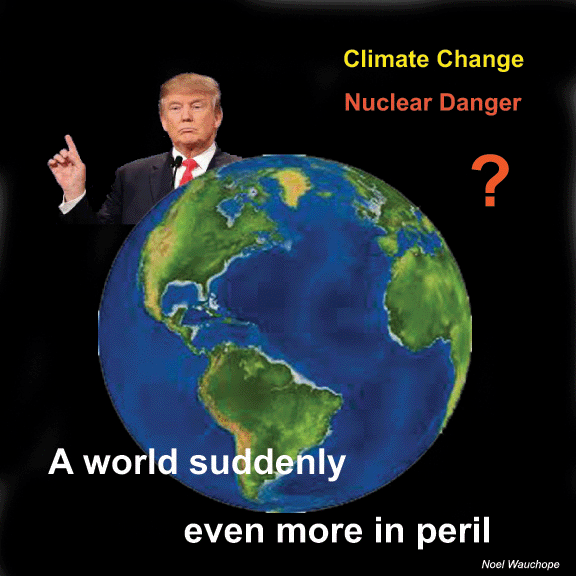 When it Comes to Climate Change, It’s G19 vs the United States, Slate, By Daniel Politi 8 Jul 17 The annual Group of 20 meeting is supposed to be one of those boring gatherings where world economic powers get together to slap each other on the back and utter platitudes about things they all agree on. This year though, the conflicts were clear and the divisions were stark. No split was more evident than climate change, where President Donald Trump was left isolated as as every other world leader signed up to the final compromise agreement that declared the Paris accord “irreversible.” They also vowed that the deal would be implemented “swiftly” and without exceptions.
Global leaders didn’t hide their anger at Trump’s intractable position. British Prime Minister Theresa May, for example, said she was “dismayed at the U.S decision to pull out” of the Paris accord and had personally urged Trump to reconsider. German Chancellor Angela Merkel also was careful to highlight the points of disagreement with the United States. “Wherever there is no consensus that can be achieved, disagreement has to be made clear,” Merkel said at the end of the summit. “Unfortunately—and I deplore this—the United States of America left the climate agreement.”
For some the global meeting marked yet another example of how the United States is moving against the current when it comes to the crucial issue—a decision that allies of the former administration say could cost the U.S. economy dearly. “This is a clear indication that the U.S. has isolated itself on climate change once again, and is falling back while all other major economies step up and compete in the clean energy marketplace created by the Paris Agreement estimated to be worth over 20 trillion dollars,” said Andrew Light, a senior climate change adviser at the State Department under President Barack Obama……. http://www.slate.com/blogs/the_slatest/2017/07/08/at_the_g20_the_united_states_stood_alone_on_climate_change.html
South Australia’s big battery will show up the lies of Australia’s politicians and big business
 Elon Musk’s big battery brings reality crashing into a post-truth world, Guardian, 8 Jul 17, Tim Hollo For months, politicians and fossil fuel industry have lied about the viability of renewables. Now Tesla’s big battery in South Australia will prove them wrong
• Tesla to build world’s biggest lithium ion battery in South Australia
For months now, Malcolm Turnbull, Josh Frydenberg, various fossil fuel energy executives and media commentators like Paul Kelly have been rabbiting on about the “energy trilemma”. It’s their contention that energy policy must deal with cost, reliability and emissions, and that it is impossible to achieve all three at the same time. Conveniently, they choose to put emissions at the bottom of this list and bury it under a pile of coal, which they claim is cheap and reliable.
This is not true. Not even close to it. It doesn’t stand up to basic scrutiny.
Renewable energy, which obviously wins on emissions, is now beating coal on cost. What’s more, with an energy grid managed effectively by people who want renewables to succeed, it is no less reliable than fossil fuels. The fact that arch-conservative, Cory Bernardi, was recently revealed to have installed rooftop solar panels demonstrates that these people do not even believe their own rhetoric. They have just chosen to throw truth onto the fire of climate change for political reasons.
nterestingly, the great bulk of Australians already don’t believe this story. The Climate Institute’s latest (and sadly final) Climate of the Nation report, featuring comprehensive polling data on a range of climate-related issues, showed once again that the vast majority of Australians want to see more renewable energy, do not believe that renewable energy is driving price rises (correctly identifying mis-regulation, privatisation and other corporate price-gouging as more to blame), and don’t think renewables need fossil fuels to back them up in the long term.
The politicians, business people and commentators, however, continue to lie. It suits their agenda, and it clearly activates something in people’s minds – enough to make it worth their while. People know that they are wrong. But they sound like they might sort of be right.
Musk’s gambit closes this book. He has brought reality crashing in.
Within 100 days, there will be a huge battery system making South Australia’s energy grid clean, affordable and reliable, and benefitting the eastern states along with it.
All the talk of building new coal-fired power stations, or a Snowy Hydro 2.0, no longer sounds vaguely “truthy”. It sounds ridiculous. It sounds silly. It sounds like old men yelling at clouds……https://www.theguardian.com/commentisfree/2017/jul/07/elon-musks-big-battery-brings-reality-crashing-into-a-post-truth-world
Russia and the Global Nuclear Industry – theme for July 17
It’s high time that the global nuclear-free movement turned the spotlight on RUSSIA. THIS website, being anglophone, is continually criticising America. But it’ s not just the language problem that makes us neglect to scrutinise Russia: it is also the secrecy, media censorship, and persecution of dissidents that help Russia to avoid scrutiny.
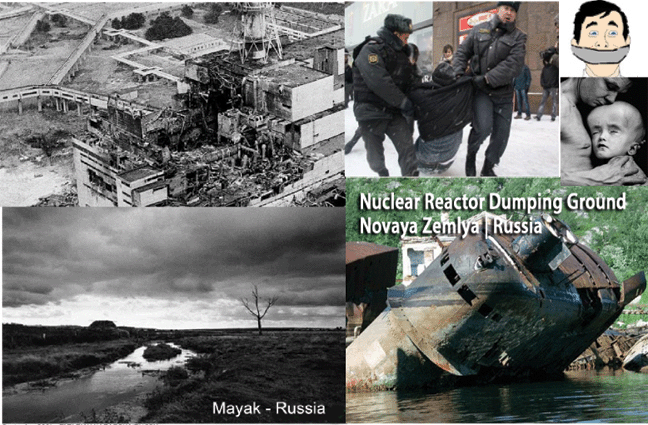
Russia’s quite scandalous nuclear history, past and ongoing, deserves to be exposed. There are 4 main issues here:
1.Russia’s history of nuclear accidents
2. Russia’s scandalous mismanagement of its radioactive trash
3. Russia’s secrecy and cover-up of its serious nuclear problems.
Since 2007, when the Howard government signed up to a nuclear development agreement with Russia, the Australian nuclear lobby has been quietly working to develop nuclear power in co-operation with Russia. This continues today, both with an Australian presentation in Moscow’s AtomExpo, and in Australia about to join the Gen IV nuclear Framework, along with Russia.
1 This month
7 April – WEBINAR – Australia and the Doomsday Clock – Preventing nuclear war through NoFirstUse and other policies
Online | Tuesday April 7, 4:00-5:30pm, Australian Eastern Time / 8:00-9:30am Central Europe Time
– Access the registration link
15 April – Zoom –Nuclear Power is Not the Solution
Apr 15, 2026 01:00 AM in Canberra, Melbourne, Sydney

Join the International Physicians for the Prevention of Nuclear War (IPPNW) on Tuesday, April 14th for a timely webinar exploring the risks associated with nuclear power and challenging the myth that it offers a simple, safe, carbon-free solution to the climate crisis

21 April Webinar: No Nuclear Weapons in Australia
Start: 2026-04-21 18:00:00 UTC Canberra, Melbourne, Sydney (GMT+10:00)
End: 2026-04-21 19:30:00 UTC Canberra, Melbourne, Sydney (GMT+10:00)
Event Type: Virtual
A virtual link will be communicated before the event.
Host Contact Info: australia@icanw.org

of the week – Australians for War Powers Reform (AWPR)
To see nuclear-related stories in greater depth and intensity
 Antinuclear