 Fukushima 311 Watchdogs

Local residents and environmental groups have condemned a plan to release radioactive tritium from the crippled Fukushima nuclear plant into the Pacific Ocean.
Officials of Tokyo Electric Power Co., the operator of the plant, say tritium poses little risk to human health and is quickly diluted by the ocean.
In an interview with local media, Takashi Kawamura, chairman of TEPCO, said: “The decision has already been made.” He added, however, that the utility is waiting for approval from the Japanese government before going ahead with the plan and is seeking the understanding of local residents.
The tritium is building up in water that has been used to cool three reactors that suffered fuel melt-downs after cooling equipment was destroyed in the magnitude 9 earthquake and tsunami that struck north-east Japan in March 2011.
Around 770,000 tons of highly radioactive water is being stored in 580 tanks at the site…
View original post 168 more words
July 14, 2017
Posted by Christina Macpherson |
Uncategorized |
Leave a comment
Fukushima 311 Watchdogs
We were all just kidding when we said we would save our ocean. Besides, what’s a little bit more poison in the Pacific? Pretending to manage the unmanageable. Dumping into the ecosystem is simply standard operation. The solution to pollution is dilution.–old adage.
Should all of us, all the other countries, stay silent while Tepco and Japan are deciding on their own to dump even more radioactive contamination into our Pacific Ocean?
I would like to point out that the Pacific Ocean does not belong to Japan, it belongs to all of us; as my dear friend Sheila Parks already pointed out in her excellent December 2013 article which I recommend to everyone to read, https://www.opednews.com/articles/The-Pacific-Ocean-Does-Not-by-Sheila-Parks-Energy-Nuclear_Fukushima_Fukushima-Cover-up_Japan-131215-303.html.
Now, a question: Will all the Pacific Ocean neighboring countries will stand saying nothing about Japan dumping all that accumulated contaminated water into the Pacific Ocean? Mind you, in addition to all what Tepco…
View original post 658 more words
July 14, 2017
Posted by Christina Macpherson |
Uncategorized |
Leave a comment
Fukushima 311 Watchdogs
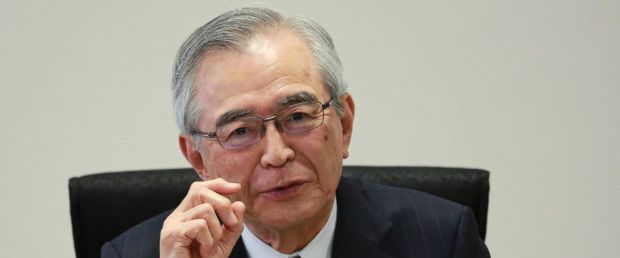 Tokyo Electric Power Co.’s new Chairman Takashi Kawamura speaks during an interview at the TEPCO headquarters in Tokyo on Thursday, July 13, 2017. Kawamura said the utility needs to stop dragging its feet on plans to dump massive amounts of treated but contaminated water into the sea and make more money if it’s ever going to succeed in cleaning up the mess left by meltdowns more than six years ago at the tsunami-hit Fukushima nuclear power plant.
The new chairman of Tokyo Electric Power Co. says the utility needs to stop dragging its feet on plans to dump massive amounts of treated but contaminated water into the sea and to make more money if it’s ever going to succeed in cleaning up the mess left by meltdowns more than six years ago at the tsunami-hit Fukushima nuclear power plant.
Takashi Kawamura, an engineer-turned-business leader who previously headed Hitachi’s transformation into…
View original post 651 more words
July 14, 2017
Posted by Christina Macpherson |
Uncategorized |
Leave a comment
Fukushima 311 Watchdogs

Abstract
To evaluate the biological effect of the Fukushima Daiichi nuclear disaster, relative differences in the growth of wild Japanese monkeys (Macaca fuscata) were measured before and after the disaster of 2011 in Fukushima City, which is approximately 70 km from the nuclear power plant, by performing external measurements on fetuses collected from 2008 to 2016. Comparing the relative growth of 31 fetuses conceived prior to the disaster and 31 fetuses conceived after the disaster in terms of body weight and head size (product of the occipital frontal diameter and biparietal diameter) to crown-rump length ratio revealed that body weight growth rate and proportional head size were significantly lower in fetuses conceived after the disaster. No significant difference was observed in nutritional indicators for the fetuses’ mothers. Accordingly, radiation exposure could be one factor contributed to the observed growth delay in this study.
Introduction
The Fukushima Daiichi nuclear power…
View original post 2,503 more words
July 14, 2017
Posted by Christina Macpherson |
Uncategorized |
Leave a comment
Australia’s position is stark. Like a drunkard preaching abstinence, our government strongly supports US nuclear weapons in keeping us “safe” (even as officials scurry to reassure the public that North Korean nuclear missiles couldn’t really reach Australia) and insists shamelessly on disarmament for others. So supportive are we of US nuclear weapons that Australia did not even show up at the UN treaty talks.
Judging by the determined – but unsuccessful – efforts on Australia’s part to see the talks fail, one suspects that our government knows exactly how powerful an instrument this global prohibition treaty will prove to be.
Rather than turning up the volume on our echoes of Washington, Australia could urge a reduction of tension by the cessation of provocative military exercises by both sides.
Nuclear weapons – the only man made threat that could virtually destroy our planet in an afternoon – have hit the news again, in two ways that represent polar opposites of the struggle to banish them forever.
In New York at the United Nations we have just witnessed historic progress towards realising the goal of a nuclear weapons free world. Late last week, the UN adopted the new ‘Treaty on the Prohibition of Nuclear Weapons’, to prohibit states from developing, testing, producing, manufacturing, acquiring, possessing, stockpiling, transferring, deploying, stationing, using or threatening to use nuclear weapons, under any circumstances.
That’s a fairly comprehensive thumbs down to the weapons, the strongest collective statement yet from governments that they are totally illegitimate in every respect.
Meanwhile, in Washington DC and Pyongyang, two people – chronologically adults but in other respects displaying no signs of maturity – are squaring off at each other, each with a finger on a button that can incinerate cities.

Donald Trump and Kim Jong-un display the very reason that the new UN treaty is so critically important, because it categorically rejects any role for any nuclear weapons in anyone’s hands. As Ban Ki-Moon, former UN Secretary-General said, “There are no right hands for the wrong weapons”.
The treaty leaves no doubt that its prohibitions apply not only to actually using nuclear weapons but also to their possession. Continue reading →
July 14, 2017
Posted by Christina Macpherson |
General News |
Leave a comment
 Josh Frydenberg warns states against going it
 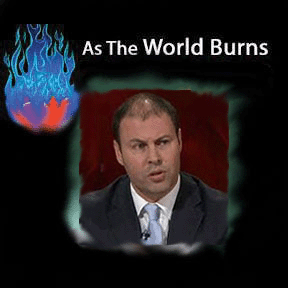 alone on clean energy target, The Age, Adam Gartrell, 14 July 17 The Turnbull government has warned the states their threat to “go it alone” on a clean energy target will only create chaos and inefficiency in the nation’s electricity system.
Energy ministers will clash on Friday as the states seek to pressure the Turnbull government to decide whether it will adopt a clean energy target – the key recommendation of Chief Scientist Alan Finkel’s review of Australia’s energy security – despite ongoing internal divisions over the policy proposal.
Led by South Australian Treasurer Tom Koutsantonis, the Labor states on Thursday threatened to bypass the federal government altogether. Without swift progress on Friday they would ask the Australian Energy Market Commission to model how a state-based target would work, Mr Koutsantonis said.
“The time to act is now – Australian households and businesses cannot be held hostage by the impotence of the federal Liberal government,” he said.
But federal Energy Minister Josh Frydenberg cautioned against the move, urging patience from the states…..
The renewed debate over Finkel came as a Liberal backbencher came under heavy fire for suggesting “people will die” as a result of renewable energy subsidies……http://www.theage.com.au/federal-politics/political-news/josh-frydenberg-warns-states-against-going-it-alone-on-clean-energy-target-20170713-gxafok.html
July 14, 2017
Posted by Christina Macpherson |
AUSTRALIA - NATIONAL, climate change - global warming, energy, politics |
Leave a comment
A nuclear warhead strike could trigger worldwide climate change, resulting in billions of deaths from drought and famine, chilling study warns http://www.dailymail.co.uk/sciencetech/article-4693934/How-nuclear-warhead-trigger-climate-change.html
- Report found bombs currently held by major powers could spur climate change
- Detonation of less than five warheads from the US could cause nuclear drought
- And China could bring on the phenomenon with just one 5MT land-based missile
- Ash would cause temps and precipitation to drop, leading to drought and famine
By Cheyenne Macdonald For Dailymail.com
14 July 2017 | As tensions build around the world, many countries have begun beefing up their defense capabilities to prepare for a nuclear threat.
But, experts warn the repercussions of a blast won’t just be limited to the site of a nuclear strike – instead, such an event could cause global devastation.
A new report found that warheads of magnitudes already owned by several major nuclear powers could trigger climate change as the resulting black ash causes temperatures to drop, leading to drought, famine, and billions of deaths. The researchers from the University of Nebraska-Lincoln investigated 19 types of weapons currently held by five major nuclear powers: the US, Russia, China, the United Kingdom, and France.
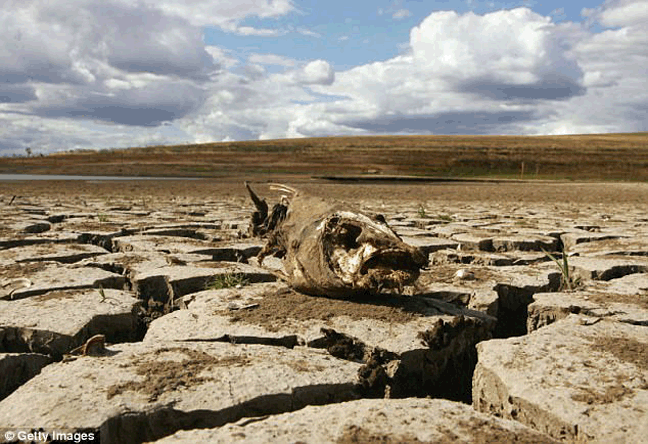
According to the report, it would take just a handful of these bombs to bring on disastrous effects that would ripple worldwide.
‘We’re losing our memory of the Cold War and we’re losing our memory of how important it is to get this right,’ said co-author Tyler White, a political scientist who specializes in international security and nuclear policy.
‘Even a conflict that doesn’t involve the United States can impact us and people around the world.’
With just three 1.2-megaton (MT) bombs, or two Trident D5 SLBM (each with four 475-KT warheads), the US could bring on a nuclear-drought, the researchers warn. Continue reading →
July 14, 2017
Posted by Christina Macpherson |
Uncategorized |
Leave a comment
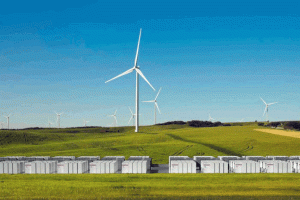 What Elon Musk’s investment tells us about our energy crisis, The Age, Perry Williams and Jason Scott JULY 14 2017 – Elon Musk’s intervention in Australia’s energy crisis is widening a divide over the future of coal.
The billionaire Tesla founder, who’s promised to help solve South Australia’s clean energy obstacles, sees no place for the fossil fuel. That conflicts with the federal government’s push for it remaining a mainstay source of electricity generation, as well as the “clean, beautiful coal” technologies that US President Donald Trump sees helping to save American mining jobs.
“Coal doesn’t have a long-term future,” Musk told reporters in Adelaide last week during a short trip to Australia. “The writing’s on the wall.” His declaration in energy-strapped South Australia, where the 46-year-old entrepreneur announced plans to build the world’s biggest battery to support the state’s blackout-plagued power grid, has rankled politicians.
Energy minister Josh Frydenberg, 45, accused the state of tapping a celebrity to paper over its patchy clean energy record. Tesla’s battery plan “is a lot of sizzle for very little sausage”, Frydenberg, a member of the conservative Liberal-led federal government, said on Monday. Deputy Prime Minister Barnaby Joyce, 50, said Musk’s plan “doesn’t make a hell of a lot of difference” to the nation’s struggles over energy security.
Most of Australia’s states and territories – free to determine their own energy and climate policies independent of the national government – beg to differ. Just hours after Musk’s announcement, the neighbouring state of Victoria closed the door on new coal-fired power stations, saying energy companies would rather invest in renewables.
Adani project
Queensland, where India’s Adani Group is planning to develop the $16.5 billion Carmichael coal mine, expects a move to clean energy will completely wipe out its carbon emissions by 2050.
Energy policy is a fraught subject with a push by the majority of Australians for more renewable power sources from the Australian majority is clashing with the government’s political imperative to keep a lid on soaring power prices. Currently, some 76 per cent of Australia’s electricity is drawn from coal-fired power stations which, while a cheap supply source, are at odds with a commitment to lower climate emissions……
The economics of building new coal plants don’t stack up and increasingly renewables will dominate base-load power, AGL chairman Jeremy Maycock said last week. Australians overwhelmingly want the government to focus on clean energy, according to a June poll by the Sydney-based Lowy Institute.
‘Highly improbable’
“It’s highly improbable that AGL will be constructing new coal-fired power stations because we don’t think the economics are likely to favour that,” Maycock said in a phone interview. “As the largest generator, we want to play our fair share in the country’s emissions reduction targets.”
For Prime Minister Malcolm Turnbull, banging the drum on coal is proving a treacherous task…….
the existing and perceived political and environmental costs attached to coal are deterring lenders.
“The high risk and cost associated with new coal plants make investors and financiers run a million miles from it in Australia,” said Ali Asghar, an analyst with Bloomberg New Energy Finance in Sydney. “The only way new coal could get built is if the government funds it and indemnifies any private entity against all future carbon risks.”
And doing so makes little sense, given that the cost of building cleaner, so-called high-efficiency, low-emission coal plants in Australia exceeds that of new projects relying on solar, wind, or gas, Asghar said.
“As solar and wind become cheaper and continue to undermine the economics of operating coal, investment in new coal plants become an even riskier proposition.” http://www.theage.com.au/business/energy/what-elon-musks-investment-tells-us-about-our-energy-crisis-20170714-gxb3i7.html
July 14, 2017
Posted by Christina Macpherson |
AUSTRALIA - NATIONAL, energy, politics, South Australia, Victoria |
Leave a comment
 Gore power to you: former vice-president launches Victoria’s green energy plan http://www.theage.com.au/victoria/gore-power-to-you-former-vicepresident-launches-victorias-green-energy-plan-20170713-gxaggu.html, Adam Carey, 13 July 17,
New battery storages that can deliver four hours of power to two regional Victorian towns of 100,000 people, and a solar farm that would power more than 400 trams are key projects in Victoria’s new plan to increase renewable energy supply and reduce reliance on burning coal.
 The battery will be up and running by this summer, the state government says, and will provide at least 40 megawatts of power in western Victoria, where the electricity network is relatively weak, boosting reliability in towns including Bendigo, Horsham, Ararat, Red Cliffs and Kerang.
Proposals that Bendigo or Ballarat lose electricity during a record-breaking east coast heatwave in February to guarantee power to NSW were angrily rejected by Victoria’s energy minister Lily D’Ambrosio, who told the Australian Energy Market Operator “it was absolutely not appropriate that Victoria had to pay consequences for failures in New South Wales”.
Victoria’s roll-out of renewable energy supply has gained extra urgency since the April closure of the Hazelwood coal-fuelled generator, which provided 20 per cent of the state’s baseload power supply.
Tenders for the $25 million project are being evaluated by the Department of Environment, Land, Water, and Planning, and is part of a nationwide embrace of battery energy, including Tesla founder Elon Musk’s commitment this month to build the world’s largest lithium-ion battery in South Australia.
Grid-scale batteries can store renewable energy to be used at times of peak demand, improving energy security and shielding consumers from severe price spikes.
The Andrews Government announced on Thursday its plan to spend $146 million on a series of renewable energy initiatives in a bid to meet its target of 40 per cent green energy for the state by 2025.
The renewable energy action plan, launched by former US vice-president Al Gore, will underpin the state’s attempt to achieve zero net greenhouse gas emissions by 2050.
It includes $48.1 million for the purchase of renewable energy certificates, much of which will go towards solar power for Melbourne’s trams.
 A 75mw solar farm that will power Melbourne’s 410 trams is due to open in the state’s north-west late next year. The powering of Melbourne’s tram network with solar energy is notional. Electricity from the solar farm will flow into the general power supply and the government will purchase renewable energy certificates for 35mw of power, which is enough to operate the city’s tram system.
The plan also features $8 million for small-scale “micro-grid” initiatives to create power at a local level, independent of the energy grid.
Mr Gore said the renewable energy plan was a “highly impressive” example of a state taking the initiative to create jobs through projects that will cut carbon emissions.
“All over the world there has been a dramatic change in the marketplace, with electricity generated with renewable sources falling below the cost of electricity generated by fossil fuels,” Mr Gore said.
Before taking a short ride on an E-Class tram, Mr Gore predicted Melbourne’s solar-powered trams “will become a symbol of the renewable energy revolution worldwide”.
Energy and Environment Minister Lily D’Ambrosio said the renewable energy plan “represents the most significant government investment in renewable energy in Victoria’s history”.
She said the plan would also drive down power prices for Victorians, who face a 15 to 20 per cent hike in their power bills from January 1.
Ms D’Ambrosio said the global economy was moving away from coal-generated power and Victoria had no option but to head in the same direction.
“When we stand still at a national level we are actually taking Australians backwards,” she said.
“The only investment that is occurring globally in new generation is around renewable energy.”
The government’s launch of a new renewable energy plan follows recent comments by Ms D’Ambrosio that Victoria might work with other states and set a renewable energy target to the exclusion of the Turnbull government.
 The Turnbull government has not committed to a renewable energy target, despite it being one of the recommendations of the Finkel review it commissioned into Australia’s energy needs.
State energy ministers are due to meet with federal Energy Minister Josh Frydenberg this week, however, Mr Frydenberg has signalled there will be no resolution on a clean energy target for Australia at the meeting, because the federal cabinet is still debating the issue.
July 14, 2017
Posted by Christina Macpherson |
energy, Victoria |
Leave a comment
 Broadcaster Alan Jones launches ugly attack on AEMO’s Zibelman http://reneweconomy.com.au/broadcaster-alan-jones-launches-ugly-attack-on-aemos-zibelman-66561/, By Giles Parkinson on 14 July 2017
Prominent radio Broadcaster Alan Jones has launched an extraordinary and unhinged attack on Audrey Zibelman, the new head of the Australian Energy Market Operator, saying “that woman” should be “run out of town.”
In a reprise of Jones’ nasty attacks on former prime minister Julia Gillard over the carbon tax, and on the same day that the head of the Coalition’s energy policy committee Craig Kelly said “people will die” from renewable energy, Jones described Zibelman as “ideologically constipated” and “full of rubbish.”
“The woman is a global warming advocate and a promoter of wind turbines,” Jones said, while repeatedly confusing the name of the organisation she runs. “That woman, watch out for her, she should be run out of town”.
Zibelman was appointed early this year and has impressed nearly everyone in the industry with her drive, clarity and understanding of the issues in how to navigate the path through the energy transition.
Her crime? Her apparent support for renewable energy – which she accepts is the cheapest form of new generation, and her push for smart, demand side responses which she says is cleaner and cheaper than building new fossil fuel plants.
Jones was also apoplectic about Zibelman’s acceptance of climate science – which he rejects – and her comments that the Hazelwood closure would not put Australia’s energy security at risk. Jones described her as a “global warming hoax alarmist.”
Zibelman led the New York state’s ground-breaking “reform the energy vision” program which looked at using localised, renewable energy and micro-grids to boost energy security after Hurricane Sandy destroyed the centralised energy infrastructure and left millions without power for weeks.
Jones’ bombast is well known. But it is of great concern that the conservative attacks on all things clean energy – solar, wind, battery storage, carbon pricing and vehicle emissions – have now turned personal and ugly as the campaign by the fossil fuel lobby and their apologists turns even more toxic.
Conservative commentators, almost all as one, turned their barbs on chief scientist Alan Finkel even before the release of his report, for failing to toe the fossil fuel line.
They have continued relentlessly since the release and when it appeared it may be possible that the Coalition might consider his recommended clean energy target, and as Finkel and numerous others made the point that renewables are clearly cheaper than new coal or gas plants.
Interestingly, Jones wasn’t the only one to attack Zibelman, with Alan Moran, the former Institute of Public Affairs regulatory boss, accusing her of “being a refugee” from Hillary Clinton’s failed presidential bid.
Jones also led a conservative attack against Tesla found and CEO Elon Musk this week after the announcement of the 100MW/129MW battery storage installation in South Australia, apparently on the belief that it was designed to power the whole state, not just make up any potential shortfalls and boost grid security.
“Elon Musk won’t be able to produce a thirtieth of the energy demand of South Australia,” Jones said, echoing comments made by federal energy minister Josh Frydenberg, adding that Musk should also be “sent home” and not paid any money.
Jones was the instigator of a series of extraordinary attacks on former PM Gillard at the height of the carbon tax debate, appearing in Canberra, along with Tony Abbott, amid signs of “ditch the witch” and calling for her to be put “into a chaff bag” and hoisted into the sea.
Jones also led the “wind fraud” rally in Canberra in 2013 which barely attracted 100 people, and forced to admit he “got it wrong” after making ludicrous claims about the cost of renewable energy on the ABC’s Q&A program in 2015.
In 2012, in a humiliating episode, Jones and his Sydney radio station 2GB agreed with the country’s radio broadcasting watchdog to undergo training in fact-checking after complaints about a statement Jones had made about climate change.
Clearly, the training did not work.
July 14, 2017
Posted by Christina Macpherson |
AUSTRALIA - NATIONAL, energy |
Leave a comment
A primer on India’s nuclear energy sector, Hans India , By Gudipati Rajendera Kumar , 10 July 17 “……..Target set by DAE is that by 2050 33 % of India’s total electricity requirement by 2050 will be from nuclear power. This comes out to be about 275000 MW. This target seems unachievable and undesirable because of following concerns –
1. India’s domestic Uranium Reserve can support only 10000 MW of energy. So our future potential depends upon development of third stage of Nuclear Program. Otherwise, there will be again overdependence upon imported Uranium as it is case with Oil currently. Hence, long term strategy will be only determined when third stage is functional.
2. Current Nuclear reactors consume significant amount of water. So most of upcoming plants will be set up near sea costs. It will put pressure on the coastline as India’s Western coastline is home to fragile ecology of Western Ghats.
3. Further, till now only 21 plants have been operational. There are long gestation periods which increase costs of the plant significantly. Only a Nuclear Industry revolution in the future in nuclear energy can make this achievable.
4. New safeguard requirements post Fukushima disaster, has pushed per MW costs of nuclear reactors significantly higher in comparison to Thermal, solar and wind plants. Jaitapur plant in Maharashtra (AREVA) is expected to cost 21 crore/ MW in comparison other sources cost 8-10 crore/ MW. It is to be seen that whether differences of operational/ running costs justify such higher capital expenditure on nuclear plants.
5. Some argue that Total costs of a Nuclear Lifecycle which involves Mining of Uranium, transportation and storage, capital costs of plants , processing/ reprocessing of plants, possible disasters and then handling of waste generated for hundreds of years is significantly more that economic value generated during lifetime of the functioning of the plant, which is generally 40-50 years.
6. Nuclear installations will be favorite targets of terrorists (also in case of war) which can cause irreversible damage to people living in nearby areas.
7. In long run if worldwide dependence on Nuclear energy increases, it will be most unavoidable way of nuclear proliferation as interest and attempt to invest in indigenous industry will increase. Otherwise smaller counties will continue to buy relevant technologies or components from a few western countries which will serve private interest of few.
July 14, 2017
Posted by Christina Macpherson |
Uncategorized |
Leave a comment
Queensland’s door would be open to Elon Musk: Trad, The Age, Felicity Caldwell, 13 July 17, Queensland’s door would be open to billionaire Elon Musk if he wanted to talk about a project in the Sunshine State, Deputy Premier Jackie Trad said following a leaders’ roundtable featuring former US vice president and climate change activist Al Gore.
Last week, South Australia announced Mr Musk’s Tesla company as the principal builder of the world’s largest lithium ion battery to expand the state’s renewable energy supply.
Mr Musk has promised to have the SA system installed and operating within 100 days, otherwise it will be free.
Ms Trad said Queensland would say yes to Mr Musk if he wanted to turn his attention to the state once the South Australian battery was built. “The door would be absolutely open,” she said.
Ms Trad said Queensland had already released an expression of interest process for a major solar battery manufacturing facility for Townsville…….
Would she hope Mr Musk might come knocking and set up a facility in Townsville?
“I think that would be incredibly exciting for Townsville and for Queensland as a whole,” she said.
On July 11, the Queensland government announced its plan for zero net emissions by 2050 and reducing emissions by 30 per cent on 2005 levels by 2030. Ms Trad spoke to Fairfax Media from Melbourne, where Queensland, Victoria, South Australia and the Australian Capital Territory have signed a “leadership declaration” at a roundtable attended by Mr Gore, who narrowly lost the 2000 US presidential election……
Australia’s states and ACT have agreed to work together to meet obligations under the Paris Agreement, a zero net carbon emissions by 2050 policy and to share information on their successes.
“We want to share innovation, understanding and learning in this space so that as a nation we can move towards what we committed to do and that is to do our bit, to reduce our emissions and keep global temperatures below an increase of 2 degrees,” Ms Trad said.
“We know that this [the Paris Agreement] is a big challenge, we know this is something that Australia signed up for.
“But what we also know is that the Turnbull government has failed to show the necessary leadership for us to move in that direction.”……http://www.theage.com.au/queensland/queenslands-door-would-be-open-to-elon-musk-trad-20170713-gxaty0.html
July 14, 2017
Posted by Christina Macpherson |
energy, Queensland |
Leave a comment
-
Redflow seeking $14.5m, shifts focus on lead-acid market
Redflow taps shareholders to back new focus on market “sweet-spot” including south-east Asia’s off-grid, telecom, commercial and industrial sectors.
-
What people just don’t get about electric vehicles
Germany’s election campaign shows we still have to get our heads around how fundamentally different electric vehicles will be.
-
How did Australia get this stupid about clean energy?
Australia’s public debate around clean energy plumbs new depths, with rebooted attacks on wind and solar, new attacks on battery storage and vehicle emission standards, and targeted attacks on key individuals. How did Australia get this stupid? And this ugly?
-
True Value Solar announces new managing director
One of Australia’s largest independent residential solar installers announces the appointment of former Conergy executive David McCallum as managing director.
-
CEFC tips $150m into logistics park, to slash truck freight emissions
CEFC backs landmark NSW project to slash freight transport emissions by shifting containers from road to rail, and powering operations with renewable energy.
July 14, 2017
Posted by Christina Macpherson |
AUSTRALIA - NATIONAL, energy |
Leave a comment
 The power of renewables and the South Australian example, Independent Australia 12 July 2017 While the Turnbull Government persists in spruiking “clean coal”, renewables continue to be the quiet achievers in energy generation. Jade Manson reports.
THE FUTURE of Australia’s energy generation has been a topic of impassioned debate in recent years.
This has been spurred on by sharp reductions in the installation price of renewable energy.
Solar and wind energy have now in many cases reached parity with installation prices for coal, and gas and is cheaper in the long-term. In December 2016, the World Economic Forum reported that solar and wind had the same installation price as fossil fuel companies in more than 30 countries. In 2016, clean energy investment grew by almost 50% in Australia. We have reached a tipping point, where investment in renewable energy will continue to rise, while investment in fossil fuels will fall.
Lazard’s energy analysis shows that the levellised cost of energy for wind and solar now outperforms fossil fuel sources of power. Levellised cost represents every cost component – installation, operations and maintenance and fuel costs – divided by the total energy generated during the plant’s lifetime.
Discussions comparing renewable and fossil fuel electricity generation usually centre around the up-front costs and do not consider the generation costs, or the social and environmental consequences of different energy sources. Renewable energy has significantly lower generation costs and does not require continued fuel supply. With installation costs now being similar – and likely to decrease significantly over the next decade – renewable energy is a tremendously worthwhile investment that will break even rapidly and continue to provide returns indefinitely.
This economic competition is making fossil fuel companies nervous and contributing to the heated debate around the issue. Fossil fuel companies still hold a significant amount of power and influence after decades of being at the top of the economic food-chain. Companies such as China National Petroleum, Sinopec Group, Shell Global and ExxonMobil are all in the top ten largest businesses globally, with over $100 billion in annual revenue. These companies are using the wealth they have accumulated since the beginning of the industrial revolution to influence politics and the global market toward their own interests.
This can be seen clearly in the fact that, despite the economic, health and social benefits of renewable energy, those in Parliament continue to support fossil fuel companies……..
Increasing renewable energy investment will also create more jobs and will allow Australians to capitalise on the renewable energy investment boom. While the Coalition declares “coal is good for humanity“, solar jobs are rising and in 2016, made up 665 of open energy job postings. According to Solar Citizens, renewable jobs increased by 34% in the first quarter of 2016. Indeed, data showed that solar positions made up 66% of open energy job postings, against oil with a 21% share and coal with 10%.
Transitioning to renewable energy: The South Australian case
South Australia has sped past its renewable energy target of 50% renewable generation eight years in advance, putting it on track to reach 100% renewable generation by 2030. This should be achieved more easily than in the previous 15 years due to the falling cost of renewable energy.
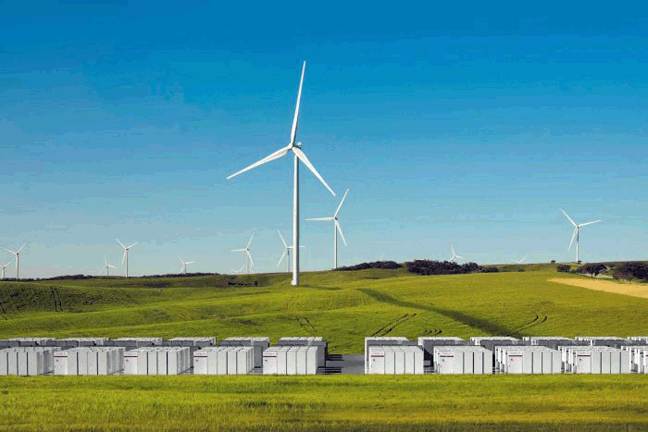
A deal has recently been made between the South Australian Government and Tesla CEO, Elon Musk, to install the world’s largest battery in South Australia………
Electricity prices in South Australia are very high compared to the Eastern States. The Eastern States are part of a highly interconnected grid, while South Australia only connects to Victoria via two locations. Typically 90% of energy prices in South Australia come down to generation (45%) and distribution (45%). The generation component is made up of several power sources, including gas, diesel and renewable energy sources. These suppliers bid into the market, and the lowest bids are accepted by the Australian Energy Market Operator (AEMO) until demand is reached. When renewable energy is in the mix, the market price for generation is very low.
The distribution component is a duopoly run by the companies ElectraNet (owned by State Grid Corporation of China, YTL Corporation Malaysia and Hastings Funds Management) and SAPN (owned by Cheung Kong Infrastructure Holdings Hong Kong). This international ownership of South Australia’s electricity grid has raised security concerns, as these companies may not act in South Australia’s best interests. A bid by Cheung Kong Infrastructure Holdings to buy the NSW electricity grid was knocked back in 2016, on national security grounds.
Due to lack of competition, there is the potential for unnecessary price increases by the power distribution companies. As renewable energy becomes more prevalent, power distribution will make up a larger share of energy costs and these problems will need to be addressed. Renewable energy infrastructure should lead to reduced electricity prices, due to their significantly decreased running costs. If this is not the case, then it calls into question the pricing by the power suppliers and distribution companies. If pricing becomes disproportionate to the service provided, then the government may need to introduce increased regulation or buy back the grid from private distribution companies.
You can follow Jade Manson on Twitter @JadeAlanaM. https://independentaustralia.net/environment/environment-display/the-power-of-renewables-and-the-south-australian-example,10495
July 14, 2017
Posted by Christina Macpherson |
energy, South Australia |
Leave a comment
Stop trying to save the planet, Matthew Canavan tells Queensland government
Federal minister attracts ridicule after he says state should ‘concentrate on saving jobs today’ instead of reducing greenhouse gas emissions to zero by 2050, Guardian, Michael Slezak, 13 July 17,[article includes many tweets as examples] The federal resources minister, Matthew Canavan, has attracted a slew of criticism after attacking the Queensland government for trying to “save the planet in 2050”.
On Tuesday, Queensland announced it would aim to reduce net greenhouse gas emissions to zero by 2050. The announcement was far from radical, with identical pledges already made by the Coalition-led New South Wales government, as well as Labor-led Victoria, South Australia and the Australian Capital Territory.
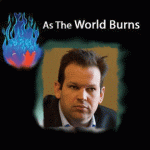 But the move attracted the ire of Queensland-based Canavan, who tweeted: “Instead of trying to save the planet in 2050 the QLD labor should just concentrate on saving jobs today!”…….
it was unclear to many on Twitter why taking action on climate change and growing employment today would be seen as mutually exclusive aims.
Although Queensland’s announcement was unlikely to have much impact on Adani’s plans to build Australia’s biggest coalmine in the state, many people pointed out that coalmining produced relatively few jobs compared with those threatened by climate change.
Craig Kelly, the Liberal MP who chairs the Coalition’s backbench energy committee, was also criticised after he claimed renewable energy would lead to people dying of cold because it was pushing up energy prices.https://www.theguardian.com/australia-news/2017/jul/13/stop-trying-to-save-the-planet-matthew-canavan-tells-queensland-government
July 14, 2017
Posted by Christina Macpherson |
AUSTRALIA - NATIONAL, politics |
Leave a comment








 Antinuclear