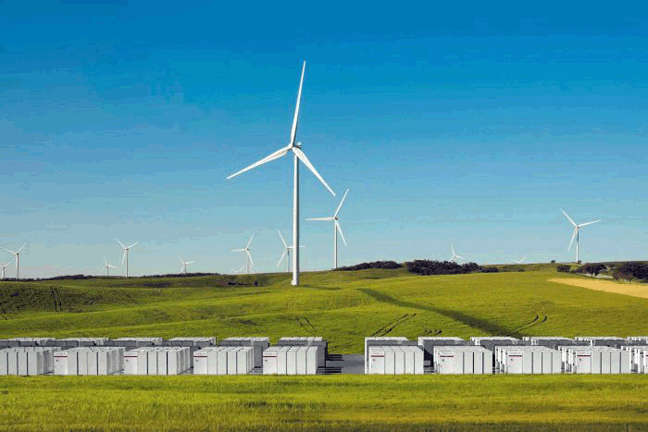
The billionaire Tesla founder, who’s promised to help solve South Australia’s clean energy obstacles, sees no place for the fossil fuel. That conflicts with the federal government’s push for it remaining a mainstay source of electricity generation, as well as the “clean, beautiful coal” technologies that US President Donald Trump sees helping to save American mining jobs.
“Coal doesn’t have a long-term future,” Musk told reporters in Adelaide last week during a short trip to Australia. “The writing’s on the wall.” His declaration in energy-strapped South Australia, where the 46-year-old entrepreneur announced plans to build the world’s biggest battery to support the state’s blackout-plagued power grid, has rankled politicians.
Energy minister Josh Frydenberg, 45, accused the state of tapping a celebrity to paper over its patchy clean energy record. Tesla’s battery plan “is a lot of sizzle for very little sausage”, Frydenberg, a member of the conservative Liberal-led federal government, said on Monday. Deputy Prime Minister Barnaby Joyce, 50, said Musk’s plan “doesn’t make a hell of a lot of difference” to the nation’s struggles over energy security.
Most of Australia’s states and territories – free to determine their own energy and climate policies independent of the national government – beg to differ. Just hours after Musk’s announcement, the neighbouring state of Victoria closed the door on new coal-fired power stations, saying energy companies would rather invest in renewables.
Adani project
Queensland, where India’s Adani Group is planning to develop the $16.5 billion Carmichael coal mine, expects a move to clean energy will completely wipe out its carbon emissions by 2050.
Energy policy is a fraught subject with a push by the majority of Australians for more renewable power sources from the Australian majority is clashing with the government’s political imperative to keep a lid on soaring power prices. Currently, some 76 per cent of Australia’s electricity is drawn from coal-fired power stations which, while a cheap supply source, are at odds with a commitment to lower climate emissions……
The economics of building new coal plants don’t stack up and increasingly renewables will dominate base-load power, AGL chairman Jeremy Maycock said last week. Australians overwhelmingly want the government to focus on clean energy, according to a June poll by the Sydney-based Lowy Institute.
‘Highly improbable’
“It’s highly improbable that AGL will be constructing new coal-fired power stations because we don’t think the economics are likely to favour that,” Maycock said in a phone interview. “As the largest generator, we want to play our fair share in the country’s emissions reduction targets.”
For Prime Minister Malcolm Turnbull, banging the drum on coal is proving a treacherous task…….
the existing and perceived political and environmental costs attached to coal are deterring lenders.
“The high risk and cost associated with new coal plants make investors and financiers run a million miles from it in Australia,” said Ali Asghar, an analyst with Bloomberg New Energy Finance in Sydney. “The only way new coal could get built is if the government funds it and indemnifies any private entity against all future carbon risks.”
And doing so makes little sense, given that the cost of building cleaner, so-called high-efficiency, low-emission coal plants in Australia exceeds that of new projects relying on solar, wind, or gas, Asghar said.
“As solar and wind become cheaper and continue to undermine the economics of operating coal, investment in new coal plants become an even riskier proposition.” http://www.theage.com.au/business/energy/what-elon-musks-investment-tells-us-about-our-energy-crisis-20170714-gxb3i7.html



 Antinuclear
Leave a comment