Yami Lester is mourned: his daughters carry on the anti nuclear fight
 We mourn the passing of Yankunytjatjara elder Yami Lester OAM, who was blinded by the ‘Totem 1’ nuclear test of 1953 but never gave up fighting for his country and people. Yami played a vital role in exposing the terrible impacts of the British nuclear testing program, suffered largely by Aboriginal people whose lands were contaminated.
Yami’s daughters Rosemary and Karina are carrying on the fight. Rosemary recently spoke at the Women’s March to Ban the Bomb in Sydney, and Karina addressed the ban treaty negotiating conference at the UN on behalf of 35 Indigenous groups worldwide. The Treaty acknowledges the ‘disproportionate impact of nuclear-weapon activities on indigenous peoples’.
We are glad that the international community banned nuclear weapons within Yami’s lifetime.
You can leave a tribute message for the Lester family via the No Dump Alliance website.
By 2018, North Korea able to launch a nuclear-armed long range missile at Australia
 Why it’s time to fear North Korea, The Australian July 26, 2017, CAMERON STEWART North Korea will be able to reliably launch a nuclear-armed long range missile at Australia and the United States as early as next year, according to a stunning new assessment by the Pentagon.
The prediction brings forward by around two years previous US intelligence assessments of the progress of North Korea’s nuclear and missile programs.
It follows an analysis of recent missile tests by the hermit kingdom which found that scientists in Pyongyang have advanced their technology on the country’s missile testing program faster and more efficiently that was predicted by the west.
Senior US officials have told the Washington Post that the Pentagon’s Defense Intelligence Agency has concluded that North Korea’s leader Kim Jong-un will be able to make a ‘reliable, nuclear-capable Intercontinental Ballistic Missile’ sometime in 2018.
In July 4, Mr Kim launched his country’s first missile with the range to strike the US state of Alaska and northern Australia.
The US intelligence assessment shows that the US now believes North Korea is closer than previously thought to having the know-how to miniaturise its nuclear weapons to arm its new ICBM……http://www.theaustralian.com.au/news/world/north-korea-able-to-launch-nuclear-strike-on-australia-as-early-as-2018/news-story/6602ff2c8575b1cd5d7c8dcb93577096
World Vision leader scathing about Defence Industry Minister Christopher Pyne’s plan for Australia to export weapons
‘Profiting from bloodshed’: Tim Costello criticises Christopher Pyne weapons export plan, SMH, Amy Remeiki , 17 July 17
World Vision Australia chief Tim Costello said Australia would be “exporting death” and “profiting from bloodshed” if it followed through on Defence Industry Minister Christopher Pyne’s plan to see the nation become a major arms exporter. Speaking to Fairfax Media, Mr Pyne said he wanted to see Australia not only build but design military assets, such as warships, on par with other players and allies such as Britain, France and Germany to help bolster the nation’s influence and reinforce relations.
But Mr Costello strongly criticised the plan, which he said carried terrible consequences.
“This is a government that has cut humanitarian aid, which saves lives, to the lowest level in our history, and it is now seriously discussing the merits of becoming a major weapons manufacturer and exporter,” he said.
“The government says this is an export and investment opportunity – but we would be exporting death and profiting from bloodshed. Mr Costello said it was naive to imagine Australia could control whose hands the weapons ended up in, once they were sold…….http://www.smh.com.au/federal-politics/political-news/profiting-from-bloodshed-tim-costello-criticises-christopher-pyne-weapons-export-plan-20170717-gxcomj.html
America’s polluting methods of disposing of military wastes
Wonder if this is the sort of thing that’s going on at Woomera?
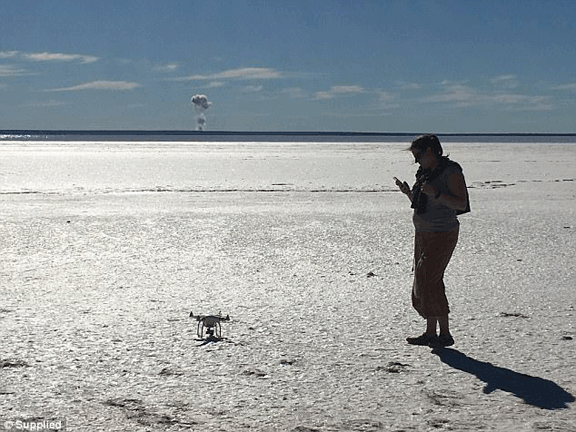
The U.S. military burns millions of pounds of munitions in a tiny, African-American  corner of Louisiana. The town’s residents say they’re forgotten in the plume., by Abrahm Lustgarten, ProPublica, Photography by Ashley Gilbertson/VII Photo, special to ProPublica July 21, 2017 COLFAX, LOUISIANA— Two years ago, the U.S. military had an embarrassment on its hands: A stockpile of aging explosives blew up at a former Army ammunition plant in Minden, Louisiana, sending a cloud of debris 7,000 feet into the sky
Norther Territory Aboriginal owners’ legal case: they wanted “low level nuclear waste dump”
Wonder which Whitey businessmen are funding this one?
 Nuclear waste fight sparks $17m claim, AMOS AIKMAN, The Australian, July 26, 2017Traditional owners who want a nuclear waste dump on their land are suing the Northern Land Council for more than $17 million, claiming that the federal statutory authority neglected its duty to support their bid to use the land to alleviate crippling poverty.
Documents filed in the Federal Court allege that the NLC, which is legally bound to consult with indigenous landholders and pursue their best interests, failed to do so repeatedly in relation to proposals to house Australia’s low-level nuclear waste at Muckaty Station……..
The first applicant, Ngapa traditional owner Jason Bill, welcomed the serving of legal papers yesterday.
“Great news: that’s the thing that my family have been waiting for,” Mr Bill said.
“All we were asking for is a low-level waste dump … we’ve looked into it and heard about it from the professionals, and it’s not going to damage the environment.”….. http://www.theaustralian.com.au/national-affairs/indigenous/nuclear-waste-fight-sparks-17m-claim/news-story/1fa95bb665d1dbdb653d0e2e8b7df0e9
U.S. judge upholds nuclear power plant subsidies
U.S. District Judge Valerie Caproni in Manhattan rejected claims that federal law preempted New York and its Public Service Commission from offering credits to promote clean energy and reduce reliance on fossil-fueled or gas plants.
The plaintiffs said the credits could boost electric bills for New York’s “captive ratepayers” by $7.6 billion over 12 years, and violate the “dormant” Commerce Clause by impeding Congress’ power to regulate commerce among states.
But the judge said New York’s “zero-emissions credits” program was “plainly related to a matter of legitimate state concern”: the production of clean energy, and reduction of emissions from other energy that could add to global warming……..
Audrey Zibelman, in her role as PSC chair, was the lead defendant. Nuclear generators receiving the credits and their owners, including Exelon Corp, also sided with the governor.
Cuomo endorsed the subsidies in connection with his “Clean Energy Standard” announced last August, which required that half of New York’s electricity come from renewable energy sources such as wind and solar by 2030.
The case is Coalition for Competitive Electricity et al v. Zibelman et al, U.S. District Court, Southern District of New York, No. 16-08164.
Reporting by Jonathan Stempel in New York; editing by Grant McCool https://www.reuters.com/article/us-new-york-nuclearpower-idUSKBN1AA2VF

One Clean Energy Target solution – ENERGY EFFICIENCY
Energy efficiency: The unsexy solution for a Clean Energy Target, REneweconomy,By Richard McIndoe on 25 July 2017 The COAG Energy Council is supporting 49 of the Finkel Review’s 50 recommendations, including new demand response measures, which are crucial to driving down electricity prices.
It’s a big step in the right direction, but why have we stalled on a Clean Energy Target?
Unfortunately, the CET has become another political stick to beat the government with. To be more accurate, it’s a stick with which the Coalition beats itself. Labor sits by quietly, biding Napoleon’s sage advice not to interrupt your enemy when he’s making a mistake.
Reducing costs to all consumers is critical; ensuring quality power supply is non-negotiable; and there can’t be many people who really think coal fired power stations are good for the environment.
It’s known as the “energy trilemma,” and a CET which includes real, hard energy efficiency targets will help us solve it quickly, at the least cost.
Let’s move the debate away from solely whether to invest billions in new coal or new solar, and let’s start investing a fraction of that amount in energy efficiency.
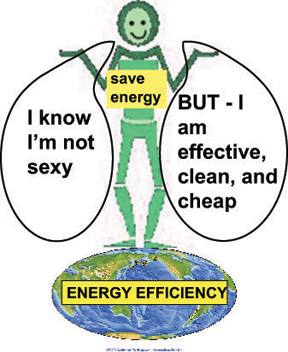
We can start by re-badging it as energy productivity, which sounds way sexier for politicians on both sides. Fact of the matter is that, along with solar and storage, energy efficient technology is moving so quickly that today’s CET may soon be out of date. Energy efficiency technologies which reduce business and residential customers’ usage by well over 10% are available today.
Improved energy productivity also benefits everyone, which will certainly be of interest if you live in an apartment, don’t own your own home or simply can’t afford a sparkling set of solar panels on your roof.
The difficulty is getting your energy company to provide energy efficient technology to you.
They’d much prefer to keep selling you more energy from newly built solar and wind projects than reduce their overall sales revenue.
No surprises there, it’s just business protecting its own market.
The convergence of new, low cost technology and continuing short-sighted price gouging by incumbent gentailers is driving more business and commercial customers to seek relief from high electricity costs through energy efficiency, solar and storage.
With just a modest effort by customers and a modicum of government support, we can easily achieve the proposed CET…….
The Government has a golden opportunity to include energy efficiency measures in the CET that will make it more acceptable to all sides and move forward from this embarrassing impasse.
They should do this now.
A clear CET with firm energy efficiency targets is a vital tool in solving the energy trilemma, and a lifeline that customers desperately need in the battle against electricity prices. http://reneweconomy.com.au/energy-efficiency-unsexy-solution-clean-energy-target-76298/
Dramatic shrinkage of sea ice over the past few decades
 Here’s how much Arctic sea ice has melted since the ‘80s, REneweconomy, By Andrea Thompson on 24 July 2017 Climate Central
Arctic sea ice has been melting at a steady clip this summer as it heads toward its annual low point. But a new chart shows that with nearly two months still left in the melt season, sea ice area is already below what would have been a yearly low in the 1980s.
The comparison shows the clear long-term decline of Arctic sea ice fueled by the global rise in heat-trapping greenhouse gases.
The dramatic shrinkage of sea ice over the past few decades is driving major changes, from the loss of crucial Arctic habitat to the potential influence of weather patterns around the world……http://reneweconomy.com.au/heres-much-arctic-sea-ice-melted-since-80s-55828/
Electricity from Small Modular nuclear Reactors (SMRs) will be more expensive than from large ones
Not surprisingly, with costs so high, few reactors are being built. The hope offered by the nuclear industry is that going back to building smaller reactors might allow more utilities to invest in them.
The main priority preventing safe deployment [of small nuclear reactors] is economics. Most commercial proposals for SMRs involve cost-cutting measures, such as siting multiple reactors in close proximity. This increases the risk of accidents, or the impact of potential accidents on people nearby.
Cost overruns aside, smaller reactors might be cheaper but they also produce much less electricity and revenue. As a result, generating each unit of electricity will be more expensive.

Small nuclear power reactors: Future or folly? https://theconversation.com/small-nuclear-power-reactors-future-or-folly-81252, M V Ramana, July 25, 2017 Nuclear energy companies are proposing small nuclear reactors as a safer and cheaper source of electricity.
In June, Canadian Nuclear Laboratories put out a “call for a discussion around Small Modular Reactor (SMRs) in Canada,” and the role the organization “can play in bringing this technology to market.”
The news release asserts that SMRs are “a potential alternative to large-scale nuclear reactors,” would be effective at “decreasing up-front capital costs through simpler, less complex plants” and are “inherently safe” designs. All of this warrants examination.
As a physicist who has researched and written about various policy issues related to nuclear energy and different nuclear reactor designs for nearly two decades, I believe that one should be skeptical of these claims. Continue reading
Vatican to hold big conference to support UN nuclear weapons ban
 Vatican conference aims to build momentum for nuclear disarmament, Catholic News Agency, By Andrea Gagliarducci, 25 July 17, Nuclear disarmament will be the focus of a Vatican conference this Nov. 10-11, following recent progress toward international bans on nuclear weapons.
Archbishop Silvano Maria Tomasi told CNA that “the Holy See is working to create a public opinion convinced that the world is safer without nuclear weapons, rather than with them.”
The archbishop is delegate secretary to the Dicastery for Promoting Integral Human Development, which is working to organize the disarmament conference.
The Holy See has invited Antonio Gutierres, Secretary General of the United Nations, to address the conference. It is not reported whether he has accepted the invitation.
Archbishop Tomasi said that the conference is conceived as a follow-up to the Treaty on the Prohibition of Nuclear Weapons, passed July 7 at the United Nations.
Until the treaty, nuclear weapons were the only weapons of mass destruction not explicitly banned by any international document.
The treaty passed with 122 votes in favor and one abstention, Singapore. However, 69 countries, namely all nuclear weapons states and all NATO members excepting the Netherlands, did not take part in the vote.
The U.N. decided to start negotiations for the treaty after a series of three conferences on the humanitarian consequences of nuclear weapons. The first conference took place in Oslo, Norway in March 2013. The second was held in Nayarit, Mexico in February 2014.
The third conference, held in Vienna, Austria, Dec. 8-9, 2014, was the first meeting on nuclear weapons attended by some nuclear weapons states.
At the end of the Vienna conference, 127 states formally endorsed a humanitarian pledge, with 23 more voting to approve a resolution in its favor. The endorsing states said they were aware that the risk of nuclear weapons use and their “unacceptable consequences” are avoidable only “when all nuclear weapons have been eliminated.”
The pledge called on all nuclear powers to take concrete measures to reduce the operational status of nuclear weapons and remove them from deployment. It called on nuclear powers to diminish nuclear weapons’ role in their military doctrines and to make “rapid reductions of all types of nuclear weapons.”
Archbishop Tomasi, who attended the Vienna conference in his former position of Holy See Permanent Observer to the U.N. in Geneva, told CNA that the Vienna conference is “particularly important, because it underscores that just being in possession of nuclear weapons is already not ethical.”
The November 2017 conference at the Vatican aims to be another step on the path towards nuclear disarmament.
It would build on the conference to negotiate the Nuclear Weapons Ban Treaty, which took place in New York in March 2017……..http://www.catholicnewsagency.com/news/vatican-conference-aims-to-build-momentum-for-nuclear-disarmament-69412/
ANZ, Commonwealth Bank, Westpac and National Australia Bank, slash lending to coal miners
Big four banks slash lending to coal miners, The Age, Clancy Yeates, 25 July 17, Australia’s big banks have slammed the brakes on project finance lending to expand the coal industry since late 2015, but are still lending billions for other fossil fuel developments, environmental finance group Market Forces says.
ANZ and Commonwealth Bank, previously named as the largest lenders to fossil fuels, both signalled they were actively reducing loans to some carbon-intensive sectors including the coal industry,
Bell is tolling for coal, as wind and solar now “base-cost renewables.”
 Base-cost renewables: When wind and solar finally kill coal,http://reneweconomy.com.au/base-cost-renewables-when-wind-and-solar-finally-kill-coal-72324/ [good graphs] By Giles Parkinson on 19 July 2017 Coal generation may have a future in Australia’s energy grid, as prime minister Malcolm Turnbull would have us believe, but it may not be a long one.
It is now clearly recognised, away from the imaginary world of the fossil fuel lobby, that the cheapest form of new generation in Australia – and most other places in the world – is wind and solar, and certainly not coal and gas (or nuclear).
Recently, Bloomberg New Energy Finance predicted that the cost of new wind and solar would soon beat the cost of refurbished coal plants.
Now BNEF predicts that solar will beat the cost of existing, fully depreciated and unrefurbished coal plants by 2032. And wind will follow soon after.
“At that point it will be cheaper to build solar than it is to shovel coal into fully depreciated coal-fired power station.
“That is going to be a critical changing point in energy economics. It is one that was previously unthinkable, it was on no one’s horizon.”
And this is a prediction that will affect not just Australia. It will occur in just about every country in the world, including in China, also in the 2030s, with a stunning impact in energy markets across the globe.
The result of this, Bhavnagri says, will be a shift from the concept of “baseload” to a new concept that BNEF describes as “base-cost renewables.” Continue reading
1 This month
Chernobyl: The Lost Tapes – A good documentary on Chernobyl on SBS available On Demand for the next 3 weeks– https://www.sbs.com.au/ondemand/tv-program/chernobyl-the-lost-tapes/2352741955560
15 April – Zoom –Nuclear Power is Not the Solution
Apr 15, 2026 01:00 AM in Canberra, Melbourne, Sydney

Join the International Physicians for the Prevention of Nuclear War (IPPNW) on Tuesday, April 14th for a timely webinar exploring the risks associated with nuclear power and challenging the myth that it offers a simple, safe, carbon-free solution to the climate crisis

21 April Webinar: No Nuclear Weapons in Australia
Start: 2026-04-21 18:00:00 UTC Canberra, Melbourne, Sydney (GMT+10:00)
End: 2026-04-21 19:30:00 UTC Canberra, Melbourne, Sydney (GMT+10:00)
Event Type: Virtual
A virtual link will be communicated before the event.
Host Contact Info: australia@icanw.org

of the week – Australians for War Powers Reform (AWPR)
To see nuclear-related stories in greater depth and intensity
 Antinuclear