Al Gore’s new film: An Inconvenient Sequel: Truth to Power
Climate change: Al Gore gets inconvenient again Michael E. Mann, Nature, 27 July 2017
Michael Mann views the US statesman’s second film probing climate change.
An Inconvenient Sequel: Truth to Power
As US vice-president under Bill Clinton, Gore became the figurehead of the movement to combat human-driven global warming. He also became the preferred punchbag for climate-change cynics in search of a straw man. Gore is such a towering, seemingly unassailable figure in this arena that critics have gone after him with all guns blazing. As Tom Toles and I noted in our book The Madhouse Effect (Columbia Univ. Press, 2016; see Nature 538, 34–35; 2016): “They have criticized his weight, his energy bills, and incidents in his personal life — indeed, pretty much anything else they can scrape up.”
There’s one problem with taking on Gore. He punches back, and above his weight. After all, he’s up against arguably the most entrenched, wealthy and powerful industry the world has ever known: fossil fuels. And this pugilist is still very much in the fight. Witness his new film An Inconvenient Sequel: Truth to Power — the follow-up to his 2006 An Inconvenient Truth.
For those fearing a preachy PowerPoint lecture on climate science, be assured: An Inconvenient Sequel isn’t that. Rather, it largely takes the scientific evidence as a given, not least because Gore has already done a whole film on that. This instalment is an attempt to show us how striking climate impacts have become in the decade since his first movie.
Early in An Inconvenient Sequel, there’s a scene on the Greenland ice sheet, where glaciologists Eric Rignot and Konrad Steffen point to the dramatic retreat of ice in recent years. We witness rivers of surface melt water gushing away from the ice sheet to the open water of the North Atlantic Ocean. Gore poses the question: “Where is all of that water going?” He then answers it. We’re transported to Miami Beach, Florida, where we witness the flooding of streets that now comes simply with seasonal high tides. If melting Greenland ice seems distant and abstract, the perennial flooding of Miami and other coastal cities, and low-lying, highly populated countries from Bangladesh to Belgium is anything but.
The drought that has afflicted Syria for more than a decade is the most pronounced and prolonged for at least 900 years (as far back as we have reliable palaeodata). Climate change has undoubtedly had a role. Gore shows us how the impact of the drought on rural farmers led to increased conflict, a civil war, mass exodus, global conflict over immigration and, as a consequence, the emergence of Islamist terrorist group ISIS. If drought in Syria seems distant or even mundane, the threat of terrorism and global political instability is immediate and visceral. Gore has a genius for joining the dots in the global mapping of climate impacts.
In An Inconvenient Truth, Gore showed a version of the famous ‘hockey-stick’ curve that my co-authors and I published in the late 1990s ( et al. Geophys. Res. Lett. 26, 759–762; 1999), revealing a dramatic spike in temperature over the past century. There is a ‘hockey stick’ in the new film, but it charts instead the remarkable global growth in renewable energy over the past decade. Climate change is accelerating; so too is our ability to tackle it. There are reasons for cautious optimism……
Finally, the film casts an inconvenient light on humanity. It is astonishing that we’re still mired in a political debate about whether climate change even exists when, with each passing year of insufficient action, the challenge of averting a catastrophe becomes ever greater. Knowing that Al Gore is still optimistic is a shot in the arm at a time of uncertainty. http://www.nature.com/nature/journal/v547/n7664/full/547400a.html?foxtrotcallback=true
Adani spending spree as megamine gains pace
ADANI has unlocked about $400 million to spend on a massive escalation of work over the next few months on the Carmichael megamine and rail project.... (subscribers only)
http://www.couriermail.com.au/business/adani-chief-about-to-splurge-400m-as-megamine-gains-pace/news-story/33581d471eddb470a9ad025ae45ff422
Matt Canavan makes it quite clear that he WAS the Minister For Mining
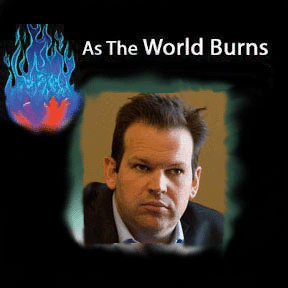 Canavan comes out as “minister for mining sector,” internet gets really mad, REnewecono0my, By Sophie Vorrath on 28 July 2017 Australia’s recently resigned resources minister has unleashed a torrent of public criticism, after posting a heartfelt note of farewell to “the mining sector” on his Facebook page.
Canavan stood aside as federal minister for resources and northern Australia this week after it was revealed he held dual Australian and Italian citizenship. He has blamed his mother for the oversight, and is mounting a legal battle to remain in the Senate.
“It has been such an honour to represent the Australian mining sector over the past year,” the July 27 post begins.
“From the small, gambling explorers and prospectors to the large, world-beating multi-nationals, the industry provides rich and diverse experiences that can take you to the smallest towns of outback Australia to the biggest cities in the world.”
The note, which also touches on the current state of commodity prices and jobs, sparked instant outrage from readers, who noted Canavan was “supposed to represent the people of Queensland, and not private mining companies.”……http://reneweconomy.com.au/canavan-comes-minister-mining-sector-internet-gets-really-mad-65405/
Western Australia’s boom in lithium mining
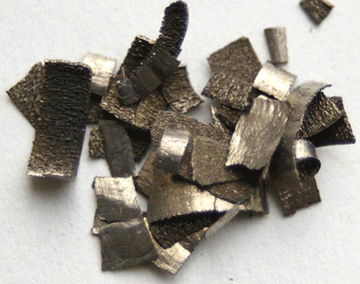 Car industry revolution fuels Western Australia’s lithium boom, ABC News, By Kathryn Diss, 29 July 17, Electric cars are driving rapid mining investment in WA, with the state supplying most of the lithium needed to manufacture batteries worldwide.
Most electric vehicles (EVs) use lithium-ion batteries, the same technology which powers smartphones, tablets and laptops.
As car makers around the globe race to meet new EV targets, demand for batteries has driven lithium exports from WA as the state now produces more than half of the world’s supply.
Global leaders have been behind the push, with new European emissions legislation forcing car markers to increase their targets and France recently announcing it wanted to end the sale of petrol and diesel cars by 2040.
It joins similar targets set by India (2030) and Norway (2025).
The British Government is also set to ban the sale of petrol and diesel cars from 2040 as part of a plan to clean up air pollution.
Growth in demand ‘surprised most analysts’
Batteries to store household solar power, which would allow consumers to disconnect from the electricity grid, are also driving demand to a lesser extent.
“The speed at which demand has grown for lithium carbonate equivalent has surprised most analysts, ourselves included,” Katana Asset Management’s Romano Sala Tenna said.
“Up until a few months ago the conventional thinking was by about 2025, we would need about 330,000 tonnes per annum of lithium carbonate, [but] based on recent announcements from larger automobile manufacturers, we are now thinking we will need at least double that — about 600,000 tonnes per annum.”
While that may sound small compared to the 800 million tonnes the state’s iron ore industry exports each year, the activity in the sector is already creating thousands of new jobs and generating millions in royalties for the cash-strapped WA Government.
The Greenbushes mine in the state’s South West, which is part owned by China’s Tianqi Lithium and America’s Albemarle, is one of the world’s largest lithium producers and is undergoing an expansion to double production.
The mine has seen both boom and bust since starting out as a tin operation in 1888, but is now on the cusp of another upswing — laying claim to what was considered the world’s highest grade lithium deposit.
“It is the longest continuously running mine in Western Australia and it’s on its third product. It just seems to keep producing new life,” Tianqi Lithium general manager Phil Thick said.
“Lithium is obviously a game changer for that mine. It’s been significant as a tin and tantalum mine, but lithium value is substantial.”
The joint venture is also building what it claims to be the biggest lithium processing plant in the world in Kwinana south of Perth. The project will cost $400 million and create 500 construction jobs.
‘More than just a mini-boom’
Growth in the sector has been rapid.
In January, the state had just one mine producing lithium — it now has four and exports have jumped six-fold.
Business observer Tim Treadgold has witnessed big changes in WA’s mining landscape during his 40 years commentating on the sector.
“This is more than just a mini-boom, this is the real McCoy, we could go from one [mine] two years ago to eight by this time next year. It really has been quite remarkable what’s going on,” he said.
Activity in the sector is attracting big names including Chilean major Sociedad Química y Minera de Chile (SQM) which has inked a deal to bankroll a new deposit in the Goldfields with Kidman Resources.
It includes plans to build a $100 million refinery at either Bunbury, Perth or Kalgoorlie.
The deal was announced just days after Kidman won a Supreme Court battle against another miner to maintain control of the mine.
“The world has beaten a path to our door. The arrival of SQM was a real wakeup call that the world wants it and it’s coming here and it’s prepared to pay for it,” Mr Treadgold said……….http://www.abc.net.au/news/2017-07-29/car-industy-lithium-revolution-driving-next-mining-boom-in-wa/8748322
Ralph Nader argues that public awareness must rise, on global threats
 Can the World Defend Itself from Omnicide?, Common Dreams, by Ralph Nader, 27 July 17, Notice how more frequently we hear scientists tell us that we’re “wholly unprepared” for this peril or for that rising fatality toll? Turning away from such warnings may reduce immediate tension or anxiety, but only weakens the public awareness and distracts us from addressing the great challenges of our time, such as calamitous climate change, pandemics, and the rise of a host of other self-inflicted disasters…….
Negotiations are not even underway for a cyberwarfare treaty among nations. The sheer scale and horrific implications of this weaponry seems to induce societies to bury their heads in the sand. Former ABC TV host of Nightline, Ted Koppel, discusses this emerging threat in his recent, acclaimed book, “Lights Out: A Cyberattack, A Nation Unprepared”:
Former Secretary of Defense and CIA Director, Leon Panetta, says Koppel’s book is “an important wake-up call for America.” Yet neither he nor the enormous military-industrial complex, of which he remains a supportive part, are doing much of anything about this doomsday threat to national security. The big manufacturers are too busy demanding ever more taxpayer money for additional nukes, aircraft carriers, submarines, fighter planes, missiles and other weaponry of an increasingly bygone age………
Our present educational systems – from Harvard Law School, MIT to K-12 – are not rising to these occasions for survival. Our mass media, wallowing in trivia, entertainment, advertisements and political insults, is not holding the politicians accountable to serious levels of public trust and societal safety. Time for new movements awakening our best angels to foresee and forestall. Do any potential leaders at all levels want to be first responders? https://www.commondreams.org/views/2017/07/27/can-world-defend-itself-omnicide
1 This month
To see nuclear-related stories in greater depth and intensity
– go to https://nuclearinformation.wordpress.com/


 Antinuclear