With South Carolina’s $multibillion nuclear project, US nuclear industry survival hangs on just one project, in Georgia
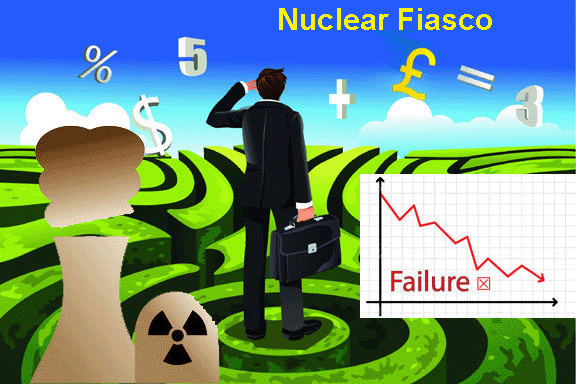
 Fate of U.S. Nuclear Now Hinges on One Utility in Georgia, Bloomberg, By Jim Polson
-
Nuclear revival rests with Southern after Scana scraps project
-
Regulator urges Southern to make final decision by year-end
Southern calling it quits could prove to be the final nail in the coffin for the long-awaited U.S. nuclear renaissance that has failed to materialize in the aftermath of Japan’s Fukushima nuclear accident. In 2012, Southern and Scana became the first companies to gain approval to build U.S. reactors in more than 30 years — only to find themselves in troubling times for the industry.
On top of construction setbacks and ballooning costs, nuclear plants are reeling under intense competition from cheap natural gas and renewables that have spurred states led by New York to go as far as offering subsidies for existing reactors to keep them open……. https://www.bloomberg.com/news/articles/2017-08-01/fate-of-new-nuclear-in-u-s-now-rests-on-one-utility-in-georgia
Climate change will bring more “ghost forests” along coastlines
 Climate change before your eyes: Seas rise and trees die https://www.guelphtoday.com/world-news/climate-change-before-your-eyes-seas-rise-and-trees-die-686109PORT REPUBLIC, N.J. — They’re called “ghost forests” — dead trees along vast swaths of coastline invaded by rising seas, something scientists call one of the most visible markers of climate change. Canadian Press 1 August 17 PORT REPUBLIC, N.J. — They’re called “ghost forests” — dead trees along vast swaths of coastline invaded by rising seas, something scientists call one of the most visible markers of climate change.
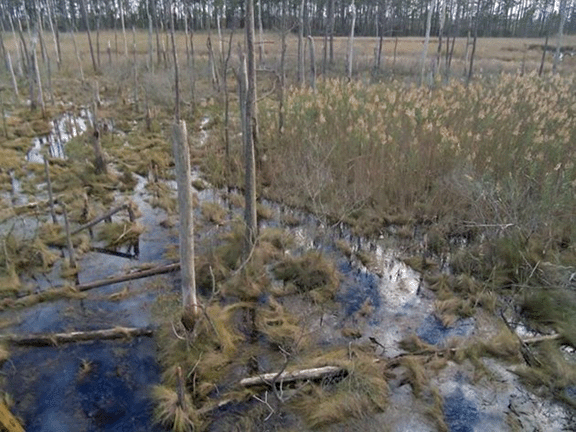
The process has happened naturally for thousands of years, but it has accelerated in recent decades as polar ice melts and raises sea levels, scientists say, pushing salt water farther inland and killing trees in what used to be thriving freshwater plains.
Efforts are underway worldwide to determine exactly how quickly the creation of ghost forests is increasing. But scientists agree the startling sight of dead trees in once-healthy areas is an easy-to-grasp example of the consequences of climate change.
“I think ghost forests are the most obvious indicator of climate change anywhere on the Eastern coast of the U.S.,” said Matthew Kirwan, a professor at Virginia Institute of Marine Science who is studying ghost forests in his state and Maryland. “It was dry, usable land 50 years ago; now it’s marshes with dead stumps and dead trees.”
It is happening around the world, but researchers say new ghost forests are particularly apparent in North America, with hundreds of thousands of acres of salt-killed trees stretching from Canada down the East Coast, around Florida and over to Texas.
The intruding salt water changes coastal ecosystems, creating marshes where forests used to be. This has numerous effects on the environment, though many scientists caution against viewing them in terms of “good” or “bad.” What benefits one species or ecosystem might harm another one, they say. Continue reading
2 August REneweconomy news

-
Welfare lobby’s misguided and self-defeating attack on solarWelfare lobby is right to rail against Australia’s ridiculous electricity prices, but echoing fossil fuel talking points against solar and other new technologies is self defeating.
-
Australia solar market heads for 12GW by 2020Australia’s installed solar PV capacity set to double in three years, according to latest APVI data, as the big solar market gears back up.
-
GE wins South Australia tender for back-up generatorsGE wins tender for back-up generator, and will install mobile units using diesel this summer, before turning them into longer-term gas-fired units.How much will a Tesla Model 3 cost in Australia?The best way to estimate the prices is to use Tesla’s own configuration prices for the USA/Aus Model S and then scale them for the lower numbers.
1 This month
Chernobyl: The Lost Tapes – A good documentary on Chernobyl on SBS available On Demand for the next 3 weeks– https://www.sbs.com.au/ondemand/tv-program/chernobyl-the-lost-tapes/2352741955560
15 April – Zoom –Nuclear Power is Not the Solution
Apr 15, 2026 01:00 AM in Canberra, Melbourne, Sydney

Join the International Physicians for the Prevention of Nuclear War (IPPNW) on Tuesday, April 14th for a timely webinar exploring the risks associated with nuclear power and challenging the myth that it offers a simple, safe, carbon-free solution to the climate crisis

21 April Webinar: No Nuclear Weapons in Australia
Start: 2026-04-21 18:00:00 UTC Canberra, Melbourne, Sydney (GMT+10:00)
End: 2026-04-21 19:30:00 UTC Canberra, Melbourne, Sydney (GMT+10:00)
Event Type: Virtual
A virtual link will be communicated before the event.
Host Contact Info: australia@icanw.org

of the week – Australians for War Powers Reform (AWPR)
To see nuclear-related stories in greater depth and intensity
 Antinuclear