 A survivor of the atomic bombings in 1945 remarked, “This pain that we carry, let it end with us.” As memorials are held, in Japan, in UK, and around the world, there is hope for an end to nuclear weapons, as the UN Nuclear Weapons Ban Treaty is developed.
On climate, there’s a gradual realisation that it is still worth fighting climate change: but catastrophic change might be inevitable.
On nuclear – well – things are grim for the nuclear industry, with the abandoning of 2 reactors being developed in South Carolina – after $9 billion already spent on them, just about the last straw following the Westinghouse bankruptcy, the French and Finnish nuclear build problems, and Britain’s dubious Hinkley and Moorside projects.
CLIMATE.
Matt Canavan, (now resigned as Resources Minister) makes it quite clear that he WAS the Minister For Mining
NUCLEAR. Lucas Heights nuclear reactor was always intended as a step towards nuclear weapons, AND IT STILL IS. South Australians Brett and Michael Rayner overjoyed at the beauty of nuclear wastes at ANSTO, – apparently unaware of the toxicity of the nuclear waste they’re inviting to their property.
Garma 2017[ Aboriginal reconciliation congress) pushes for nationwide Makarrata (Treaty)
Lithium Australia – company seeks to recycle rare earths. – Western Australia’s boom in lithium mining.
RENEWABLE ENERGY – I can’t keep up. Go to REneweconomy.
August 5, 2017
Posted by Christina Macpherson |
Christina reviews |
Leave a comment
Climate change a serious threat to national security: Climate Council http://www.mygc.com.au/climate-change-serious-threat-national-security-climate-council/, 5 Aug 17 INTENSIFYING climate change poses a serious threat to Australia’s national security and we are not sufficiently prepared, according to a new submission released from the Climate Council.
Climate Council CEO Amanda McKenzies said urgent reforms are needed in order for Australia’s defence forces to deal with the vast and far-reaching impacts of climate change.
She warns more resources and stronger planning is needed to enable the defence force to tackle the increasing threat as extreme weather events, such as bushfires, floods and cyclones become more intense. “The Australian Defence force will have to play an increasing role at home and in the Pacific as extreme weather events become more frequent and forceful,” Ms McKenzies said.
“This requires more resources and strong planning. To bury our heads in the sand would risk not being able to cope effectively.
“When it comes to tackling this threat, Australia is at risk of being labelled Missing In Action, all while the UK and US militaries have spent years preparing for intensifying climate change, driven by the burning of fossil fuels.”
It comes after 2016 was named the hottest year on earth, smashing consecutive records set in 2015 and 2014, as a result of rising greenhouse gas levels from the burning of coal, oil and gas. See below story.
McKenzie said the Climate Council’s recommendations span from military planning and operations, through to training, testing and acquisition.
“These recommendations have already been rolled out and implemented in the US and the UK. Australia cannot ignore these critical footsteps already taken by our strategic allies,” she said.
“We’ve even seen the fingerprints of climate change in Syria’s civil war. The country’s severe drought, which was exacerbated by climate change, contributed to instability in Syria.”
“This should serve as a warning signal for the Australian Defence Force. Australia and its military must be equipped and prepared in the face of worsening climate change.”
AUSTRALIA’S HOTTEST JULY ON RECORD Continue reading →
August 5, 2017
Posted by Christina Macpherson |
AUSTRALIA - NATIONAL, climate change - global warming |
Leave a comment
 “I want you to feel the presence of not only the future generations, who will benefit from your negotiations to ban nuclear weapons, but to feel a cloud of witnesses from Hiroshima and Nagasaki.”
“We have no doubt that this treaty can – and will – change the world.” – Setsuko Thurlow, a Hiroshima atomic bomb victim
The elimination of nuclear weapons has been the cause that Greenpeace campaigned so passionately and heavily for since 1971.
Even with the passing of the UN’s Nuclear Weapons Ban Treaty, Japan still remains an outlier, betraying the hopes of atomic bomb survivors from Hiroshima and Nagasaki.
It started with just 12 of them. With a bold mission, this group of activists set sail to Amchitka island off Alaska to protest the detonation of an underground US nuclear test. It was September 1971, and though the mission was initially unsuccessful, it was the beginning of what became Greenpeace, and just one of the many issues – the elimination of nuclear weapons – that the environmental organisation would campaign endlessly against.
Fast forward to 2017, and what was once a hard-fought battle and one of Greenpeace’s legacy issues, has now become a successful defeat. On 7 July, the United Nations adopted the “Nuclear Weapons Treaty” with an overwhelming majority – an epoch-making agreement that prohibits not only the development, experiment, manufacture, possession, and use of nuclear weapons, but also the “threat to use”. Nuclear and chemical weapons, and anti-personnel landmines and cluster bombs were also banned. The Treaty will be open for signature by states on September 20th.
To our disappointment, however, Japan did not join the 122 countries, or two-thirds of the United Nations member countries, that stood up to stop nuclear weapons. The peculiar absence of Japan, whose preamble explicitly recognizes “unacceptable suffering of and harm caused to the victims of the use of nuclear weapons (Hibakusha) as well as those affected by the testing of nuclear weapons” begs explanation. Continue reading →
August 5, 2017
Posted by Christina Macpherson |
General News |
Leave a comment
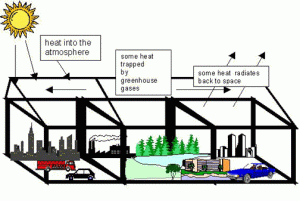 Australia’s greenhouse gas emissions soar in latest figures Figures reveal trend of increasing emissions since the carbon tax was repealed in 2014 and cast doubt on whether Australia can meet cuts in Paris agreement, Guardian, Michael Slezak, 5 Aug 17, Australia’s greenhouse gas emissions are rising to the highest figures seen in years, according to official government figures, increasing 1.6% in the last quarter and 1% in the past year.
The country’s emissions in the year to March 2017 are the highest on record at 550.3m tonnes of CO2 equivalent when emissions from land use change are excluded – a sector where the government says its figures have a high degree of uncertainty.
The country’s emissions rose by 1.6m tonnes in the quarter to March 2017, or by 1.1% – a figure that is the same whether estimations of land use emissions are taken into account or not…….
The figures reveal a clear trend of increasing greenhouse gas emissions since the carbon tax was repealed in 2014 – a trend that runs counter to Australia’s international commitments…….
Australia pledged to increase its emissions at Kyoto and is meeting its 2020 emissions targets using an accounting measure, where it could “carry over” the amount it overshoots its Kyoto targets, allowing it to increase its emissions again. https://www.theguardian.com/australia-news/2017/aug/04/australias-greenhouse-gas-emissions-soar-in-latest-figures
August 5, 2017
Posted by Christina Macpherson |
AUSTRALIA - NATIONAL, climate change - global warming |
Leave a comment
One reaction would be to say, ‘Too bad, we’re going to miss the 2-degree target,’ so we kind of throw up our hands and say there’s nothing we can do,” Raftery said. “But I think that’s exactly the wrong message to take away from the study. The more warming it is, the worse the consequences, and that makes it even more urgent to to take urgent action to at least limit temperature increase to be as close to 2 degrees as possible.”
Catastrophic climate change all but unavoidable; now what? UW study finds little chance of keeping temperature rise within 2 degrees Celsius, Seattle PI, By Stephen Cohen,
August 3, 2017 Seattle is suffering through its worst heat wave of the year, but according to a recent University of Washington study, increasingly hotter temperatures — and their deadly outcomes — are all but unavoidable.
That doesn’t mean we shouldn’t take steps to try and slow down the rising thermometer.
The UW study, co-authored by statistics and sociology professor Adrian Raftery and associate professor of atmospheric sciences Dargan Frierson, concluded there is a 90 percent chance the Earth’s average temperature will rise by more than 2 degrees Celsius (about 3.6 degrees Fahrenheit) by 2100.
Limiting a rise to less than 2 degrees was one of the goals of the 2015 Paris climate agreement due to the potentially catastrophic effects of such an increase, including heat waves, extreme storms, flooding, sea level rise, etc. But the study, published on July 31 in the journal “
Nature Climate Change,” found there is a less than 5 percent chance that the goal will be met, and only a 1 percent chance the increase will be limited to 1.5 degrees.
“If we’re to keep anywhere close to the 2-degree limit, we basically need to pull out all the stops on all registers over the next 80 years,” Raftery told SeattlePI. “I don’t see any alternative.”
Continue reading →
August 5, 2017
Posted by Christina Macpherson |
General News |
Leave a comment
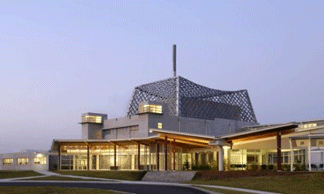 Canberra hoped that aiding Britain might be a step toward its own bomb.
Australia took tentative steps to go it alone. This included the Lucas Heights nuclear plant on Sydney’s southern fringe. Still Australia’s only reactor, it began its life researching, among other things, nuclear weapons
“We have the people, the knowledge, the history, the uranium and we still have Lucas Heights.”
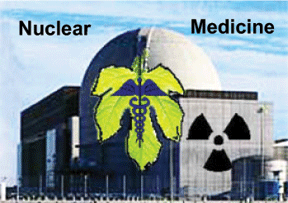 Australia’s secret plans to have its own nuclear arsenal, AMERICA. Russia. China. Britain. The world’s most powerful countries all have nuclear arsenals — and few people know Australia was almost one of them, Benedict Brook@BenedictBrook, news.com.au, JULY 11, 2017 “…….A military expert has told news.com.au, that top secret plans were so advanced Australia was considered “top of the pile” of countries expected to acquire its own nuclear arsenal
It was 60 years ago that the last nuclear bomb was detonated in Australia, a British weapon at the Maralinga test site in South Australia.
If you look closely, evidence of Australia’s plans for its own nuke remain. A few hours south of Sydney, at picturesque Jervis Bay, a small road leads into the bush. By a boat ramp is a large car park.
However, this was never designed to be a place for tourists’ vehicles. Rather, it is the unfinished foundations of Australia’s first commercial nuclear power station.
The public were told it would revolutionise the country’s energy needs. The truth was it would enrich uranium for Australia’s atomic bombs.
Associate Professor Wayne Reynolds is a defence and foreign policy expert at the University of Newcastle and author of the book Australia’s Bid for the Atomic Bomb….. “We wanted to have a navy; in WWII we wanted access to heavy bombers; and so we wanted nuclear weapons. We wanted to maintain a strategic leading edge.”
Australia didn’t want to go it alone. During WWII, British and Australian experts had worked alongside their American counterparts on the Manhattan Project to build the world’s first atomic bomb.
The expectation was that the US would share the results with its allies.
“In 1946, the Americans changed that calculation by announcing they would not share any of the technology or weapons,” says Prof Reynolds. “Britain and Australia were cut out from the club”……. Many in the government harboured a desire for a joint “Empire” bomb produced between Australia, Britain, Canada and South Africa.
Despite the UK’s ownership of the bombs it detonated at Maralinga, Canberra hoped aiding Britain might be a step toward its own bomb. Certainly, no one underestimated Australia’s atom ambitions. “German, Italy, the Netherlands — all wanted nuclear weapons but Australia was top of the list because of our uranium resources, our scientists and our enrichment program,” Prof Reynolds says.
Australia took tentative steps to go it alone. This included the Lucas Heights nuclear plant on Sydney’s southern fringe. Still Australia’s only reactor, it began its life researching, among other things, nuclear weapons…..
In the early 1960s, the Menzies Government was discussing with the US the top secret “SEATO plan 4” which could have seen American bombs on Australian soil.
“This were absolutely not known by the public and plan 4 was only declassified thirty years later,” says Prof Reynolds.
…..In 1968, ex-RAAF pilot Gorton became Prime Minister. The nuclear non-proliferation treaty (NPT) was already in the works. However, a big supporter of a homegrown nuclear deterrent, Gorton wanted to Australia to be on the “brink of manufacture” of a weapon, says Prof Reynolds…….
Gough Whitlam formally ended Australia’s atom ambitions by signing onto the NPT and tying the country’s security to the US…….
Prof Reynolds says it is unlikely Australia would seek to host nuclear bombs — its own or others. But history warns you to never say never.
“Historically, we’ve gone with the major powers. But if this unravels we might need a capability down here,” he says.” “We have the people, the knowledge, the history, the uranium and we still have Lucas Heights.” benedict.brook@news.com.au http://www.news.com.au/technology/science/australias-secret-plans-to-have-its-own-nuclear-arsenal/news-story/2bcac85b0f2cbe3f7e377217d6ef999b?platform=hootsuite
August 5, 2017
Posted by Christina Macpherson |
AUSTRALIA - NATIONAL, weapons and war |
Leave a comment
 Heading to the slopes this winter? Why much of the snow you’ll see comes from a machine, not the sky, ABC Rural , By Catherine McAloon, 5 Aug 17
, With below average rain and warmer than usual temperatures, this Australian winter has produced conditions that would have once spelled disaster for the local ski industry.
The first month of winter was the driest June on record in much of the country’s south, while July brought record-breaking heat and little rain.
But despite the mild conditions, it has been pretty much business as usual at many of the major alpine resorts, with visitor numbers tracking around average.
That is because Australian ski resorts have invested heavily in advancements in snowmaking machines that can produce enough snow to cover ski runs, even when Mother Nature provides no natural snowfall.
This season, for the first time, some mountains have introduced a new generation of snowmaking technology that can churn out machine-made snow in just about any weather conditions.
And with predictions climate change could slash Australia’s ski seasons, resorts are making big investments in ramping up their snowmaking equipment to ensure the industry can keep drawing tourists to alpine regions in the winter months……….
Coping with climate change Australian ski seasons have always been hugely variable from year to year, but the long-term trend for natural snowfall is towards declining levels of natural snowfall.The CSIRO’s latest climate change modellingpredicts, under a low-risk scenario, the average snow season across Victoria and some of New South Wales will become 20 to 55 days shorter and, under a worst-case scenario, 30 to 80 days shorter.
Victoria’s Alpine Resorts Co-ordinating Council also commissioned a report into how climate change could affect the state’s alpine resorts, published last year, which found seasons had been getting shorter with less overall snow depth since the 1960s.
That trend was tipped to accelerate, while winter weather would become more unpredictable……http://www.abc.net.au/news/2017-08-05/snowmaking-the-future-in-face-of-climate-change/8752210
August 5, 2017
Posted by Christina Macpherson |
climate change - global warming, Victoria |
Leave a comment
 It’s Official: Nuclear Power Can’t Compete With Renewables, EcoWatch, By Paul Brown, 4 Aug 17 The nuclear revival the global industry has been hoping for took another hammer blow this week when two reactors under construction in South Carolina were abandoned, only 40 percent complete.
The plan had been to build two Westinghouse AP1000 pressurized water reactors to lead the nuclear revival in the U.S., but cost overruns and delays dogged the project and will have the opposite effect. This is a further humiliation for Westinghouse, the U.S. nuclear giant that earlier this year filed for bankruptcy because of the costs associated with this new design. Hopes that a new generation of reactors could be built in the U.S. and sold to the rest of the world rested on the success of this project, and it has spectacularly failed.
By this week, construction had already cost $9 billion, almost the entire original budget, with years of building still to go. The reactors were originally scheduled to begin producing power in 2018, but this had been put back to 2021. Cost overruns had meant the final cost could be $25 billion. Around 5,000 construction workers have lost their jobs.
Changing context
The two owners of the project who had taken control after the Westinghouse bankruptcy, South Carolina Electric & Gas and Santee Cooper, announced they would halt construction rather than saddle customers with additional costs……..
Nuclear power did find favor in some quarters in the U.S. because it was regarded as a low carbon source of electricity. But President Trump is trying to dismantle legislation that would have helped the industry get credit for this.
The repercussions of the decision to abandon the building of the South Carolina reactors will be felt across the Atlantic in the UK, where three reactors of the same design were due to be built in Cumbria in the northwest of England. NuGen, the UK company that planned to build them, is, like Westinghouse, a subsidiary of the Japanese giant Toshiba. It was already reviewing its plans to build them before this week’s news broke.
Officially this is still the position, but it seems unlikely that the company would gamble on trying to build reactors of a design that could not be completed successfully in the U.S.
All big nuclear companies have new designs being constructed on home turf. Their plan has been to demonstrate how well they work and then export them. But this is currently not working anywhere, most spectacularly in Europe, where the French giant EDF is in deep trouble with its flagship design, the even larger 1,600 megawatt pressurized water reactor.
Rapid delay
Prototypes under construction at Olkiluoto in Finland and Flamanville in France are, like the AP 1000, years late and over budget.
Construction has started on two more at Hinkley Point in Somerset in the West of England, but already, within weeks of the first concrete being poured, a delay has been announced.
Although the British Government still supports the project, it has already been questioned by the UK National Audit Office, which polices government finances. The NAO said consumers will be paying far too much for the electricity even if the project is finished on time, which on the industry’s past record seems extremely unlikely.
With renewables providing more and more cheap power in Europe and across the world, it seems unlikely that any of the new generation of large nuclear plants will ever be able to compete.
Phase-out planned
Japan, still suffering from the after effects of the Fukushima disaster of 2011, is unlikely to be able to resuscitate its nuclear industry, and South Korea, with arguably the most successful nuclear construction record, has a new government which wants to phase out the industry.
Only China and Russia, where what is really happening in their nuclear industries is a closely guarded secret, remain as likely exporters of new nuclear stations.
Both countries offer to supply fuel to countries which buy their reactor models. As well as building them, they offer as part of the package to get rid of the spent fuel and waste, so any country that buys nuclear power from China and Russia is effectively tied to them for a generation or more.
So for Russia and China, selling nuclear power stations is a political decision to extend their influence rather than an economic one—and it could be an expensive option for all concerned. From a purely economic perspective, however, it appears the nuclear industry is reaching the end of the road. https://www.ecowatch.com/westinghouse-nuclear-2469123144.html
August 5, 2017
Posted by Christina Macpherson |
Uncategorized |
Leave a comment
Melting glaciers in Swiss Alps could reveal hundreds of mummified corpses
Frozen bodies of couple who vanished 75 years ago among those uncovered recently as global warming forces ice to retreat, Guardian, Philip Oltermann and Kate Connolly, 5 Aug 17, Swiss police say hundreds of bodies of mountaineers who have gone missing in the Alps in the past century could emerge in coming years as global warming forces the country’s glaciers to retreat.
Alpine authorities have registered a significant increase in the number of human remains discovered last month, with the body of a man missing for 30 years the most recent to be uncovered.
Rescue teams in Saas Valley in the Valais canton were called last Tuesday after two climbers retreating from an aborted ascent spotted a hand and two shoes protruding from the Hohlaub glacier…….
The discovery comes less than a week after the bodies of a Swiss couple, missing for 75 years, were found in the Tsanfleuron glacier in the same canton…….
Switzerland’s glaciers have been melting at an unprecedented rate, losing almost one cubic km in ice volume or about 900 bn litres of water over the past year. According to an investigation by Tagesanzeiger newspaper, eight of the 10 months in which the glaciers have lost the most in volume over the past century have been since 2008.
Since 1850, when glaciers covered 1,735 sq km (670 sq miles) of Swiss land, the total area has shrunk by a half, to about 890 sq km.
Police in Valais expect the bodies of many more missing persons to emerge because of global warming. “It’s quite clear,” a spokesman, Christian Zuber, told the Guardian.
“The glaciers are retreating, so it’s logical that we’re finding more and more bodies and body parts. In the coming years we expect that many more cases of missing persons will be resolved.”…… https://www.theguardian.com/world/2017/aug/04/melting-glaciers-swiss-alps-could-reveal-hundreds-mummified-corpses
August 5, 2017
Posted by Christina Macpherson |
General News |
Leave a comment
Donald Trump’s environment boss Scott Pruitt heading to Australia, ABC News , Exclusive by defence reporter Andrew Greene, 4 Aug 17, A climate science critic and one of the most controversial figures in the Trump administration will soon tour Australia in a visit environmental activists are likely to target with protests.

Key points:
- Critics accuse Pruitt of trying to weaken the EPA
- Liberal backbencher Craig Kelly says Australia should welcome Pruitt “with open arms”
- Greenpeace says visit could spark protests and is not helpful for Australia as it tackles climate change policy
Lawyer Scott Pruitt was last year handpicked by Donald Trump to head the US Environmental Protection Agency (EPA).
Critics accuse the former Oklahoma attorney-general of trying to weaken the EPA since assuming his role as administrator in February.
The ABC has confirmed the Republican politician is scheduled to fly to Australia this year, joining other Trump administration figures who have already made the journey, including Vice-President Mike Pence, Secretary of State Rex Tillerson and Secretary of Defence James Mattis.
Federal Government backbencher and climate change sceptic Craig Kelly has welcomed Mr Pruitt’s impending visit……..
Alix Foster Vander Elst, a campaigner with Greenpeace Australia Pacific. – “To have someone who supports the fossil fuel industry at the head of the Environmental Protection Agency in the US is obviously extremely unproductive and upsets many people……..http://www.abc.net.au/news/2017-08-05/donald-trump-epa-boss-scott-pruitt-to-vist-australia/8776752
August 5, 2017
Posted by Christina Macpherson |
AUSTRALIA - NATIONAL, politics international |
Leave a comment
-
GE, Engie to build 119MW wind farm in South Australia
Engie and GE commit to 119MW wind farm in South Australia, taking confirmed new wind and solar projects in that state to more than 600MW.
-
Coal lobby hits peak denial on battery storage, renewables
Australia’s biggest coal miner and leading research organisation come up with ridiculous claims on battery storage in attempts to justify new coal plants and CCS.
-
-
Book Review: Energy Unlimited – 4 steps to 100% renewables
This well-timed Australian book offers a step-by-step how-to for businesses transitioning to a more sustainable energy future.
August 5, 2017
Posted by Christina Macpherson |
AUSTRALIA - NATIONAL, energy |
Leave a comment
 Another attack on the Bureau, but top politicians have stopped listening to climate change denial, The Conversation Michael J. I. Brown Associate professor, Monash University, August 4, 2017 Has the Australian climate change debate changed? You could be forgiven for thinking the answer is no.
Just this week The Australian has run a series of articles attacking the Bureau of Meteorology’s weather observations. Meanwhile, the federal and Queensland governments continue to promote Adani’s planned coal mine, despite considerable environmental and economic obstacles. And Australia’s carbon dioxide emissions are rising again.
So far, so familiar. But something has changed.
Those at the top of Australian politics are no longer debating the existence of climate change and its causes. Instead, four years after the Coalition was first elected, the big political issues are rising power prices and the electricity market. What’s happening?
A few years ago, rejection of climate science was part of the Australian political mainstream. In 2013, the then prime minister Tony Abbott repeated a common but flawed climate change denial argument:
Australia has had fires and floods since the beginning of time. We’ve had much bigger floods and fires than the ones we’ve recently experienced. You can hardly say they were the result of anthropic [sic] global warming.
Abbott’s statement dodges a key issue. While fires and floods have always occurred, climate change can still alter their frequency and severity. In 2013, government politicians and advisers, such as Dennis Jensen and Maurice Newman, weren’t shy about rejecting climate science either.
The atmosphere is different in 2017, and I’m not just talking about CO₂ levels. Tony Abbott is no longer prime minister, Dennis Jensen lost preselection and his seat, and Maurice Newman is no longer the prime minister’s business advisor.
Which Australian politician most vocally rejects climate science now? It isn’t the prime minister or members of the Coalition, but One Nation’s Malcolm Roberts. In Australia, open rejection of human-induced climate change has moved to the political fringe……..
Have those who rejected global warming and its causes changed their tune? In general, no. They still imagine that scientists are up to no good. The Australian’s latest attacks on the Bureau of Meteorology (BoM) illustrate this, especially as they are markedly similar to accusations made in the same newspaper three years ago.
This week, the newspaper’s environment editor Graham Lloyd wrote that the BoM was “caught tampering” with temperature logs, on the basis of measurements of cold temperatures on two July nights at Goulburn and Thredbo. For these nights, discrepant temperatures were in public BoM databases due to automated weather stations that stopped reporting data. The data points were flagged for BoM staff to verify, but in the meantime an amateur meteorologist contacted Lloyd and the Institute of Public Affairs’ Jennifer Marohasy.
In 2014, Lloyd cast doubt on the BoM’s climate record by attacking the process of “homogenisation,” with a particular emphasis on data from weather stations in Rutherglen, Amberley and Bourke. Homogenisationis used to produce a continuous temperature record from measurements that may suffer from artificial discontinuities, such as in the case of weather stations that have been upgraded or moved from, say, a post office to an airport.
Lloyd’s articles from this week and 2014 are beat-ups, for similar reasons. The BoM’s ACORN-SAT long-term temperature record is compiled using daily measurements from 112 weather stations. Even Lloyd acknowledges that those 112 stations don’t include Goulburn and Thredbo. While Rutherglen, Amberley and Bourke do contribute to ACORN-SAT, homogenisation of their data (and that of other weather stations) does little to change the warming trend measured across Australia. Australia has warmed over the past century, and The Australian’s campaigns won’t change that…….
How will Malcolm Turnbull’s government respond to The Australian’s retread of basically the same campaign? Perhaps that will be the acid test for whether the climate debate really has changed. https://theconversation.com/another-attack-on-the-bureau-but-top-politicians-have-stopped-listening-to-climate-change-denial-81993
August 5, 2017
Posted by Christina Macpherson |
AUSTRALIA - NATIONAL, climate change - global warming, media |
Leave a comment
As a coastal defence, the Great Barrier Reef’s value to communities goes way beyond tourism https://theconversation.com/as-a-coastal-defence-the-great-barrier-reefs-value-to-communities-goes-way-beyond-tourism-80952Mark Gibbs
Director, Knowledge to Innovation; Chair, Green Cross Australia, Queensland University of TechnologyAugust 4, 2017 Rising sea levels are widely recognised as a threat to coastal communitiesworldwide. In Australia, the Climate Council estimates that at least A$226 billion of assets and infrastructure will be exposed to inundation if sea levels rise by 1.1 metres. Another report recommended that global mean sea level rise of up to 2.7 metres this century should be considered in planning processes.
The Queensland state government has commissioned the QCoast2100 program. This program aims to help with the development of coastal climate adaptation plans for Queensland communities exposed to sea-level rise.
Although the largest population centres in Queensland are in the state’s southeast, several of the most populous regional centres in Australia are located along the Great Barrier Reef coastline between Gladstone and Cape York. These include Townsville, Cairns, Gladstone, Mackay and Port Douglas.
A major task in developing coastal adaptation plans under the QCoast2100 program is to model inundation from a range of scenarios for sea-level rises and assess how assets will be inundated in the future. However, another threat is on the horizon.
How urban centres are protected
Urban centres along the reef’s coastline, which forms the majority of the Queensland coast, are protected from major ocean storms by natural deposits of coastal sediments. These include dunes and associated vegetation such as coastal forests, wetlands and mangrove systems.
These natural features continue to exist largely because the Great Barrier Reef’s outer reefs dampen incoming ocean waves. Although exposed to the occasional cyclone – which can lead to short-term erosion at specific locations – much of the coastal zone inside the reef is slowly growing out into the sea.
This increasing buffer zone can form a natural barrier to coastal recession.
A recently released report estimated the total economic, social and icon asset value of the Great Barrier Reef at A$56 billion. By design, this report did not include many of the ecosystem services the reef provides. One of these is its role in reducing the energy of waves that impact the coastline behind the reef.
However, an earlier assessment of the total economic value of ecosystem services delivered by the reef estimated the present coastal protection benefit is worth at least A$10 billion.
Despite the inherent uncertainties in such assessments, it is clear the reef acts to reduce incoming wave energy and its impacts on cities and towns along much of the Queensland coastline. The total economic value of these benefits is in the billions of dollars.
What role is bleaching playing?
The Great Barrier Reef’s ability to keep protecting the Queensland shoreline, and communities living along it, depends upon the ability of individual reefs in the system to grow vertically to “keep up” with rising sea level.
The jury is still out on whether the outer reefs will be able to keep up with predicted rises. This is an active area of research.
However, it is clear reefs that are extensively affected by coral bleaching will struggle to maintain the essential processes required for productive reef-building. Many reefs are now experiencing net erosion.
Predictions of ocean warming suggest that bleaching events will become even more common in coming decades. Increasing levels of atmospheric carbon dioxide are also making the oceans more acidic, which makes it more difficult for organisms such as corals to maintain their skeletons, which are made of calcium carbonate. This mineral dissolves more rapidly with increasing acidification, reducing the reef’s capacity to recover from storm damage and coral bleaching.
Therefore, as bleaching events and acidification continue, the outer reefs that protect the Queensland coast from ocean waves will increasingly struggle to perform this function.
In turn, over time the Queensland coast will potentially suffer from more coastal erosion, which may increase the vulnerability of coastal infrastructure. This effect, combined with rising sea levels leading to more coastal inundation events, multiples the risks to coastal settlements and infrastructure.
August 5, 2017
Posted by Christina Macpherson |
climate change - global warming, Queensland |
Leave a comment









 Antinuclear