The Productivity Commission has warned of possible political interference in the investment decisions, and former treasurer Wayne Swan described it as a government “slush fund” operated by a board stacked in favour of the mining industry.
Bank calls for more transparency on Northern Australia Infrastructure Facility’s $5b loan scheme
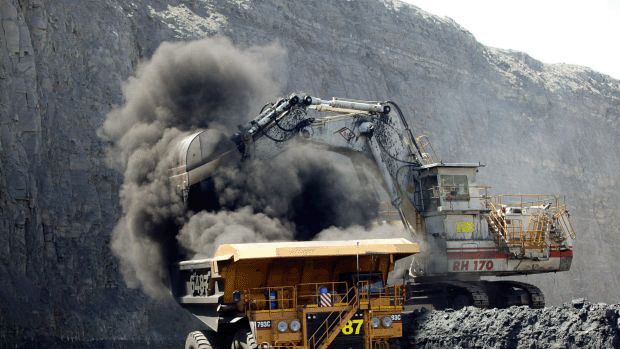 ‘More transparency needed’: Bank questions secrecy of $5b loan scheme, Newcastle Herald, 24 Aug 2017 A $5 billion infrastructure loan scheme derided as a secretive Turnbull government slush fund has attracted further criticism – this time from a major bank.
National Australia Bank – whose own industry is plagued by claims it is opaque and untrustworthy – has raised concerns that the Northern Australia Infrastructure Facility, a controversial government loan scheme designed to kickstart private sector investment in the north, lacks transparency.
NAB also warned that the fund was taking a “lender of last resort” approach that may not provide the economic shot-in-the-arm that Northern Australia requires.
The bank’s concern adds to a chorus of complaint that the much-vaunted infrastructure fund, which headlined the 2015 federal budget, is cloaked in secrecy, lacks governance and exposes taxpayers to a high risk of losing their money.
Australia leads in small-scale solar, but USA quickly turning to it, too
 Small-scale solar will displace $2 billion of US power by 2025 http://reneweconomy.com.au/small-scale-solar-will-displace-2-billion-us-power-2025/ By Bloomberg New Energy Finance on 23 August 2017 By 2025, over $2 billion worth of U.S. electricity production will change hands from traditional generators to small-scale generation assets.
Worldwide, the small-scale solar photovoltaic capacity operated by homes and businesses is predicted to grow consistently as depicted by Bloomberg New Energy Finance in the New Energy Outlook 2017.
In countries like the U.S. which face stagnant electricity demand growth, the growth in distributed electricity production will take sales from generators in the wholesale markets and regulated power regions.
Australia leads the way in distributed energy, with around 45 per cent of total demand to be delivered by locally sourced distributed power solar, wind and storage, by 2040.
Clients can access the full report here.
South Australia calls for Federal Govt loan for Port Augusta solar plant
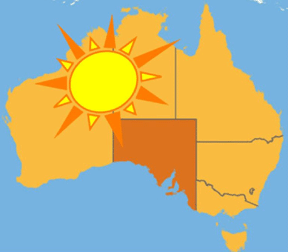 Premier Jay Weatherill calls on Federal Government to provide $110m loan for $650m Port Augusta solar plant, Adam Langenberg, Luke Griffiths, The AdvertiserAugust 23, 2017 PREMIER Jay Weatherill has dared the Federal Government to block a $110 million loan banked on to finance Port Augusta’s $650 million solar thermal plant……
Mr Frydenberg was in Whyalla on Wednesday as he launched a $30 million battery storage facility on the Yorke Peninsula, as revealed by The Advertiser yesterday.
He said it would play an important role in securing South Australia’s electricity network.
Less than two months after the State Government announced its deal with US billionaire Elon Musk’s Tesla, Mr Frydenberg unveiled plans that would see the Federal Government’s Australian Renewable Energy Agency fund up to 40 per cent of a 30MW, 8MW/h battery.
Electranet will design and build the battery before leasing out its commercial operation to a yet-to-be-decided energy retailer.
To be located at Dalrymple — one of the electricity network’s “weak points”, according to Mr Frydenberg — it is expected to be connected to the grid by February 2018.
The Tesla battery, to be located in Jamestown, will be 100MW, 129MW/h.
“We don’t claim to have the biggest battery or the biggest system, what we do claim is to be putting in place practical, cost-effective, needed policy solutions and practical solutions to the challenges SA faces,” Mr Frydenberg said prior to presenting at the Global Maintenance Upper Spencer Gulf conference in Whyalla…….
In his speech, Mr Koutsantonis declared the Upper Spencer Gulf an economic participation region under the State Government’s industry participation policy.
Local businesses will now be given a 20 per cent weighting when vying for public project work.
“We have seen how successful this policy has been since it was implemented in northern Adelaide and now we want to replicate those achievements in the Upper Spencer Gulf,” he said. http://www.adelaidenow.com.au/news/south-australia/premier-jay-weatherill-calls-on-federal-government-to-provide-110m-loan-for-650m-port-augusta-solar-plant/news-story/40c4bb6cffce77e1c2cf0f5816fd1334
Victoria’s smart renewable energy policy
 Victorian government generates smart policy to drive surge in renewable energy, http://www.theage.com.au/comment/the-age-editorial/victorian-government-generates-smart-policy-to-drive-surge-in-renewable-energy-20170823-gy2he1.html The transition from coal-generated electricity to renewable energy is inevitable and crucial. Science has demonstrated beyond reasonable doubt that carbon emissions from coal and gas are a primary cause of dangerous global warming and climate change.
One of the main financial burdens on Australian families and businesses in recent years has been the sharp increase in the price of electricity, which has been driven by a surge in gas prices, and, many contend, by over-investment in transmission infrastructure – poles and wires – by power companies. Another key reason is the lack of investment in renewable energy, which is becoming increasingly competitive even with the cheap coal that still provides most of our baseload electricity.
The main reason investment in renewable energy has slowed is political; a lack of policy consistency and the perplexing anti-renewables stance of former Coalition prime minister Tony Abbott undermined confidence by generating uncertainty. Australia’s total greenhouse gas emissions rose in the March quarter by 1.6 per cent, the biggest rise in almost a decade, making it all the more difficult for the country to meet its international commitments.
So the Victorian government’s decision to provide some certainty is welcome, and should help lead to affordable, reliable renewable energy. The government is asking green energy companies to tender for a contract to supply 650 megawatts of power, which is sufficient to meet the demand of every household in Geelong, Ballarat, Bendigo and the Latrobe Valley. The move comes a month after the government announced new battery storages that can deliver four hours of power to two regional Victorian towns of 100,000 people, and two solar farms to power Melbourne’s entire tram network, the world’s biggest.
The measures are fundamental to achieving the state government’s renewable energy targets of 25 per cent by 2020 and 40 per cent by 2025. At the moment, about a 10th of the state’s power comes from renewable sources. The policy is all the more necessary following the recent closure of the Hazelwood coal-fired power station, which provided more than a fifth of Victoria’s electricity.
Enough renewable power for Victoria’s 4 biggest regional cities
Renewable energy boost to power Victoria’s four biggest regional cities, The Age, Adam Carey, 23 Aug 17, In a huge boost to Victoria’s electricity supply, renewable energy companies will compete to supply Victoria with 650 megawatts of power – enough for the energy needs of every household in Geelong, Ballarat, Bendigo and the Latrobe Valley.
The competitive “reverse auction” will be the biggest of its kind in Australia, as corporations tender for the contracts to power 389,000 households. This is expected to trigger investment of about $1.3 billion in renewable projects such as construction of wind and solar farms.
Expressions of interest will open in October.
The projects are critical to the government’s target to increase Victoria’s renewable energy level to 40 per cent by 2025.
The government will seek to lock in its renewable energy target – 25 per cent by 2020 and 40 per cent by 2025 – by tabling legislation today. Currently about 10 per cent of the state’s power needs are met with renewable sources.
Premier Daniel Andrews said he was confident the legislation would pass…….
Energy minister Lily D’Ambrosio said modelling indicated households would save $30 a year on energy bills on average, and large companies would save $140,000 a year, over the life of the renewable energy target scheme.
“We know for a fact that more supply, in a pure economics 101 sense, means cheaper prices and that’s what we’ll be delivering,” Ms D’Ambrosio said.
“We are getting solar projects built, we’ve already got two wind farms under way … so the sooner we can get that in there, the sooner people will see that flow through their energy bills,” she said…..
Kane Thornton, chief executive of the Clean Energy Council, said the government’s move to legislate its “ambitious” 40 per cent target would give the renewable energy industry more confidence to invest in Victoria.
“It will deliver billions of dollars of investment and thousands of jobs into regional and rural parts of this state and help to put Victoria back on the map in terms of attracting investment back into this sector,” Mr Thornton said.
He predicted renewable energy would “ultimately replace coal-fired generation” in Victoria, although Ms D’Ambrosio said coal would continue to help power the state for “many years to come”…..http://www.theage.com.au/business/energy/renewable-energy-boost-to-power-victorias-four-biggest-regional-cities-20170822-gy22gs.html
More than 70 per cent of the countries in the world could run entirely on renewable energy by 2050
 Independent 23rd Aug 2017, More than 70 per cent of the countries in the world – including the UK, US,China and other major economies – could run entirely on energy created by
wind, water and solar by 2050, according to a roadmap developed by
scientists.
And they pointed out that doing so would not only mean the
world would avoid dangerous global warming, but also prevent millions of
premature deaths a year and create about 24 million more jobs than were
lost.
One of the scientists said the social benefits of following their
roadmap were so “enormous” and essentially cost free that human society
should “accelerate the transition to wind, water and solar as fast as
possible”. Rooftop solar panels and major solar power plants; offshore and
onshore wind turbines; wave, hydroelectric and tidal schemes; and
geothermal energy would also be used to replace fossil fuels to generate
electricity, power vehicles and heat homes.
The UK is about to publish its own Emissions Reduction Plan, which is supposed to set out how Britain willmeet its international commitment in the fight against climate change – to
cut emissions by 57 per cent below 1990 levels by 2030. While the UK has
been making good progress on decarbonising electricity generation, the
transport and domestic heating sectors remain problematic. As part of its
attempts to improve air quality, the Government has announced it will ban
the sale of new fossil fuel-powered vehicles in 2040.
It remains to be seen how radical it will be in encouraging the switch from gas-central heating
to low or zero-carbon methods. Writing in the journal Joule, a team of
researchers led by Professor Mark Jacobson, of Stanford University in the
US, warned the stakes were high. http://www.independent.co.uk/environment/wind-solar-water-power-countries-entirely-powered-2050-renewable-energy-climate-change-fossil-fuels-a7908821.html
25 August REneweconomy news

- 100% renewable energy for 139 nations detailed in new Stanford report
Mark Z. Jacobson and 26 of his colleagues have compiled a report that shows exactly how 139 nations could transition to 100% renewable energy by 2050 without throwing millions of people out of work.
-
Australia urged to aim for 100% renewables by 2030sAs climate impacts mounts, there is a growing push for a 1.5°C target. This would mean reaching 100% renewable energy within 20 years. Australia could lead, and reap enormous economic benefits.
-
Neoen may expand Vic solar farm to 126MW after tram tender winNeoen says it may treble size of its Nurmukah solar project off back of Victoria government tender win.
-
Infigen eyes commercial and industrial sector for new renewablesInfigen Energy reports a jump in profit for FY2107, as the company continues its transformation into an “active energy markets participant.”
-
Victoria leads, Federal government leans on energy transitionYesterday was an historic day for Victoria’s energy future. And there’s more good news on the way. Not that you would know it from listening to federal energy minister.
-
AEMC suggests new body to decide on battery storage standardsAs industry rejects Standards Australia home battery ban proposal, AEMC calls for new body to govern standards for distributed energy market.
-
Windlab to receive $10 million milestone success payment in respect of the Coopers Gap Wind FarmWindlab has become entitled to receive a milestone success payment of just over $10 million in respect of the Coopers Gap Wind Farm.
-
Rethinking the grid: Changes in power sector are an opportunity, not a threatThe Department of Energy’s study on grid reliability and resilience offers an incomplete picture of our grid’s transformation.
Adani to fight $12k fine for environmental breach
The Indian mining giant will contest the fine issued by the Queensland Government over the unauthorised release of sediment stormwater from the Abbot Point coal terminal.
http://www.abc.net.au/news/2017-08-24/adani-will-fight-fine-over-sediment-discharge-at-abbot-point/8840560
1 This month

of the week – Australians for War Powers Reform (AWPR)
To see nuclear-related stories in greater depth and intensity
 Antinuclear