Leonid Petrov, a leading North Korean expert, said Australia could play a much better and more viable option in the crisis.
Dr Petrov, a visiting fellow at the College of Asia and the Pacific at the Australian National University, said it was obvious someone who served as US deputy assistant secretary of defence for nuclear and missile defence policy would recommend buying a US-made piece of equipment.
However, Dr Petrov said there was a cheaper option on the table.
“Australia can save a lot of money (and lives) by using its diplomatic channels and mediate a comprehensive peace deal, which North Korea is begging for since 1974,” he said.
North Korea missile crisis: Could Australia be targeted by Kim Jong-un? A PENTAGON adviser has warned Australia could be on the receiving end of Kim’s fury as experts say anything could happen.news.com.au Debra Killalea@DebKillalea 2 Oct 17
IT WAS a stunning warning that made Australia sit up and take notice.
Former Pentagon official Dr Brad Roberts said Australia needed to develop greater missile defences in the event of a North Korea missile strike.
Dr Roberts, who served as US deputy assistant secretary of defence for nuclear and missile defence policy between 2009 and 2013, also warned Australia had no say in Kim Jong-un’s decisions.
“Unfortunately, Australia doesn’t really get to choose whether or not North Korea threatens it — it’s the choice that the North Korean leader,” he told the ABC.
“His objective is to make us fearful so that our leaders will not stand up to his threats and coercion.”
But just how much of a target is Australia, and are we likely to feel the wrath of Kim?
CAN A NORTH KOREAN MISSILE HIT AUSTRALIA?
Experts warn anything is possible and hope this scenario remains an unlikely possibility. Continue reading →
I never had any doubt about the genuineness of Hawke’s position when he said at the time that “we are not an aligned country which had to agree, or did agree, with every single aspect of US policymaking.
The ability to maintain a healthy balance in our alliance relationship seems, unhappily, to have largely evaporated since the Hawke-Keating years.
Gushing sentiment has become the norm..
The election of President Donald Trump has given a new urgency to restoring some real balance in the alliance relationship. We can only hope that enough cooler and wiser heads than his own will emerge to eventually dispel the worst fears generated during his campaign and in his first weeks in office.
We now have to be ready for American blunders as bad as, or worse than, in the past. We will have to make our own judgments about how to react to events, based on our own national interests.
Australian foreign and defence policy for the foreseeable future is going to have to be founded on three core principles: More self-reliance. More Asia. Less United States.
Trump era: Australia should rely less on the US, GARETH EVANS, The Australian,
Australia’s alliance with the United States was not undervalued by the Hawke-Keating governments. But nor did we overvalue it, and we certainly did not accept that its care and maintenance demanded obeisance to all Washington’s whims and wishes.
Then, as today, there could be little doubt that the ANZUS alliance contributes hugely to our military capability, above all in the access it gives us to American intelligence and weapons systems. As self-reliant as we may be, we are by no means completely self-sufficient, certainly when it comes to really major threat contingencies. It has been credibly estimated that without the alliance, Australia would have to triple or quadruple its defence spending, at a budgetary cost of an additional $70 billion to $100bn a year. There is, moreover, the deterrent value against potential aggressors that a close alliance with a global superpower, on the face of it, seems clearly to provide.
But the issue of deterrent value needs closer scrutiny than it usually gets. The ANZUS Treaty formally provides only that each party “will consult together whenever in the opinion of any of them the territorial integrity, political independence or security of any of the Parties is threatened in the Pacific” (Article III) and that in the event of an “armed attack in the Pacific Area on any of the Parties” each “would act to meet the common danger in accordance with its constitutional processes” (Article IV). That is in significant contrast to the language of Article 5 of the NATO treaty, whereby “The Parties agree that an armed attack against one or more of them in Europe or North America shall be considered an attack against them all” and commit to applying armed force as necessary in response. Continue reading →
Trump says North Korea talks are ‘waste of time’, President contradicts Tillerson’s statement that lines of communication are open Ft.com by Demetri Sevastopulo in Washington, 2 Oct 17 Donald Trump dismissed the prospect of talks with Pyongyang as pointless barely a day after his secretary of state said the US was using new channels of communication to weigh the possibility of negotiations with North Korea about its nuclear programme. “I told Rex Tillerson, our wonderful Secretary of State, that he is wasting his time trying to negotiate with Little Rocket Man,” Mr Trump tweeted on Sunday morning. “Save your energy Rex, we’ll do what has to be done!”.
In a second tweet later in the day, he added: “Being nice to Rocket Man hasn’t worked in 25 years, why would it work now? Clinton failed, Bush failed, and Obama failed. I won’t fail.”
The US president’s interventions came after Mr Tillerson told reporters during a visit to China that Washington had three direct channels of communication with North Korea……..
Richard Haass, president of the US Council on Foreign Relations, slammed Mr Trump for undercutting his secretary of state. “Potus truly misguided here-& SecState should resign,” he tweeted on Sunday. Ian Bremmer, head of Eurasia Group, a risk consultancy, said the president’s comments were the “stupidest tweet on national security I’ve ever seen from a sitting head of state”………
After Mr Trump used a speech at the UN to describe Mr Kim as “Rocket Man . . . on a suicide mission” and threatened to “totally destroy” North Korea, Mr Kim responded by calling the US president a “mentally deranged dotard” while his foreign minister said Pyongyang would consider detonating a hydrogen bomb over the Pacific Ocean…….
To send a strong signal to Mr Kim, the US has been conducting increasingly frequent high-profile exercises around the Korean peninsula, sometimes with Japan and South Korea. Last weekend, US warplanes flew farther north from the demilitarised zone — that separates South and North Korea — than at any point in the 21st century. In combination with the military warnings, Washington is leading a global campaign to ratchet up economic pressure on North Korea in an effort to squeeze the regime, cut off funding for weapons programmes, and force Pyongyang to the negotiating table. The UN has recently imposed two sets of harsh sanctions that — combined with previous measures — embargo 90 per cent of North Korean exports. The US has also imposed unilateral sanctions and has punished Chinese and Russian companies that have been accused of facilitating weapons development in North Korea.https://www.ft.com/content/cd2087a0-a5f1-11e7-ab55-27219df83c97 Follow Demetri Sevastopulo on Twitter: @dimi
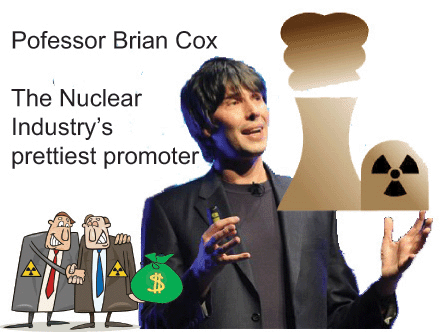
Brian Cox is a very personable and knowledgeable TV star and particle physics expert. He is also a promoter of the nuclear industry. He is a big fan of plutonium -powered space travel.
Currently, Cox is in Cumbria, UK, addressing schoolchildren groups, and revving up enthusiasm for science and technology. All good, yes. He enthuses about the opportunity for top jobs in high tech in Cumbria. Good? Yes, but – where are these future jobs? Well – in the nuclear industry, which is desperately trying to get a new nuclear power station built.
Whitehaven News 29th Sept 2017, Television star Professor Brian Cox says Cumbria has a world-leading industry which warrants talent – but there’s a shortage of scientists and engineers. But he hopes to change that by helping to bring the prestigious Infinity Festival to the area and inspiring hundreds of teenagers to follow their dreams. Professor Cox was the star speaker at today’s festival which was held at West Lakes Academy in Egremont. More than 200 schoolchildren, aged 13 and 14, attended the event from schools across the whole of the county. http://www.whitehavennews.co.uk/news/Professor-Brian-Cox-visits-Egremont-and-declares-Cumbria-is-a-world-leading-high-tech-industry-941aa057-9b77-46a5-8eac-6e92f0341783-ds
The scientist, Professor Brian Cox, has told guests at the opening of a new exhibition in Whitehaven that nuclear power should be an important source of energy in the UK.
Famous scientist argues for ‘stable’ forms of energy, The famous scientist Professor Brian Cox has told guests at the opening of a new exhibition in Whitehaven that nuclear power should be an important source of energy in the UK.
Battling climate change is a once-in-a-century chance to build a fairer and more democratic economy. We can and must design a system in which the polluters pay a very large share of the cost of transitioning away from fossil fuels. And in wealthy countries such as Britain and the US, we need migration policies and levels of international financing that reflect what we owe to the global south, given our historic role in destabilising the economies and ecologies of poorer nations for a great many years, and the vast wealth of empire extracted from these societies in bonded human flesh.
Around the world, winning is a moral imperative for the left. The stakes are too high, and time is too short, to settle for anything less.
A new shock doctrine: in a world of crisis, morality can still win,Guardian, Naomi Klein, 29 Sept 17 Jeremy Corbyn, Bernie Sanders and Podemos in Spain have shown that a bold and decent strategy can be a successful one. That truth should embolden the left.
To take one example, the Caribbean and southern United States are in the midst of an unprecedented hurricane season, pounded by storm after storm. Puerto Rico – hit by Irma, then Maria – is entirely without power and could be for months, its water and communication systems severely compromised. But just as during Hurricane Katrina, the cavalry is missing in action. Donald Trump is too busy trying to get black athletes fired for daring to shine a spotlight on racist violence. A real federal aid package for Puerto Rico has not yet been announced. And the vultures are circling: the business press reports that the only way for Puerto Rico to get the lights back on is to sell off its electricity utility.
This is a phenomenon I’ve called the Shock Doctrine: the exploitation of wrenching crises to smuggle through policies that devour the public sphere and further enrich a small elite. We’ve seen this dismal cycle repeat again and again: after the 2008 financial crash, and now in the UK with the Tories planning to exploit Brexit to push through disastrous pro-corporate trade deals without debate.
Ours is an age when it is impossible to pry one crisis apart from all the others. They have all merged, reinforcing and deepening each other like one shambling, multi-headed beast. The current US president can be thought of in much the same way. ,It’s tough to adequately sum him up. You know that horrible thing currently clogging up the London sewers, the fatberg? Trump is the political equivalent of that. A merger of all that is noxious in the culture, economy and body politic, all kind of glommed together in a self-adhesive mass. And we’re finding it very hard to dislodge.
But moments of crisis do not have to go the Shock Doctrine route: they do not need to become opportunities for the obscenely wealthy to grab still more. They can be moments when we find our best selves……..
In recent months the Labour party has showed us there’s another way. One that speaks the language of decency and fairness, that names the true forces most responsible for this mess, no matter how powerful. And one that is unafraid of some of the ideas we were told were gone for good, such as wealth redistribution, and nationalising essential public services. Thanks to Labour’s boldness, we now know that this isn’t just a moral strategy. It’s a winning strategy. It fires up the base, and it activates constituencies that long ago stopped voting altogether…….
What happened here in Britain is part of a global phenomenon. We saw it in Bernie Sanders’ historic campaign in the US primaries, powered by millennials who know that safe centrist politics offers them no kind of safe future. We see something similar with Spain’s still young Podemos party, which built in the power of mass movements from day one. These electoral campaigns caught fire with stunning speed. And they got close to taking power – closer than any other genuinely transformative political programme has in Europe or North America in my lifetime. But not close enough. So in this time between elections, we need to think about how to make absolutely sure that, next time, all of our movements go all the way………
Battling climate change is a once-in-a-century chance to build a fairer and more democratic economy. We can and must design a system in which the polluters pay a very large share of the cost of transitioning away from fossil fuels. And in wealthy countries such as Britain and the US, we need migration policies and levels of international financing that reflect what we owe to the global south, given our historic role in destabilising the economies and ecologies of poorer nations for a great many years, and the vast wealth of empire extracted from these societies in bonded human flesh.
The more ambitious, consistent and holistic that the Labour party can be in painting a picture of the world transformed, the more credible a Labourgovernment will become.
Around the world, winning is a moral imperative for the left. The stakes are too high, and time is too short, to settle for anything less.
The Federal Government is failing to help. They are talking about extending the life of old, polluting coal-fired power stations; more subsidies and taxpayer assistance to the fossil fuel industry; and pressuring states to frack more gas – an industry that directly competes for prime agricultural land.
They can’t be thinking of our interests. Farmers are the ones already impacted by climate change – look no further than heatwaves and severe rain shortages in parts of the country. We are also dealing with soaring energy costs.
It’s time we used our voice to speed up the change we need. NSW farmer Jim McDonald is a case in point. Infuriated by rural MPs who were spouting anti-renewable energy guff, he started an open letter. More than 2000 farmers around the country have signed on.
As individuals we can get drowned out, but collectively our voice carries weight. If our views are to be heard, however, we must start talking to elected representatives before it’s too late.
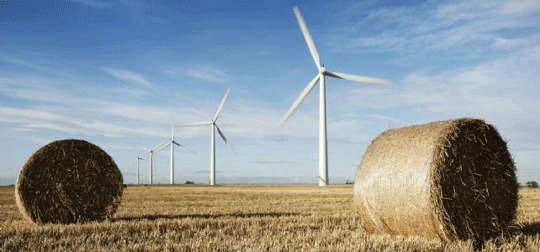
Farmers are looking to renewables and storage to cut their energy costs. If you think that should be encouraged, then speak out. Farmers directly benefit from large-scale renewable projects. Wind turbines alone generate approximately $20 million worth of passive income for us.
Agriculture is one of the most climate-exposed industries in the country. If you think farmers should be supported to cope with what’s happening now, and steps taken to avoid worse impacts into the future – then speak out!
The future of farming won’t be assured without a fight. Add your voice. Verity Morgan-Schmidt is CEO of Farmers for Climate Action
Predicted collapse reignites worker safety concerns at WIPP, Adrian C Hedden, Carlsbad Current-Argus Sept. 29, 2017 Worker safety could yet again become a concern at the Waste Isolation Pilot Plant.
A rock collapse in a portion of the plant’s underground mine where nuclear waste is permanently emplaced is expected in four to six weeks.
The collapse is expected in Room 6 of Panel 7 in the underground, which was off limits to workers for at almost a year before a Thursday announcement by the U.S. Department of Energy of a potential collapse.
Since it was sealed, no ground control measures took place in Room 6………
Rick Fuentes, president of the United Steelworkers Union Local 12-9477, which represents WIPP waste handlers, said the mine is safe for now.
But Fuentes worried that the underground can be unpredictable, and a collapse could occur sooner than expected.
“We’re not going to take any chances,” Fuentes said. “The underground is unpredictable. It could move faster.”……..
“When you deal with mother nature, it’s hard to know what will happen,” Fuentes said. “Day in and day out we have to stay on our A-game to ensure workers are safe.”
When measurements show the ground is unstable or if stability deteriorates at a dangerous rate, Fuentes said all underground activity will cease until conditions become safe.
https://nuclearexhaust.wordpress.com/– 2 Oct 17 For proof of existing technical foresight regarding the accident and failure paths at Fukushima Diiachi, please read “The Menace of Atomic Energy” by Nader and Abbott, Outback Press, Victoria, Australia. Copyright 1977. ISBN 0 86888 0515. Also please see https://nuclearhistory.wordpress.com/2014/01/29/the-eccs-controversey-of-the-1960s-and-1970s-usa-in-the-light-of-march-2011/
Extracted quotations.
“A major factor that contributed to the accident was the widespread assumption in Japan that its nuclear power plants were so safe that an accident of this magnitude was simply unthinkable. This assumption was accepted by nuclear power plant operators and was not challenged by regulators or by the Government. As a result, Japan was not sufficiently prepared for a severe nuclear accident in March 2011. The Fukushima Daiichi accident exposed certain weaknesses in Japan’s regulatory framework. Responsibilities were divided among a number of bodies, and it was not always clear where authority lay. Continue reading →
28 Sept 17, ‘When Four Corners travelled to India to investigate the activities of the giant Adani group, they soon discovered the power of the company.
‘While attempting to film and gather information about Adani’s operations, the Four Corners team had their cameras shut down, their footage deleted and were questioned for hours by police.
‘The team were left in no doubt that their investigations into the Indian company triggered the police action.
‘For months, Four Corners has been digging into the business practices of the Adani Group.
This is the corporate colossus that plans to build Australia’s biggest mine site. … ‘ http://www.abc.net.au/4corners/digging-into-adani/8997202
Daily Mail 28th Sept 2017,On January 27, 2017, the Bulletin of the Atomic Scientists moved the arms of its doomsday clock to 2.5 minutes to midnight – the closest it has been since 1953. Meanwhile, atmospheric carbon dioxide levels now hoverabove 400 parts per million.
Mark Latham urges Australia to “go nuclear” .. (subscribers only) http://www.dailytelegraph.com.au/news/opinion/mark-latham-australia-needs-to-go-nuclear-to-prevent-power-shortages/news-story/2037b5cde469e3c097405ac169a36741
Top investment groups push for action on climate risks, Ft.com 2 Oct 17 by Ed Crooks in New York and Attracta Mooney in London
BlackRock and others demand disclosure at US energy companies, analysis shows
Large investment groups including BlackRock and Vanguard have stepped up pressure on US energy companies to address the risks associated with climate change, despite the Trump administration’s lack of action to address the threat.
An analysis of shareholder votes at this year’s annual meetings showed investors have taken a more active role in pushing for information on climate risks, often voting for improved disclosure against company board recommendations. In votes at seven of the largest US energy companies this year, the 30 largest investors switched their votes to support disclosure on climate risk a total of 38 times, having opposed similar resolutions in 2016, according to ShareAction, a campaign group.
The data came from regulatory filings compiled by Proxy Insight, an information service. The increasingly assertive position taken by large investors had its most significant impacts at ExxonMobil and Occidental Petroleum, two of the largest US oil groups. There was majority support for proposals calling on the companies to publish regular reports on the possible impact on their businesses of policies to address the threat of climate change. In both cases, BlackRock and Vanguard, the world’s two largest fund managers, voted to support the proposals. …….
Edward Kamonjoh, executive director of the 50/50 Climate Project, said he expected investors to seek better explanations from fund managers when they decide not to support climate-related resolutions. “Large fund managers with poor voting records on climate risk can expect public challenges on the dichotomy between their engagement priorities and voting practices,” he said.https://www.ft.com/content/48ad5476-a6aa-11e7-ab55-27219df83c97
‘India’s former environment minister Jairam Ramesh is “absolutely appalled”
by the Australian Government’s approval of the Adani Group’s massive coal mine in North Queensland,
which he says will threaten the survival of the Great Barrier Reef, “a common heritage of mankind”.
‘Mr Ramesh, an elder statesman of India’s opposition Congress Party,
also said the Federal Government and Queensland Government have failed to do adequate due diligence
on Adani Group’s environmental and financial conduct in India before granting environmental approvals and mining licenses. …
‘”You’re giving a tax break to a project that is actually going to have adverse environmental consequences, which will have multiplying effects on weather patterns in the region, across the world. I find it bizarre,” he said. …
Adani coal ‘will be too expensive for Indian market’
‘Australian politicians have argued India needs the coal from Adani’s Carmichael mine
in North Queensland to lift millions of India’s poor out of “energy poverty”.
‘But another respected Indian observer, the former head of India’s Ministry of Power, E.A.S Sarma, dismissed that as false and misguided. …
‘”We cannot afford that, it is so expensive. My assessment is it will not be possible for the Indian market
to absorb Adani coal.” … ‘
The ATSE is the Australian Academy of Technological Sciences and Engineering. There are over 800 Fellows of the ATSE (FTSE).[1] They include the following people:







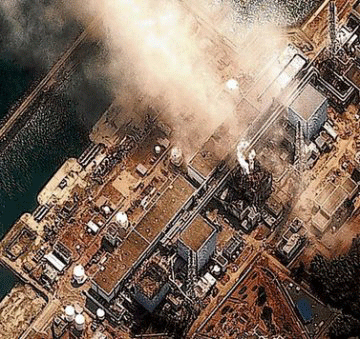 THE FUKUSHIMA DAIICHI ACCIDENT REPORT BY THE DIRECTOR GENERAL IAEA INTERNATIONAL ATOMIC ENERGY AGENCY GC(59)/14



 Antinuclear