Tony Abbott seems to be a very confused person. He certainly is not following the nuclear lobby script – “that nuclear fixes climate change” – hell – Tony doesn’t even believe that climate change, if it exists at all, matters!
He’s supposed to be a Liberal – I thought that Liberals didn’t believe in socialism – that is – governments taking over industries – but he wants to have government run coal power stations (or more correctly government run stranded assets?)
And, poor Tony – is under the illusion that he knows anything at all about science – and that his knowledge is better than that of researchers at Australian National University.
Tony Abbott says nuclear power should be part of Australia’s energy mix THE AUSTRALIAN GREG BROWN, Canberra @gregbrown_TheOz , 5 Oct 17Tony Abbott has called on the Turnbull government to change laws to allow for the construction of nuclear power plants.
The former prime minister said nuclear power should be part of Australia’s energy mix, as well as government-funded coal power plants.
“If we ever do need zero emissions baseload power the only reliable way of getting it is nuclear, currently nuclear is illegal under federal law, well that law should be changed,” Mr Abbott told 2GB radio on Wednesday.
Mr Abbott was critical of a government advertisement played during the AFL and NRL grand finals that mentioned the electricity system was in “transition”……
“If the private sector won’t build new coal fired power stations because of political risk, well then the government must……
“I think people are thoroughly sick of this kind of alarmism,” he said.
“I don’t think we should take this so-called research very seriously and the researcher in question just few months ago was saying that she didn’t think she could have a baby because that would exacerbate climate change.
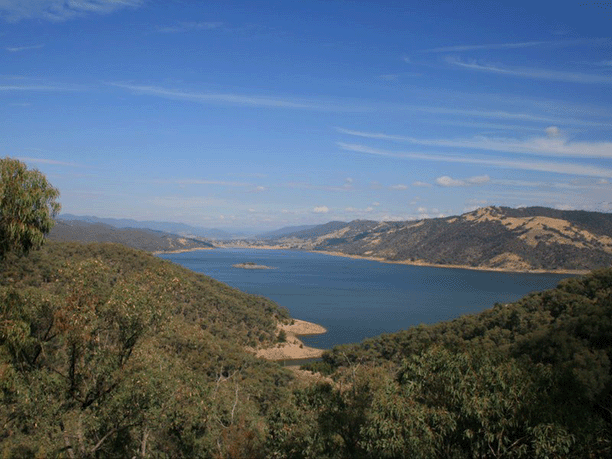
Nuclear debate: Burrinjuck Dam a potential site, Yass Tribune,Louise Thrower and Toby Vue,
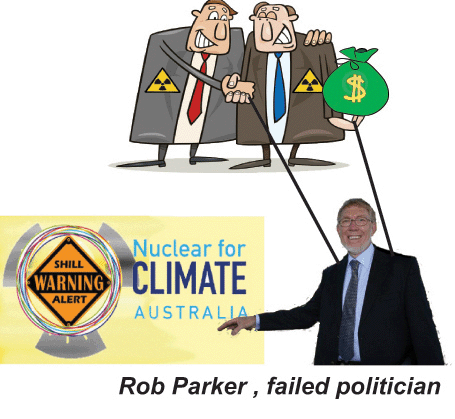
Rob Parker, who coordinates Nuclear for Climate Australia (NCA), argued politicians should not shy away from nuclear energy.
In southern NSW, NCA has identified Marulan, Burrinjuck and the Shoalhaven as three of 18 potential sites for nuclear reactors, envisaged to be constructed by 2040 and provide 140.9 terawatts of energy annually.
Mr Parker ran unsuccessfully as a Labor candidate for Goulburn in 2007 and as an independent in 2011. But he says his views are not political, other than to shatter notions………
Burrinjuck Dam cited for nuclear reactor
Mr Parker argued that nuclear energy needed to be 80 per cent of the mix due to climate change. He said the best locations were those near water, rail and the transmission grid.
“Yass has a high viability because of the dam. It also has a good grid connection and good geology,” he said.
NCA proposes that cooling in Burrinjuck would be a hybrid wet-dry process, with water being drawn from Burrinjuck Dam to a storage reservoir at the power station.
However, Ms Goward said “those of us who live here would recall the last serious drought, when the levels of the Burrinjuck Dam were dangerously low”.
“I do not believe the community nor this government would support the use of Burrinjuck Dam as part of a nuclear facility,” she said.
Mr Parker believed Mr Barilaro was raising the possibility of smaller modular reactors being developed across more sites, which did not involve significantly opening up the grid or a large water supply.
New Zealand Educates Youth on Nuclear Disarmament, https://www3.nhk.or.jp/nhkworld/en/news/editors/5/nzeducatesyouthonnucleardisarmament/index.html– Hiromi Kurosaka 5 Oct 17 , New Zealand is a staunch advocate of abolishing nuclear arms. Its policy coalesced in the 80s after strong opposition. And as a new generation grows up, the country is still committed to educating them about the horrors of nuclear weapons.
A commemoration of the victims of the atomic bombing of Hiroshima takes place annually in staunchly anti-nuclear New Zealand. The country adopted an anti-nuclear policy decades ago. Opposition had grown over the years as France repeatedly tested its nuclear weapons in the region’s waters. New Zealand’s policy bans the country from possessing nuclear arms or bringing them into its territory. Nuclear power isn’t used in the country either.
This year marks the 30th anniversary of the policy. A school focusing on teaching students the importance of disarmament invited survivors of the atomic bombing of Hiroshima to recount their painful experiences.
15-year-old Yasmin Clements-Levi, who heard the accounts of survivors for the first time, said “I’m really glad that I learned now, really exactly what they’ve gone through and how it affects them to this day.”
The school held a debate to help students think more deeply about the issue. Some of the students were against nuclear weapons. “It’s just horrible — the fact that so many people can die. It’s generally not worth it to have them in the world at all.” “If a terrorist group like ISIS were to get nukes, they could cause infinite destruction.”
Others maintained that they’re necessary. “If you talk about the ethical issue of having nuclear weapons, the possibility could be considered a good thing because it stops any war from escalating,” said a student.
Yasmin also gave her opinion: “The fact is that as long as we keep them, the higher the chance will be that we will have a nuclear war.”
The teacher says the point wasn’t to reach a conclusion, but to expose students to a range of opinions to get them thinking about nuclear weapons. “I think it’s absolutely vital as Kiwis that — of course they can form their own opinions — but to make them aware of the consequences that nuclear weapons can have, and that New Zealand must stay nuclear-free,” she says.
“I’d like to see this young generation coming together again in the future to actually take an action, now to get rid of the nuclear weapons,” Yasmin says.
30 years may have passed since New Zealand’s policy began, but support for it still remains strong. New Zealanders are passing it down to make sure the idea never fades away.
The reason for the unusually high radiation is that the animal lived in fields which are still affected by fallout from the nuclear disaster in Chernobyl, 31 years ago.
After the explosion at the reactor in what is now Ukraine, much of Sweden was covered in a toxic cloud of radioactive iodine and cesium-137. When the rain came, the area around Gävle in the centre-east of the country took the brunt of the radioactive pollution.
But while levels of radiation in animals such as elk and reindeer have been continually decreasing, wild boar have now begun to move north into the areas worst affected by the nuclear fallout – meaning the level of radiation among the boar population seems to be on the rise.
One boar shot in August had a radiation of 13,000 becquerel per kilogram (Bq/kg), whereas the limit set by Sweden’s Food Agency (Livsmedelsverket) for safe consumption is 1,500 Bq/kg.
And another boar, which was shot a while ago but was kept in freezer storage, has just had its radiation level measured at 16,000 Bg/kg, or in other words, more than ten times the safe limit. That animal was killed in Tärnsjö, located between Uppsala and Gävle.
“This is the highest level we’ve measured,” Ulf Frykman, an environmental consultant who tests radiation levels in game meat, told SVT.
Frykman said his team had measured around 30 samples of meat so far this year, and found that only five or six of those were below the safe limit.. The animals themselves rarely suffer any negative health effects from the radiation due to their short life spans, but people who consume meat with high radiation levels face an increased risk, albeit still a small one, of developing cancer.
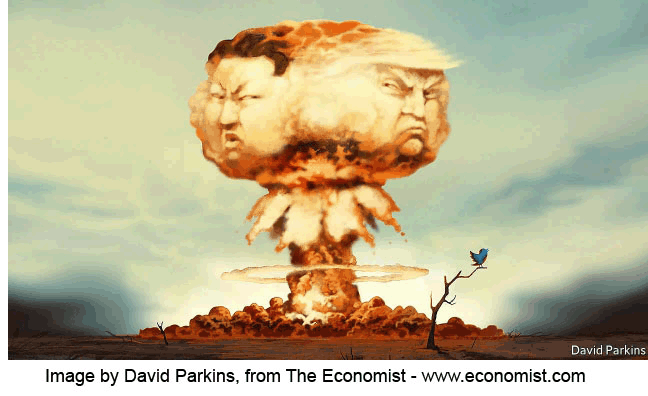
The evolving tragedy that is North Korea is now at the mercy of a mere miscalculation, or accident, an isolated piece of stupidity, or a Trump shot from the hip – even just a piece of an intercontinental ballistic missile (ICBM) dropping on Japan.
This vicarious situation necessitates Australia adopting a strong, independent, foreign policy stance on this challenge, in our national interest. The inflammatory rhetoric from both Trump and Kim Jong-un seems to have no limit, but achieves very little, except more missiles and tests from Pyongyang, and more threats of military options/retaliation from the US.
Sanctions are important, especially now they have been given greater grunt by China, but they will take many months to be fully effective. Clearly, military engagement would be catastrophic, so every effort should be made to foster effective diplomatic engagement and, ultimately, hopefully, negotiation. Obviously, the major powers, the US, China, Russia and Japan, would be fundamental to any effective resolution.
In this context, Australia needs to consider what more we can do, if anything, as a middle-ranking power, but capable, at times, of punching above our weight, especially from the point of view of our national interests.
I fear that we are far too embedded in the US position, and where it may go. I am concerned that our political leadership is simply happy to be subservient to the US, leaving them, Trump, to define us. Yet, we could play a more significant role, diplomatically, in attempting to manage the emerging crisis.
In attempting to understand and strategise on how events might unfold, we would have to contemplate the possibility, even if we gave it a low probability, that an effective target for North Korean aggression could be Pine Gap – it would not kill many of us, but would represent a very significant blow to US intelligence capability.
To be absolutely clear, despite all the US bluster, I sincerely doubt that Pyongyang will ever be the aggressor, would ever initiate a war. Apparently, China has told the North Koreans that they will only come to their defence if they are attacked, but not if they are the aggressor. But have no doubt, the nuclear tests, and rocket launches, will continue, with rockets directed towards say Guam, but to land outside their territorial waters.
The point is that we need to look after our own interests, and position ourselves most effectively, from that perspective. In these terms, we could announce a desire to establish an embassy in Pyongyang, with a view to opening and developing a dialogue, perhaps, ultimately leading to a resumption of the Six Party talks.
Other back channels could also be exploited. For example, I was somewhat surprised that our Foreign Minister, Julie Bishop, didn’t create the opportunity to meet with her North Korean counterpart at the recent UN meetings. Australia could also play a significant role in co-ordinating the responses of many of our Asian neighbours, from sanctions to missile interception and defence capabilities.
We presently run our “diplomacy” with North Korea, with a non-resident ambassador, based in Seoul, making trips up North. This would surely be insulting to the North Koreans, and easily dispensed with as just another “branch of the US”. It doesn’t begin to give Pyongyang the global recognition that it so desperately craves.
We need to be seen to be able to stand on our own two feet, and we might be surprised at just how much influence we could achieve.
Despite all the sabre rattling and inflammatory rhetoric, the world needs a diplomatic solution on North Korea. Sanctions may ultimately force Pyongyang to the negotiating table, but there will be no alternative to face-to-face, hard-headed negotiations that, surely, must initially accept North Korea as an emerging nuclear power, and then focus on deterrence. Think about it from their point of view. The world seems to happily accept countries such as India, Pakistan, and Israel, as nuclear powers, but where is the balance of risks? These are risks that we don’t want to talk about, while at the same time saying that North Korea is a “clear and present danger”.
The government needs to be prepared to discuss publicly its assessment of the North Korean situation. I really don’t understand why we don’t use the processes of Parliament, and encourage a parliamentary debate, leading to a broader debate across civil society.
All too often, the way government has worked in this country is that government closes down debate on an issue, calls all the shots, and, in the end, we drift into a situation that is not necessarily in our national interest. Recall the futility of Howard’s sycophantic support of Bush junior in the Iraq war. We never should have been involved.
On North Korea, we are again letting the issue drift, driven by the possible irrationality of the US. We will end up where, in our national interest, we won’t want to be. Yet, we could play a globally significant role in resolving the matter.
John Hewson is a professor at the Crawford School of Public Policy and a former leader of the Liberal Party.
Rick Perry’s new coal subsidy could wreck America’s power markets, The Hill, BY HAL HARVEY, — 10/05/17 When old, established industries are threatened by new, better technologies, they often go running to Washington for special protections. It is an old practice, generally taxing the common good for private interests. Unfortunately, the U.S. Department of Energy has set a new record for gall in this practice in a fairly stunning move that would impose a new tax on electricity consumers and roil America’s power markets for years to come.
Here’s the story: Renewable energy — especially wind and solar — has plummeted in price. Today a new wind farm, for example, is often cheaper than just the operating costs of an old coal power plant. Cheap natural gas creates additional price threats to existing coal or nuclear. And these favorable economics for renewables and gas don’t even count the public benefits they create through clean air, reduced greenhouse gas emissions and avoided fuel price spikes.
This transition motivated DOE’s recent study of grid reliability, after coal and nuclear owners warned that closing their plants and adding renewables would cause blackouts. It turns out, though, even DOE’s study found this wasn’t the case, and that clean energy works just fine on our grid.
So, across the country, in power grids where economic dispatch reigns, renewables are booming, and coal plants are shutting down. This is not a “war on coal” nor is this reality susceptible to change through political pro-coal statements. It is free-market economics, plain and simple.
What can the owners of these old power plants do? They posit changing the rules, so instead of simply being paid for electricity, they get paid for “other attributes” as well, including a novel term among utilities, “fuel-secure power plants.” The idea is that having a pile of coal next to your uneconomical power plant should be richly rewarded, bringing your 1970s technology back into the black.
At first blush, this may seem sensible. Surely having a deep inventory of on-site fuel, be it a pile of coal, nuclear fuel or water behind the dam benefits the grid? Well, it turns out that reliable power is better delivered by a diversity of sources, rather than a few huge power plants. It also turns out that wind, for example, is often more reliable than coal. ……..
Energy Secretary Rick Perry has ignored this evidence, and proposed a rule to the Federal Energy Regulatory Commission to subsidize the oldest power plants on the grid. His request is anti-innovation, anti-economy, and anti-environment. It is a wholesale repudiation of the free market. And it flatly contradicts Texas’ experience………
Can We Save the Reef? #Catalyst #Science #StopAdani #ClimateChange
Off Australia’s northeast coast lies a wonder of the world; a living structure so big it can be seen from space, more intricate and complex than any city, and so diverse it hosts a third of all fish species in Australia. John Pratt 3 Oct 17
The Great Barrier Reef as we know it — 8,000 years old and home to thousands of marine species — is dying in our lifetime.
Can We Save the Reef?
The epic story of Australian and international scientists who are racing to understand our greatest natural wonder, and employing bold new science to save it. VisitJohn,
New research shows disastrous outcomes for nearby US allies if North Korea strikes
SEOUL • As United States President Donald Trump threatens to destroy North Korea, even some of his closest aides have warned of the potentially disastrous effects of a war.
New research published on the 38 North website points to just how catastrophic the impact might be on the regime’s neighbours.
If North Korean leader Kim Jong Un were to launch a nuclear attack on Seoul and Tokyo – both within striking distance of his weapons – as many as 2.1 million people could die and another 7.7 million could be injured, according to the 38 North report.
The analysis by Mr Michael Zagurek Jr, a consultant specialising in databases and computer modelling, is based on North Korea’s current estimated weapons technology and bomb strength.
Mr Zagurek assumes that Mr Kim has a baseline arsenal of 20 to 25 warheads and the capacity to put them on ballistic missiles.
Concerns about a nuclear conflict in North Asia have increased as Mr Kim accelerates his programme of acquiring weapons capable of hitting continental US, and as Mr Trump threatens preemptive military action.
While the chance of a direct attack on US allies Japan and South Korea remains slim, Mr Zagurek said history was replete with miscalculation by “rational actors” during crisis situations.
North Korean Foreign Minister Ri Yong Ho last month said the regime’s possible next steps include testing a hydrogen bomb over the Pacific Ocean.
According to Mr Zagurek, it is possible that another nuclear test, an intercontinental ballistic missile test, or a missile test that has the payload impact area too close to US bases in Guam might see Washington react with force.
US options could include attempting to shoot down the test missiles or possibly attacking the North’s missile testing, nuclear-related sites, missile deployment areas or the Kim regime itself. In turn, the North Korean leadership might perceive such an attack as an attempt to remove the Kim family from power and, as a result, could retaliate with nuclear weapons, he added.
North Korea’s older warheads have yields in the 15-25-kilotonne range, around the size of the bombs that devastated Hiroshima and Nagasaki in 1945.
Fatality estimates rise significantly if North Korea were able to strike with bombs similar to the one it tested on Sept 3, which had a likely yield of 108-205 kilotonnes, Mr Zagurek said.
Australia adds 97MW rooftop solar in September, set for record 1GW in 2017
Australia maintains strong pace of rooftop solar installations in September, and is now set to break through the 1GW annual instal milestone for the first time in 2017.
CS Energy signs 10 year agreement with Kennedy Energy Park
Another page in Queensland’s renewable energy boom story has been turned with Queensland Government-Owned generator – CS Energy – entering a 10 year-agreement with the 60 megawatt Kennedy Energy Park.
Stunning new low for solar PV as even IEA hails “age of solar”
Saudi solar tender attracts stunning low bid of $US17.9/MWh, as even the conservative IEA hails a “new era of solar.” And while Australia currently enjoys an investment boom, a new report by Climate Council says “politics” is the only major barrier to a high penetration renewable grid.
In energy and transportation, stick it to the orthodoxy!
At most, the current orthodoxy – despite its renewable energy, electric vehicles and energy efficiency – will result in flat or gently declining emissions. It’s time to stick it up the orthodoxy!
US plan to defibrillate failing coal plants is part of a global trend
Rick Perry’s plan to require increased payments to some coal plants is part of a global trend as the coal lobby desperately tries to rescue failing coal plants.
Many utilities believe cyberattacks could bring down the electric distribution grid
Coupled with anticipated risk to employee and customer safety and physical assets, unprepared distribution utilities must act now to improve cybersecurity capabilities.
Utilities scramble to catch up with stunning fall in renewable energy costs
While it may take decades yet for renewables to become the dominant form of generation globally, their presence today is permanent, economically rational and their advance inevitable.
Greens push 20GW energy storage target to shift debate from baseload
Greens unveil plan for 20GW of energy storage by 2030, providing incentives for storage at household and grid level, and try to move the energy debate beyond the limited scope of baseload vs renewables.
ARENA, CEFC back plan to recycle EV-batteries for household storage
A Melbourne company that has found a way to recycle EV batteries for use in household and grid-scale storage gets some money from Turnbull’s innovation fund.
Renewable energy markets un-moved by bizarre push for coal
Once upon a time political divisions on energy policy would have had a significant impact on the renewable energy market. This time, however, it has been largely ignored.
Investec Australia supports Australian green energy sector
Investec Australia Limited’s Infrastructure Finance & Investment team has added to its local funding of green energy by helping a UK developer of solar projects expand in Australia.










 Antinuclear