20 October – latest REneweconomy news
 RenewEconomy
-
Graph of the Day: What we need, what we’re gettingHow Turnbull’s National Energy Target will be worse for the renewable energy sector than no policy at all.
-
BYD hones focus on Australia home battery marketChinese battery and EV giant is ramping up its presence in Australia’s home energy storage market with its modular B-Box battery offering.
-
The NEG will reduce competition, and that’s not good for pricesIt seems like the government’s plan may reduce competition, and that is never good for price in the long run. One of the many advantages of state run reverse auctions is they introduce new suppliers and new players into the system.
-
Coalition energy target may require a “go slow” on rooftop solarEnergy Security Board forecasts suggest a sharp slow down in rooftop solar deployments to meet its modest renewable energy share. It comes as concerns grow about ESB process and the alacrity with which the normally snail-paced AEMC has moved to confer great powers upon itself.
-
Construction of Kennedy Energy Park underway, as CEFC tips in another $94mWork to begin on first 60MW of 1200MW Kennedy Energy Park, after the wind, solar, and battery storage project in north Queensland received another $94m from the Clean Energy Finance Corporation, and an $18m grant from ARENA.
-
Coalition’s energy policy hinges on tricky wordplay about coal’s roleThe new policy could end up feeding demand for coal.
-
JinkoSolar p-type multi-crystalline silicon solar cells achieve new world record in conversion efficiency againJinkoSolar Holding Co today announced that its practical sized P-type multi-crystalline silicon solar cells reached the world’s highest conversion efficiency of 22.04%
-
Lights Out! The dark side of demand managementSelf serving and misleading comments from CEO of one of the country’s iconic energy businesses need to be held up as a shining example of how recent energy summit forgot about one key person: the customer.
Rising soil temperatures cause release of carbon, increasing climate change
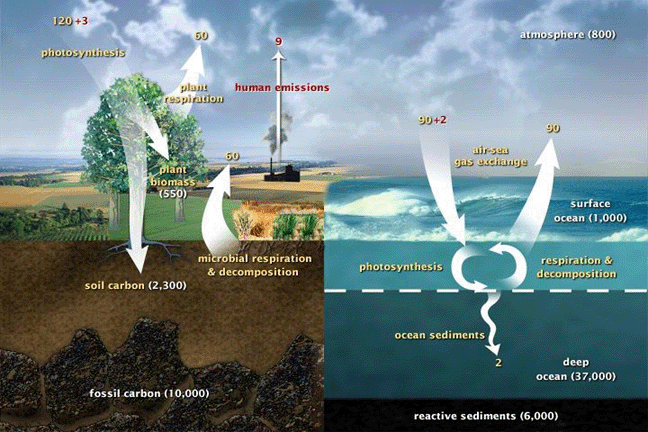
Warming soils release carbon to further accelerate climate change, Independent Australia Climate News Network 26-year study find rising temperatures could cause soils to release carbon on a scale with the potential to accelerate climate change even further. Tim Radford reports.
As the world’s soils warm, they may surrender potentially dangerous amounts of carbon to the atmosphere. Rising temperatures could mean rising levels of carbon dioxide respired by the microbes underfoot.
The world’s longest-running soil-warming experiments deliver no easy assurances forests will continue to absorb atmospheric carbon that pours from vehicle exhausts, power stations and factory chimneys as humans burn fossil fuels, raise greenhouse gas levels and send the planetary thermometer ever higher.
The conclusion is based on a set of experiments described in the journal, Science.
Carbon budget
Since 1991, researchers have been measuring the soil carbon traffic in Harvard Forest, Massachusetts, in the United States. In this forest are sets of plots six metres square. Some are left wild. Some have electric cables dug into the soil to deliver 5°C warmth of the kind that might be expected later this century. Some have soil disturbed but not warmed. Researchers tried every combination and compared the soil carbon loss over time.
They measured phases of substantial carbon loss from the warmed soils, alternating with phases of no detectable loss. That is: they measured soil carbon loss to the atmosphere, and stasis, but never observed evidence that warmed soils might store carbon more efficiently. Altogether, the warmed soils lost 17% more of the carbon stored in the top 60 centimetres than unheated soils.
“We know that microbial soil respiration is a major, and natural, source of greenhouse gases to the atmosphere. Using the long-term warming experiment as a window into future climate change, we see that warming has a profound but discontinuous effect on greenhouse gas emissions,” says one of the authors, Kristen DeAngelis, assistant professor of microbiology at the University of Massachusetts at Amherst.
The carbon budget – the flow of carbon into and from the atmosphere – is at the heart of all climate change forecasting. ……. https://independentaustralia.net/environment/environment-display/warming-soils-release-carbon-to-further-accelerate-climate-change,10837
Turnbull’s National Energy Guarantee works against battery energy storage
Battery storage proponents despondent about future under National Energy Guarantee, http://www.abc.net.au/news/rural/2017-10-19/concern-energy-policy-will-stymie-growth-in-battery-storage/9061948, ABC Rural, By Babs McHugh, Some in the fledgling tech-metals mining and processing industry are dismayed that the Federal Government’s new energy policy does not appear to support renewable energy storage such as batteries.
Australian Vanadium chief executive Vincent Algar said the National Energy Guarantee (NEG) unfairly pitted the batteries and renewable energy storage sector against fossil fuel electricity producers such as oil and gas.
“With coal and gas considered a dispatchable energy source under the NEG, what incentive will there be to source dispatchable energy from a battery?” he said.
Dispatchable power can be turned on and off and used immediately as needed.
The NEG will mandate that energy retailers need to buy a certain amount of energy from dispatchable sources, which include coal, gas, and pumped hydroelectricity storage.
Lower cost makes coal and gas more attractive
Mr Algar, whose company will mine and process vanadium, as well as promote vanadium battery technology, believes pure economics dictates that energy retailers will go to the much cheaper coal and gas producers.
“If a company is building a renewable energy project, what incentive will there be for them to put that dispatchable energy in the form of a battery?” he said.
“On top of that is the removal of subsidies for renewable energy, and no clean energy target, so it further reduces any incentives.
Mr Algar is also concerned the NEG will bring to a halt the research and development of advanced renewable energy and battery technologies.
“Australia has the runs on the board. It has invented things like the flow battery [which uses vanadium], and they’re doing brilliant work in eastern states that will improve the efficiency of solar panels, for example,” he said.
“These are developments that will generate jobs and make us a net exporter of renewable technology, but this policy could really put a dampener on that.”
FACT CHECK: Did Hillary Clinton Tell FBI’s Mueller to Deliver Uranium to Russians in 2009 ‘Secret Tarmac Meeting’?
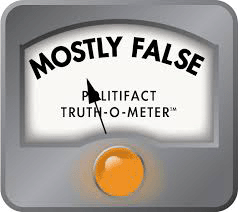 Did Hillary Clinton Tell FBI’s Mueller to Deliver Uranium to Russians in 2009 ‘Secret Tarmac Meeting’? Snopes, 19 October 17,
Hyperpartisan web sites mischaracterized a State Department cable alerting the U.S. Embassy in Russia of a transfer of criminal evidence obtained in a sting operation.
CLAIM: Then-Secretary of State Clinton ordered then-FBI Director Robert Mueller to deliver highly enriched uranium to the Russians in a secret plane-side meeting in 2009.
WHAT’S FALSE: There was nothing nefarious in the transfer of the ten-gram sample, which was done at the request of Russian law enforcement and with the consent of the government of Georgia, whose agents had participated in its confiscation.
Does Western Australia need its own renewables target?
National Energy Plan: Does WA need its own renewables target?, ABC, By Nicolas Perpitch, 19 Oct 17 The Federal Government’s flagship new energy plan was signed off by the Coalition partyroom this week with great fanfare — but there’s growing uncertainty about what it means for WA.
The McGowan Government has not yet received a briefing on the national energy guarantee (NEG) policy, which is designed to operate through the National Energy Market.
WA is not a part of this market.
The new policy will see the Clean Energy Target and subsidies for renewables cut in 2020, and Prime Minister Malcolm Turnbull says there will be an opportunity to import the principles of the new system into the WA market.
While the general consensus — including from Energy Minister Ben Wyatt — is that there will be no immediate impact on WA, some in the state’s energy sector are concerned.
Solar ‘may still need boost’
Solar panel distributor and managing director of BayWA Renewable Energy Durmus Yildiz said the Government had not considered whether the fledgling solar industry was able to compete with other providers………
Energy Minister Ben Wyatt has already flagged the possibility of WA following other states and setting its own renewable energy target (RET) once the Clean Energy Target is cut.
Sustainability Energy Now WA chairman Ian Porter said such a move would provide certainty to the market.
“It provides an indication to investors that their policies are favourable to ‘x’ amount of generation being put into the system via renewables,” Mr Porter said. “It provides certainty. Investors want certainty. People know then the target is set and they can bid for it.”
Murdoch University Engineering and Information Technology School lecturer Tania Urmee said it would replace lost federal incentives.
“The cost of renewable energy technology is going down, so if the states have their own policy and their own trigger for renewable energy, that will be really good,” Dr Urmee said.
“And I think that keeps (investment) going.”…….http://www.abc.net.au/news/2017-10-19/energy-reform-explainer-how-will-it-affect-wa/9065974
Why the High Court shut down Tassie’s anti-protest laws in Bob Brown case
Michael Bradley
The High Court has given judgment in Bob Brown’s case against Tasmanian anti-protest laws, and found the laws invalid on the basis they infringe the implied constitutional freedom of political communication….. (subscribers only )
https://www.crikey.com.au/2017/10/19/high-court-shuts-down-tassies-anti-protest-laws-in-bob-brown-case/
20 October Reneweconomy News
RenewEconomy-
-
Why Turnbull’s plan could be disaster for renewables, climate, pricesNEG appears to be the most ill-considered, poorly detailed and potentially useless policy that anyone can remember, and a disaster for renewable energy, climate targets and consumer prices. It appears to be the work of Australia’s so-called “energy mafia”, hungry to retain power of incumbent oligopoly.
-
It’s the end, not the means that countAmongst all the sound and fury regarding the Government’s energy plan there is a central question going unanswered – what is the level of emissions reduction being proposed by the Government? And at what cost?
-
The no-name policy with little chance of reducing power pricesThe runway to strong emission reductions at an affordable price is at risk of being thrown away under the Coaliton’s new policy, which could require retailers to buy the output from its own expensive Snowy Hydro project. The energy mafia would approve.
-
States gobsmacked by lack of detail, research in Turnbull’s NEGStates stunned by lack of detail in new energy policy. In a testy phone hook-up they were told all the government had was a press release and an eight-page letter.
China set to add 50GW new solar PV in 2017China has installed 42GW of new solar PV in 2017 so far, putting it on track to reach a record 50GW for the year. Meanwhile, in battery storage…The NEG: A carbon price by any other nameAssuming it is implemented, the Turnbull government’s National Energy Guarantee will in effect establish a de facto price on carbon emissions from the power sector.Replacing the Clean Energy Target with a dirty one?The decision to walk away from a Clean Energy Target makes no sense. But small communities will forge ahead with the transition to renewable energy. -
Pneumonia Dangers the Elderly Face
Lucy Wyndham
According to the Lung Foundation of Australia, the number of Australians between the ages 50 and 80-years-old infected with the pneumonia virus rises every year. It’s currently at around 200 per 100,000. Many older Australians don’t realise how urgent it is to get the appropriate vaccinations to protect them from this possibly fatal infection.
Equally concerning is that the elderly often won’t develop the same symptoms as younger people who get pneumonia; their bodies are ill-equipped to handle the infection and it will take longer for them to get over the infection than it does for younger people. Read on to discover how pneumonia affects the elderly in more detail.
What is Pneumonia?
Several types of lung infections caused by malignant organisms can cause pneumonia. Your lungs process nitrogen, oxygen and other nutritive gasses for your body to use. When your lungs are compromised, several other areas of your health are compromised as well.
In addition, the viruses and bacteria that cause pneumonia are contagious. However, not everyone exposed to a pneumonia causing bacteria or virus will get pneumonia. Healthy people or those who’ve been properly immunised typically won’t get pneumonia.
- Bronchial/Lobular pneumonia is an inflammation of the bronchi,
- Lobar pneumonia is an infection of the lung lobes, and
- Double pneumonia is an infection present in both lungs.
The Symptoms of Pneumonia and the Elderly
Typical symptoms of pneumonia include a rattling, phlegmy cough; shaking; the chills; feeling a worst flu after an initial cold or flu; a fever of over 102 degrees; shortness of breath and other breathing issues; chest pain; nausea; diarrhea and vomiting.
However, elderly people typically won’t experience a fever. Many of them experience low body temperature as a sign of pneumonia infection. They will also begin to behave differently, experiencing altered mental states. Many will start to appear unaware of their surroundings.
Changes in the Body
As the human body ages, the systems begin to breakdown. Many senior citizens have multiple chronic diseases making their immune systems weaker. The body also experiences physiological changes like:
- Weakening of the respiratory muscles and cough reflexes,
- Loss of lung elasticity, and
- Decrease in mucociliary clearance, (the coughing mechanism and the bronchial cilia aren’t strong enough to move viruses and bacteria out of the lungs).
What Healing Looks Like
When it comes to healing, it takes longer for elderly people to recover from a pneumonia infection (6 to 8 weeks) than it does for younger people, (2 to 3 weeks). The symptoms are also more severe for older people because their systems are weaker. If you have older people in your life, it’s crucial to keep them immunised and give them access to ongoing medical care to increase their chances of avoiding pneumonia infection.
1 This month

of the week – Australians for War Powers Reform (AWPR)
To see nuclear-related stories in greater depth and intensity
 Antinuclear