With breathtaking hypocrisy, Cory Bernardi puts the case for thorium nuclear power. He implies that nuclear power needs no government funding. He implies that thorium power is not nuclear. Thorium power requires plutonium or enriched uranium, to quickly transform thorium 232 into uranium 233 – then nuclear fission occurs just as with conventional nuclear reactors. But worse, as plutonium or enriched uranium, or both, are also used.
CONSERVATIVE senator Cory Bernardi has weighed into the power debate, calling on leaders to ‘open their minds’ to an alternative solution. Staff writer, AAP News Corp Australia Network OCTOBER 22, 2017 CONSERVATIVE senator Cory Bernardi has weighed into the power crisis debate, calling the Turnbull government’s approach a “baby step in the right direction”.
In an interview with Sky News, Senator Bernardi said building a nuclear power station or a coal-fired station would be competitive when the government was spending $3 billion on renewables “that aren’t working for us at night or when the wind isn’t blowing”.
“The only way you’re going to solve this energy crisis is to get government completely out of it and to say, ‘If you’re going to build a power station, we’re going to give you contractual certainty that the conditions upon which you build it today will remain for the life of that power station’,” he said.
“They have to open their minds to nuclear power or a thorium power station because that can solve the emissions crisis if you believe that’s important but it can also provide competitive base-load power for our country.”
…..Conservative senator Cory Bernardi said what the Turnbull government was proposing was a “baby step in the right direction”.
“Saving $100 in ten years time is neither here nor there,” he told Sky News.
“We need absolutely to provide certainty for our business community in this country.”
Adani and the loggers should watch out – we have a right to peaceful protest to protect our environment, The high court has drawn a line in the sand against laws which burden the right of Australians to peaceful protest.
The court made no judgement on Tasmanian premier Will Hodgman’s decision to flatten the Lapoinya state forest in northwest Tasmania against the wishes of the local community. But it struck down his Workplaces (Protection from Protesters) Act 2014 aimed at stopping people from protesting effectively against such forests being logged.
Lapoinya is a huddle of farms southwest of the Bass Strait city of Burnie. Its rolling hills have a patchwork of lush pastures, ploughed fields and copses of trees. At the heart of the district was the Lapoinya forest, a couple of hundred hectares of wildlife-filled rainforest, eucalypts and ferneries with the crystal-clear Maynes Creek, a key nursery for the world’s largest freshwater crayfish, running through it.
When Forestry Tasmania revealed plans for the forest to be clearfelled for the distant wood-processing factory owned by Malaysian logging company Ta Ann, the people of Lapoinya remained confident that common sense would prevail. They called on the state government to intervene and ran a colourful but respectful public campaign to prevent the logging.
Neither the premier nor his minister for forests visited or intervened. Instead, draconian anti-protest laws were enacted and by early 2016 the logging was imminent.
I was invited to a dinner by the community and afterwards treated to a concert by talented local youngsters, with songs devoted to forests. The Lapoinyan dilemma was excruciating: these good people would never be violent or attack logging machinery, but would not be silenced as a distant and indifferent administration in Hobart destroyed their iconic forest.
The locals prepared for a peaceful stand. If the public could see how beautiful the Lapoinya forest was then surely, even at this eleventh hour, the resulting political pressure would cause the government to back off.
The bulldozers and chainsaws arrived in January 2016, with a cavalcade of police.
While premier Hodgman assured Tasmanians his new laws were aimed at “radical” environmentalists and not “mums and dads”, the first two people arrested were a grandfather and a mother of two. That mother, also a neurosurgery nurse, was Jessica Hoyt. Her parents, Stewart and Barbara, have a farm adjoining the forest. In her teenage years Jessica, along with her siblings, had enjoyed riding along the forest’s bridle trail. The two were charged and faced first-offence fines of $10,000.
The next day, reeling from the destruction, Jessica took friends back into the doomed forest. She was arrested again while walking through the trees and ferns. This second arrest put her in danger of being jailed for four years.
A few days later, along with several others, I was also arrested after going back to Lapoinya to make video clips, intended for public distribution, about the sheer bloody-mindedness of the government’s operation. I was standing in an adjacent forest reserve. A bulldozer had backed off and the screech of the chainsaws and roaring thud of the trees coming down was close and confronting.
The incongruity of laws stifling such a reasonable protest against the destruction of the public commons, in a democracy with a long history of advancement through peaceful protest, was compelling. This was underscored when, after our arrests, I received a number of messages from experienced legal experts from around Australia suggesting the laws breached the constitution’s implied right to freedom of political expression.
Guided by Hobart solicitor Roland Browne and joined as co-plaintiff by Jessica, I engaged Melbourne barrister Ron Merkel QC to challenge the constitutional validity of the Hodgman laws in the high court. A public appeal by my foundation raised more than $100,000 to affray the costs, especially in case we lost.
On Wednesday the high court ruled that those laws do infringe the freedom to peaceful protest inherent in the Australian constitution.
“It is necessary to keep firmly in mind that the implied freedom is essential to the maintenance of the system of representative and responsible government for which the Constitution provides. The implied freedom protects the free expression of political opinion, including peaceful protest, which is indispensable to the exercise of political sovereignty,” they said. by the people of the commonwealth. It operates as a limit on the exercise of legislative power to impede that freedom of expression.”
The Hodgman government had breached the limit of legislative power. Tasmania already had the usual array of laws to prevent dangerous or damaging behaviour. It also had a Forest Management Act which, besides guaranteeing the public its time-honoured access to the forests, empowers the police to arrest people who interfere with logging operations. The draconian new laws were not necessary for that purpose. They were designed to stymie effective environmental protests, like that at Lapoinya, which could draw public support and be politically embarrassing. The high court found the laws out, noting the deterrent effect on peaceful protest of their provisions: “The combined effect … can bring the protest of an entire group of persons to a halt and its effect will extend over time. Protesters will be deterred from returning to areas around forest operations for days and even months. During this time the operations about which they seek to protest will continue but their voices will not be heard.” It is for premier Hodgman, a lawyer, to say; but just as he did not see the unconstitutionality of these laws, so I doubt he was their origin.
It should be a warning to the other environmental wreckers.
We are in a world of gross, rapid and escalating environmental damage. Corporations profiting from exploiting non-renewable resources face growing public scrutiny and antipathy.
They cannot win the argument for wrecking ecosystems, so their alternative is to wreck environmentalists. Elsewhere in the world, scores of environmentalists are being killed each year by rampaging profiteers. But Australia is a peaceful democracy and the effective option is to lobby weak governments to clamp down on protests.
The high court’s decision does not directly affect laws in states or territories other than Tasmania. But it draws that line in the sand and will be a benchmark for more challenges if other governments pass laws to protect environmental destruction from peaceful public reaction. More widely, it bolsters that right for people standing up for any good cause.
There are growing calls for governments, already falling over themselves to grant concessions to the coral-killing Adani coalmine proposal in Queensland, to enact more draconian anti-protest laws than those already in place. The extreme right voices making those calls had better go read this judgment for democracy.
The Lapoinya forest was razed, but it has proved to be a pyrrhic victory for the destroyers. Out of the peaceful but heartfelt stand of the handful of people in Lapoinya has come a high court ruling upholding the right to peaceful protest for every Australian
“The problem with the Australian government’s position is that it’s two-face, it’s totally hypocritical,” Dr Wareham said. She said Australia argued that allies needed nuclear weapons to protect us but countries like North Korea couldn’t have them. “We don’t have any credibility on the issue if we say we need them ourselves,” Dr Wareham said.
She criticised Australia’s boycott of the UN Treaty on the Prohibition of Nuclear Weapons with the United States. “Australia was trying very actively to undermine the treaty to ensure it didn’t come into existence. We’ve got a pretty shameful record in that respect,” Dr Wareham said.
“We know we could take a far more stronger and independent stance. We know from opinion polling that the Australian people want a ban on nuclear weapons.” “Other US allies have been able to distance themselves … New Zealand did a long time ago in the 1980s and New Zealand has a good relationship still.”
ICAN is a Geneva-based organisation but was launched in Melbourne on April 23, 2007. Dr Wareham, one of its founders, lead rallies and campaigns in Canberra. “It was very exciting to hear we’d been awarded the Nobel Peace Prize,” she said. Dr Wareham probably would not attend the ceremony itself but she said it was good recognition not just for ICAN’s leaders, but for everyone involved in the campaign. She said the prize would give prominence to the issue of nuclear weapons but said complete abolition of nuclear weapons was the goal.
“We’re fully mindful of the enormous challenges ahead,” Dr Wareham said.
“Unless we address this problem and start to get down to zero nuclear weapons then we know they’re going to be used again at some stage,” she said.
Dr Wareham said by selling uranium to countries who hadn’t signed the nuclear non-proliferation treaty, Australia was undermining it.
“The export of uranium just makes the abolition … more difficult,” she said.
Renew Our World, a partnership of several Christian groups, coordinated the letter signed by five Anglican archbishops and several other Christian leaders which called on governments to make good on the promises they released during the Paris Climate Change talks. The partnership said world leaders need to take action on the issue during the COP23 next month or else it will be too late, the Anglican News detailed.
The letter read in part: “As Christians across the globe we are calling for action on climate change. The changing climate is causing great damage to people and planet right now, and we are particularly concerned about hunger and poverty hitting the most vulnerable communities, who did least to cause it.”
The five archbishops who signed the letter were Philip Freier of Australia; Francisco De Assis Da Silva of Brazil; Thabo Makgoba of South Africa; Albert Chama of Central Africa; and Winston Halapua of Aotearoa, New Zealand and Polynesia. Bishop Jwan Zhumbes of Bukuru in Nigeria and Bishop Robert Innes from the Church of England’s Diocese in Europe also signed the document. There were also 580 other Christian leaders who signed the said document.
Meanwhile, Fiji’s Prime Minister Frank Bainimarama announced on Oct. 18 that their country will issue the first sovereign green bond from a developing country. The country wants to raise 100 million Fiji dollars (roughly $50 million) to be used in the fight for climate change and its transition to 100 percent renewable energy, Climate Home News reported.
Bainimarama explained that people in the Pacific were the first ones to be affected by climate change, and the changes in the sea level and weather patterns were becoming detrimental to their security and development. Ahead of their presidency of the COP23, Fiji wants to set an example to other countries that are vulnerable to the effects of the climate change.
This misunderstanding is costing everyone – from individual shop owners to giant shopping centres – significant money through bloated electricity bills. The political argy bargy on energy has distracted from the fact that the price of solar has experienced a historic drop that even the smartest energy experts failed to predict.
The result? Today, virtually every business in regional Australia can save money with solar. It’s actually cheaper to borrow money and invest in a solar installation than it is to pay your current energy bills. In many instances, the business case for solar today is 50 to100 per cent stronger than it was just 12 months ago.
Typically, the return on investment is around three years and reputable commercial installers guarantee the system for five years – so there’s zero risk. Right now, you’re paying more money than you need to be for energy. Why? Because of the widely-held misconception that traditional energy is still cheaper than solar.
So-called “golden parachutes,” written into the contracts of those executives in case of a sale or takeover, could trigger payments estimated at $28 million for Chief Executive Kevin Marsh and roughly $12 million each for two other SCANA leaders, according to The State newspaper’s review of the company’s federal filings.
Turnbull, Frydenberg and Abbott’s electorates back 50% renewables target
ReachTel poll finds majority in three Liberal-held seats support carbon pricing, and more ambitious renewable policy, Guardian, Katharine Murphy, 22 Oct 17 Voters in the electorates held by Malcolm Turnbull, Josh Frydenberg and Tony Abbott would be more likely to support the government’s new energy policy if it ensured Australia had at least 50% renewable energy by 2030, according to a new opinion poll.
The ReachTel poll, commissioned by progressive thinktank the Australia Institute, shows a majority of voters in those Liberal-held seats support carbon pricing, and would support more policy ambition in driving renewable energy into the power grid.
Federal parliament is due to resume on Monday for a week which could see the high court deliver its much anticipated verdict on the citizenship cases, and also see Queenslanders heading to a state poll.
The debate over energy policy will also continue throughout the week.
The Turnbull government last week unveiled its national energy guarantee, a policy that will impose reliability and emissions reduction obligations on energy retailers from 2020 if the states agree to an overhaul of the national electricity market rules.
The new opinion poll shows 59.4% of voters in the prime minister’s electorate of Wentworth would be more likely to support the national energy guarantee if it drove 50% renewables by 2030. The sample size was 859 residents.
The number for Kooyong, the energy minister’s seat, was 60.5% (sample size 911) and Abbott’s seat of Warringah was 55.7% (879 residents).
The poll suggests voters are not buying the government’s message that the proposed guarantee will lead to lower power prices. Voters were more inclined to believe prices would go up than decrease.
Last week the government was claiming wholesale prices would likely decline by 20% to 25% a year between 2020 and 2030 and residential bills would go down “in the order of” $100 to $115 per year over the same period as a consequence of the policy change.
But the government has also requested more detailed modelling work to put to state governments at a forthcoming meeting of the Council of Australian Governments…….
Ben Oquist, the executive director of the Australia Institute, said the latest poll demonstrated the community wanted to get on with the transition from coal to renewables.
“The key to effective energy and climate policy is as much about the ambition as the design of any scheme and these results show voters back a more ambitious program of emissions reduction,” he said.
Oquist said there was concern that the scheme would only deliver a renewable energy penetration of between 28-36%, which is less than what the chief scientist Alan Finkel modelled would happen without any government policy intervention.
Victoria Renewable Energy Target written into law, without support of LNP, REneweconomy, By Sophie Vorrath on 23 October 2017 Victoria has become the first state in Australia to have its renewable energy target written into law, after the Labor Andrews government’s Renewable Energy (Jobs & Investment) Bill was passed by Parliament on Friday.
State energy minister Lily D’Ambrosio said on Friday the governments’ VRET of 25 per cent renewable energy by 2020, and 40 per cent by 2025, had passed the Legislative Council with 20 votes to 18, and despite not winning a single vote from the opposition Coalition party.
The “historic” vote comes amid growing confusion and concern about what the federal Coaltion’s National Energy Guarantee means for Australia’s energy sector, and particularly for the renewable energy industry, with no national renewable energy target in place beyond 2020, and the suggestion development could go backwards under the new plan, resulting in just 28-36 per cent renewables by 2030.
The state governments, in particular, have reacted with frustration to the NEG, which – as Giles Parkinson pointed out here on Friday – is a decision by the Turnbull government to essentially rely on the same state-based renewables targets it has so often derided as reckless.
All of Australia’s Labor states and territories have their own renewable energy targets, each of them more ambitious than the federal government’s goal of 20 per cent by 2020.
Queensland and the Northern Territory are aiming for 50 per cent by 2030; South Australia is already there but looking to add more; while the ACT has already signed contracts with wind and solar farms to take it to 100 per cent renewables by 2020.
Victoria’s own target, now legislated, is expected to cut the average cost of power for households by around $30 a year; $2,500 a year for medium businesses and $140,000 a year for large companies. It is also forecast to drive a 16 per cent reduction in the state’s electricity sector emissions by 2034-35, and create up to 11,000 jobs.
Despite these projected benefits, the state targets have been used regularly by the federal government as scapegoats for rising electricity prices and the closure of ageing coal plants – an irony that is not lost on the states, particularly considering the federal Coalition needs their approval for the NEG to be put into place, because it requires significant changes to the National Electricity Market rules…….http://reneweconomy.com.au/victoria-renewable-energy-target-written-law-without-support-lnp-31448/
E.P.A. Cancels Talk on Climate Change by Agency Scientists https://www.nytimes.com/2017/10/22/climate/epa-scientists.html By LISA FRIEDMANWASHINGTON— The Environmental Protection Agency has canceled the speaking appearance of three agency scientists who were scheduled to discuss climate change at a conference on Monday in Rhode Island, according to the agency and several people involved.
Washington Post 20th Oct 2017,The world’s biggest scientific experiment is on course to become the most expensive source of surplus power. Components of the 20 billion-euro ($24 billion) project are already starting to pile up at a construction site in the south of France, where about 800 scientists plan to test whether they can harness the power that makes stars shine.
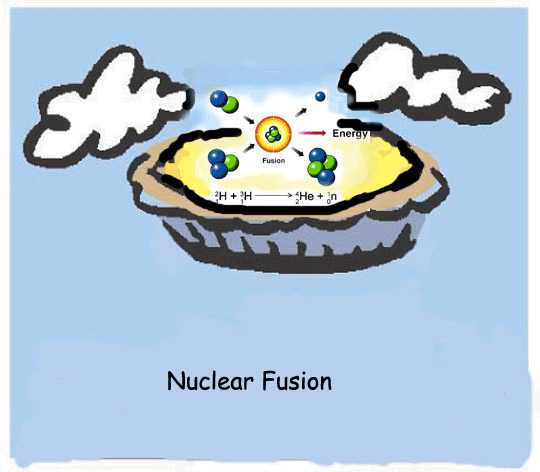
Assembly of the machine will start in May. Unlike traditional nuclear plants that split atoms, the
so-called ITER reactor will fuse them together at temperatures 10-times hotter than the Sun — 150 million degrees Celsius (270 million Fahrenheit). Its startling complexity, with more than a million pieces and sponsors in 35 countries, mean questions remain about over whether the reactor will work or if it can deliver electricity at anything like the cost of more traditional forms of clean energy.
With wind-farm developers starting to promise subsidy-free power by 2025 and electricity demand
stagnating, even the project’s supporters are asking whether ITER will ever make sense. “I’m dubious,” said Chris Llewellyn Smith, director of energy research at Oxford University who has spoken in favor of the research project. “The cost of wind and solar has come down so rapidly, so the competition has become harder to beat than you could have conceivably imagined a decade ago.” http://washpost.bloomberg.com/Story?docId=1376-OY3SHX6S972801-2RKS837QMLNSJG9Q1LHCUFO248
Tamworth Regional Council uranium removal $50,000 more than initial estimate, Northern daily Leader, Jacob McArthur , 22 Oct 17
THE budget for the clean-up of uranium contamination in Bendemeer has blown out by $50,000, with a council report pointing to the lack of available information on removing the chemical from water supplies for the jump.
At Tamworth Regional Council’s meeting on Tuesday, councillors will vote on allocating a further $50,000 for the removal of uranium from the Airlie Rd bore at Bendemeer, after a report found the initial funding allocation fell short.
Elevated levels of uranium were detected in underground drinking water supplies for Kootingal and Bendemeer in October last year.














 Antinuclear