Call For Senate Inquiry Into South Australia’s Nuclear Dump Sites
Going Ballistic Over “Pathetic” Nuclear Dump response
*Call For Senate Inquiry Into SA’s Nuclear Dump Sites After Minister Squibs on Senate Documents Order
NXT Senator Rex Patrick and SA-Best Leader Nick Xenophon say the only way to get answers for the communities of Kimba and Hawker on the reasons their townships were selected as a potential radioactive waste dump sites is through a Senate inquiry into the consultation and selection process.
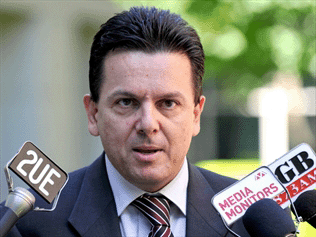 Both Senator Patrick and his SA-Best colleague, Nick Xenophon, are gobsmacked at the totally inadequate response by Senator Matt Canavan, the Minister for
  Resources and Northern Australia, to a Senate order to produce all the documents he used to determine there was ‘broad community support’ to continue exploring Kimba as a site for the low-level waste dump.
On Wednesday Senator Patrick successfully moved the motion for the Minister to make public all the information gathered by Government departments.
Earlier in the year the Minister advised he would need a figure in the range of 65% community support to progress plans in Kimba. Three ballots have been run in Kimba and none have reached 60%.Yet despite not hitting the criteria he set himself, the Minister selected two Kimba sites for further assessment.
Senator Patrick sought the Senate order after the Government refused to provide a local community member with a definition of ‘broad community support’ under freedom of information laws.
“When I asked for all the information used by Minister Canavan on how he came to make his determination to proceed to the next phase of consultation, all I got was a disingenuous response saying that there was no threshold which constituted ‘broad community support,” Senator Patrick said.
Nick Xenophon said: “None of the information used to make the decision was provided. We need to see and share with the community what was put to him to make his decision.”
Senator Patrick will move for the Senate inquiry into the contentious issue when parliament resumes next year.
“If I cannot get satisfactory answers, then there’s no choice but to ask the Senate to look into the process undertaken to date and the Government’s reasoning in moving forward to the next stage of the assessment despite the deep division in the community,” he said.
“I made it very clear to the Government during my first speech in the Senate that I had a strong interest in accountability and transparency.
“I want to work constructively with this Government but my enthusiasm to do so is contingent on them embracing a key principle of responsible government – openness and transparency.
“When it comes to decisions made about the people and supposedly for the people, they must be open about them, particularly when it comes to a nuclear dump site, “ said Senator Patrick. Follow links to the response from Minister Canavan and Senator Patrick’s Senate motion
https://www.pdf.investintech.com/preview/437f7094-dbb4-11e7-9f8d-0cc47a792c0a/index.html
The long haul towards getting rid of nuclear weapons

 A long road to abolishment of nuclear weapons, http://www.timescolonist.com/opinion/op-ed/comment-a-long-road-to-abolishment-of-nuclear-weapons-1.23115603 JONATHAN DOWN / Times Colonist DECEMBER 7, 2017 With the Doomsday Clock now set at 2.5 minutes to midnight, the key role of the International Campaign to Abolish Nuclear Weapons in building the historic UN Treaty on the Prohibition of Nuclear Weapons is more remarkable than ever.
On July 7, 122 United Nations member countries adopted the treaty, and 50 nations have signed it since Sept. 20. It is anticipated that by the end of 2018, the treaty will become international law.
Recognizing that the risk of nuclear war is even higher today than during the Cold War, the Nobel Committee is honouring ICAN’s work with the 2017 Nobel Peace Prize to be awarded in Oslo on Sunday. Canadian peace campaigner and Hiroshima bomb survivor Setsuko Thurlow, together with ICAN’s executive director Beatrice Fihn, will accept the prize.
However, although a Canadian activist will receive the Nobel in Oslo, Canada has turned its back on the treaty and refused to sign. Pressure from the United States is considered the main reason for this decision, which directly contradicts Canada’s international reputation as a supporter of nuclear disarmament. It also flouts the treaty’s vision of a world where nuclear weapons are stigmatized, prohibited and eventually eliminated.
Run almost entirely by enthusiastic, highly motivated young people from different parts of the world, ICAN clearly understands that 21st-century threats such as terrorism, cyber-security, failed states and climate change can’t be solved with nuclear weapons. Inflammatory rhetoric threatening “fire and fury” moves the world ever closer to the catastrophe of a nuclear war. Rather than acting as a deterrent, the threat of nuclear weapons encourages nations such as North Korea to accelerate their efforts to acquire their own nuclear arsenal.
ICAN-affiliated organizations are found in more than a hundred countries, including Canada, and the Nobel prize is a tribute to the millions of activists such as Thurlow who have worked to abolish the worst weapons of mass destruction. Victoria-based Vancouver Island Peace and Disarmament Network is affiliated with ICAN through member organizations, and several members participated in the negotiations leading up to the landmark treaty.
Canadians should be extremely proud of ICAN and the huge amount of work that has been done to advance the cause of global peace. We have a long way to go before nuclear weapons are finally abolished — but this year’s Nobel Peace Prize shows that the civil world is on the right track.
Jonathan Down is a pediatrician in Victoria and president-elect of Physicians for Global Survival, the Canadian affiliate of IPPNW. He is a member of the Vancouver Island Peace and Disarmament Network.
Having won the Queensland election, Annastacia Palaszczuk will be vetoing the Adani coal megamine
 Annastacia Palaszczuk finally wins Qld election
The veto of a federal loan for Adani’s controversial $16.5 billion Carmichael mine will be one of Annastacia Palaszczuk’s first jobs once her government is sworn in she says…. (subscribers only)
http://www.afr.com/news/politics/annastacia-palaszczuk-finally-wins-qld-election-after-tim-nicholls-concedes-20171207-h015mi
For Australia’s cities, climate change is already here
Heatwaves, infrastructure and resilient, The Saturday Paper Greg Foyster 9 Dec 17 It’s 5pm on a Friday after a week of 40-degree days in Melbourne, and commuters are lined up at platforms on Flinders Street Station, desperate to get home.
But something’s wrong – all the departure screens are blank. Commuters check their smartphones, craning sunburnt necks. Train tracks have buckled, carriage airconditioners have conked out, and now a bushfire threatens transmission lines to the east, the city’s umbilical link with Latrobe Valley power stations. As blackouts cascade across the suburbs, Twitter bristles with the hashtag #Meltbourne. More than half a million people are stranded.
This scenario is fiction, but based on fact. On February 6, 2009, after a string of 40-degree days, telecommunications, public transport, power and lifts really did start to fail. “The city itself very nearly failed,” explains Melbourne Lord Mayor Robert Doyle. “We somehow got through that Friday night and got the 850,000 people who were in the centre of the city home. Black Saturday was the next day.”
Doyle shared this anecdote at the opening of Refuge, an arts event held last month that turned North Melbourne Town Hall into a heatwave emergency relief centre. It’s part of the city’s new “resilience” strategy, published in May 2016, to prepare for disasters.
Sydney is also working on a resilience plan, Continue reading
USA increasingly isolated internationally, with Donald Trump’s menacing talk on North Korea
 Donald Trump’s menacing talk on North Korea is leaving the US isolated https://www.theguardian.com/us-news/2017/nov/30/donald-trump-menacing-talk-north-korea-us-isolated
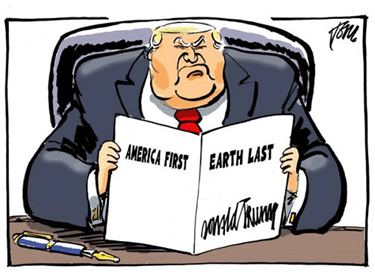
The US president seems oblivious to the consequences of war, and international support for his belligerence is weakening, Guardian, Simon Tisdall, 1 Dec 17, Donald Trump’s latest threat to destroy North Korea’s regime by force produced an angry response from Russia on Thursday. Yet elsewhere, the menacing talk from Washington was mostly met with uncomfortable silence.
While there is no shortage of international concern about Kim Jong-un’s latest, “breakthrough” missile test on Wednesday, Trump’s bellicose talk of war is rendering the US increasingly isolated.
Sergei Lavrov, Russia’s foreign minister, appeared to voice doubts shared by other countries when he claimed on Thursday that Trump was deliberately pushing Pyongyang towards military confrontation. “It seems they have done everything on purpose to make Kim lose control and make another desperate move,” he said. Continue reading
Australia’s top companies ignore climate change, and we let them
the mis- or non-management of climate risk is rampant in corporate Australia.
Whether the situation stays like this is up to investors
 http://www.smh.com.au/business/markets/companies-ignore-climate-change-and-we-ve-let-them-get-away-with-it-20171208-p4yxjg.html Julien Vincent , 8 Dec 17
Last week, APRA Executive Board member Geoff Summerhayes warned the transition to a low carbon economy is already underway and “institutions that fail to adequately plan for this transition put their own futures in jeopardy, with subsequent consequences for their account holders, members or policyholders.”
The speech followed a Centre for Policy Development discussion paper on how companies can follow the recommendations of the Financial Stability Board’s Task Force on Climate-related Financial Disclosures (TCFD).
The TCFD has set the standard for climate risk disclosure since its draft recommendations were released a year ago. Its final recommendations were backed by over 100 companies with a combined market capitalisation of over $3 trillion, which should give an idea to how seriously the TCFD is being taken.
But is it though? Market Forces has just examined the ASX top 50 companies’ responses to the TCFD. Only seven had delivered on the key recommendation to disclose information on how their company performs in a scenario where global warming is held below 2°C, while 31 don’t even mention the TCFD recommendations, let alone implement them.
It isn’t the first warning sign that corporate Australia is failing to manage climate risk. Continue reading
AGL resists govt pressure, goes for gas, wind, solar – not coal
AGL resists PM to ditch coal for cheaper gas, wind, solar power
AGL Energy has rejected Turnbull government pressure to extend the life of the coal-fired Liddell power station and instead revealed a $1.36 billion plan to replace it with electricity generated from gas, wind and solar…. (subscribers only)
http://www.afr.com/business/energy/electricity/agl-energy-unveils-14b-liddell-replacement-scheme-20171206-h0022p
Southern California is burning
 California’s Climate Emergency, Rolling Stone, By Eric Holthaus, 8 Dec 17 Fires continue to burn Southern California, and climate scientists have warned us for years that the region was entering a year-round fire regime In the hills above the Pacific Ocean, the world crossed a terrifying tipping point this week.

As holiday music plays on the radio, temperatures in Southern California have soared into the 80s, and bone-dry winds have fanned a summer-like wildfire outbreak. Southern California is under siege.
That one of California’s largest and most destructive wildfires is now burning largely out of control during what should be the peak of the state’s rainy season should shock us into lucidity. It’s December. This shouldn’t be happening.
The Thomas fire is the first wintertime megafire in California history. In a state known for its large fires, this one stands out. At 115,000 acres, it’s already bigger than the city of Atlanta. Hundreds of homes have already been destroyed, and the fire is still just 5 percent contained.
In its first several hours, the Thomas fire grew at a rate of one football field per second, expanding 30-fold, and engulfing entire neighborhoods in the dead of night. Hurricane force winds have produced harrowing conditions for firefighters. Faced with such impossible conditions, in some cases, all they could do is move people to safety, and stand and watch.
“We can’t control it,” firefighter and photographer Stuart Palley told me from a beach in Ventura. “In these situations, you can throw everything you’ve got at it, tanker planes dropping tens of thousands of gallons of flame retardant, thousands of firefighters, hundreds of engines, you can do everything man has in their mechanical toolbox to fight these fires and they’re just going to burn and do whatever the hell they want. We have to learn that.” As we spoke, another wall of flames crested a nearby ridge, reflecting its orange glow off the sea.
The Thomas fire isn’t the only one burning right now. At least six major fires threaten tens of thousands of homes and have forced hundreds of thousands of people to flee in recent days. “California fires enter the heart of Los Angeles” read one New York Timesheadline, a statement so dire it could double as a plot synopsis in a nearby Hollywood movie studio. Million-dollar mansions in Bel Air were evacuated, and the 405 freeway, one of L.A.’s busiest, was transformed into a dystopian hellscape during the morning commute. Ralph Terrazas, the Los Angeles fire chief, called the conditions the worst he’s seen in his entire 31-year career. “There will be no ability to fight fires in these kinds of winds,” said Ken Pimlott, the state fire chief. Shortly after these statements, state officials sent an unprecedented push notification to nearly everyone in Southern California, ominously warning millions of people to “stay alert.”
For years, climate scientists have warned us that California was entering a year-round fire regime. For years, climate campaigners have been wondering what it would take to get people to wake up to the urgency of cutting fossil fuel emissions. For years, we’ve been tip-toeing as a civilization towards a point of no return.
That time is now.
The advent of uncontrollable wintertime megafires in California is a turning point in America’s struggle to contain the impacts of a rapidly changing climate. …….http://www.rollingstone.com/culture/features/southern-california-wildfires-climate-change-emergency-w513659
Will wildfires finally change Rupert Murdoch’s climate stance?
 The media-mogul’s Santa Monica vineyard was saved from wildfire destruction, but the world may yet burn thanks to his climate views, says Richard Schiffman New Scientist, By
A wildfire has ripped through one of the wealthiest neighbourhoods in the US, damaging Rupert Murdoch’s $28.8 million vineyard estate in the Santa Monica mountains at the edge of Los Angeles.
The media-mogul’s palatial house was saved, thanks to firefighters who spent the afternoon and night battling the conflagration. Others weren’t so lucky. Hundreds of homes and scores of lives have been lost in both northern and southern California in a spate of recent wildfires that were fiercer and moved faster than any in recent memory.
Such fires are made more likely as the world warms. California has just had its hottest summer on record, and the recent wildfires came much later in the year than normal. We also know that seven of California’s 10 largest recorded wildfires have occurred in the last 14 years.
California isn’t alone. Wildfires are occurring with greater… subscribers only https://www.newscientist.com/article/will-wildfires-finally-change-rupert-murdochs-climate-stance/
1 This month
7 April – WEBINAR – Australia and the Doomsday Clock – Preventing nuclear war through NoFirstUse and other policies
Online | Tuesday April 7, 4:00-5:30pm, Australian Eastern Time / 8:00-9:30am Central Europe Time
– Access the registration link
15 April – Zoom –Nuclear Power is Not the Solution
Apr 15, 2026 01:00 AM in Canberra, Melbourne, Sydney

Join the International Physicians for the Prevention of Nuclear War (IPPNW) on Tuesday, April 14th for a timely webinar exploring the risks associated with nuclear power and challenging the myth that it offers a simple, safe, carbon-free solution to the climate crisis

21 April Webinar: No Nuclear Weapons in Australia
Start: 2026-04-21 18:00:00 UTC Canberra, Melbourne, Sydney (GMT+10:00)
End: 2026-04-21 19:30:00 UTC Canberra, Melbourne, Sydney (GMT+10:00)
Event Type: Virtual
A virtual link will be communicated before the event.
Host Contact Info: australia@icanw.org

of the week – Australians for War Powers Reform (AWPR)
To see nuclear-related stories in greater depth and intensity
 Antinuclear